Showing posts with label Yuen Clan. Show all posts

Monday, January 26, 2026

Taoism Drunkard (1984) - R.I.P. Yuen Cheung-Yan (1947 - 2026)

Taoism Drunkard (1984)
Aka: Drunken Wu Tang; Miracle Fighters 3
Chinese Title: 鬼馬天師
Translation: The Cat and the Moon Monster


Starring: Yuen Yat-Choh, Yuen Cheung-Yan, Yuen Shun-Yi, Zhu Hai-Ling, Lo Pi-Ling, Yuen Shun-Yi, Hilda Liu Hao-Yi, Yen Shi-Kwan, Mandy Chan Chi-Man, Tsui Oi-Sam, Tai Bo
Director: Yuen Cheung-Yan
Action Director: The Yuen Clan


On January 1st of this year (2026), Yuen Cheung-Yan passed away. He was best known as “Yuen Woo-Ping’s brother,” although he was a talented action director in his own right. He was also an established character actor, often playing small-but-memorable roles in a lot of movies, especially those that were connected to his brother in one way or another. He even made it to Hollywood, staging the fight sequences for the first two Charlie’s Angels films (not the reboot with Kristen Stewart) and the Ben Affleck Daredevil.

His career as an action director goes all the way back to 1968, at which point he would have been 21 years old. That was alongside Chan Siu-Pang on the
wuxia film The Flying Dragon Dagger. He went back and forth between work at the Shaw Brothers and indy films, ranging from the classic Vengeance! (1970) to In Eagle’s Shadow Fist (1973), an early role for Jackie Chan. In fact, it may have been Yuen Cheung-Yan’s working with Jackie in that role that ultimately helped Yuen Woo-Ping convince Ng See-Yuen to cast Jackie in Snake in the Eagle’s Shadow. It was Yuen Cheung-Yan who wore the monster suit for the Shaw Brothers classic The Mighty Peking Man. By the time of his passing, he had amassed about 111 credits as an action director or fight choreographer.

Taoism Drunkard
was Yuen Cheung-Yan’s first foray into directing. The film is part of the Yuen Clan “Sorcery Cycle,” which started in 1982 with Miracle Fighters. Cheung Yan’s more famous brother Woo-Ping had directed the first two entries: Miracle Fighters and Shaolin Drunkard. This third entry was produced by Lo Wei and Yuen Cheung-Yan took up the directorial reigns—Yuen Woo-Ping might have been busy on Drunken Tai Chi at the time. It certainly a B-movie classic for people who just like completely random films.

The film opens with a palm reader being approached by Master Ruthless (Yuen Shun-Yi, of
Shaolin Drunkard and Drunken Tai Chi), also known as “Old Devil”. Ruthless asks for his fortune, only to surprise the palm reader by having no lines on his palms—we later learn that he had been captured by the Taoist sect and sentenced to placed on a metal roller coaster and having his hands run across metal plates covered with acid as punishment for his evil deeds. He kills the fortune teller and reveals the hiding spot of his senior brother (Yen Shi-Kwan, of The Master Strikes and Once Upon a Time in China), who had betrayed him and turned him in to the Taoists. The two have a fight and Ruthless kills his brother.

Back at the Taoist Sect’s headquarters, the Drunken Taoist (Yuen Cheung-Yan—whom we’ll call Bucktooth) is driving around in his wicker Ratmobile, terrorizing the monks and just making a general nuisance out of himself. He goes to far when he breaks the arm on one of the god’s statues and his older brother, the head priest (Hsiao Hou-Tou, The Evil Karate and The Vampire Dominator), tasks him with finding a virgin born on a specific date in order to perform a ceremony to placate the god whose statue he destroyed. Otherwise he’ll be kicked out of the temple.

It ultimately turns out that the young man in question is Cha Lee (Yuen Yat-Chor, of
Young Taoism Fighter and Miracle Fighters), the grandson of an old witch (also Cheung-Yan) who had helped the Taoists to defeat Master Ruthless back in the day. She is training her grandson to be a powerful kung fu sorcerer and kung fu master, and is in possession of a special sacred text that Ruthless is after. Ruthless shows up to try to steal the text, which is protected by the Watermelon Monster (a giant bowling ball with teeth who talks like Gonzo from “The Muppet Babies”).

Lots of shenanigans ensue, largely revolving around the horny widowed sister (Lo Pi-Ling, of
Calamity of Snakes) of Cha Lee’s girlfriend, Shiu Fang (Zhu Hai-Ling, of The Shanghai 13 and The Thunderbolt Commander). She’s anxious to get back in the dating game with her lover (Tai Bo, of Project A II and Ninja in the Dragon’s Den), although a practical joke involving séance and Shiu Fang leads her to believe that Bucktooth is her soul mate. There is also a subplot involving a sorceress/extortionist, Starry Devil (Hilda Liu, of A Fist Full of Talons and Golden Queen Commando), and her entourage. She is ultimately blackmailed into helping Master Ruthless after he douses her with a potion that will age her to death in a few minutes.

Taoism Drunkard
is the same style of film as its predecessors, although a bit more scattershot in the plot territory. I mean, all of these play fast and loose with the plot, but this one spins its wheels for much of the first two-thirds of the running time. Eventually, this one starts to focus itself when Starry Devil is blackmailed into helping Master Ruthless after he douses her with a potion that will age her to death in a few minutes. At that point, we have a running series of battles between Master Ruthless, Starry Devil and our two heroes (Cha Lee and Bucktooth) over the aforementioned text.

But there is plenty of Komedy to keep viewers interested until then, provided that they can ignore the lack of direction in the story. There are kung fu fights involving Giant Bongs and Komically-Oversized Swords. There is a séance played for laughs. There is a scene in which the sister’s lover tries to kill Bucktooth for taking his place as the paramour. And of course, there is the famous Watermelon Monster, which sounds screwy on paper, but is even nuttier when you actually watch the film.

The fight scenes were staged by the Yuen Clan, who would include: Yuen Woo-Ping, Yuen Cheung-Yan, Yuen Shun-Yi, Yuen Yat-Chor, and Brandy Yuen. I’m not sure if all five of them were on hand for the film, but there is a good chance that such was the case. The fights are generally wired-up and filled with gimmicks. When Ruthless fights his senior brother, the latter wears a vest of spikes which makes him throw himself backward in an attempt to skewer his enemy. Later fights are bit more standard. Starry Devil fights with long silk sashes that work like a lash, although they have razor sharp coins on them that can slice through human flesh. There is some pure kung fu in Cha Lee’s earlier fights with Ruthless, or when Cha Lee goes buck wild on Starry Devil’s entourage. It all climaxes with a big fight involving flying explosives that leave their victims wearing pig masks and a heat-seeking bowling ball. Personally, I prefer all the fights in
Shaolin Drunkard to the ones in this one, but it’s all goofy enough to merit a watch with like-minded friends

Thursday, April 17, 2025

Web of Death (1976)

Web of Death (1976) Chinese Title: 五毒天羅 Translation: Five Venom Heavenly Web


Starring: Yueh Hua, Lo Lieh, Ching Li, Wang Hsieh, Angela Yu Chien, Wang Chung, Lily Li Li-Li, Ching Miao, Ku Feng, Chiang Yang

Director: Chor Yuen

Action Director: Tong Gai, Yuen Cheung-Yan


Web of Death is the third movie that Shaw Brothers director Chor Yuen made in his second wuxia cycle, which would define the vast part of his output between 1976 and 1984. Most of the films he made were adaptations of stories written by famed wuxia novelist Gu Long, although this particular film was based on a story by Wong Ying. Wong Ying was a popular writer, albeit not quite up to the standard of his contemporaries, Gu Long and Jin Yong. He was younger than them, being born in 1956, which was when Jin Yong was serializing his first novel, The Book and the Sword. But the man was no less talented, as this movie adapted his work when Wong Ying was but 20 years old.


Of the three movies that Chor Yuen made in 1976—the other two being Killer Clans and The Magic Blade—this is considered the least of them. It has all of the hallmarks of a classic Shaw Brothers films: elaborate sets and costumes, a strong cast, decent fight choreography, coupled with a complex plot populated by lots of characters and martial arts clans to follow. Strangely enough, it is the action choreography that keeps this firmly rooted in “Good” territory, as opposed to “Excellent” or “All-Time Classic.”


The movie opens with a meeting of martial arts masters, who are met by the then-head of the Five Venoms Clan (Chiang Nan, of The Iron Bodyguard and Call Me Dragon). The man unveils his secret weapon: the “Five Venoms Spider.” This is a mystical little creature—played by a regular tarantula with a dubbed-in elephant call, that can shoot deadly, acidic webs at all people in a sizable radius. The spider kills all of the masters present, but later the man relinquishes the weapon, which is hidden away from all the martial world.


Several generations later, the Five Venoms Clan is having a meeting of the Chief (Wang Hsieh, of Heroes Two and The Secret of the Dirk) and his sub-chieftains. Liu Shen, the Snake Chief (Lo Lieh, of Clan of the White Lotus and Heroes of the Wild), points out that there is a martial arts tournament coming up and the winner will determine the best in the Martial World. The Five Venoms Clan has been on the decline these past few decades and both the Toad and Scorpion Leaders (played by Lu Wei and Tung Choi-Bo, respectively) have lost their territory to the other schools. Liu Shen suggests that they unearth the Five Venoms Spider and use it to win the tournament and restore the clan to its former glory. The Chief, however, forbids such things and ends the meeting right then and there.


We learn that Liu Shen is having an affair with the Chief’s wife (Cave of the Silken Web’s Angela Yu, in her last Shaw Brothers outing). Both are conspiring to kill the man so that Liu Shen can assume the leadership of the clan. They decide to start spreading rumors that the Five Venoms Spider has already been found in order to spur the other clans, led by the Wu Tang Clan, to action. In Liu Shen’s words, “We’ll have the righteous clans find it for us.”


The rumor-mongering works, and soon the heads of the different schools (Shaolin, Emei, etc.) are meeting at Wudan Mountain to discuss the weapon. The head of the Wu Tang school, Tian Suan (Ching Miao, of Five Tough Guys and Clans of Intrigue), designates his senior student, “Three Saints” Fei Yingxiang (Yueh Hua, of Green Dragon Inn and Dragon Swamp), to go to Shaolin to try to learn more about the rumors. On his way to Shaolin, he meets a girl dressed as a male beggar, who claims to know someone (who knows someone who knows someone) who knows about the Five Venoms Spider. She tells him to meet her at a nearby lake in 10 days. That girl turns out to be Hong Susu (Ching Li, of The Magic Blade and Killer Clans), the daughter of the Venoms Clan chief.


Hong Susu heads back to the Venoms Clan headquarters, where she discusses the matter with her father. He reassures that the Five Venoms Spider has indeed not resurfaced, as it’s hidden in a “forbidden” place. Hong Susu figures out that said place is the tomb of the deceased Clan leaders. Unfortunately for both of them, the chief’s wife is eavesdropping on their conversation and relays the information to Liu Shen. He comes up with the idea of making two maps and sending them to two different clans, and then spreading the rumor that said clans have a map to the weapon. 


The rumor reaches Wu Tang, and two students—Fei Jingyie (Wang Chung, of Police Force and Five Tough Guys) and Qiuxin (Lily Li, of Shaolin Mantis and Soul of the Sword)—are sent to investigate. They come across a bloodbath: one of the clans has been attacked by the Holy Fire Clan. Jingyie and Qiuxin intervene, but when the smoke clears, both clans have been wiped out. They take the map and head for the crypt, where they find the other clan has already arrived. Jingyie sends Qiuxin to find Fei Yingxiang and tell him what’s going on. When the other clan is massacred by the crypt’s traps, Jingyie sneaks in and makes his way to where the Five Venoms Spider is being kept. While leaving the tomb, weapon in hand, Jingyie is ambushed by Hong Susu (who doesn’t know who he is) and is poisoned by her Five Venoms darts. Once she realizes who her victim is, she hires the Golden Dragon Security Company to carry both the weapon (hidden in a crate) and Jingyie back to Wu Tang. But Mr. Xie (Chiang Yan, of The Flying Guillotine and The Spiritual Boxer) has made some underhanded deals with some very shady people…


There are a lot of twists and turns to the story, which is what makes it so fun. It does not get too convoluted, but there are a lot of plot complications that stem from mistaken identity, incorrect assumptions on the part of (otherwise righteous) characters, and just rash actions on the part of the main protagonists. The main villains are obviously motivated by ambition, but a lot of the bad things that happen to the main characters occur because of their own prejudice and envy. While the bad guys are definitely bad, the good guys have negative human qualities that keep them from making the right decisions, too.


All this talk of the Five Venoms Clan may make some readers wonder if this has anything in common with Chang Cheh’s classic The Five Deadly Venoms. Not really. This is a wuxia pian through and through, while The Five Deadly Venoms, for all its wuxia trappings, is a kung fu movie. That said, one may consider this to be a precursor (of sorts) to The Five Deadly Venoms, with the latter being set many generations later when the clan is in its death throes. The movie does have the feel similar to that of Kung Fu Cult Master (itself based on Jin Yong’s Heaven Sword and Dragon Sabre), where you can switch “The Evil Sect” with the “Five Venoms Clan” and the “Great Solar Stance” and “Magic Stance” with the “Five Venom Spider.” So, if you liked the over-the-top quality to that Jet Li film, you might enjoy this.


To me, the action was the weakest aspect of the film. Tong Gai and Yuen Cheung-Yan are great choreographers for sure, and the swordplay exchanges are well done. But they are generally quite short and none of the fights really stand out in any way. Tong and Yuen opt to emphasize the supernatural aspects of the fighting, realized via practical effects. So be prepared for lots of smoke, sparks, flames, and cheesy spider web effects. Lo Lieh’s character wields a staff with a snake head at the end that shoots spark and flames at its opponents. Yueh Hua has a fight at the Five Venoms Clan hideout—which itself is covered with kitschy spider motifs—that is full of explosions of poisonous gas (i.e. lots of smoke bombs going off) and acid pools. And you can guess what the Holy Fire Clan uses in their fight scenes. So yeah, too much “smokes and mirrors” and not enough of the nitty-gritty fight choreography. Thankfully, everything surrounding the action is fun to watch, though.


Thursday, May 23, 2024

Three Shaw Brothers Horror Films - Capsule Reviews

The Oily Maniac (1976) 
Original Title: 油鬼子
Translation: Oil Devil


Starring: Danny Lee Sau-Yin, Chen Ping, Lily Li Li-Li, Wang Hsieh, Wa Lun, Ku Feng, Tung Lin, Angela Yu Chien, Lam Fung, Wai Wang, Lau Wai-Ling, Terry Liu
Director: Ho Meng-Hua
Action Director: Yuen Cheung-Yan

Filmed (mostly) in Malaysia. Strange mixture of horror, action, and softcore porn. Danny Lee (The Super Infra-Man and The Mighty Peking Man) plays Sheng Yung, a lawyer in Kuala Lampur, Malaysia, who is a crippled no thanks to a bout with polio as a child. When we meet him, we learn that his surrogate uncle (Ku Feng, in a silly wig) is in danger of losing his coconut oil factory thanks to some shady loan business that the previous owner had been involved in. A fight breaks out between the employees and the Yang family, who want to take the factory, and the uncle accidentally kills someone. Despite it being a case of trespassing, self-defense, and protecting his daughter (Chen Ping, of Illicit Desires and Killer Clans) from sexual assault, the uncle is found guilty of murder and sentenced to hang. Before his execution, he passes on a spell to Sheng Yung to protect his daughter Yue from the Yang family.

Sheng Yung loves Yue, but she does not return his affections. She is in love with the current head of the factory, Chen Fu Sin (Wa Lun, who looks like Sun Chien in this film). Sheng Yung bemoans his "useless" crippled state, but decides to use the spell anyway to save Yue from being raped. He becomes the "Oily Maniac," a monster that looks like a cross between Hedorah and The Creature from Haunted Sea, with a little bit of H-Man thrown in. He kills one of the Yang brothers and then proceeds to become a vigilante. He kills a clandestine doctor (Lau Wai-Ling), a blackmailer (Keung Hon), and a woman (Angela Yu) who faked being raped to get rich off the proceeds. He then learns that his boss (Wang Hsieh) at the law firm, the surviving Yang brother (Chiang Yang), and some others are involved in some shady business involving the coconut oil factory and goes after them. Meanwhile, his co-worker, Hsiao Ly (Lily Li), has discovered his alter-ego...

Despite the subject matter, the film is surprisingly not all that violent. When the "Oily Maniac" kills people, he usually just breaks their neck or steps on their chest. There is not much blood. There are a number of "fight" scenes, staged by Yuen Cheung-Yan. But they are less "kung fu" and more "shambling monster wildly swinging his arms." What this movie has is a lot of female flesh on display. No fewer than five actresses (including Chen Ping, Terry Liu and Angela Yu) bare their breasts for the camera. Chen Ping does so on three occasions, including two rape sequences. Poor girl. Only Lily Li keeps her clothes on. It's an exploitation film in the classic vein: amusing practical FX, a gooey-slimy monster, a high body count, and lots of nudity. I just wish the action scenes were staged a bit more expertly, given Yuen Cheung-Yan's talent.


Spirit of the Raped (1976)
Aka: The Deadly Game

Original Title: 索命
Translation: Ask For Life


Starring
Liu Wu-Chi, Lin Wei-Tu, Tung Lin, Wong Yu, Wang Chung, Wang Hsieh, Teresa Ha Ping, Tin Ching, Lau Wai-Ling, Chan Lap-Ban
Director: Kuei Chih-Hung
Writers: Ni Kuang, Sze-to On

Lesser-known supernatural revenge horror from Shaw Brothers whose title is probably a little overstated. There is one attempted rape via aphrodesiac and a possible one alluded to via a throwaway line of dialog. On the the put-upon heroine, Liu Miaoli (Liu Wu-Chi, Legends of Lust and 14 Amazons), does get robbed quite a bit. I almost wonder if "raped" in this context was supposed to be "robbed," much like "rape" in Rape of the Sword was more akin to "theft." After all, the Latin root for "rape", "raptum," means "to snatch or grab." In any case, Spirit of the Robbed would make a little more sense.

Anyway, Liu Miaoli has recently married Chen Liang (Lin Wei-Tu, The Master of Kung Fu and Legends of Lust). Unfortunately, while still on their honeymoon period, the bus they're taking is assaulted by three crooks: Tung Lin, Wong Yu and Wong Chung. Wong Chung stabs Chen Liang to death after the latter tries to hide his money, leaving Liu Miaoli a widow. She receives a lot of donations from friends, family and neighbors, but ends up getting swindled and (stealthily) strong-armed by a conman (Wang Hsieh). She then gets mugged by a pimp (Tin Ching, of The Delightful Forest and Intrigue in Nylons) in a complicated plot to force her into prostitution. Liu Miaoli manages to escape. By now, she's so traumatized by the wickedness of Man that she buys a red dress and jumps from a cliff to her death. According to Chinese legend, if a person commits suicide with red clothes, her vengeful ghost will return to haunt her enemies...

And you better believe that all the miscreants will get what's coming to them. The conman is first, who starts suffering from hallucinations of gouged-out eyes and nightmares of something trying to dig his own eyes out. He ends up in a mental institution, but Liu Miaoli isn't done with him yet... Then she goes for the pimp and his girlfriend (Lau Wai-Ling, who played the Japanese clandestine doctor in The Oily Maniac). The latter's belly becomes swollen with green goo and her face is covered with boils. The former has a fatal date with a Bar Lizard. And then it's time for the robbers from the bus...

Spirit of the Raped is an extremely cynical and misantropic little movie, arguably moreso than The Oily Maniac. This film is filled with some of the scummiest people this side of Jigoku. That all said, the main problem is that the movie doesn't really have a main character after the first third. The second and third acts are very episodic, each of them focusing on a different (set of) victim(s). You're obviously rooting for these people to meet their (much deserved) ends, but there's no suspense because nobody you care about is in danger. 

There is quite a bit of gore, which isn't the most realistic, but it's still better than the CGI nonsense of that recent Renfield movie. There are decapitations, possessed people lapping up slime, near-disembowelings, and even someone growing an entire head from a tumor on their neck (and this came out before The Manitou). The nudity is notably less than in most other Shaw horror films I've seen. As an exploitation movie and moral tale, it works. But as a movie that follows established storytelling norms, it leaves a bit to be desired.


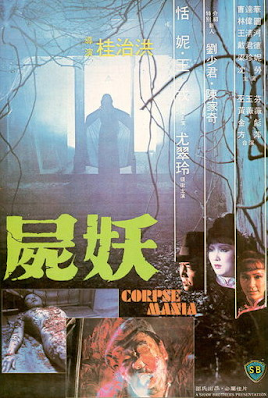
Corpse Mania (1981)
aka: Corpse
Original Title: 
屍妖
Translation: Corpse Demon (or Wight)


Starring
Wang Yong, Tanny Tien Ni, Yau Chui-Ling, Walter Tso Tat-Wah, Tai Kwan-Tak, Eric Chan Ga-Kei, Lau Siu-Kwan, Gam Biu, Jenny Leung, Wong Ching-Ho, Fong Ping
Director: Kuei Chih-Hung
Writer: Sze-to On, Kuei Chih-Hung

A mysterious stranger moves into a large house in Guangzhou, accompanied by a female companion who appears to be sick. A few days later, the local busybodies start complaining of a horrible stench on the street. Finally, the smell becomes so awful that the police enter the house and find the rotting, maggot-filled corpse of a naked girl. An autopsy performed on the girl reveals that she had been violated after her death. So, there's a necrophiliac on the loose. Police Chief Zhang (Wang Yong, of Imperial Tomb Raiders and The Proud Twins) is in charge of the investigation. He learns of a similar case that happened in Foshan a few years before and heads there for more information.

Upon meeting their chief constable, Chief Lu (Walter Tso, of The Story of Wong Fei-Hung and Eighteen Powerful Swords), he learns the story of Li Zhengyuan (Eric Chan, of My Rebellious Son and The Enchantress). Li was a mysterious heir to a lot of money and a reasonably constant visitor of the local bordello, ran by Madam Lan (Tanny Tien Ni, of The Magic Blade). One day, Li offers to buy the liberty of one of the establishment's most popular girls, who appears to be losing a fight to tuberculosis. A few days later, the wine delivery boy, Lin Bin (Lau Siu-Kwan, of The Emperor and his Brother and Hex after Hex), sneaks into the Li Manor. There, he witnesses Zhengyuan having sexual relations with the corpse of his new bride. The authorities are informed and Li Zhengyuan is sent to an insane assylum. 

The case in Guangzhou bears all the hallmarks of the Foshan case, not to mention the fact that Li Zhengyuan had left the asylum just a  few months earlier. A couple of days later, a policeman is murdered at the abandoned Li Estate. The constable's final words are "Li Zhengyuan." Moreover, the decaying body of another one of Madam Lan's prostitutes is discovered on premises. We also learn that the dead body in Guangzhou belonged to one of Madam Lan's girls as well. So, is Li Zhengyuan not only back, but with a vengeance this time around?

Corpse Mania is something of a crime thriller/police procedural with horrific elements. There are a number of scenes where the camera focuses lovingly on the corpses of naked women, who are completely covered in maggots. The necrophilia is depicted in one scene, which involves Eric Chan massaging the dead body of a girl with a furry glove (I will never look at the massage scene in Thunderball the same again) and then thrusting on top of her (although filled close up enough that it isn't explicit). The second half has a series of brutal murders as the killer closes down on his intended victims as the police try to close down on him. It isn't as outright gory or salacious as most of Kuei Chih-Hung's other films, and has a few interesting twists at the end, too. Worth a view (if you have a strong stomach).

Thursday, April 13, 2023

Tiger Cage (1988)

Tiger Cage (1988)
Chinese Title特警屠龍
Translation: SWAT Dragon Slaying


Starring: Jacky Cheung Hok-Yau, Carol Cheng Yu-Ling, Simon Yam Tat-Wah, Irene Wan Pik-Ha, Donnie Yen Ji-Dan, Leung Kar-Yan, Ng Man-Tat, Vincent Lyn, Johnny Wang Lung-Wei, Yuen Shun-Yi, Yuen Cheung-Yan, Michael Woods, Stephen Berwick
Director: Yuen Woo-Ping
Action Director: Yuen Shun-Yee, Yuen Cheung-Yan, Yuen Yat-Choh, Donnie Yen, Paul Wong


It took several years for Yuen Woo-Ping to really adapt to the modernization of Hong Kong action in the 1980s. Even after Jackie Chan and Sammo Hung (and audiences in general) moved onto more stunt-driven action fare, Yuen Woo-Ping was still doing kung fu comedies (eg. Drunken Tai Chi) and his kung fu-sorcery-comedies (eg. Shaolin Drunkard and Taoism Drunkard). With the exception of the breakdancing oddity Mismatched Couples starring Donnie Yen, it wasn’t until 1988 that YWP really got with the times—the same could also be said about Lau Kar-Leung.

The resulting project, Tiger Cage, is interesting in that it was leagues away from anything he had done since his career as director took off in 1978. In fact, it is easily one of the bleakest action films of that period, even moreso than your typical blood-soaked John Woo bullet ballet. It’s a film in which cops doing their job—busting criminals—throws them into a downward spiral of violence because not even they themselves can be trusted.

We open with a drug deal being brokered between the supplier, Swatow Hsiung (Johnny Wang Lung-Wei, of Twin Dragons and Crippled Avengers), and a trusted buyer of his, Hsiu (Leung Kar-Yan, of The Victim and The Thundering Mantis). Hsiu turns out to be an undercover officer, and tonight’s the night that his team has planned a raid on Hsiung’s operations. A huge gunfight erupts between Hsiu’s team and Hsiung’s lackeys, leaving most of the latter dead, including his brother (Yuen Shun-Yee, of Miracle Fighters and Iron Monkey). Hsiung gets away, but it goes without saying that he’s going to want revenge.

Now, let’s meet Hsiu’s team first: Hsiu himself answers to Inspector Michael Huang (Simon Yam, of Bullet to the Head and Doctor Lamb), whose job it is to take the brunt of his superior’s criticisms while the team does its job. Below him is Inspector Shirley Ho (Carol Cheng, of Operation Condor and Burning Sensation), who is also Hsiu’s fiancée. They’re engaged to be married in a few days, so you know that they’re destined for marital bliss. More or less on Hsiu’s level is department veteran “Uncle” Te (Ng Man-Tat, of Holy Weapon and Heroes Among Heroes). Below Hsiu are the two younger officers, Fan Shun-Yu (Jackie Cheung, of High Risk and Future Cops) and Terry (Donnie Yen, of Ip Man and Iron Monkey 2). Both men are idealistic and impulsive, although Terry is a bit harder to control than Fan, even though his fighting skills are superior.

Anyway, on the eve of Hsiu and Shirley’s wedding, Swatow Hsiung shows up unannounced as Hsiu is getting in his car to go to (presumably) his bachelor send-off and blows the man away with a 12-guage shotgun. Hsiu succumbs to his wounds in Shirley’s arms—she was trying on her wedding dress at the moment—so a bloody wedding dress and an incomplete declaration of “I love you” are her final memories of her beloved. The rest of the team immediate opt for the “police brutality” solution as they put the screws on all the local hoodlums in order to find out where Hsiung is. Finally, a ruse involving blowtorch torture is able to loosen one guy’s lips and they find out he’s about to skip town.

The team converges on the docks and a big fight breaks out before they finally subdue their man and take him into custody. But…Swatow Hsiung has an ace of his sleeve. You see, his mentor in the drug world (the director Yuen Woo-Ping in a cameo) let him in on a little secret: Uncle Te is involved with an American gang of drug pushers in an operation known as “American Ginseng.” Hsiung mentions the operation to Te as he’s leading him to the squad car, prompting him to sneakily empty his revolver, slip it into Hsiung’s hands, and get his colleagues to respond, resulting in some police-assisted murder.

Normally, that would be it and the team would go on to their next case. But when Hsiung started shooting off his mouth, Fan Shun-Yu was in earshot of the conversation. He now suspects Uncle Te of some underhanded dealings and starts tailing him, looking for evidence. He eventually does find it, although he leaves his camcorder in the car that day when he’s out flirting with his girlfriend, Amy (Irene wan). Terry is also in the car, and innocently watches the video in hopes of finding something to make fun of his partner about. What he sees is a drug deal involving Uncle Te, who happens to be Terry’s mentor.

Although Fan’s sense of justice can make him a little unhinged at times, he has some modicum of self control. Not Terry. Terry tracks down his mentor to another drug exchange with some American criminals (Michael Woods and Stephen Berwick, both of In the Line of Duty IV) and tries to arrest both them and Uncle Te on the spot. What he does is get himself killed, at which point the cycle of violence between the good cops, bad cops and criminals really starts to spiral out of control.

This film’s in-name-only sequel has become a Hong Kong action classic for its frequent fight scenes and superior fight scenes involving Donnie Yen. This one reaches similar heights, albeit for different reasons. There is a fair amount of action in it, although Donnie Yen himself only gets one prolonged fight scene in the middle—it is a doozy, though. The rest of the action consists of gunfights, explosions, painful stuntwork, and fighting that can be best described as “choroegraphed brutality.” Of note is a particularly brutal showdown between Ng Man-Tat, Jackie Cheung and Michael Woods in an apartment filled with gas, which involves broken furniture and a baseball bat. There is some limited martial arts at the end, including a brief fight between Jackie Cheung and the lead American drug dealer, played by Vincent Lyn (Blonde Fury and Operation Condor). But the Donnie Yen sequence is the high point in that particular department.

Where Tiger Cage really shines is in its bleak tone, which gradually reveals black and white to be separated by numerous shades of grey. When Uncle Te is forced to orchestrate Hsiung’s death on the fly, it is initially believed to be him protecting his own interests. But as the film progresses, more people on the police force are revealed to be involved in the American Ginseng operation. And because of the rank of those people—and the ignorance of the more righteous cops like Fan and Terry—they are always two steps ahead of the good guys, even once their façade falls. It is only through a mixture of luck and some craziness on Fan’s part that they are able to survive until it’s time for the climax to begin.

The thing is, the film treats police corruption almost like a systemic problem, the natural evolution of one’s initial idealism into something more self-centered because police work pays little and nobody really cares about your well being (unless you get killed on duty and someone wants to make a political speech about it). We even learn at one point that Hsiu himself was on the take, in a scene where Shirley opens his personal drawer and finds a bank statement worth millions and several forged passports. We never learn where he got all the extra money—perhaps he simply kept the money he made posing as a drug pusher--just that even the most honest policemen might have some skeletons in their closet.

Tiger Cage
is very much the sort of movie that Sha Po Lang (aka Killzone) was trying to both pay homage to and update back in 2005, when Hong Kong action cinema was in a steep decline. Both films deal with the unending cycle of violence between dedicated cops (who often skirt the limits of the law) and the drug gangs, who have little consideration for human life. Sha Po Lang feels a bleaker film overall because of its ending, but at least its cops are stretching the rules to compensate for holes in the system that allow the evil to thrive.

Tiger Cage
has an even more cynical outlook on human nature and the “infallibility” of man’s institutions of law and order. The ability for Good to prevail, especially once evil infiltrates its walls, is simply a matter of chance. Much of that cynicism continues to this very day, both in Hong Kong (where many view the police as tools of the CCP to suppress democracy and render the Basic Law void) and in the United States, where extreme Leftist groups proclaim “Defund the Police” while many on the Right see the FBI as little more than a tool to serve its leaders’ own interests and keep the elites in power. And all this coming from the guy who gave us Drunken Master is nothing short of impressive.

Sunday, February 19, 2023

Wing Chun (1994)

Wing Chun (1994)
Chinese Title: 詠春
Translation: Wing Chun (or Yongchun in Mandarin)


Starring: Michelle Yeoh, Donnie Yen Ji-Dan, Waise Lee Chi-Hung, Kingdom Yuen King-Tan, Catherine Hung Yan, Norman Tsui Siu-Keung, Cheng Pei-Pei, Chui A-Fai, Xu Xiang-Dong
Director: Yuen Woo-Ping
Action Director: Yuen Woo-Ping, Yuen Shun-Yee, Donnie Yen


As I always like pointing out, the unwritten rule of kung fu movies during the early 90s wire-fu craze was that they either were a) remakes of Shaw Brothers films or b) about a Chinese folk hero. Most of the time, Wong Fei-Hung or any of his contemporaries sufficed for these movies. Of course, semi-legendary figures like Fong Sai-Yuk and Hung Hey-Kwun also got their fair share of representation. Interestingly enough, not many female martial artists got their due during this period, even though the concurrent wuxia films were brimming with beautiful women on wires.

I suppose that has something to do with the dearth of female Chinese folk heroes to tell stories about. There is obviously Hua Mulan, whose story hadn’t become well known in the West during this time, and who hadn’t been the subject of a Hong Kong film since the 1960s. There is a Fu Hao, a famous female military officer
and concubine to the Shang Emperor who lived in the 13th century B.C. There is also Fang Qiniang, the founder of the Fujian White Crane style, whose story was sorta told in the 1979 film The Crane Fighters. And let’s not forget Ma Suzhen, who was the subject of a handful of kung fu movies in the early 70s, and had gotten a PRC wushu film about her in the late 1980s. But for some reason, none of these women inspired Hong Kong filmmakers in the 1990s.

Perhaps the reason was that by 1990, there weren’t enough bankable female martial arts stars to pull off this sort of movie. Mainstream actresses like Anita Mui, Maggie Cheung and Brigitte Lin (and their stunt doubles) were getting lots of roles, but they had mainstream crossover appeal. The Girls n’ Guns movement was quickly losing steam: Moon Lee was working more and more for television, Yukari Oshima was more active in the Philippines, Kara Hui Ying-Hung was mainly getting supporting roles, as was Sibelle Hu. There was Cynthia Khan, who seemed to find steady work in Hong Kong, the Philippines, Taiwan, and on TV. I’m not sure why she wasn’t cast for any of the roles above.

The most bankable actress with martial arts cred in the early 1990s was Michelle Yeoh, who’d made her triumphant comeback to the big screen in
Police Story 3: Supercop, and was soon appearing in all sorts movies: kung fu films, wuxia pian, superhero fantasies, and more. To my knowledge, she was the only woman who headlined a 1990s kung fu film, which was about one of the most famous female martial artists of all time: Yim Wing Chun.

Our film opens with the righteous (if cheap and a smidge lecherous) Scholar Wong (Waise Lee, of
Zen of Sword and A Better Tomorrow) visiting some village in Southern China, telling his assistant about how he needs to do something about the local bandit army who’s terrorizing the region. They stop at some establishment where Wing Chun (Yeoh) and her sharp-tongued aunt, Abacus Fong (Yuen King-Tan, of Fight Back to School and Future Cops), are hanging out. The bandits show up and Wing Chun drives them way, manipulating Scholar Wong’s body so as to make it look like he beat them (stealing a gag from Yuen’s own Snake in the Eagle’s Shadow).

A few days later, the bandits show up at a local festival, trying to kidnap a young woman, Charmy (Catherine Hung of
Death Melody and Black Wind Inn). The unfortunate young lady has arrived in town with her sick husband looking for a cure for the latter’s illness, and now has a bunch of bandits trying to rape her! Wing Chun once again drives off the bandits, much to the chagrin of the local martial arts masters. In order to win back face, those masters show up at the Yim Family Tofu Shop the next day and challenge Wing Chun to a duel. This is Michelle Yeoh we’re talking about here, so obviously she kicks their representative’s ass and sends the whole lot packing.

It's at that time that Charmy’s husband has passed on and the ill-fated widow is now selling herself to pay for his burial. Abacus Fong and Wing Chun take Charmy under their wing while convincing Scholar Wong to pay for the burial. The newly-single Charmy becomes the store’s “Tofu Beauty,” and soon every man in the town is interested in tofu (apparently a euphemism in Chinese for “vagina”) and soy milk (a euphemism for “semen,” as I understand it). That would include Scholar Wong, who has given up his machinations to marry the tomboyish Wing Chun in favor of the more conventionally beautiful Charmy. At the same time, Wing Chun’s long-forgotten fiancé, Leung Pok-To (Donnie Yen), has also shown up in town looking to reconnoiter with his long-lost love. However, since mistaken identity subplots are as common in Hong Kong films as credited action directors are, Leung mistakes Charmy for Wing Chun and Wing Chun (who wears men’s clothes) for her lover. Shenanigans ensue! Plus, Wing Chun keeps fighting those pesky bandits.

While Yuen Woo-Ping worked on some generally serious kung fu movies in the 1990s, like
The Tai Chi Master and Fiery Dragon Kid, this one is closer in tone to Last Hero in China (which he choreographed). While LHIC tended to mix parody and farce with the occasional moment of graphic violence, Wing Chun is mainly a situational romantic comedy, punctuated with frequent displays of martial mastery and effects-driven creativity. I think there are only two deaths in this film: the offscreen death of Charmy’s husband and one bandit whom their leader, Flying Chimpanzee (Norman Tsui Siu-Keung, of Bastard Swordsman and Tiger on the Beat), punches out of anger. The fight scenes, while often intense, are not very violent, keeping within the lightweight tone of the movie. Drama is limited to the occasional moment of self-introspection, which keeps the film from becoming outright sappy on the whole.

Much of the film revolves around the machinations of the male characters—Leung Pok-To, Scholar Wong, and a bandit called Flying Monkey (Chui A-Fai, of
A Warrior’s Tragedy)—to get into Charmy’s knickers. In Leung’s case, it’s because he’s too dense to realize that Michelle Yeoh in men’s clothing is still smokin’ hawt Michelle Yeoh. At the same time, Abacus Fong is doing some maneuvering of her own, as she’s out for love and companionship, too. Actress Kingdom Yuen overacts a storm in this role, making for a memorable performance as a greedy woman who has no inhibitions in saying what’s on her mind, even if it offends everyone around her. She makes a great foil to Michelle’s more reserved and bemused Wing Chun and some of the funnier moments are just watching those two interact with each other.

Speaking of bemused, that is the best way to describe Michelle Yeoh’s super-confident approach to her fight scenes for most of the first half. Except for when she’s fighting Flying Chimpanzee, she tends to fight off her attackers with a perpetual amused look on her face while hardly breaking a sweat. It’s a testament to Michelle’s toughness that she’s able to pull off such physicality while not losing her cool. And she does it all here: flashy kicks, complicated handwork, weapons (saber, pole, butterfly swords), prop-fu, and more. I think this is a favorite Michelle film for a lot of fans and it’s not very hard to see why.

Yuen Woo-Ping’s action is heavily wired up (as was the style of the time), but still staged in a way that makes the most of the performers’ physical abilities, including Norman Tsui’s stunt double. He also makes sure that each fight is not a repeat of the one before. But you have one fight where Wing Chun uses Scholar Wong as a prop. Then a more conventional hand-to-hand/sword fight. Then a crazy sequence in which she challenges an opponent to smash a plate of tofu and then does all sorts of moves and furniture kicking to prevent that from happening—sort of an homage to the calligraphy fight from
The Magnificent Butcher. Later on, she has a weapons fight with Flying Monkey while both are on horseback. In the last act, there’s another complex sequence in which she and Flying Chimpanzee fight while balancing on a large metal spear. It’s a testament to the Yuen family inventiveness that each fight has a distinct personality while never falling out of step with the tone of the film as a whole.

What you shouldn’t expect in this movie is a faithful retelling of the Wing Chun legend or an
Ip Man-level workshop on the awesomeness of wing chun as a fighting style. I’m sure that that last part was much of the reason that Donnie Yen and Yuen Woo-Ping had a falling out during filming. Interestingly enough, when those two finally made a movie together years later, it was Ip Man 3, a movie about wing chun! The film only pays lip service to the events that led to Yim Wing Chun’s training and is set years afterward, so it’s totally an original story. And to see Yuen Woo-Ping’s expert action direction in a period piece bereft of evil Qing officials and equally-evil foreigners who are out to exploit China make the film even more refreshing.


This review is part of Fighting Female February 2023: The Month of Michelle. Click on the banner below for more reviews of her films.


Monday, January 16, 2023

Crouching Tiger, Hidden Dragon: Sword of Destiny (2016)

Crouching Tiger, Hidden Dragon: Sword of Destiny (2016)


Starring: Michelle Yeoh, Donnie Yen, Harry Shum Jr., Natasha Liu Bordizzo, Jason Scott Lee, Veronica Ngo, Eugenia Yuan, Roger Yuan, JuJu Chan Szeto, Chris Pang
Director: Yuen Woo-Ping
Action Director: Yuen Shun-Yee, Chan Siu-Wah, Ni Haifeng


Making a sequel to Crouching Tiger, Hidden Dragon some fifteen years after the original was sort of a strange idea. It obviously had precedent in films like Drunken Master and Tron, and being the fourth book in a quintet of novels, there was still at least one sequel (and three possible prequels) that could be mined out of the source material. The Hong Kong wire-fu bug that had started with The Matrix and continued with the first CTHD and continued up through the The Forbidden Kingdom (among others) had calmed down in Hollywood by that point. By 2010, most wire-assisted martial arts were saved for Marvel movies, which integrated that sort of action with CGI-generated superpower attacks.

Nonetheless, as
CTHD had told a compelling story, we martial arts fan initially embraced the idea to see more of it. But then we learned that it was being produced by Netflix…and directed by Yuen Woo-Ping…in English. Although Netflix has done its share of popular series and original films, they haven’t really gotten a hang of adapting Asian IPs into products for Western consumption. In fact, it’s become a meme that the worst thing that can happen to a Japanese manga is for it to get a Netflix live-action adaptation. They did a good job with Marco Polo (or so I’m told), but that seems to be a bit of an outlier. So, strike one!

Then there was the announcement of Yuen Woo-Ping as the director. As we already know, Sifu Yuen had been the first film’s action director, which had gotten him all sorts of award and accolades around the world. However, his work as a director is a bit more uneven than his work as an action director and fight choreographer. Oh sure, he’s directed more than his fair share of genre classics back in the late 70s and early 80s, but his work from the mid-80s onward is a bit less consistent.
Iron Monkey and Tai Chi Master are both wire-fu classics; Heroes Among Heroes is less so (at least from my perspective). Tai Chi II had some good fights, but suffered from a generic plot and a few moments of terrible wirework. His last directorial effort before being hired onto CTHD: SOD was True Legend, which I liked a lot, but a lot of people hate it for good reason: the third act has very little to do with the first two, introducing new (Caucasian) villains just because films like Fearless did that. So, guarded optimism with that particular choice.

But then you get the bit about the movie being filmed in English. Y’know, by 2016, you’d think that people would be warier about “white-i-fying” an Intellectual Property whose first entry was filmed in Mandarin. Moreover, if Yuen Woo-Ping’s dramatic abilities have generally lacked consistency, why in the hell would you hire him to make a movie in a language that he doesn’t speak? Especially when that movie is the sequel to one of the most important martial arts films not only of the past two decades or so, but of all time, too? Yeah, this was starting to look like a disaster with each new detail.

The film is set some 18 years or so following the events of the first movie. The Green Destiny sword has remained in the stewardship of Sir Te[1] while Yu Shu-Lien (a returning Michelle Yeoh) has spent her years in quiet solitude. While all that has been going on, the White Lotus Clan, led by Hades Dai (Jason Scott Lee, of
Dragon: the Bruce Lee Story), has been threatening the other clans in the jiang hu (or Martial World), vying for supremacy over all. At the urging of a mysterious blind woman (Eugenia Yuan, The Man with the Iron Fists 2 and Revenge of the Green Dragons), Hades Dai places his sights on the Green Destiny, the only sword which might be capable of defeating him.

Meanwhile, Yu Shu-Lien has come out of seclusion to pay her respects to Sir Te, who has recently passed on. On her way to Beijing, she is ambushed by a group of bandits belonging to Hades Dai’s clan, led by Wei Fang (Harry Shum Jr., of
Crazy Rich Asians and Revenge of the Green Dragons). Shu-Lien is able to repel them with the help of a mysterious stranger, who flees her presence before she can thank him. Once at Sir Te’s estate, Shu-Lien meets a mysterious woman named Snow Vase (Natasha Liu Bordizzo, of Detective Chinatown 2 and The Day Shift). Snow Vase successfully stops Wei Fang from stealing the Green Destiny and becomes Shu-Lien’s student afterward.

Knowing that Hades Dai and his forces will come back for both the sword and for Wei Fang, Shu-Lien sends out the Bat Signal for backup from the
jiang hu underworld. Help comes in the form a bunch of fighters led by Silent Wolf (Donnie Yen). Silent Wolf was not only Shu-Lien’s benefactor in the previous scuffle with Wei Fang and his men, but he’s actually Shu-Lien’s long-thought-dead fiancée! Yup, the same guy for respect of whom Shu-Lien never returned her love for Li Mu-Bai. Apparently, he was defeated in personal combat with Hades Dai many years before, but survived and went into seclusion without telling anyone. Now, Shu-Lien has to figure out her feelings for her former betrothed while figuring out what the deal is with Snow Vase and protecting the Green Destiny from Hades Dai’s assassins, led by extremely deadly Mantis (Veronica Ngo, of Furie and Clash).

When Wang Hui-Lung, Tsai Kuo-Jung and James Schamus adapted
Crouching Tiger, Hidden Dragon for film back in 2000, they knew that they were making a movie that would appeal not only to local audiences, but to audiences around the world. As such, they smartly pushed the Martial World elements of the story into the background, hinting that these characters lived in a more violent and turbulent place, but not dwelling on it. Instead, they focused on the love stories and the theme of a woman being able to choose her own destiny, which kept the movie more focused and allowed director Ang Lee to focus on five main characters.

Crouching Tiger, Hidden Dragon: Sword of Destiny
, under of the pen of The Forbidden Kingdom’s John Fusco, does quite the opposite, relegating the love story to a footnote status and focusing on the Jiang Hu aspects of the story. Now you have different martial clans (supposedly) vying for supremacy through mythical weapons and martial arts skills that border on witchcraft. That means that you have a lot more characters (and their backstories) to follow, which makes the narrative a little muddled. Much like the wuxia movies on the 1990s, this movie tries to fit in as many characters from the source material as possible and fill it with fight scenes, meaning that some characters are going to get the short shrift and some subplots are going to be resolved almost magically. The former flaw applies specifically to Hades Dai, who is supposed to be this evil clan leader, but we don’t see very much of him here, especially when it comes to doing Martial World stuff. The latter can be seen in the treatment of Shu Lien/Silent Wolf relationship quandary, which resolves itself with but a couple of soulful looks.

Yuen Woo-Ping seems to have left the action duties to his brother, Yuen Shun-Yee, along with Chan Siu-Wah and Ni Haifeng. Yuen Shun-Yee has been choreographing fight scenes by his brothers’ side since the late 1970, and recently had the same position in the YWP-directed
Master Z: The Ip Man Legacy. Chan Siu-Wah has been on Yuen Woo-Ping’s stunt team since the 1990s, assisting Sifu Yuen in films like The Banquet and the last two Ip Man films. Ni Haifeng went on to choreograph Blade of Flower, so there’s one more YWP protégé running around out there.

Their action is heavy on the wires, as one might expect. I think there was an expectation for the fights to be heavily wired, because even Donnie Yen is being swung around on cords to do the sort of kicks he never needed assistance to do before. Then again, he was 53 when he made this, so maybe he’s just slowing down. The first showdown between Shu Lien, Silent Wolf, and the bandits is probably the best fight in the film. The following fight at Sir Te’s estate is essentially a rip-off of
CTHD’s first showdown between Michelle Yeoh and Zhang Ziyi. The movie gives us a hoped-for “Ip Man vs. Bruce Lee” fight, although it’s a bit shorter than I would have liked. And that really sums the action for me: there is some good choreography at times, but the fights are generally too short. There are more of them than the first film, but there are no classics. In the end, Vietnamese actress Veronica Ngo steals the show as the ass-kicking female assassin, Mantis. She’s almost unstoppable in this film; I would have liked to have seen a climax between her and Michelle Yeoh.

If this movie had been a stand-alone adaptation of
Iron Knight, Silver Vase[2], it would have been a pretty solid wuxia film. As a sequel to Ang Lee’s renowned masterpiece, it pales in comparison. John Fusco’s script needed a bit more fine-tuning and tightening and YWP should have tried to give the film at least one all-time classic fight. You usually can count on him for that, even in his post-Matrix wire-fu days. Maybe the bean-counters at Netflix got in the way with some BS commentary like, “surveys show that 85% of American viewers don’t like long fight scenes in their movies.” I dunno. Even the heavily-flawed True Legend had that wonderful one-on-one fight between Vincent Zhao and Andy On. Whatever. It’s a decent wuxia movie overall, and certainly better than some of the stuff I’ve seen coming out the PRC, but I don’t think it deserves to be attached to the original CTHD.


[1] - Whom the characters comment is the Emperor’s brother. That detail, along with the confirmation that Li Mu Bai had been an instructor at his household, proves my theory that in the 1967 film Rape of the Sword had done an inversion of the source material and made the Li Mu Bai stand-in to be the villain, while the Jade Fox equivalente was the heroine!

[2] - The final insult to injury that this film made was to release a novelization based on the script! Why not just finance an official translation of Wang Dulu’s novel? Dummies!

Friday, October 21, 2022

Short reviews of Simon Yuen Siu-Tin Films

Ol' Dirty Kung Fu (1979) 
aka Drunken Master, Slippery Snake; Mad Mad Kung Fu
Chinese Title: 怪招軟皮蛇
Translation: Strange trick, soft-skinned snake


Starring: Cliff Lok, Peter Chan Lung, Lee Hoi-Sang, Simon Yuen Siu-Tin, Chiang Tao, Cheung Hei, Cheng Kang-Yeh, Wang Han-Chen
Director: Ho Meng-Hua, Yu Cheng-Chun
Action Director: Chin Yuet-Sang

One of dozens of films that were produced in the wake of Jackie Chan's success with his Yuen Woo-Ping collaborations, this one ranks on the lower end of "average" on the quality spectrum. The film is little more than a shoddy reproduction of sight gags and set pieces from both Snake in the Eagle's Shadow and Drunken Master, with an even *less* coherent plot than the latter. Simon Yuen Siu-Tin plays Sam See...I mean Beggar So...I mean Bamboo Stick, a powerful kung fu beggar. He saves the daughter of some family from a forced marriage to the local rich kung fu master's son (said master is played by Lee Hoi-San of The Magnificent Butcher) by beating him up and killing him via a mahjong title embedded in the forehead. The rich kung fu master vows revenge, taking his anger out on Bamboo Stick's student (Peter Chan), who works for an escort service. The student is framed for the theft of an important jade ring, and goes on the lam with a laborer (Cliff Lok). They spend the better part of an hour getting into random fights before the rich kung fu master catches up to them...

Some of the fighting, notably those that involve Lee Hoi-san, is pretty good, but nothing special compared to other kung fu comedies of the era. The mandatory training sequences in this are so short and perfunctory that I wonder why they were even included in the first place. I mean, other than justifying one of the film's titles, Cliff Lok wriggling under a bunch of benches doesn't really make much difference in both his fighting style or in the film's entertainment value. Considering that producer Ng See-Yuen had wanted Cliff Lok for the lead role in Snake in the Eagle's Shadow, this film stands as a glimpse into how *that* movie would've turned out had Yuen Woo-Ping had not convinced him to cast Jackie Chan instead. Yuen Woo-Ping made the right decision.


Iron Bridge Kung Fu (1979)
aka Mean Drunken Master 
Chinese title: 莽漢鬥老千
Translation: Reckless Fighting Lao Qian


Starring: Wang Kuan-Hsiung, Chin Feng-Ling, Simon Yuen Siu-Tin, Miao Tian, Tu Kuei-Hua,Shih Chung-Tien
Director: Wong Fung
Action Director: Wang Tai-Lang

Z-grade Drunken Master clone, this time focusing on another one of Wong Fei-Hung's contemporaries, Iron Bridge Sam. A bunch of evil fighters led by Dragon Head (Miao Tian) are gathered and sent to recover a jade watermelon, which a foreign collector is offering a handsome price for. The object is tracked to a town where Lung San (Wong Goo-Hung, of Swift Shaolin Boxer and The Lady Constables) works as a kung fu master's assistant. The evil kung fu fighters think that the watermelon is with the master's currest guest and a series of fights break out. Lung San is taught the Iron Bridge technique by a beggar (Simon Yuen) and fights the bad guys.

One problem with this film is a severe lack of focus. The movie can't decide who the main character is: Iron Bridge Sam or his female comic foil, 13 Points (Ape Girl's Gam Fung-Ling). Iron Bridge Sam has practically nothing to do during the first half hour, and even once the training sequences start halfway through, the film sort of forgets about him and Simon Yuen's beggar character, focusing on 13 Points' training with a female beggar, who turns out to be her mother. After almost 20 minutes ofscreen, Iron Bridge Sam finally returns to search for justice. It probably doesn't help that Wong Goo Hung, who's been better in other movies, is completely devoid of personality in this film. I guess this sort of role was better suited for a Jackie Chan type, as he's too serious and gets steamrolled into the background by Gam Fung-Ling's sassy personality.

Problems in the script and acting are further compounded by Wang Tai-Lung's lackluster action direction. I shouldn't expect much from the guy whose career highlight was Hsu Feng's Chase Step by Step, but man. The fights are stingy in both quantity, duration and just overall execution. Simon Yuen doesn't do any fighting, not even with a stunt double. Everyone else is just kind of bland. It all culminates in an extremely underwhelming final fight where the villains are defeated in a surprisingly easy manner. So yeah, there's no real reason to watch this turkey.


Ol' Dirty and the Bastard (1981) 
aka An Old Kung Fu Master
Chinese Title: 一老一少一根釘
Translation: One old and one young nail


Starring: Simon Yuen Siu-Tin, Charles Heung Wah-Keung, Cecilia Wong Hang-Sau, Yuen Lung-Kui, Thompson Kao Kang, Chow Siu-Loi, Sai Gwa-Pau
Director: Gwan Jing-Leung
Action Director: Simon Yuen Siu-Tin, Chow Sam, Chow Siu-Loi

Another grade-Z post-Drunken Master comedy and one of Simon Yuen Siu-Tin's very last films. I'm assuming it was released some time after his death. Charles Heung plays a guy who's studying under an old kung fu master (ha!), the latter of whom goes into hiding to recover from a fight he had some time before. He leaves Heung in charge of his niece (or nephew? the subtitles were wonky) and Heung takes the kid across the countryside to his home. At the same time, an old kung fu master (ha!) played Simon Yuen is leaving the house of the rich guy whose son (Yuen Lung-Kui, a lesser-known son of Yuen who was in Story of the Drunken Master) he'd been teaching, because he doesn't want to marry the kid's aunt (played by an man in drag with a head so big you'd think he was a bobble head). Meanwhile, the evil Lo Har (Thompson Kao) sends his men to Heung's house to kill his parents and kidnap his sisters (one of whom is Cecelia Wong) because he wants to marry one of them. They are rescued by the two Yuens, who eventually meet up with Heung and the kid. Simon Yuen teaches Heung a secret style and they all team up to defeat Lo Har.

Unless you're the staunchest of Simon Yuen completists (that must be a very small fraction of an already niche group), there's no real reason to watch this. The plot doesn't make sense. The characters barely register as one dimensional. The villain has no personality, nor does he have character, motives, or backstory. The action is generally uninspired until the final reel, in which it barely reaches "decent" levels. Charles Heung looks good  in his fights--he shows some crisp techniques--but is let down by the choreographers, which included Simon Yuen and Chow Siu-Lui, who hadn't a choreographed a film since 1960 when he did this. Simon Yuen does a bit more fighting without doubles than usual, at least until the finale, when his character starts doing more acrobatics. But yeah, just not very interesting or worth watching.

Hero Dream (1992)

Hero Dream (1992) Chinese Title : 淫妖豪情 Translation : Lewd Demon Passion Starring : Chin Siu-Ho, Chin Kar-Lok, Carrie Ng, Michiko Nishiw...