Showing posts with label Lo Lieh. Show all posts

Monday, March 21, 2022

Eunuch of the Western Palace (1979)

Eunuch of the Western Palace (1979)
Aka: Flying Fists; Royal Family
Chinese Title: 白馬素車勾魂幡
Translation: White Horse Car Hooking Soul Banner


Starring: Mang Fei, Don Wong Tao, Doris Lung Chun-Erh, Lo Lieh, Lung Fei, Tsung Hua, Li Hsin-Hua, Su Chen-Ping, Weng Hsiao-Hu
Director: Wu Ma
Action Director: Chan Long, Huang Fei-Long, Hsiao Huang-Long

Wu Ma was never a great director. It might even be a little charitable to call him a “good” director. Most of the time, he was a competent, if uninspired director. Most of his forays into “good” territory were those movies in which he collaborated with his mentor, Chang Cheh. His solo affairs, however, tended to rest mainly on the strength of the cast and talents of the action director. Thus, movies like The Dead and the Deadly and Kickboxer enjoy cult status mainly because of Sammo Hung and Yuen Biao, respectively. While Eunuch of the Western Palace has a solid Taiwanese cast and a provocative opening, it quickly slips into a mundane “rebels vs. tyrant” story and does nothing interesting with it.

We begin with a five-minute documentary about the history of eunuchs in China and what their function in Chinese society was—mainly to serve the women in royalty without any worry the two parties getting sexually involved. The narrator points out that the Bible also mentions eunuchs—most notably, a servant of the Queen of Ethiopa whom was converted to Christianity by the disciple Phillip—as a way of establishing that it was not simply a Chinese phenomenon. We are then “treated” to a supremely uncomfortable scene: a reenactment of the ceremony that produced new eunuchs. In it, we see little boys stripped naked (the camera does not shy away from their genitals) and tied to an altar, at which point the genitals are sliced off (!) with a fearsome-looking blade and the wound is cauterized with a brand. The narrator states that the freshly-mutilated boys had to fast for seven days: if they survived, they would begin their training.

We then start our story proper, which purports to be the tale of real-life eunuch Wang Zhi, who rose to power during the Ming Dynasty (A.D. 1368-1644). Wang Zhi (Tsung Hua, The Drinking Knight and Call to Arms) is oppressing the population and controls the Information Bureau, which means that there is nothing going on in the empire that he does not know. We open with a man and wife couple of sword fighters getting ambushed by Wang Zhi’s men. Despite the interference of a wandering fighter named Li Tin-Chin (Don Wong Tao, of Iron Swallow and Ten Shaolin Brothers), the couple are murdered, but not before the lady gives our hero a letter and tells her to pass it on to a trio of kung fu fighters.

Those fighters are Ku Shin-Shu (Meng Fei), the Killing Flag (Doris Lung), and Invincible Sword (Wang Man-Chuan of Along Comes a Tiger). The three receive the letter and head off on their way, while mysterious guy Li Tin-Chin just lurks in the shadows and shows up to get into a fight or two. Meanwhile, Wang Zhi’s men are on the alert, looking for rebels and killing them, trying to get any evidence that will reveal who’s involved in conspiracy against the eunuch. At one point, Ku Shin-Shu is injured and nursed back to health by Lung Fei, whom we know is an agent for the Eunuch.

Ku Shin-Shu’s blind trust for the agent results in one of the rebel movement’s leaders getting captured and tortured by the Eunuch. So Li Tin-Chin and others lead a daring raid on the palace to rescue him. But before they can get him out of harm’s way, the Eunuch sends a super-powerful kung fu master (Lo Lieh, of Shaolin Executioners and Heroes of the Wild) to block our heroes’ path. Will they be able to save the rebel movement and depose the evil Eunuch?

Eunuch of the Western Palace could have been a unique martial arts film steeped in Ming Dynasty intrigue, staging its martial arts bouts around the complex political machinations that would allow a servant to the court to surpass the Emperor in actual power exercised. But we do not get any of that. Instead, this film plays like a third-rate rip-off of Dragon Inn where the heroes just run around dodging or fighting the Eunuch’s agents until it is time for the climax. We do not even get to see much in terms of actual oppression: the characters talk more about how oppressive the Eunuch is than show it.

The story we do get is not particularly well told, either. In the movie, the main villain is conspiring with the Japanese to overthrow the government and take power to himself. But if he already is practically running the show with impunity anyway, is there really a need to get foreign entities involved with the power grab? Or how about the fact that the heroes have a bunch of agents running with fake letters, while the real one is tattooed on the back of one of the organizers…the same one who gets captured and tortured. Did no one thing to strip the man before torturing him? And how to the enemy agents always know where the heroes are? And where are the heroes going and why are they there in any given scene. The film feels like random scenes of our protagonists walking around or meeting up, with no real rhyme or reason to them.  

Despite boasting three action directors—Chan Long (My Life is the Line), Huang Fei-Long (Shaolin Deadly Kicks) and Hsiao Huang-Long (Three Shaolin Musketeers)—the action is rather perfunctory and at times, uninteresting. It does not help that at least two major fight scenes are filmed at night and the VHS transfer renders those fights almost unwatchable. A lot of the fights are short, with the only sustained fights coming at the end. But even so, Wu Ma unwisely skimps on the action, a kiss of death for a kung fu movie whose plot is as murky as this one’s.

The best fight sequence is the finale, in which Don Wong Tao walks into a snow ghost town to deliver a message to the Eunuch. He is ambushed by a dozen or so lackeys dressed up ninjas who are armed with sabers and spears. He kills them all before facing off with a Japanese fighter armed with razor-sharp cymbals. Then, it’s hand-to-hand combat with the Eunuch, who fights with a set of interlocking gold rings. Meanwhile, Meng Fei shows up to fight with Lung Fei, who wields a chain whip. The latter is a weapon that gets little fanfare in kung fu movies, even older ones, so it’s a welcome edition. Sadly, both Doris Lung and Wang Man-Chuan are absent from the climax.

Most the action revolves around weapons fighting, which would lead me to classify the film as a wuxia and not a straight kung fu movie. Meng Fei is armed with a pair of scimitars, while Doris Lung fights with a retractable iron spear. Wang Man-Chuan and Don Wong fight mainly with swords, as do most of the extras and stuntmen. Lo Lieh is wasted in a supporting role as a fighter with tuberculosis—he spends much his limited screen time coughing up blood—but gets two fights, including a decent one against our four heroes near the end. His character and limited fight action gives this film a shot of adrenaline whenever it threatens to go moribund, which unfortunately, is far too often for a movie like this. And for a movie that starts out as interesting as this one does, that’s a huge let down.

The 36th Chamber of Shaolin (1978)

The 36th Chamber of Shaolin (1978)
Aka: Master Killer; Shaolin Master Killer
Chinese Title: 少林卅六房
Translation: Shaolin 36th Room


Starring: Gordon Liu Chia-Hui, Lo Lieh, John Cheung Ng-Long, Wilson Tong Wai-Shing, Wa Lun, Hon Kwok-Choi, Lau Kar-Wing, Wai Wang, Wong Ching-Ho, Woo Wang-Daat, Lee Hoi-Sang, Henry Yu Yang, Norman Tsui Siu-Keung, Wong Yu, Simon Yuen Siu-Tin
Director: Lau Kar-Leung
Action Director: Lau Kar-Leung, Wilson Tong


Lau Kar-Leung’s follow-up to his seminal film The Executioners of Shaolin can be in some ways considered a prequel to the same. The latter followed the exploits of Chinese folk hero Hong Xiguan, the (possibly legendary) founder of the hung gar style of kung fu, presumably after he had already studied kung fu at the Shaolin Temple. The 36th Chamber of Shaolin is set a decade or so before, revolving around San Te, the monk who convinced Shaolin to start accepting laymen disciples, including Hong. Both films fit more or less into Chang Cheh’s “Shaolin Cycle” of films, although the stories themselves are deal more with the history and philosophy of martial arts instead using Shaolin history as a vehicle for blood-soaked tales of brotherhood.

Lau Kar-Leung’s “little brother” Gordon Liu stars as Liu Yu-De, a student and son of a seafood seller in 18th Century China. When he discovers that his teacher (Wai Wang, who played Hong Xiguan in The Shaolin Temple) is actually a rebel trying to plan an uprising against the reigning Manchus[1]. Wishing to become part of something bigger than themselves, Liu and some of his classmates use his dad’s business a way to transport messages under the nose of General Tien Ta (Lo Lieh). The conspiracy is eventually uncovered by one of the General’s Men, Lord Tang (Wilson Tong), who kills Liu’s classmates and murders his father. Liu, now a fugitive, flees to Shaolin to study kung fu.

After a year of cleaning duty, Liu, now dubbed San Te by his fellow monks, begins his training in the 35 chambers. Each chamber represents a section of the temple reserved for training a particular part of the body, or a given martial arts style. Through his unwavering dedication and force of sheer will, San Te is able to complete 34 of the 35 chambers—the film is unclear as to whether he ventures into the first chamber, which concerns the memorization of ancient sutras and the ability to project one’s qi, or inner energy, long distances. The Abbot (Wu Wang-Daat, who also played an abbot in the Heaven Sword and Dragon Sabre films and the period drama The Last Judgement) recognizes his ability and offers to let him take charge of one of the chambers. San Te expresses his desire to create a 36th chamber, in which laymen would be allowed to learn Shaolin kung fu. But the abbot refuses and ultimately expels San Te from the temple.

The major flaw in The 36th Chamber of Shaolin is the truncated final act. This portion follows San Te as he starts recruiting potential students to learn kung fu while avenging the wrongs committed against his family and fellow countrymen. It takes up only 25 minutes in a film running nearly two hours. A lot of famous names are dropped in this sequence, including Hong Xiguan (From China With Death’s Henry Yu), Luk Ah-Choy (The Bastard Swordsman’s Norman Tsui Siu-Keung), and strongman Tong Qian-Jin[2], although we never learn much about their motivations for wanting to learn kung fu. We never find out why Hong Xiguan is already involved in anti-Qing activities when he meets up with San Te; much like Chang Cheh’s films, a familiarity with the legends is assumed to a certain extent. Nonetheless, this movie gets points for focusing on San Te instead of Fang Shiyu and Hu Huiqian, whose stories had already been done to death by Chang Cheh. The final fight between San Te and the General that climaxes film also feels like an afterthought, since the story moves so fast at this point that Lau Kar-Leung doesn’t bother ratcheting up the tension between the two characters.

Nonetheless, the anti-Qing set-up for the story is not director Lau Kar-Leung’s true focus. Instead, he focuses on the martial and emotional development of the character of San Te, an important figure in the history of Shaolin martial arts. Unlike a lot of revenge-driven heroes who study kung fu at Shaolin (eg. Jet Li’s character in The Shaolin Temple and Gordon Liu’s character in 8 Diagram Pole Fighter), San Te actually starts to absorb Buddhist philosophies as much as he learns martial arts. Thus, when he leaves the temple, he doesn’t do so as a hate-filled killing machine (see Angela Mao’s character in Broken Oath for an example of that), but as a force of righteousness and a patriot. It’s clear that he realizes that lives will be taken on both sides as a result of the forthcoming conflict between the Han Chinese and the Qing rulers—watch him not stop one of the protagonists from killing a Qing official after he disarms the latter in a fight. But he does not relish the idea of killing himself; he merely means to help his Shaolin compatriots understand that keeping their kung fu to themselves while their countrymen are routinely oppressed is not the right thing to do.

As it stands, The 36th Chamber of Shaolin is good candidate for best martial arts “training” movie. It’s far from the first: Lau Kar-Leung had already done the training bit for Chang Cheh’s Shaolin Martial Arts and, to a lesser extent, Five Shaolin Masters. Meanwhile, a large portion of The Shaolin Temple’s running time is devoted to training (in the same geographical/historical context), as is Marco Polo. Even early “bashers” like The Chinese Boxer, The One-Armed Boxer and Lady Whirlwind feature limited training sequences. And yet, The 36th Chamber of Shaolin stands as the “perfect” training movie, followed most likely by The Drunken Master in a distant second.

So what constitutes a “perfect” training film? I would argue that such a movie strikes the perfect balance in displaying exercises and activities that a) serve as general body conditioning, b) develop the body in a way more specific to the style(s) being taught, and c) show the characters learning a specific style. The earlier movies like The Chinese Boxer and Lady Whirlwind focus solely on item “b”, which erroneously suggests that sticking one’s hand in pans full of stones will teach someone taiqi quan. The Shaolin Temple also falls into that trap, mainly because it follows the progress of so many characters, so it ends up focusing on an individual activity for each character that would be preparatory to learning a specific style or weapon, but not necessarily conducive to learning the techniques themselves. Shaolin Martial Arts focuses on item ‘c’, but fails by trying to summarize the wing chun style as the one-inch punch and not much else.

San Te’s martial prowess is developed through the chambers, all of which boast an original form of training in order to develop one’s skills or strength in a given area. The first chamber involves controlling one’s weight transfer, speed, and balance by walking over a log floating in a pond to get to the other side. A later chamber involves strengthening the wrists by striking a bell with a long piece of bamboo with a heavy iron weight at the end. One chamber requires him to hit sand bags repeatedly with his head. Only after strengthening his body, developing his reflexes and refining his senses through the first chambers is he allowed to actually start learning kung fu and weapons forms, including the sabre and the pole.

Viewers coming into the movie expecting a “fight fest” will be disappointed. All of the kung fu action comes in the second half, most of which is San Te sparring with his superiors. The best action comes near the end of San Te’s initial stay in Shaolin, when he must defeat the Justice Monk (The Magnificent Butcher’s Lee Hoi-San). The Justice Monk fights with a pair of baht jam do, or butterfly swords. San Te first fights with this fists. Losing the fight, he trains with the yuet ngah chan, or Monk’s Spade and fights again. During his training, he accidentally slices through a bamboo stalk, which inspires him to found a new weapon: the infamous three-section staff. The fights between these two characters represent the best action in the movie.

The dynamism of the aforementioned fights, not to mention their importance in showing the viewer the evolution of San Te as a martial artist, has the unfortunate effect of making the later fights seem almost anemic in comparison. While more is at stake, namely San Te’s life, his character has progressed so much that his duels with Wilson Tong, John Cheung (of Bloodsport and Police Story 2) and finally Lo Lieh feel “too easy” in comparison. This is especially true for Lo Lieh, who, despite his training, was never the best martial artist in the industry. Saving him for the final fight against Gordon Liu at the height of his talent proves to be a slight misstep in that he never even seems like a credible threat to San Te. Lau Kar-Leung would have been better off using Johnny Wang Lung-Wei or Ku Feng in the lead villain role. Nonetheless, as a training movie, there are none better. As a demonstration of Southern Shaolin kung fu, only a few surpass it. As an all-around kung fu movie, it makes it 80% of the way before it falters, but still gives you enough quality action and story to make it a highly recommended experience.


[1] - The subtitles in the Netflix version of the film mistakenly refer to the Manchus (or Qings) as “Tartars”, a term reserved for the Mongols. While there were some linguistic and cultural similarities between the two groups, they are nevertheless distinct ethnicities.

[2] - This character was played by Hu Che in The Men from the Monastery and Leung Yat-Ho in the 1994 TV series “Kung Fu Master.”

Showdown at the Equator (1978)

Showdown at the Equator (1978)
Chinese Title: 過江龍獨闖虎穴
Translation: Cross the River and Dragon Alone


Starring: Lo Lieh, Nora Miao, Bruce Leung Siu-Lung, Larry Lee, Ng Ming-Choi, Fung Ngai, Tong Tin-Hei
Director: Gwan Jing-Leung
Action Director: Ng Ming-Choi


While certainly entertaining (at least in spurts), Showdown at the Equator features two important bait and switches. First, the film suffers from some terrible B-movie titling. You see, the title suggests a Central African, Indonesian or Northern Brazilian setting. Any one of those places would certainly make for a unique kung fu movie experience, although Indonesia would most likely be the place that the filmmakers would have money to film. Sadly, the movie is set in Hong Kong, rendering the English title completely null. I can’t blame the writer, as the Chinese title translates into something akin to “Martial Law Armed Venture”. The second lie is in the casting, which places Lo Lieh in top billing and Bruce Leung Siu-Lung in third place. That’s not very accurate, as Lo Lieh’s role amounts to little more than a glorified cameo and Leung Siu-Lung in a supporting role.

The movie opens up with a non-sequitur action sequence in which a couple of guys drive up to a building and make a beeline to a room where some schmo is hurriedly packing his suitcase. A fight—complete with the most primitive early 70s basher choreography—breaks out and goes on for almost five minutes until the suitcase guy is knocked off the roof to his doom. I *think* this scene is referenced later on when Leung Siu-Lung, who plays an undercover cop, is asked by his superior to investigate the murder, but it’s quickly forgotten about. The next scene takes us to a restaurant where much of the action will take place, owned by some guy and his daughter, played by Nora Miao. The local gang shows up and demands “insurance” money, tearing up the place when the owner won’t pay up. They’re visited later by a loner (frequent Leung Siu-Lung collaborator Larry Lee) who offers to help them out. He first beats up the employees of the gang leader’s bar, and then the gang leader and his men when they come back to the restaurant to settle accounts.

Well, that gang leader is actually a low-level enforcer in a larger racket that the police want to take down. His boss is a bald fellow (Tong Tin-Hei) who runs a casino. In turn, he answers to Fung Ngai (who played the overweight sensei in Fist of Fury), who in turn, answers to the mysterious figure known only as “Steve” (Lo Lieh, whose name is spelled “Law Lieed” in the opening credits). As it turns out, Larry Lee is an undercover cop trying to bust the gang, but his boss (whose assistant, interestingly enough, is not Chinese, but Indian) wants to find out who the big kahuna is before making his move. In any case, there a bunch of fights and Larry has his cover blown and Nora Miao is kidnapped in the most unconvincing scene of the movie: Nora has already established herself as a top fighter in this movie, but the villains  grab her arms and drag her to a waiting car in broad daylight. Couldn’t she just karate chop the piss out of these guys?

And then there’s Bruce Leung. Early in the movie, we meet his character, who apparently is an undercover cop posing as a mechanic who’s being courted by Fung Ngai’s men. An early scene with his mother suggests that he’ll be one of the main characters. His cover is blown in the first act, mainly because his idiot boss (also Larry Lee’s boss) has the unfortunately habit of meeting his undercovers for status updates in public places. Nice work, stupid. But after that, Leung’s character just sort of appears occasionally and doesn’t do much…until the climax, when he takes over and the final fight revolves solely around him and Lo Lieh. That’s some weird (re: bad) writing right there, folks.

Obviously, films like this live or die on their action and this one gets a solid B. The action duties are given to Ng Ming-Choi, a heavyset fellow whom perceptive fans will recognize as being one of the Japanese students in Fist of Fury and one of the guards that Bolo Yeung kills in Enter the Dragon. He also doubles as a thug in this movie. The fights are of the basher style popular in the early 70s, but which had more or less fallen out of favor by 1978. The first fight is something out of a Jimmy Wang Yu film, but thankfully things improve once the more talented people get involved. Most of the fights belong to Larry Lee, whose the main star of the movie, despite being fourth billed. He looks pretty good in his fights: he’s fast, intense and his kicks reach a decent height. His punches are mainly Mississippi Haymakers, but there’s more power behind them than your average early 70s chopsockey.

Despite the bulk of the fighting going to Larry Lee, it’s Bruce Leung whose fights really stand out. He only has three (two of which are in the last 10 minutes), but his kicks are quite good. I liked his alternating-feet roundhouse kicks, which he pulled off in rather quick succession. Even cooler is watching him perform some pre-Ip Man machine gun punches during his initial fight. He doesn’t quite match Donnie Yen for quantity, but it’s still pretty neat to see something like that in a 70s movie. Also impressive is Nora Miao, who steps on the scene fighting off thugs with nunchaku! She doesn’t perform any flashy moves, but she chops and ridge hands her opponents like she means it (her natural (and cute) scowl helps sells the intensity of her blows).

I’m disappointed that there wasn’t more from Bruce Leung Siu-Lung and the finale is a bit disappointing, especially when they interrupt the Leung/Lo Lieh fight for a car chase involving a VW bug, but the movie wasn’t a total waste. The fights range from pretty good to quite impressive and the cast is solid as well. Not particularly memorable, but I think hardcore old school fans should find something to enjoy here.

Sunday, March 20, 2022

Heroes of the Wild (1977)

Heroes of the Wild (1977)
aka: Heroes of Shaolin; Fox of Shaolin: Hero of the Wild; Kung Fu Challenger
Chinese Title: 大武士與小票客
Translation: Great Samurai and Little Ticket


Starring: Chen Sing, Hwang Jang-Lee, Ting Wa-Chung, Lo Lieh, Doris Lung Jun-Erh, Corey Yuen, Yuen Biao, Chen Ming-Li
Director: William Chang, Gwon Yeong-sun
Action Directors: Corey Yuen, Yuen Biao, Yuen Shun-Yee

Heroes of the Wild is a special film for martial arts movie enthusiasts. Peking Opera classmates Yuen Biao and Yuen Kwei, who had spent most of the year as Yuen Woo-Ping’s assistants, moved up in the world and took on the job as head fight choreographers, alongside Woo-Ping’s brother, Yuen Shun-Yee. Corey Yuen has since gone on to be one of the best action directors in world action cinema, so this film is a treat in that it shows us what he was capable of doing when given enough leeway[1]. It was also Legendary Superkicker Hwang Jang Lee’s fourth film of 1977 and features one of his more versatile fighting performances. Taiwanese starlet Doris Lung also gets one of her best fighting performances, too. And all this, plus a strong story, compelling characters, and a great chemistry between lead actors Chen Sing and Ting Wa-Chung, who was maturing as an actor by this point.

The movie begins with a teenage boy (Ting Wa-Chung) flying a kite on the beach with his dad. Then it comes. Anyone who's watched a lot of kung fu movies knows what I'm talking about. It's that musical rift ripped off from The Spy Who Loved Me in the pyramids-Jaws scene. Almost always it's used to introduce some bad guy. The guy in this movie is Tu Ta-Shen (Chen Sing) and he's come to challenge the dad to a fight. They fight and Tu wins, causing the dad to commit suicide as a form of honor. However, before dying, the dad asks Tu to carry out a last request: bring to justice a traitor, Nan (Hwang Jang-Lee), who's begun siding with Qings in order to overthrow the Ming dynasty. Tu accepts and decides to take the man's teenage son with him, in order to train him for revenge.

Some time later, we find Tu and the son, Siao Hu, traveling along the countryside in capes and cone-shaped straw hats. They kind of look like wandering samurai, which isn't surprising, as this part of the storyline is vaguely reminiscent of the old Lone Wolf and Cub films—even the literal translation of the title suggests a direct inspiration. The two arrive in a town and Tu makes contact with some mysterious dude in a mask (the mask looks like the "Oni" mask that I saw in an old Sega game called “Black Belt”).

The resulting conversation teaches us that Tu is not only a martial artist, but an assassin as well. Actually, he's an assassin of the most dangerous type: if he doesn't agree the client's choice of who to knock off, he knocks off the client and takes their money. Makes me wonder how he'd get any business. I guess when you're dealing with the best, you're willing to take a few risks.

So the guy in the mask hires Tu to kill Nan as well, but tells him that he should go through Nan's colleague, Lui (Lo Lieh). Tu and Siao Hu challenge Lui to a duel, but Lui sends his effeminate student to meet them. Siao Hu takes the challenge but is beaten for his efforts. Tu nurses Siao Hu back to health and begins to train him further in kung fu. Some time later, Tu and Siao Hu pay a visit to Lui and his gang. Siao Hu has a rematch with the rather delicate student, who gets his hind parts handed to him on a silver platter. Tu does the same thing to Lui, but ends up getting injured when Lui pulls some dirty tricks on him.

Tu and his young follower reverse roles as Siao Hu now has to nurse Tu back to health. By then, Nan has found out about Tu's plans to defeat him and sends his two grandsons (Corey Yuen and Yuen Biao) to finish him off...but they too get whooped. To add insult to injury, those two came in armed with weapons that pierce and slash and they still couldn't beat an unarmed Tu. But don't worry, the fight itself is quite a sight to behold and is a good example of the high-quality weapons fighting in this movie.  

By this time, Nan is ready to duel with Tu. And they do. However, this time Tu gets to learn the lesson of what happens whenever you try to step to Hwang Jang-Lee, especially before the climatic fight: You get whooped. Hwang Jang-Lee is one of those guys whom you do not want to fight, especially if you're not the main hero. Because if you aren't, chances are that your number is up. Yup, you don't stand a chance against Hwang. Hwang will destroy you. Even if you're the main hero, oftentimes you need a partner to beat Hwang. And sometimes, that's just not enough.

This is one of the movies in which the plot plays an important part in the film and one of the few old school movies that I've seen where character relationships play an important role in pushing the story forward. This isn't to say that the movie has to sacrifice fights for character development; the movie has a healthy balance of both. The character development is exemplified by the relationship between Tu Ta-Shen and Siao Hu. Siao Hu begins the film with nothing but hatred and contempt for Tu Ta-Shen but as the film progresses, he learns to channel his hatred and develops a certain degree of respect for his rival. This comes to a climax shortly after Tu's first duel with Nan. Siao Hu's development as a character is found not only on the personal side, but on the martial arts side. Siao Hu starts off the film as a whiny kid who can barely swing a pole. As the film progresses, his fighting skills gradually improve. Unlike other films, where the kid is a kung fu master after one simple training montage, Siao Hu's growth is more realistic. At the last reel of the film, we learn to what extent his skills have truly developed.

Tu Ta-Shen's character is just as memorable as Siao Hu's. He's a man of honor and principle. He works as an assassin, but has a personal code which prevents him from killing those of honor and integrity. Also beneath his violent exterior is a certain degree of tenderness, as demonstrated by the affection he learns to feel for Siao Hu, who should be his rival, and for the aforementioned prostitute. What's interesting is that the character is played by Chen Sing, who was one of the great perennial villains of the old school. If you’ve seen The Himalayan, you’ve seen just how sleazy and despicable a villain Chen could be. But Chen in fact played a hero in many of his earlier films, like The Bloody Fists; The Two Cavaliers; and The Rage of Wind. As Tu Ta-Shen, Chen gets to combine aspects of both his heroic and villainous roles to create a compelling antihero for the audience to root for.

Villainy is provided by Hwang Jang-Lee and company. One review I read of this film said that this was Hwang "at his white-haired nastiest." I think that's a bit of an overstatement, as he was far more evil in movies like Invincible Armor and Secret Rivals, Part II. Actually, his character is fairly restrained in this one. He's supposed to be a traitor the Mings, but his character is far more interested in being a champion than in any political machination. We learn the reason for this seemingly inconsistent behavior at the climax.

In addition to our man Hwang, supporting villains are played by Lo Lieh, Lung Jun-Erh, Yuen Biao, and Corey Yuen. All four of them do a good job with their roles and the film's choreographers provide everyone with a good showcase of his or her talents. Most notable is Doris Lung Jun-Ehr as Hwang’s granddaughter, who fights with a combination of the snake fist style and a pair of short, double-bladed spears. Her character is implied to be the superior to that of her brothers—the two Yuens—and she does especially well in her fight scenes, of which she has a few.

I want to note that Corey Yuen, who helmed the choreography alongside Yuen Biao, gets to fight in front of the camera. I say this because most people (fans of the genre) know him to more of a director and choreographer than an actor. He's worked on some of the best action films of the 1980s, more than half of Jet Li's filmography, and a bunch of other movies over the years. He's a creative choreographer, so with that in mind, it's refreshing to see him fighting in front of the camera just as much as directing behind it. Actually, he's had supporting villain roles in about four Hwang Jang Lee movies that I've seen, including Invincible Armor and Dance of the Drunk Mantis. Now I just need to see Yuen Woo-Ping and Ching Siu-Tung fight in a movie and I'll be satisfied.

The two Yuens to a great job of choreographing the plentiful fights. The style of choreography is characteristic of the era, an intricate combination of real kung fu styles and some acrobatics (probably provided by the Yuens as well). In a lot of movies, the players can take a lot of blows during a fight and still keep on going. Here, the power of the hits in emphasized and the actors aren't able to take as much punishment. This helps give the fights a slightly more realistic flavor, which is refreshing.

For you purists out there, you should be glad to know that there's a lot to see in this movie. Chen Sing uses his infamous tiger style while Hwang Jang-Lee uses the Eagle's claw/tae kwon do combination that he uses in a lot of other movies. Fans of Hwang Jang-Lee shouldn't be disappointed with his performance in this movie. He once again shows us that he can fight with his hands and with weapons just as well as he can kick. His kicking is good in this movie, although not as over-the-top as it is in some of his other movies. However, it's still used to good effect and depicted with a large amount of power.

Ting Wa-Chung, who plays Siao Hu, uses a combination of the praying mantis style and the tiger style, which is cool. Ting has always come across as a C-grade imitator of Meng Fei and Alexander Fu Sheng. He had that young baby face and petulant attitude. Today he’s most known—by hardcore fans—for showing up in the flawed Death Duel of the Mantis and the grade-Z Drunken Master rip-off Peculiar Boxing Tricks and the Master. This film represents Ting’s best work as both an actor and a fighter. He uses that Fu Sheng-esque arrogance to good effect, and some solid emoting when he has the opportunity to kill his master in a cheap shot.

There's also a lot of weapons work in this movie. Actually, the weapons work is some of the best that I've seen and ranks alongside Lau Kar-Leung's Shaolin Challenges Ninja in variety and quality. Hwang, showing his versatility, fights with a pudao, or assault blade (also known as a horse blade, as it was used in battle to slice off the legs of horses from under them) and looks great. Also seen are the double sai swords, pole, three-sectional staff, spear-tipped batons, sword and tonfa, and the shuangdao (that sword that "miraculously" splits into two swords). It's all great stuff.

I highly recommend this movie. It's an excellent film with great characters to compliment great fight scenes. Or is it vice-versa? That doesn't matter. What matters is that when you watch this movie, you'll not only get a showcase for about seven famous martial arts performers, but you get a compelling story to go along with it. If that's not enough for you, I don't know what is.


[1] - According to the Hong Kong Movie Database, he worked as choreographer on Duel of the Dragons; Kung Fu 10th Dan; and two Manda the Snake Girl films. We believe this film, however, is where he really came into his own.

Shaolin Deadly Kicks (1977)

Shaolin Deadly Kicks (1977)
aka: The Flash Legs; Deadly Kick, Flash Legs
Chinese Title: 太極八蛟
Translation: Tai Chi Eight Dragon


Starring: Dorian Tan Tao-Liang, Lo Lieh, Wang Hsieh, Doris Lung Chun-Erh, Chin Kang, Lu Ti, Tsai Hung, Ou-Yang Sha-Fei, Gam Sai-Yuk, Wu Chia-Hsiang, Cheng Fu-Hung, Lung Fei, Chen Hui-Lou, Min Min, Wang Tai-Lang, Tseng Chao
Director: Wu Ma
Action Director: Huang Fei-Long, Hsiao Huang-Lung


There is not much to be said about the background of Shaolin Deadly Kicks. It’s a film directed by Wu Ma, a well-known character actor and disciple of sorts of Chang Cheh. The two collaborated directly on a number of projects, including The Water Margin; All Men are Brothers; Shaolin Avengers and The Shaolin Temple. Prior to that, Wu worked as Chang’s assistant on Return of the One-Armed Swordsman and The Singing Thief, among others. That said, unlike John Woo, another disciple of Chang Cheh--who inherited his mentor’s penchant for blood-soaked tales of brotherhood and male bonding--Wu Ma was a more workmanlike director. His work was generally competent: he knew how to place a camera, he could film action in reasonably competent way, and he can handle drama okay. And that more or less describes Shaolin Deadly Kicks: it does everything solidly, without standing out in any way.

The movie opens with eight robbers breaking into a house to steal a map to a hidden treasure. When the owner of the house is roused from his sleep and goes to see what’s happening, one of the robbers (Lo Lieh, of King Boxer and Mad Monkey Kung Fu) kills him with a metal claw at the end of a rope. Knowing that the Law will soon be on their trails, the lead robber (Shaw Brothers actor Lu Ti, of The Bastard and The Men from the Monastery) cuts the map into eight pieces and suggests they go on with their lives for three years before getting together and finding the treasure.

At the end of the three years, one of the robbers (Chen Shen-Lin, who spent his career playing extras and bit roles in films like The Shaolin Invincibles and Heroes of the Eastern Skies) is a now a lout living at a brothel without ever paying his bill. He gets kicked out and is quickly arrested for being a deadbeat. He’s thrown in a cell with some guy named Hung Yi (Dorian Tan Tao-Liang), who is desperate to leave. The two escape with the help of a third prisoner, and they meet up with a second robber (played by Li Hsiao-Ming, who worked as choreographer on Snake in the Crane’s Shadow and Drunken Arts and Crippled Fist). Both men thing that their respective pieces of the map are enough to find the treasure. In any case, both Hung Yi and the third prisoner turn out to be undercover policemen—there’s a third constable who is following closely behind. A big fight breaks out and everyone but Hung Yi is killed, leaving him all by himself to find the remaining six bandits.

The story is a bit episodic, with Hung Yi tracking down a bandit, confronting him, getting into some fights, and ending up with another piece of the map. This essentially repeats itself until we reach the climax, when Hung Yi faces off with the last surviving robber. Along the way, he befriends a young woman (Doris Lung Chun-ehr), who happens to be the daughter of the one of the bad guys. This puts her father at odds with his cohorts, especially when the latter begins to suspect just who exactly Hung Yi is. The film ends as the final villain is dealt the killing explosion, so we don’t even really know what happens to the actual treasure. There is also a bizarre subplot involving one of the bandits as a nobleman who does matchmaking: his latest match is a pretty young woman and a dwarf (Ai Tsu-Wang) who acts like a kid and whose face looks like it was repeatedly struck with the Oxford Dictionary. Hung Yi steps into to save the bride from her husband, since God forbid this pretty girl be forced to have sex with an unattractive midget.

The film is pretty standard chopsocky business, although the second “episode”, in which Hung Yi goes after the third bandit, Chang Fang (Kam Kong, who was Dorian Tan’s student and a frequent bad guy in these films) is actually rather compelling. It is easily the best directing that Wu Ma does in the film; it’s a shame he was on autopilot for the rest of the movie. Chang Fang is a poor woodsman whose mother (Ou-Yang Sha-Fei, of Death Duel and The Avenging Eagle) is blind and whose child is sick in bed. He doesn’t have enough money to buy medicine; he’s hoping the pending robber reunion will turn his fortunes around. When Hung Yi meets up with him, Hung Yi notices his quarry’s family situation and mercifully allows him to give up his piece without going to jail. Chang’s mother begins to suspect that her son has been up to no good. In order to not disappoint her, he prefers to try to kill Hung Yi—away from the house—fearing that when his colleagues come calling for the map piece, his mother will find out about his nefarious activities. Hung Yi kills him, but gives the family money and reassures them that the man had done nothing wrong. The mother believes him, but the tears on Chang’s wife’s face suggest that she has figured out what is really going on.

The action is frequent and varied, if a little lackluster in its execution. The fighting is solid, but it lacks the power and energy of the movies Tan Tao-Liang had done at Golden Harvest the year before under Sammo Hung’s direction. Choreographers Huang Fei-Long and Hsiao Huang-Long were undistinguished action directors for the most part. The former is best known for his work on Story of the Dragon and The 18 Bronzemen, a beloved indie classic. The latter was starting his career as a choreographer when this was made and would make a number of lesser-known Taiwanese films, including 7 Promises and Eunuch of the Western Palace, which we’ll discuss later on.

Tan Tao-Liang gets a strong showcase for his legwork, at least in terms of demonstrating his flexibility with his legs. Tan could never—or chose to never—indulge in the crazier aerial kicks that his contemporaries Casanova Wong and Legendary Superkicker Hwang Jang Lee could pull off. He does perform a few jumping spin kicks, but he favors multiple side kicks, high roundhouse and spin kicks, and chain kicking. Nonetheless, when you build a movie around the leads footwork, it can get boring quickly if you don’t have anything behind it.

Thankfully, the action directors thrown in a whole slew of weapons to keep things interesting. The first big fight between Hung Yi and the bandits has the latter fighting with shovels and hoes. Later, when Hung Yi squares off with Chang Fang, a large stick with a rope tied to it is used. Taiwanese mainstay Lung Fei uses a variation of the Sun and Moon Blade that looks like half of a buzzsaw. Another bandit lives in a House of Traps and is guarded by two men with extendable spears. There are also claws, bombs, bamboo stakes, cane swords and other weapons included in the madness. The frequent action, combined with a few good character moments, makes this recommended for aficionados, although the uninitiated might find the film a bit tedious.

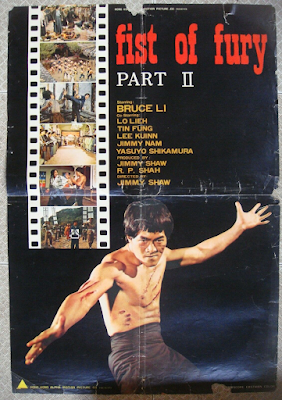
Fist of Fury, Part II (1977)

Fist of Fury, Part II (1977)
aka Chinese Connection 2; Fist of Fury 2
Chinese Title: 精武門續集
Translation: Ching Woo School the Sequel


Starring: Bruce Li (Ho Chung-Tao), Tien Feng, Lo Lieh, Chan Wai-Lau, James Nam, Jimmy Lung, Sit Hon, Lee Kwan
Director: Jimmy Shaw, Lee Tso-Nam
Action Director: Tommy Lee


Fist of Fury 2, another attempt to make a sequel to the Bruce Lee hit, makes for a fascinating example of divergent evolution next to the early Jackie Chan effort. Both films seek to tell the story of the Ching Wu School following the death of Chen Zhen, albeit from the points of view of different characters. In this case, we see what happens to the school’s teacher, played once again by Tien Feng, in the aftermath of the massacres of both the Japanese and Ching Wu schools that marked the last act of Fist of Fury. Interestingly enough, if not for a key moment in the film’s opening scene, this film could actually pass for a prequel to New Fist of Fury as well as a sequel to The Chinese Connection.

We open with the funeral procession of Chen Zhen, performed by the remaining students from the school. As the pallbearers are burying the casket, Ma Li’er (not played by Nora Miao, but by some actress whose face is obscured by the traditional Chinese funeral garb) throws her onto the coffin and commits suicide. This troubles an already-shaken Teacher (a returning Tien Feng), who soon finds himself turning to alcohol to deal with his problems, which are only just beginning.

Shortly after the funeral, some Japanese martial artists led by another interpreter, Mr. Wong (Chan Wai-Lau, filling in for Wei Ping-Ao), enter the Ching Wu school. They announce that their leader, Mr. Miyamoto (Lo Lieh, who had played the lead Japanese baddie in The Chinese Boxer), has acquired the school and now requires the students to vacate the premises. The students don’t take that very well and try to fight back, only to get whooped by the superior Japanese fighters. The Chinese students flee and try to hide out at the other local schools, but are hunted down by the Japanese and subsequently tortured.

A few months later, one of the remaining Ching Wu students sneaks by the grave of Chen Zhen, which has been cordoned off by the Japanese. He finds a stranger who claims to be Chen Zhen’s brother, Chen Shan (Bruce Li, aka Ho Chung Tao). The student warns Chen Shan to beat it, but too late, some Japanese karate fighters show up. Rather than leave, Chen Shan wipes the floor with the lot and forces them to pay respect to his dead brother. Mr. Miyamoto is really going to love that, isn’t he?

Miyamoto starts pressuring the local police inspector to arrest Chen Shan, although the inspector sympathizes with Chen enough to let him off the hook. The Japanese school reacts by using violence to coerce the other schools into turning Chen Shan in, which quickly puts the schools at odds with what little remains of Ching Wu, now that the Teacher is a useless drunk. Of course, it will only take but a few patriotic speeches to get the schools on Chen’s side, guaranteeing Miyamoto’s ire. Miyamoto declares the extermination of all schools in Shanghai, which his men handily carry out, even though two of the masters survive and go into hiding.

Obviously, the masters won’t be able to hide for very long, leaving it up to Chen to protect them. Moreover, the inspector can only stick up for Chen for so long until he puts him and his men in jeopardy. So Chen will eventually have to go on the offensive if he wants to save the kung fu students of Shanghai and his own tail.

Despite being a reworking of the film it’s supposed to be a sequel for, Fist of Fury 2 succeeds partially on the strength of its action and its rather bleak storyline. Like New Fist of Fury, the filmmakers try to continue the story of the Ching Wu school in a logical (well, at least according to the logic of kung fu movies) way, but here the villains are far more cruel and dastardly then Chen Sing and his daughter were in the other movie. The entire first act is devoted solely to showing people suffer—heck, Bruce Li doesn’t even show up until almost the 30-minute mark. Even after Chen Shan quickly establishes his fighting credentials, a lot of people are going to be unfairly walloped and snuffed before the curtain falls. That said, the major failing of the script is that the plot goes in circles for most of the second and third acts, following a pattern in which Chen Shan beats up some Japanese, the Japanese rough up some others trying find out where he is, Chen Shan argues with other Chinese about the validity of his actions, the Japanese rough up more people, Chen Shan comes to the rescue, rinse and repeat.

The movie also benefits from Tommy Lee’s action direction, which is a lot better than what we got in too many other Bruce Li films. Tommy Lee had offered his talents to the groundbreaking hit The Secret Rivals the year before and was already on his way to becoming one of Taiwan’s most talented fight choreographers of that era. He wisely avoids trying to fit Bruce Li completely into the Bruce Lee mold, giving him a similar, but distinctive style instead. Li (or Ho Chung Tao, if you will) kicks a lot better here than he has done in other films and his handwork is sufficiently complex to set itself apart from Bruce’s simpler punches. The main flaw to the action is that the group melees tends to be repetitive and uninteresting whenever Ho Chung Tao isn’t dishing out the hurt.

The storyline isn’t exactly original, and the movie loses a few points for its treatment of the Ma Li’er character. Watching her mature in New Fist of Fury was a refreshing piece of character development, so her suicide in this film’s first reel feels almost sexist and backward in comparison. Interestingly enough, after the funeral sequence, there are no women in the movie whatsoever (save a few extras, probably). Compare that with the Jackie Chan film, which had two strong female characters on both sides.

Criticisms aside, this is rightly considered to be one of the better Bruce Li vehicles out there. Interestingly enough, Li spent a good portion of his career as not only a Bruce Lee imitator, but on making movies that involved the Little Dragon himself somehow. Bruce Lee: A Dragon Story; Young Bruce Lee and Bruce Lee, the Man, the Myth were pseudo-biographical films about Bruce Lee. Bruce Lee’s Deadly Kung Fu tells a fictional account of how jeet kune do was founded, even though Li didn’t technically play Lee in the film. Exit the Tiger, Enter the Dragon; New Game of Death; and Bruce Lee, We Miss You were set in alternate universes following Bruce Lee’s death. Dynamo is essentially a Brucesploitation film about a man who becomes a Brucesploitation actor, if you can wrap your head around that.

Moreso than Bruce Le and Dragon Lee, Bruce Li’s films were, for better or worse, intimately related to the great star himself. Both men had similar martial arts training, especially in the wing chun style (I’m going to guess that Ho Chung Tao also trained a bit in tae kwon do). I suppose then that it’s only fitting that Bruce Li/Ho Chung Tao be cast in a sequel to Bruce Lee’s most revered film. And it should be fitting that it beats out all of the other attempts to make a sequel to Fist of Fury, including Donnie Yen’s recent Legend of the Fist: Return of Chen Zhen.

Black Belt Karate (1977)

Black Belt Karate (1977)
Chinese Title: 黑帶空手道
Translation: Black Belt Karate


Starring: Larry Lee Gam-Kwan, Lo Lieh, Bruce Leung Siu-Lung, Billy Chong Chuen-Lei, Chiang Tao, Peter Chan Lung, Tony Leung Siu-Hung
Director: Suen A-Foo
Action Director: Larry Lee, Bruce Leung Siu-Lung


Okay, I watched this last night and I rather enjoyed it. It was one of those films that I was watching it, I wonder why it isn't more well known. We fans often take it as conventional wisdom that Heroes of the East was the first Chinese kung fu movie to treat Japanese martial arts with any degree of real respect. However, this film predates it by a year and Larry Lee, who apparently is a black belt in Goju-ryu (the same style that Yukari Oshima trained in, and apparently both Steven Seagal and Cynthia Rothrock have trained in it, too), gives the style an excellent showcase, giving it all the respect that it deserves. I should point out that I trained in Goju-Ryu for a number of years as an adolescent, so I might be biased.

Larry Lee (best known for his collaborations with Bruce Leung Siu-Lung) plays Tommy, a country hick who shows up in Jakarta, Indonesia looking for work. He's also obsessed with karate, despite not actually knowing it. In typical kung fu movie fashion, he works a menial job deliving food, making periodic stops in front of a karate school in order to pick up a movement or two. He eventually gets fired, but is taken in by the head of the karate school, whose daughter has grown fond of him. Tommy is an exceptional student and learns quickly, even winning a trophy at the local amateur provincial tournament. Some misunderstandings lead to him getting kicked out of the school, but some treachery on the part of the school's head instructor leads the sensei to reinstate Tommy as a student and send him to Hong Kong for further training.

While not a Brucesploitation film per se, Bruce Leung Siu-Lung shows up in the last half hour as Larry's advanced karate instructor. Leung Siu-Lung's Wikipedia page suggests that he trained in Goju-Ryu karate himself, although interviews with him suggest he studied only Northern kung fu and wing chun. In any case, Leung does his own thing in his fights, including a prolonged fight between him and perennial movie heavy Chiang Tao. That means machine gun punches and lots of spinning and roundhouse kicks, all performed with speed and power. He also does some Bruce Lee-esque nose thumbings, but nothing too Bruce-like. Indonesian actor Billy Chong makes an early HK appearance as the sensei's son and Larry's best friend. His character doesn't give a great performance, since his character is depicted as never quite being good enough. He does throw a few good kicks in his final fight and does some Bruce Lee-inspired gestures, too.

That said, Larry Lee is at his absolute best here. A far cry from his manic basher fighting in 
Showdown At the Equator and his competent-but-not-great shapes in Four Shaolin Challengers, Lee is completely in his element fighting with pure Goju-Ryu. One thing I like is that the film is set in the modern day, but Lee choreographs the fights to look like shapes-oriented combat, but with authentic karate techniques and stances instead of kung fu. It's not *realistic*, but it shapes choreography isn't meant to be. His punches and kicks are crisper than they were in his other films and I just enjoy seeing joint kicks, mawashi (wheel) blocks, saifa (elbow) strikes and whatnot be incorporated so cleanly into the fighting. 

My only complaint about the action is that the relative realism of the fights is lost in the big finale, when the script suddenly introduces a new final boss, played by Lo Lieh. Lo Lieh shows up wearing a cape and challenges Larry Lee to a duel to the death. Lee fights with Sammo Hung regular Peter Chan and then Lo Lieh. That's where the trampoline jumps, edited flips and more exaggerated aspects of 70s kung fu action kick in. After the pure karate of the earlier fights, plus the manic no-frills fighting performance of Bruce Liang, the final fight is a bit of a letdown. The choreography isn't *bad*, but I wish they had gotten Yasuaki Kurata or Chen Sing to be the main karate heavy.

Saturday, March 19, 2022

Clan of the White Lotus (1980)

Clan of the White Lotus (1980)
Aka: Fists of the White Lotus
Chinese Title: 洪文定三破白蓮教
Translation: Hong Wending Breaks the White Lotus Sect


Starring: Gordon Liu Chia-Hui, Lo Lieh, Kara Hui Ying-Hung, Lam Fai-Wong, Johnny Wang Lung-Wei, King Lee King-Chu, Yeung Ching-Ching, Hsiao Ho, San Sin, Ching Miao
Director: Lo Lieh
Action Director: Lau Kar-Leung


By the time 1979 had rolled to a close, Lau Kar-Leung had demonstrated that striking out on his own as a director was the best career decision he could ever make. Starting with 1977’s Executioners of Shaolin, he had proceeded to make one masterpiece after another—save his follow-up to his freshman effort, The Spiritual Boxer. Clan of the White Lotus was released on the very first day of 1980 and bears his watermark, even if he was officially only working as the action director. Despite Lo Lieh being credited as the director, this is very much a Lau Kar-Leung film and deserves to be spoken of with the same tones of reverence reserved for Heroes of the East and The 36th Chamber of Shaolin.

The movie more or less picks up where the Executioners of Shaolin leaves off. We start off with a retcon of the finale of that film, in which Hong Wending (this time played by Gordon Liu) is facing off against Pai Mei (this time, it’s The Victim’s Wilson Tong instead of Lo Lieh). He has a helper this time, in the form of Wu Ah-Biu (King Lee King-Chu, a member of Lau Kar-Leung’s action team). With Hong’s tiger claw and Wu’s crane’s beak, they are able to ferret out Pai Mei’s weak point and kill him.

An unspecified amount of time later, the local governor (Johnny Wang Lung-Wei of The Martial Club and Invincible Shaolin) had received an imperial edict declaring that the ban on Shaolin martial arts has ended, that all layman disciples should be released from prison, and that work on rebuilding the temple must be allowed to commence. The governor doesn’t really like that idea, nor does his uncle, the head of the White Lotus Clan (played by Lo Lieh, who plays him like he played Pai Mei in Executioners of Shaolin). So the two conspire to have their men slaughter as many Shaolin disciples as they can.

Among the dead are Wu Ah-Biu, who had gotten arrested at some point but was now a free man, and his sister, Wu Siu-Ching (Yeung Ching-Ching, who eventually went on to be a fight choreographer in the Royal Tramp and Bride with White Hair films). Only Hong Wending and Wu’s widow, Mei Ha (Kara Hui Ying-Hung), survive the massacre and they go into hiding at a basket factory. From here on out, Hong Wending will spend the rest of the movie training in different styles in order to prepare himself for his battle with the White Lotus Chief.

On the surface, this is a redundant fight fest. The plot is largely is circular: the hero faces off with the villain, loses, trains, faces off with the villain, etc. In less capable hands, that would be bad storytelling, not to mention would be tedious to the viewer. Thankfully, director Lo Lieh and action director Lau Kar-Leung add a few layers to the story by making the whole exercise a reflection on the difference between “hard” and “soft” styles—compare Gordon Liu’s direct, strength-based tiger-crane technique with Kara Hui’s more wushu-esque women’s style. Against most opponents, the former is more than adequate for the job. However, against a nigh-invincible opponent like the White Lotus Chief, sheer brute force is not the answer.

What’s particularly interesting is how the action evolves with Hong Wending’s training. During his initial confrontation with the main villain, Wending uses his patented tiger claw[1] against him because his comrade is too injured to use his crane style effectively. When he starts training for revenge, Hong’s first instinct is to combine the two styles into a single technique, now that his friend is no longer around. However, their second duel reveals that the White Lotus Chief has advanced his kung fu so much, and has such vast control over his on qi, that he can control his body weight and “float away” from powerful blows. Thus, Wending must now learn more about soft kung fu styles in order to simply get a single blow in.

But that’s not all. During their third encounter, Wending is able to hit the White Lotus Chief, but his unable to hurt him. And that’s where we learn that the Chief has concentrated all of his body’s energy into a single point, called a “pulse” in the movie. Unlike Pai Mei in Executioners of Shaolin, whose weak point was located in one of the basic striking points (i.e. the top of the head, throat, eyes, groin, solar plexus, etc.), the location of the White Lotus Chief’s pulse is a lot more obscure. So to prepare for the final showdown, Wending must study acupuncture in order to learn more about the different places where his adversary’s pulse might lie. That just adds an extra layer to the action; the hero must continuously magnify his skill set in order to defeat the ultimate evil.

Where the action tells a layered story of its own, it is infinitely enhanced by the dynamic choreography of Lau Kar-Leung, assisted by frequent collaborators Hsiao Ho and Lee King-Chiu. When Gordon Liu first storms the White Lotus Monastery and takes on dozens of opponents armed with swords, before facing off with perennial Shaw Brothers heavy Johnny Wang Lung-Wei, the tiger claw Liu performs constitutes one of the fastest and most powerful examples of the art, right up there with Chen Sing’s performance in The Himalayan. In a lesser film, this fight would make a great climax as it were.

Knowing full well that a second fight with Pai Mei in the same locale may be dismissed as “more of the same” by some viewers, Lau Kar-Leung gives it its own identity in two ways. On one hand, there is the addition of Gordon Liu’s soft style. More importantly, replacing the one-on-many fight concept that preceded the previous duel is a one-against-two fight with Pai’s bodyguards (one of whom is played by Hsiao Ho), who wield jian, or two-edged straight swords. The choreography on display is extremely complex, as Gordon Liu bobs and weaves his way between two people stabbing at him with swords simultaneously.

The final fight is broken into two parts. In the first part, Liu faces off with the bodyguards a second time, who now use their sword scabbards as elongated handles for their weapons, swinging them like a traditional pudao, or horse-chopping blade. The uninitiated may not be fully impressed, but it is a clever and subtle way to add a bit of variation to the proceedings. Gordon Liu fights them off with a chain whip, a weapon that doesn’t get enough attention in movies, mainly because it’s very difficult to choreograph well. Liu makes his using the weapon look effortless. The second part has Gordon Liu fighting off Lo Lieh with acupuncture needles, much like Jet Li’s Kiss of the Dragon, but far more elaborate.

In the end, Clan of the White Lotus is another notch on Lau Kar-Leung’s masterpiece belt, even if he did not direct it. As an action director, he would have worked directly with Lo Lieh in how to stage and portray the action, in addition to deciding which moves to use and how they should be executed. Considering the quantity of action in the film and approach to martial arts philosophy that it takes, it’s safe to say that it is Lau’s film as much as it is Lo’s. And for that, this film is indeed one of the Great Ones.


[1] - This is another retcon from Executioners of Shaolin, as that film suggests that Hong Wending never perfected the Tiger Style, but excelled in the Crane style because of his mother’s training him.

Hero Dream (1992)

Hero Dream (1992) Chinese Title : 淫妖豪情 Translation : Lewd Demon Passion Starring : Chin Siu-Ho, Chin Kar-Lok, Carrie Ng, Michiko Nishiw...