
Showing posts with label Polly Shang Kuan Ling Feng. Show all posts

Friday, October 4, 2024

The Traitorous (1976)

The Traitorous (1976)
Aka: Shaolin Traitorous
Chinese Title:
 大太監
Translation: Great Eunuch


Starring: Carter Wong, Polly Shang-Kuan Ling-Feng, Chang Yi, Sammo Hung, Huang Feilong, Hou Po-Wei, Lin Hsiao-Hu, Li Ying, Hsieh Hsing
Director: Sung Ting-Mei
Producer: Yen Wu-Tong
Writer: Chang Hsin-Yi
Action Director: Chan Chuen, Ko Pao


The Traitorous is one of not two, not three, but a whopping fourteen movies that Carter Wong made in 1976. That definitely should set some sort of a record for a leading man. Carter Wong is a beloved figure among genre fans, and American moviegoers may recognize him as the Elemental who famously inflates himself to death in John Carpenter’s Big Trouble in Little China. But before he took that role, he had been a fixture in kung fu films since the early 1970s.

Some martial arts movies fans like to talk about “who is the real deal?” Carter Wong definitely fit that description. He started studying Southern Shaolin kung fu both Wudan Qigong when he was kid. He also practiced Karate, Hapkido, and Muay Thai. That last one was notable because he was a champion kickboxer is Asia during from the late 1960s up through the mid-1980s. He also served as a martial instructor for the police in Hong Kong, New York, and São Paulo, Brazil. He founded his own kung fu style, Chung Hop Kuen, which is a synthesis of all the different styles he studied over the years.

Carter got his start in film in 1972 with Golden Harvest. His first film was opposite Angela Mao and Sammo Hung in Hap Ki Do, where he plays one of the three main protagonists. He would also star with Angela Mao in both The TournamentWhen Tae Kwon Do Strikes; and Deadly China Doll. He worked with Golden Harvest until 1975, at which point he became a free agent. From that point on, Carter mainly worked out of Taiwan, although he did have a notable supporting role in Chang Cheh’s Marco Polo. Wong remained a regular presence in Taiwanese martial arts films until the early 1980s, at which point his career slowed down and he started focusing on teaching kung fu. His most beloved films to this day include Joseph Kuo’s Born Invincible; the 18 Bronzemen movies; and Hap Ki Do (although that’s more for Angela Mao’s performance than Wong’s).

The Traitorous is set during the Ming Dynasty and purports to be based on real events. The crux of the story is that there is a eunuch, Wei Zhongxian (a real-life historical personage), who has accumulated quite a lot of power thanks to the Emperor’s tendency to delegate too much of his job to in favor of worldly pleasures. Wei has given a lot of power to his second-in-command, Tin Erh-Kang (Chang Yi). When we meet Tin, he and his entourage (including Sammo Hung as a captain) are visiting a little shack in the country inhabited by the exiled General Shang. Tin and his men slaughter Shang, his daughter, and his son. The only survivor is Shang Yung, the general’s grandson, who goes to Shaolin. After a powerful demonstration of stoic devotion, Shang Yung is accepted at the temple as a pupil.

Ten years or so later, Shang Yung has finished his training and is allowed to leave the temple. He heads into the town where Tin Ehr-Kang is established and makes an unholy nuisance of himself, beating up officials wherever he can. His first victim is Tin’s third-in-command (Huang Feilong). This catches the attention of Tin’s adopted daughter, Tso Yun-Lan (Polly Shang-Kwan), who is just the kung fu bad ass that Shang has become. The two have a few showdowns together until it becomes clear that Tso’s allegiances are questionable. We later learn that her parents were unjustly murdered by Tin (at Wei’s request), so she has blood debt to pay. The two eventually team up to defeat the wicked eunuch.

Storywise, The Traitorous is a very simple film. It does resemble movies like The 18 Bronzemen in terms of its story, but is a lot more streamlined. The training portions only take up the first act or so, after which the film is non-stop fighting up through the protracted finale between our heroes and the evil Tin Ehr-Kang. Unlike some of those contemporary Joseph Kuo films, like the Bronzemen movies and Shaolin Kids, this film makes expert use of both Carter Wong and Polly Shang-Kwan, giving both performers ample opportunity to demonstrate their skills.

Carter’s focus in this film is Shaolin kung fu, which was part of his original training in real life. He performs a lot of animal styles in his fights, especially the panther style, which is refreshing. Carter gets flack from some fans because, despite his off-the-screen fighting pedigree, he did not always look great on film. His larger and more muscular physique made him look stiff in a lot of his fights. I personally found that less of a problem in this film, and choreographers Chan Chuen (who’d worked with Carter during his Golden Harvest days) and Ko Pao (who choreographed Carter in The Rebel of Shaolin and Dragon Gate) get a good performance out of Wong.

As usual, Polly Shang-Kwan puts in a great fighting demonstration in her role as the feisty Tso Lun-Yan. She plays down her Taekwondo skills, which had been the focus of her fighting in her earlier basher films, and focuses on handwork, no doubt taken from her Karate training. She punches the living hell out of everyone in her path and threatens to steal the show from the Carter, as she was wont to do at the time.

Joining them are two more genre favorites: Sammo Hung and Chang Yi. The latter plays the second-in-command to the main villain. Sammo uses the praying mantis style in his fights, with low stances and his index fingers extended. In a memorable scene, he kills Carter Wong’s mother by gouging her eyes out with his mantis skills, despite the fact that she was a defenseless woman. When Carter faces off with Sammo near the end, the latter does get to fight briefly with the 3-section staff. Chang Yi, now entering the villain phase of his career, uses what appears to be a mixture of different animal styles, including the praying mantis and the dragon style. He would return to the mantis style for a few more of his films, including The Secret of the Shaolin Poles and Eagle’s Claw.

The Traitorous also appears to be one of the earlier films of this vintage to have people fight in formations. In this case, it is not the Shaolin monks, but the guards of the Eastern Depot—sort of like the Ming Dynasty NSA or FBI—who have a special attack formation set to the beating of drums. The fighters circle their opponents and sometimes form a human wall with the fighters standing on each other’s shoulders. Once in a while, the men at the top will attack with a net to ensnare their opponents. While certainly making for some visually interesting fights, the idea of characters fighting in formation doesn’t make a lot of sense outside the Shaolin Temple. If you’re trying to capture rebels and traitors, you don’t want to have to set up a drum set to get your men fighting: your targets can just run away!

All things considered, I think The Traitorous can easily hold its own with anything Joseph Kuo was making at the same time, or even with Chang Cheh’s concurrent Shaolin films—at least on a pure choreography level. And unlike Chang Cheh’s The Shaolin Temple (made the same year), this film doesn’t waste the talents of its female protagonists. It embraces and amplifies them; it reminds us that Polly Shang-Kwan was one of the fighting divas of the 1970s. Add that to Carter Wong’s Southern Shaolin showcase and some strong villains and you got an indie fu film that deserves more attention.
Wednesday, July 31, 2024

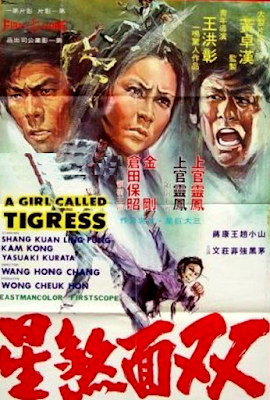
A Girl Called Tigress (1973)

A Girl Called Tigress (1973)
Original Title: 雙面女煞星
Translation: Double-Faced Female, Evil Star


Starring: Polly Shang-Kuan Ling-Feng, Yasuaki Kurata, Kam Kong, Shan Mao, Cheng Fu-Hung, Blacky Ko Shou-Liang, Lung Fong
Director: Wang Hung-Chang
Action Director: Gam Ming (Tommy Lee), Leung Siu-Chung


Polly Shang-Kuan Ling-Feng participated in pratically all of the different sub-genres of martial arts movies of the old school period, from 60s wuxia pian to kung fu comedies. In 1973, Polly starred in a series of basher movies, including the Golden Harvest production Back Alley Princess, which turned out to be her most successful film. Four of these basher movies paired Polly with Japanese martial artist Yasuaki Kurata. I still have not seen Lady Whirlwind and the Rangers, but as of now, A Girl Called Tigress is probably the best of the others.

Polly plays Miss Hsi, a young lady who has shown up in some Republic-era Chinese town. After looking around and stopping at the local restaurant for some hot buns, Hsi is set upon by the lecherous locals...because film experience has taught me that it never did pay to be a beautfiul woman in Republic Era China. The locals try to flirt with her, but she beats the hell out of them instead. She runs into more of them outside of town later on, and kicks the shit out of them again. The second, however, she is joined by a stranger (Kam Kong, of The Crane Fighters and Thou Shalt Not Kill...But Once), who also is good at kung fu.

The stranger kindly invites her back into town and offers to pay for her hotel room. The hotel owners react strangely to her presence there, however. One of the employees slips her a roofie and informs the local crime boss, Chow Kun (Yasuaki Kurata, Tiger vs. Dragon and The Angry Guest). Chow Kun arrives at the hotel and has the sleeping Hsi whisked away to his house. This is where things get interesting: Hsi is a dead-ringer for Chow's girlfriend (also Polly). The latter denies it, although we know she surely recognizes the girl.

It doesn't take long to figure out what is going on. Hsi and the other girl are twin sisters. The latter ran way to be with her boyfriend, but eventually ended up as Chow Kun's girl. Their dad is dying, but the sister is too embarrassed to return home. The stranger is actually a detective on the heels of some riches stolen from a bank a few years back. Long story short: the sister's then-boyfriend stole the money at about the time she absconded with him and hid the money on the territory of a second crime boss (Chao Chiang, The Bride from Hell and Heroine Susan). Chow Kun killed the boyfriend, unbeknownst to the sister, and shacked up with her. Miss Hsi proposes a switch between her and her sister so the latter can leave and visit her dad on his deathbed, but Chow Kun is a possessive bastard...

A Girl Called Tigress is a low-budget production. The sets are minimal. The costumes are basic. It encapsulates why both Hong Kong and Taiwan had switched over to bashers almost completely by 1973: the overhead for producing them was far less than the wuxia pian both territories had been making. The plot is perfunctory. It even throws in a quick flash of boobs (not from Polly) for good exploitation measure.

But the action is terrific. The fights were staged by Gam Ming aka Tommy Lee, who was still early in his career here--known mainly for his collaborations with Chan Sing up to this point. Gam also worked with Polly Shang-Kuan on Lady Whirlwind and the Rangers. Joining him is Leung Siu-Chung, who had worked with Polly and Kurata-san on both Seven to One and A Gathering of Heroes. There are a number of dust-ups in this film, including a handful of fights between Polly and A Bunch of Thugs, including a lengthy bout at Kurata-san's mansion. Taiwanese regular Shan Mao and a young Blackie Ko show up as fighters working for Kurata-san's rival, and the latter shows off some nice kicks in his fights. Kam Kong, who had trained under Dorian Tan Tao-Liang, gets a chance to fight mainly with his legs, which he didn't always do in his movies. 
He's not a bad kicker, and his larger size gives his kicks more "oomph!" than some of his contemporaries.

The finale is one of my favorite old school fights, especially by early 1970s standards. Kam Kong and Kurata-san go at it for several minutes at a railroad/mine. Kurata's shito-ryu karate gets a great showcase, with fast reverse punches and high kicks. There is some brief weapons work in the form of them two men swinging pick axes at each other. Kam is eventually dispatched, leaving Polly Shang-Kuan to pick up the slack. Shang-Kuan had black belts in both karate and Taekwondo and gets to show off her strong punches and kicks like few other movies, especially once they started focusing on more comic and camp elements. As a pure showcase for Polly's training, few of Polly's movies compare to her demonstration in
A Girl Called Tigress, especially the long finale. She once said that Bruce told her "If I'm the dragon, then you're the phoenix."  From a straight action point of view, A Girl Called Tigress places Polly alongside Angela Mao and Chia Ling as one of the great divas of the 1970s.

Thursday, March 14, 2024

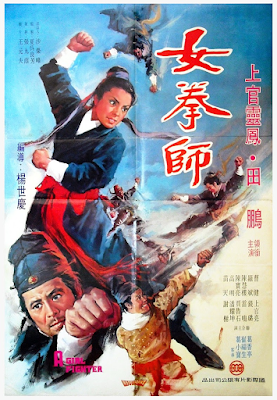
A Girl Fighter (1972)

A Girl Fighter (1972)
Aka: Girl Boxer
Chinese Title: 女拳師
Translation: Female/Woman Boxer


Starring: Polly Shang-Kuan Ling-Feng, Roc Tien Peng, Luo Bin, Ko Hsiang-Ting, Lui Ming, Ko Hsiao-Pao, Tsao Chien, Chan Wai-Lau, Wan Chung-Shan, Miao Tian
Director: Yang Shih-Ching
Action Director: Pan Yao-Kun


One of the unwritten rules of “basher movies”—kung fu movies made in the early 1970s in the wake of the success of The Chinese Boxer—was that most of them would take place in the Republic Era, and occasionally in modern times. A lot of that has to with the general cheapness of the production and the ability to save money on costumes, wigs, and complex sets. Exceptions were few. The most notable was The Prodigal Boxer (1972), which was set in the Qing Dynasty and was about Chinese folk hero Fong Sai-Yuk. Even more strange was A Girl Fighter, starring Taiwanese martial arts diva Polly Shang-Kuan.

Kuan had gotten her start in the wuxia genre in the late 1960s with films like Dragon Inn and Swordsman of All Swordsman. She stayed generally busy throughout the 1970s until her career waned in the final year of the decade. In any case, she was a prominent figure during the Basher Period, stuck around for the coming of Shapes, was there for the resuscitation of wuxia pian in the late 1970s, and even delved a little into Brucesploitation (in films like Magnum Fist). What makes A Girl Fighter unique is that it certainly feels like a wuxia pian (especially with its Ming Dynasty setting), but much of the fighting is open-handed, and yet it doesn’t quite reach Basher levels of crudeness in terms of choreography.

The movie begins with a couple enjoying some peaceful time together…until the unheralded arrival of a scoundrel named Chin Teng-Chiao (Luo Bin, of Swordsman at Large and Wang Yu, King of Boxers). Chin Teng-Chiao is the son of the richest and most influential man in town, so the little butthole thinks he can do whatever he wants, such as raping the daughter-in-law of the Liu family patriarch. When she puts up a struggle and her In-Laws step in to defend her, Chin just kills the entire family and that’s that.

Well, not quite. The magistrate, Hsu Chung-Huan (Ko Hsiang-Ting, of Struggle for a Vengeance and Fists for Revenge), and his advisor (Lui Ming, of Lightning of Bruce Lee and The Female Chivalry), have received an order from the capital to bring Chin Teng-Chiao in to be judged for his crimes. The problem is that this particular city does not have an actual police force. One assumes that law and order was maintained via private security funded by Chin Zhan-Peng. And since one assumes that Chin will not give up his son, the question of “Who will take responsibility for the job?” arises.

The question is answered by the arrival of a young lady named Sima Muyong (Polly Shang Kuan, of Seven to One and The 18 Bronzemen). Sima offers to bring in Chin Teng-Chiao. After dispatching a quartet of the magistrate’s guards in a display of her martial prowess, Magistrate Hsu figures that she’s as good an option as any other and gives her the job. It doesn’t take long for Sima to track Chin Teng-Chiao to a brothel and interrupt his merrymaking with a prolonged kung fu thrashing. She ultimately arrests him and takes him into custody.

But that is where things get complicated. Elder Chin (Tsao Chien, of Dragon Gate Swordsman and Chinese Kung Fu and Acupuncture) initially sends his flunkies to bribe the magistrate into letting his son go. But the issue has already reached the Top Brass, so even if Magistrate Hsu wanted to, there’d be no getting around that. However, the trial will not be held in town, but in the city of Zhending, which is located a few towns over and across the Black River. That means that Elder Chin has more than enough opportunities to ambush Sima Muyong and her men as they transport their prisoner through the countryside. And even if they do get that far, an attack by Chin’s men on the magistrate’s hall results in the theft of the Official Stamp, which means that Sima Muyong will have no way to prove who she is once (and if) she arrives.

Sima is undaunted, however, and soon takes the journey with six guards on her team. They are waylaid in the forest by Chin’s men, led by Chen Tianba (Chan Wai-Lau, of Showdown and The Fearless Hyena). They almost lose Junior Chin in the scuffle, but he is picked up by a wandering swordsman named Keng Tan-Hsin (Roc Tien, of The Samurai and The Tongfather). We later learn that Keng is the nephew of Liu Patriarch, and wants to kill Chin Teng-Chiao himself. But before he can do that, another entity shows up and steals Chin Junior. This new guy is Dong Qiming (Miao Tian, of Chivalrous Robber Lee San and Crazy Nuts of Kung Fu), a member of the guard from the destination town. He also wants to ensure that Chin arrives safely to his trial. In any case, they eventually all meet up an inn in the next town. It isn’t long, however, before Ching Zhan-Peng and his men have the entire place surrounded.

If you watch enough of these films like I do, you end up surprised when you see connections that you never saw before. For instance, the 1977 wuxia movie Green Dragon Inn is essentially a remake of A Girl Fighter. And that film also starred Polly Shang Kuan Ling Feng. There was a bit of a role reversal: Yueh Hua played the heroic captain and Polly Kuan played the vengeful niece of the murdered family, but the story for both films is essentially identical, including a prolonged sequence of the good guys and the prisoner trapped in an inn by the bad guys. The main difference is, like the title implies, this is Polly Shang-Kuan’s movie through and through. In Green Dragon Inn, she had to share the screen with genre veterans Yueh Hua and Lo Lieh. Here, she dominates practically every fight sequence there is, and the film is better for it.

The action was staged by Pan Yao-Kun, best known for the other half of the duo that gave us A Touch of Zen. He was pretty busy in Taiwanese cinema during the late 60s and early 70s, although he seemed to get less work as guys like Tommy Lee, Alan Chui, Robert Tai and Chan Muk-Chuen rose to prominence. He did make something of a comeback in the 1980s, even contributing to the superior action sequences of Young Hero of Shaolin 2. He does some okay work here, probably superior to the fights he did in Polly Kuan’s Rider of Revenge the previous year.

The action is mainly made up on group melees, often with the characters fighting with swords, with the exception of Polly, who mainly uses her bare hands. By this point, Polly had gotten her black belts in three different styles (karate, tae kwon do and judo) and it’s all on display here. Her blocks, punches and kicks are all performed with crispness. I could see the age yuke (high block) and moves that I myself performed back when I did karate. The fighting is interesting, because part of it is typical wuxia sword-slinging stuff, but then you have all these empty-handed fights as the title implies. This was pretty rare for a film with a wuxia setting back in 1972. And the moves and techniques are more genuine than the film’s basher contemporaries, so A Girl Fighter does feel like an outlier. The main problem with the action is that it is performed a bit slow: some of the speed and intensity that you’d find in the best bashers of that era is lost in favor of giving Polly Kuan’s skills a proper demonstration. The other problem with the action is Roc Tien (as usual), who is okay when he’s wielding a sword, but clumsy looking when he’s not. But there’s enough pure unadulterated Polly on display that I’m willing to forgive Roc’s awkwardness and Pan Yao-Kun’s lack of intensity with the hand-to-hand choreography.

Monday, March 21, 2022

Return of the Kung Fu Dragon (1978)

Return of the Kung Fu Dragon (1978)
Chinese Title: 車馬砲
Translation: Chariot Horse Cannon


Starring: Polly Shang-Kuan Ling-Feng, Chen Sing, Nick Cheung Lik, Tsai Hung, Chuan Yuan, Tung Li, Lin Chi, Li Chung-Chien, Yuan Shen, Sze-Ma Yu-Chiao, Hsiao Wang
Director: Yu Chik-Lim
Action Director: Chen Muk-Chuen, Jacky Chen Xiao-Long


Polly Shang Kuan Ling Feng had a reasonably busy year in 1978, making some seven films with a seventh film, the Korean production The Tigresses, having been produced the year before but released in January. Moreover, 1978 was ultimately her loopiest year, considering how in Little Hero she fought giant rubber kung fu squids and in Zodiac Fighters, men in lobster costumes were her opponents. Lung Wei Village was easily her most conventional film. Return of the Kung Fu Dragon falls somewhere in the middle: the garish costumes and colorful (if cheap sets) serve a conventional revenge tale.

The movie is set in the fictional land of Phoenix Island, located in the South China Sea. The place is run by a benevolent “emperor”—is it possible for an empire to consist of a single island—played by Tien Yeh (of The Super Swordsman and The Blind Hero Fighting Evil Wolf). There is a coup in the empire and the emperor is killed by a powerful magician (Tsai Hung) in the service of a military officer (Tung Li, of Adventure at Shaolin and Dragon on Shaolin Tower) with a goofy dubbed voice. Thankfully, both men’s kung fu is really good, so when they storm the palace, they are able to defeat the emperor’s two loyal generals, played by Chuan Yuan (Tung Li’s real-life brother) and Chen Sing. The former is able to escape the palace with the princess, who will grow up to be played by Sze-Ma Yu-Chiao (whose wide-set, beady eyes makes her look like the Taiwanese equivalent to Anya Taylor-Joy).

Meanwhile, the new emperor (i.e. the guy with the goofy voice) marries the emperor’s widow (Lin Chi, of The Young Tiger and Conspiracy) and takes Chuan Yuan’s daughter as his own and raises her to be the princess. She will played by Polly Shang Kuan Ling Feng.

Eighteen years later, the real princess has come of age and completed her kung fu studies under the tutelage of a powerful master (Yuan Shen, of Blood of the Dragon and The Evil Karate) living on a mountain protected by magic fog. The princess, accompanied by the master’s assistant, a red-nosed dwarf (Hsiao Wang), goes back to town to defeat the emperor and take her kingdom (or empire) back. She assisted by the standing princess, who has learned the truth of her identity, plus the sons of the other two generals, played by Nick Cheung Lik (The Dragon Lives Again and Dragon Lee Fights Back) and Li Chung-Chien (The Invincible Kung Fu Trio and The Crippled Masters).

This conventional “defeat the kung fu tyrant” story takes frequent trips into the bizarre, although always with a wink and a nod. Much of the comic relief comes from the princess’s dwarf friend—although to be honest, he may not be a dwarf as much as an exceptionally short young fellow. Polly Shang Kuan largely stopped taking herself seriously in the mid-70s, so she’s almost always smiling, even when face kicking the villains with great aplomb. There’s some unintentional humor in the fact that the evil magician is constantly escorted by a cute young lady (Yang Fang, whose short career consisted of small roles in films like Fight for Glory and 12 Bald-Headed Beauties) who has to carry his long beard.

The low budget manifests itself in the costumes, which vary wildly from one character to another. Polly Shang Kuan frequently wears a gold-sequin tunic, which suggests she walked off the set of a late 1970s disco peplum movie. Her two male companions dress as if they showed up four years early to a Conan the Barbarian dress rehearsal. Some of the lower ranking bad guys wear metal-studded black leather tunics which I assume was taken from whatever bondage porn was allowed to be made in Taiwan in the 1970s. Everyone else wears conventional Ming Dynasty-esque robes.

Taiwanese mainstays Chen Mu-Chuan (Iron Monkey and The Crippled Masters) and Jackie Chen Xiao-Lung (whose name manages to rip off both Jackie Chan and Bruce Lee) handle the action, which is surprisingly not that bad. Chen Mu-Chuan had a solid career in the late 1970s, often working with the best actors (David Chiang, Chen Kuan-Tai, etc.) on their most mediocre films. His films were generally quickly-shot affairs, so the choreography steps were often performed a bit metronomically. Jackie Chen’s work was a lot more uneven: the finale to The Fearless Dragons is one of the best old school fights ever, while Tai Chi Shadow Boxing has some of the slowest fight choreography on record. These two do a surprisingly good job on the action here, no doubt buoyed by the natural talent of the three leads.

Polly Kuan’s tae kwon do skills get a great showcase here and her kicks are as powerful as ever. Nick Cheung Lik and Li Chung-Chien are also solid kickers and their bootwork is just as good as Polly’s. Tung Li and Tsai Hung, both Taiwanese perennials, are also very solid in their roles and do a good job with their fighting. Some of the action is hampered by the occasional use of drop-frame editing, in which a frame or two is removed in order to simulate the use of undercranking. There are no all-time classic fights, but they’re fun while they last. The strangest thing about the fighting is when Polly Shang Kuan visits the old master, who teaches her a new style based on the movements of chess pieces—the Chinese title refers to three pieces on a chessboard. And not once, but twice, our heroes find themselves standing on giant chessboards—in different locales, I’ll add--which allows them to use their special styles.

Outside of the action, the film is a technical mess with questionable artistic merits. I mentioned the costumes and sets. The editing is also dodgy. The best example is near the end, when three of the protagonists attack one of the villains inside his volcano lair (yes, there is one of those) with flying side kicks. All three of them hit their target, but suddenly one of the heroes falls outside of the lair (!?) and hits his head on a tree (!!??) and dies (!!!???). The movie also moves at such a fast pace—rarely do five minutes go by without a fight scene breaking out—that you never really get a feel for the characters. Return of the Kung Fu Dragon is not a very good film, but it’s fun to watch while it lasts.

Tigresses (1978)

Tigresses (1978)
aka Black Leopard of Shaolin Temple
Chinese Title: 少林寺黑豹
Translation: Shaolin Black Leopard


Starring: Polly Shang-Kuan Ling-Feng, Kim Jeong-Nan, Kim Young-In, Kwon Il-Soo, Choi Sung-Kyu, Choe Jae-Ho, Cho Sung-Go, Kim Jeong-Jung
Director: Lee Hyeok-Su
Action Director: Kwon Il-Soo


Another oddball South Korean chopsockey film mixing overwrought melodramatics, hard-hitting martial arts, with a dash of just outright weirdness. Obviously, the film's star, Taiwanese starlet Polly Shang Kuan Ling Feng, was and is no stranger to kung fu weirdness: she fought giant kung fu squids in Little Hero and lobster men in Zodiac Fighters. So she's in familiar territory whenever the action suddenly requires her to fire liquid nitrogen from her hands in order to defeat a fire-breathing foe. And despite these dips into the absurd, this film has a straight-forward revenge story that for the most part, plays the fights completely straight. 

We open with the House of Park being assaulted by a former butler (Kim Young-In) and his kung fu entourage. They kill the Patriarch and most his guards, but one guard (Choe Bong, of 
Dynamite Shaolin Heroes) is able to flee, along with the matriarch (Cho Hak-Ja of Leopard Fist Ninja) and the family's two daughters: Mi-Ryung (Polly) and Il-Mae (Kim Jeong-Nan, the tomboy from Snake and Crane Arts of Shaolin). Il-Mae is taken and hidden by the house maid, while the matriarch takes Mi-Ryung to study kung fu at Shaolin. She killed shortly afterward by the villain's men. Ten or fifteen years later, the Kim daughters are adults. Kim Mi-Ryung is aware of her noble heritage, and dons a black mask to terrorize the bad guy and his kung fu cohorts. Some time later, Kim Il-Mae shows up, also an expert in the fighting arts, but with little knowledge of her destiny. She ends up teaming up with the villain to fight Mi-Ryung, until they discover that they are sisters...

I saw almost the same exact story done (better) a few weeks ago in 
Duel of Karate and there are lots of movies that deal with the siblings-separated-at-birth-get-righteous-vengeance story, from Shaolin Prince to Double Impact. There's nothing new in the story here, save the fact the villain employs guys who turn invisible or use hypnotic eyes to make their opponents dizzy. But Polly Shang Kuang Ling Feng is on the job, and she knows how to deal out the weirdness to defeat the weirdness, like emitting smoke and fog from her palms to make her enemies appear. And being 1977, director Lee Hyeok-Su (who later did Hard Bastard and Buddhist Fist and Tiger Claws with Legendary Superkicker Hwang Jang Lee) treats this all with the utmost of seriousness, as if it were completely logical that firing blasts of cold mist was customary Shaolin Temple training.

Where the film falters most, unfortunately, is the editing. Scenes just sort of end and jump around with little rhyme or reason. In one sequence, Polly tries to assassinate the main villain in his sleep but his interrupted and injured by Il-Mae. She arrives at her hideout, but in the next scene, her character is back at the villain's manor, fighting his men. Suddenly, we see her recuperating back at the house. I'm not sure, but I *think* it was Il-Mae dressing up as Polly's character in order to drive up her asking price to the villain. I'm not quite sure, though. Even worse, the climax begins with the free-for-all at the villain's house, but suddenly cuts to Polly chasing the bad guy through snowy mountains for the final fight. It completely forgets about how Il-Mae was fighting off the rest of the villain's bodyguards, so we don't get any closure on that fight. Il-Mae shows up after the final fight is over, letting us know that she's alive, but it would've been more satisfying to see them off the bodyguards together, and then fight the final boss together.

On the subject of fighting, the action isn't bad. I'm not sure who the choreographer was, although Kwon Il-Soo, who played one of the special fighters, does have a background in action direction, so maybe it was him. Outside of the occasionally whack-a-doo moments, the fighting is fairly straight forward. Polly Shang Kuan, who had a black belt in both tae kwon do and karate, gets plenty of opportunity to show off her powerful kicks--she doesn't a lot of flashy aerial boots, but she kicks with strenght and power. The choreography has that madcap energy that Korean films often have in place of more crisp and complex techniques. Sadly, Kim Jeong-Nan doesn't fight as much as we'd like to see her fight. She showed in 
Snake and Crane Arts of Shaolin that she can bust it out when wants. This film gives her little space for that. But for fans of Polly, I think this film is a must.

Monday, March 14, 2022

Seven to One (1973)

Seven to One (1973)
Chinese Title: 女英雄飛車奪寶
Translation: Heroine Speed Race


Starring: Polly Shang Kuan Ling Feng, Yasuaki Kurata, Yee Hung, Ma Chee, Shah Liu-Hui, Chow Chung-Lim
Director: Hou Cheng
Action Directors: Leung Siu-Chung, Bruce Leung Siu-Lung, Tommy Lee (Gam Ming)


For those of you like me who were profoundly disappointed with A Gathering of Heroes, which brought together one of the greatest fighting divas of all time with Kurata, arguably the greatest Japanese screen fighter of all time, then Seven to One will inevitably come across as a step up, even if it’s far from perfect as a movie, even by early 1970s standards. The story doesn’t always make sense and the McGuffin plot ends up amounting to very little, but it does give us a generous helping of fight scenes from both Polly Kuan and Yasuaki Kurata, including the climax, so it does have something going for it.

This is one of the (relatively) few films that Polly made set in modern times, which means that we get Polly dressed in bell-bottoms and pink, red, and orange blouses, looking as hawt as ever. Seriously, I don’t think I’ve seen the woman look as beautiful as she does here. Granted, I’ve only watched a handful of her movies, but I stand by my declaration with no shame whatsoever. What I find particularly interesting about her being so gorgeous here is that she never exposes any skin in this movie. I recently watched some of Charlie’s Angels and it was all about the tight clothes, cleavage, unzippered jumpsuits with no bras on, etc. Most of the kung fu divas, especially those from the 1970s and 1980s, were just as charming, charismatic, beautiful, and sexy while still maintaining a modest dress code. It’s an approach to filmmaking that the Chinese have always understood that Hollywood can never seem to get: you can make a sexy female action hero without rubbing her body in our faces at every opportunity.

On the other hand, the fact that this is the 1970s means that we also get to see Yasuaki Kurata as a evil karate-chopping rock singer(!) who, at one point, wears a lilac suit jacket over one of those frilly white dress shirts. I’m ashamed to admit, however, that I didn’t pay much attention to the size of his lapels. I’ll save that for another watching.

The movie opens the way any movie should: a bunch of guys attacking Polly Shang Kuan, playing a woman named Ting, for no reason, other than for her to beat them up and establish early on that she’s more than a force to be reckoned with. After the scuffle, we switch scenes to an evil crime boss (Ma Chee, The Killer Meteors and Tiger and Crane Fists) spending time with his mistress (Yee Hung, The Zodiac Fighters and Queen Bee). I’m still not totally sure what their purpose in this movie is, and I’ve seen it twice. Maybe writing this synopsis will help me figure it out.

So we meet Miss Ting again at a bar, where some guy talks to her from behind his menu. We don’t see who he is, but we do know that Miss Ting is looking for her father’s murderer and is looking for clues at that moment. She’s attacked at the bar, but quickly mops the floor with her attackers. We then cut to her snooping around the docks, because the docks are a wonderful place to set a fight scene. And what do you know, Ting is soon surrounded by dozens of goons armed with crowbars and chains. A prolonged fight breaks out, starting at the docks and ending in a tunnel. Ting is about to be overwhelmed when a convertible shows up out of nowhere and out pops Yasuaki Kurata. He beats up the rest of the thugs and takes Ting to safety.

Ting wakes up at Kurata’s place, after eating some cake offered by Kurata’s deaf-mute maid, head over to the club he works at as a rock singer. He doesn’t stop to talk to her, but leaves her a note written on a matchbook. Ting leaves the club and is attacked by more of the crime boss’s goons. Kurata helps her fight them off and she heads back to his swingin’ pad.

Kurata returns some time later with the crime boss’s mistress, who turns out to be the owner of the club Kurata sings at, accompanying him. They’re about to have some quality time together when the mistress figures out that they’re not alone and starts searching the house for Miss Ting. Not having found her, she decides to go home. Kurata offers his place to Ting, telling her that it’s too dangerous for her to go back to the hotel.

The next day, Kurata takes Ting on a fact-finding mission. Apparently she’s looking for her Uncle (Chow Chung-Lim, Superriders Against the Devils and Princess and the Toxicant), who might be able to tell her about her father’s murder. While not finding any leads initially, she does receive word from her uncle when she returns to her hotel. She also finds that she’s being followed by even more of the crime boss’s goons. Shaking them off her trail, she arrives at her uncle’s mansion, where he tells her the story.

Apparently a week before, Ting’s father (Shah Liu-Hui, Moonlight Sword and Jade Lion and The Mighty One) had requested for the uncle to meet him at a hotel. We then cut to footage of the father being chased by thugs all over the city before he can reach the hotel and talk to Uncle. Apparently he has an extremely valuable diamond ring in his possession. When the bad guys come a-knockin’, Ting’s father gives Uncle the ring and hides him on the balcony. The bad guys come barging in and the father shoots them to death with a pistol. You know, despite their being scores of bad guys associated with organized crime in this movie, nobody actually uses guns. Heck, they don’t even use choppers. Practically everybody just fights with their fists and the occasional found object. It’s fascinating just how much Chinese cinema warps reality in order to make a kung fu movie. But the thing about it is that it’s far more believable when it happens in a Chinese movie than in a Hollywood film. There’s just something about Chinese cinema that makes it easy to swallow that the characters live in a world where people use fisticuffs on each other at the slightest provocation. You just roll with it.

Getting back on track, the father is killed in his hotel room by the sudden appearance of Kurata, although the Uncle didn’t see what had happened, so he isn’t able to tell Polly to beware of him. By this point, the film is entering the last act, which means we’ll get a heavy dose of fight scenes from here on out. Kurata ends up picking up Polly and taking him to the mistress’ house. She tells Polly how much she hates the crime boss for being a lecherous creep (we’re treated to a phone call in which the crime boss asks the woman if she’s naked and whatnot). When Polly and Kurata leave the place, they are attacked by the crime boss’s men, while boss and his personal bodyguards enter the mistress’ house. Polly and Kurata go back into the house to find the mistress dead (and naked—this is an early 1970s kung fu film after all) in the bathtub.

Kurata and Polly rush over to the crime boss’s house, only to discover that he’s not there. There’s an interesting moment of gratuitous violence in this scene when the two question the maid as to where the boss is. She says she doesn’t know, but they figure that he’s gone to her uncle’s house. Kurata tells Polly to go to his car. After she leaves, Kurata turns around and delivers a karate chop to the top of the maid’s head, who falls back into a chair. My wife saw that scene the first time I watched this and asked me if he had killed her. I told her that he had only left her unconscious, even though it was pretty clear from the flashback sequence that Kurata’s karate chop was indeed lethal. If I were Badmovies.org, I’d refer to this scene as a RANDOM ACT OF VIOLENCE AGAINST A MAID!

So the boss and his men are busy attacking Polly’s uncle. Polly and Kurata show up and a huge fight breaks out. This is where Yasuaki Kurata finally shows his true colors to Polly, giving some nonsensical speech about how she’s good enough to take on six men at once, but not seven, or something like that. We also learn that the crime boss never even knew about the diamond ring McGuffin in the first place, making me wonder why exactly his men had spent the previous 70 minutes attacking Polly. Kurata also explains to us why the ring was so important in the first place: it had the password to a secret account in Switzerland inscribed on it.

Although I’d hardly call Hou Cheng a great director, he does keep the film paced reasonably well, which is more than I can say for his colleague Griffin Yueh. The first 25 minutes or so are brimming with action, after which the film slows down a little until the 50-minute mark, after which it becomes one fight after another, broken up by one of the lowest-octane car chases ever filmed. He also knows that we, the viewer, want to see Polly and Kurata fight, which he delivers to us in spades. Heck, even the second act is consistently interesting, because we at least have Polly to look at and an extended chase involving her character’s father.

I guess Hou and Polly must’ve gotten along quite well, since he also directed The Rangers (which I’ll be reviewing later on this year) and The Zodiac Fighters. He also seemed to have had a gift for kung fu weirdness, as The Zodiac Fighters has gone down in history as the film that featured Polly Kuan fighting against men in lobster costumes, while his Shaolin Invincibles is the movie with the infamous kung fu gorillas. Seven to One is A LOT more down to Earth than those films, to be sure.

Once again, the Leung father/son team and Tommy Lee are on board for the action, which both more plentiful and entertaining than in A Gathering of Heroes. As I’ve already stated, both Kurata and Kuan get to participate in numerous fights, which is a very good thing. Kuan, who was trained in three different martial arts (karate, judo, and tae kwon do) gets ample opportunity to show off all of her skills. Her kicks, while not especially flashy, are quite hard-hitting here and she gets a lot more height on them than a lot of screen fighters during the early 1970s. She mainly uses reverse punches and elbows when it comes to handwork, but it’s done with more flair than your average Basher film from the same time. This is some of her best work here, no doubt about it.

Kuan is matched move for move by Kurata, who gets to show off his own considerable kempo and aikido skills (mainly the former, though). He’s actually a lot quicker and more powerful than Kuan is, although he loses to her ultimately because he’s the bad guy. However, losing in hand-to-hand combat to Polly Shang Kuan Ling Feng is like Hwang Jang-Lee losing to John Liu: we know that the villain in real life is a lot better than the hero, but the hero is awesome enough onscreen that we buy it anyways. Despite the general claims about Lau Kar-Leung’s masterpiece Heroes of the East (1978) being the first Chinese movie to show respect for Japanese martial arts, I’ll say that Kurata and Polly were doing Japanese styles justice as early as 1973.

The only false move that the movie makes is at the finale, which begins with a motorcycle/car chase that is not very exciting. It doesn’t help that both vehicles look to be going at the speed limit, instead of above it. It also ends on a particularly silly note, with Polly leaping out of the motorcycle and into a rowboat as the former falls into the harbor. It’s edited in such a way that it comes across like she’s magically teleporting from one vehicle to the other.

The chase is followed by a brief fight between Kuan and Kurata, which is all well and good. However, it doesn’t take long for Kuan to literally punch Kurata’s lights out (so to speak), and so the last five minutes of the movie is Kuan sneaking around to avoid a blinded and crazed Kurata, which isn’t quite my idea of a fitting final fight.

When all is said and done, Seven to One is a fun slice of early 1970s kung fu. The quality of the fighting is up to the standards set by Sammo Hung in the Angela Mao films he choreographed during the same era and Polly puts most of her contemporaries, like Jimmy Wang Yu, David Chiang, Lo Lieh, Shih Tzu, and others to shame. The story is very much more than “Polly Kuan beats people up because of some McGuffin that most of the bad guys aren’t even aware of,” but then, this past weekend was the same one in which I watched Shaitani Dracula, the film in which no scene logically followed the one before it, so Seven to One looks perfectly fine by comparison. Truth to be told so I could accept a movie about Polly beating people up for no good reason, if the fights are well done. I’m pretty sure I’ll come across that film at some point.

Tuesday, March 8, 2022

Swordsman of all Swordsmen (1968)

Swordsman of all Swordsmen (1968)
Chinese Title: 一代劍王
Translation: Generation Sword King


Starring: “Roc” Tien Peng, Polly Shang Kuan Ling Feng, Chiang Nan, Tsao Chien, Miao Tian, Hsieh Han, Ko Yu-Min, Lu Shih
Director: Joseph Kuo
Action Director: Shek Chee-Bun, Pan Yao-Kun

Much of the world was in an uproar at the time the film was released, on October 6th. The United States was up to its neck in the Vietnam War, having dealt with the Tet Offensive, the infamous My Lay Massacre (among others), and increasing opposition on the homefront. The Pullitzer Prize-winning photograph of the South Vietnamese military officer executing a Viet Cong officer in the street didn’t help things, either. Speaking of executions, that year also saw the assassinations of both Robert Kennedy and civil rights leader Martin Luther King Jr., not to mention John Gordon Mein, an American ambassador who was murdered in the streets of Guatemala.

Little of this is seen in The Swordsman of Swordsmen, a rather conventional wuxia film about revenge. A group of baddies led by Yun Zhongjun (prolific actor Tsao Chien, who played the owner of the titular locale in Dragon Inn) massacres the Cai household, stealing the family’s prized sword and leaving only the son, Cai Yingjie (Taiwanese regular “Roc” Tien Peng), alive. Cai grows up to be a master swordsman and hunts down his family’s killers, one by one. Along the way he meets a swordswomen, Flying Swallow (Polly Shang Kuan Ling Feng, in her sophomore effort), who’ll influence his mission in ways he doesn’t imagine.

So if King Hu was the John Ford of kung fu cinema, than Joseph Kuo would be the Delmer Daves, a freelancer who frequently wrote and produced his films, in addition to directing them. Once he took his place directing martial arts films in the late 60s, Kuo could be generally depended on to fill his films with rip-snorting action, while throwing a few wrinkles into conventional martial arts movie stories. In this movie, for example, we have the full set-up for a typical wuxia tragic ending, especially once we learn about Flying Swallow and her relation to the villains. The film goes barreling forward at full speed to a downbeat conclusion, but then pointedly does not do that. Instead, we have a series of decisions made by our hero in which he earns his title (i.e. the film’s title) not just by ruthlessly cutting down everybody in sight (although he does a lot of that), but by exercising mercy and restraint as well.

The action was a lot more satisfying here than it was in the two King Hu movies I talked about. Do not expect a lot from Polly Kuan, who was still training at this point. Nonetheless, the fight choreographers Shek Chee-Bun (The Gallant Knights and The Buddhist Spiritual Palm) and Pan Yao-Kun (who worked on King Hu’s A Touch of Zen) up the pace of the action. The one-on-one duels resemble those seen in Hollywood swashbucklers and are more energetic than Han Ying-Chieh’s Peking Opera approach to screen combat. Most of the action, however, is Roc Tien taking down a dozen men at a time whenever he confronts one of his targets. There are a few exaggerated moments, like Roc Tien catching a knife between his teeth and throwing it at an opponent several feet away. But for 1968, the action was fairly solid.

Dragon Inn (1967)

 Dragon Inn (1967)

Aka: Dragon Gate Inn
Chinese Title: 龍門客棧
Translation: Dragon Gate Inn


Starring: Shih Chun, Polly Shang Kwan Ling Feng, Pai Ying, Miao Tian, Hsieh Han, Tsao Chien, Kao Ming, Ko Fei, Han Ying-Chieh
Director: King Hu
Action Director: Han Ying Chieh

King Hu’s follow-up to his hit Come Drink with Me came out the following year, on October 21st. Interestingly enough, it was the same day that 70,000 people marched on Washington D.C. to protest the Vietnam War while another 50,000 marched to the Pentagon for the same reason. This protest came on the heels of months of race riots all over the country, including Tampa, FL; Buffalo, NY; Newark, NJ; Planefield, NJ; Minneapolis, MN; a particularly bloody one in Detroit, MI; Milwaukee, WI; and finally Washington D.C.

Hong Kong was also a hotbed for manifestations and protests, in the form of the Hong Kong 1967 Riots, between communist sympathizers and the police. It started as a labor dispute, mainly between the unionists of an artificial flower factory, some of whom were communists. A violent showdown between the workers and management quickly escalated when the police got involved and the riot took to the streets. A curfew was imposted and hundreds were arrested. The pro-communist rioters were encouraged by the local newspapers, who accused the British government of being fascists and it wasn’t long before the bodies began to pile, both as the result of police brutality and by the demonstrators, who started making homemade bombs. In the end, 51 people died and 4979 people were arrested, 1936 of whom were convicted.

Meanwhile, the People’s Republic of China was going through its infamous Cultural Revolution, and the government were up to their necks in the violent activities of the Red Guard, a group of militant Maoist students who had been given Mao Zedong’s blessing to “educate” the people. This included murder, torture, destruction and defacement of historical relics, and all-around terror. Their psychological campaign against anyone who disagreed with them, including local police forces, resulted in thousands of murders and suicides. By the beginning of 1967, the Red Guards had become a liability to stability in China and the People’s Liberation Army (PLA) were given the order to suppress these far-left fanatics.

According to King Hu, this project came about both from his fascination with the Ming Dynasty and from his negative opinion of the popular James Bond franchise, in which a secret agent with a license to kill was elevated to superhero status. In this film, a corrupt eunuch (played by Bai Ying of Royal Warriors and Hap Ki Do) and his secret service entourage, the Jinyiwei[1], trump up charges against a government oficial and have his put to death. They try to execute his family, but a few faithful retainers free them and try to take them across the border. The eunuch dispatches his agents to lay a trap for them at Dragon Gate Inn, located in the middle of the desert. Arriving at the inn at about the same time is a righteous swordsman, Xiao Shaozi (Shi Jun, of A Touch of Zen and A City Called Dragon) and two equally-righteous fighters, children of a former general (played by Hsieh Han and a debutting Polly Shang Kuan Ling Feng). While both parties initially try to treat each other politely in order to not show their hands, it’s only a matter of time before the official’s family arrives and things erupt into violence.

King Hu has stated that he wanted to make a film in which the Secret Service was anything but righteous and heroic. In his mind, Dragon Inn is an anti-007 film. Nonetheless, one might see some parallels between this and the Red Guard Movement of the Cultural Revolution in King’s native China. On one hand, you had a paramilitary movement like the Red Guards terrorizing the populace with the government’s blessing, but who quickly became so destructive so as to threaten the government as a whole had they been allowed to continue. On the same token, as the Ming Dynasty eventually devolved into decadence, with the Emperor losing power to his own eunuchs as the years passed[2]. And so, you had eunuchs with the disposition of a tyrant and armies at their disposal acting with passive permission, or even without the knowledge of the emperor, which is the crux of the plot of Dragon Inn.

The action here is not the most dynamic you’ll ever see. Once more, it occasionally feels like a Japanese chambara film filtered through Peking Opera sensibilities—once more, Hang Ying-Chieh was the action director—and when our heroes—including a 17-year-old Polly Shang Kuan Ling Feng—are slicing lackeys down in single swings of the sword, it’s fine. When they engage in a one-on-one with a stronger opponent, it becomes less convincing and interesting, almost on the level of an Italian peplum from earlier that decade. The finale between four protagonists and evil Eunuch Tso is a good example of this, as the moves become less crisp, sloppier in execution and not as exciting as a fight against a nigh-invincible fighter should be. There’s more action here than in Come Drink with Me, so that’s appreciated. I just wish Han Ying-Chieh had done more to up his game this time around. That said, I must point out that Polly Kuan didn’t have any martial arts training prior to filming—after becoming a star with this film, she trained and got black belts in karate, tae kwon do and judo—and yet she steals every scene in which she has to wield a sword. It would be a few years before the woman would take her place among the fighting divas of old school chopsockey movies, but in her debut, she demonstrates that she already the intensity for the title.


[1] - The Jinyiwei are also portrayed in the Shaw Brothers classic Secret Service of the Imperial Court (1984) and Donnie Yen’s 14 Blades (2010).

[2] - This is similar to how to the Merovingian Dynasty of Frankish Kings lost power to the majordomos, or mayors of the palace, which eventually gave rise to the subsequente Carolingian Dynasty.

Hero Dream (1992)

Hero Dream (1992) Chinese Title : 淫妖豪情 Translation : Lewd Demon Passion Starring : Chin Siu-Ho, Chin Kar-Lok, Carrie Ng, Michiko Nishiw...