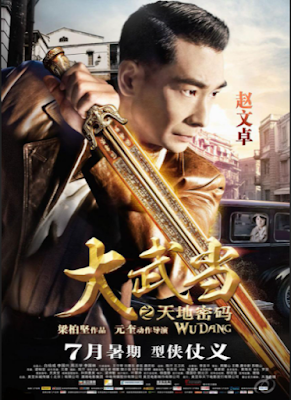
Wu Dang (2012)
Chinese Title: 大武當
Translation: Big Wu Dang
Starring: Vincent Zhao
Wen-Zhuo, Mini Yang, Fan Siu-Wong, Dennis To, Xu Jiao
Director: Patrick Leung
Action Director: Corey Yuen Kwai
The more I think about it, the more I think that China has every right
to routinely rip off Indiana Jones in their movies. China has
such a vivid history encompassing about 3600 years (more than 4000 if you count
the Xia Dynasty) and 20 dynasties, not to mention has been home to Buddhism and
Taoism. Taoism, according to movies, is all about the sorcery and crazy methods
used to expel demons and evil spirits. It’s obviously much more than that, but
it’s those crazier aspects that stick out. Let’s not forget traditional Chinese
folk religions, usually grouped into a single group called “Shenism,” which has
influenced both Taoism and Chinese Buddhism. Then there’s that whole martial
arts part of Chinese culture, which has gotten scads of attention by writers
for centuries. There’s just so much material in Chinese culture on which to
build a story about the search for some crazy relic with supernatural powers
that making their own Indiana Jones-esque movie is pretty much a no-brainer.
The most famous Indiana Jones knock-offs are Jackie Chan’s Armour
of God movies. The first sequel, Operation Condor, is one
of my favorite Jackie Chan movies, period. No doubt about it. I liked the
first Armour of God okay, but it needed an extra fight scene
or two to be really exciting. Strangely enough, those movies eschewed Chinese
mythology to focus on more “Western” treasures: the Armour of God and a cache
of Nazi Gold. I’m pretty sure that was done to attract foreign markets and make
the movies more accessible to international audiences, which Jackie has done
for years.
Beyond that, there’s pratically an entire sub-genre in Chinese cinema to
films revolving the hidden tomb of the Emperor Qin (aka Shi Huangdi) and the
attempts to find it. Most recently, there was the Jackie Chan non-Armour of God
film The Myth, which was pretty good until the underwhelming
climax. Much better was Ching Siu-Tung’s A Terra Cotta Warrior,
which benefitted from being set during China’s Republic Era, not to mention having
a better cast and a more adventure feel to it. There’s another movie
called The Aces Go Places 5: The Terracotta Hit, which I haven’t
seen yet. Heck, even the faux-Western action-comedy The Millionaire’s
Express had a subplot involving a map to the tomb of Emperor Qin. If
you want to include American movies in the mix, one might consider that crappy
third Mummy movie, whose villain was obviously the Emperor
Qin, despite China’s request for the filmmakers not to actually use his name.
There are some other odds and ends floating about. There’s another whole
sub-genre involving Wisely, a literary character who gets in all sorts of
adventures, from fighting a Xenomorph-skeleton monster in The Seventh
Curse to fighting a Vietnamese general because of a geomancy-powered
tomb in Bury Me High. Moreover, Jet Li made a more obvious Indy
rip-off in Dr. Wei and the Scripture with No Words, which only a
few people including myself like. I’ve had my eyes on a Taiwanese adventure
film called The Unknown Tomb for years, but my local video
store sold it off before I could rent it. Bastards. YOU ROBBED ME OF A MARSHA
YUEN MOVIE, YOU FOOLS! HOW DO YOU LIVE WITH YOURSELVES? At the bottom of the
barrel there’s Michelle Yeoh’s The Touch, which the less said
about, the better.
With a name like Wu Dang and Corey Yuen behind the
scenes as the action director, I was expecting the Wu Dang equivalent to Benny
Chan’s Shaolin: a serious action-drama with overwrought emotions
and extremely violent martial arts action. That’s not what I got. Instead, we
have a lightweight martial arts adventure that comes across as something of an
inversion of Jean-Claude Van Damme’s The Quest. Where that movie
was first and foremost a martial arts tournament film with a brief subplot
involving an attempted theft of a local treasure during said tourney, this
movie focuses on protagonists’ attempts to acquire a treasure while the
tournament goes on in the background.
Set in the 1930s, we open with treasure hunter Dr. Tang Yulong (Zhao
Wen-Zhuo of Fist Power and Fong Sai Yuk) arriving
in Shanghai from the States, with his daughter Ning (Josie Xu Jiao, Mulan and A
Legend is Born: Ip Man) in tow. He leaves her in his car and goes to see a
client. The client is about to make a deal with a rival of Dr. Tang’s, an
antiquities-dealing gangster named Paul Chen (Star Runner’s Shaun Tam),
regarding a mythical Wu Dang sword. Dr. Tang is rather sharp, though, and
quickly denounces the relic as a fake. However, he does discover a treasure map
leading to a secret Wu Dang treasure in the sword during the examination, we
leads to a big fight between him and Chen’s men. All this before the title
appears onscreen.
So Dr. Tang and Ning are soon on their way to the Wu Dang Temple to
participate in an important kung fu tournament. They are joined by a mysterious
kung fu beauty named Tianxin, who hails from a tribe not unlike the Min people,
who are related to the Hmong people, as far as I understand. Apparently the
sword in the preceding paragraph was created by her people and she would like
to return it to the tribe. So she beats up a bunch of people on a plane flying
out to the Wudanshan and takes their invitation. Oh, and what about Dr. Tang?
Why is he interested in the Wu Dang treasure, you ask? Why, to save his
daughter Ning from a congenital illness that claimed his wife years before.
Duh!
It doesn’t take a genius to see that Dr. Tang and Tianxin are going to
meet up at the tournament or, more importantly, at the hiding place of the real
sword. Neither of them are able to get it, however. At that moment, Bailong
(hey, that’s my Chinese name—oh, he’s played by Dennis To, although I spent the
entire film thinking it was Donnie Yen) shows up and gives both Dr. Tang and
Tianxin a taste of Wudang kung fu. After their initial defeat, Tang and Tianxin
agree to join forces and look for the other parts of the treasure first, after
which they’ll get the sword.
Meanwhile, Ning is participating in the tournament, although she’s
getting visibly sick after each bout. Her father is a doting man, but his
excursions away from her immediate presence in order to go treasure hunting
frequently leave her to own devices. She quickly makes friends with a layman
Wudang student, Shui (Fan Siu-Wong of The Death Games and Ip
Man). Shui is studying Wudang kung fu and seeking a treatment for his
ailing mother, who for her part, is more concerned about her son finding a wife
and producing an heir. Those two remind me of the son/mother team from A Touch of Zen, although thankfully Ning doesn’t sleep with Shui (considering
the Fan Siu-Wong is about 40 now and Josie Xu is 13—I guess I should point out
the former is playing a man in his 20s and the latter is playing a girl around
the age of 17, so in the context of the story, it isn’t too gross). Shui is also
participating in the tournament, utilizing a Sleeping Fist Style that the
Wudang master is teaching him.
Tang and Tianxin start finding the treasures (which include the sword, a
sutra, a magical pill, an equally-magical root, a statuette, a sacred lightning
rod, and a pearl that Tianxin is unknowingly carrying with her) while fighting
off contingents of Wudang nuns armed with swords and Paul Chen’s thugs, who
eventually show up at the temple. We also learn that Paul Chen is in league
with Bailong to get the treasures for themselves. While Paul is in it for the
money, Bailong has other ideas: if the treasures are joined in the right place
(presumably at the right time, which just happens to be when everybody is
treasure hunting), they will allow their owner to reach Nirvana.
That’s pretty silly, when you think about it. The main religion
practiced at the Wu Dang temple tends to be Taoism, although I’ll give it to
filmmakers in that the two religions influenced each other over the centuries.
Nirvana can be defined as the true peace of mind and the act of becoming one
with the universe (or with the Supreme Being). As I understand it, when one
attains Nirvana, they leave the life/death cycle and stop reincarnating,
because they’re past that (to put it in simple terms). Okay. In this movie,
however, attaining Nirvana is little more than becoming a murderous wire-fu
super villain. It’s pretty goofy, but at least there’s some decent kung fu at
the end.
Like many Chinese movies that don’t really care about international
audiences, the movie is something of a multi-headed genre dragon with a little
something for everyone. It’s a period piece adventure. It’s a kung fu movie.
It’s a tournament film. There’s romance and melodrama. There’s violence and
special effects. There’s a happy Hollywood ending. There’s a man performing a
Sleeping Fist Style. It’s fun for the whole family!
Well, the last time Patrick Leung and Corey Yuen worked on a movie
together, it was the horrid Huadu Chronicles: Blade of the Rose (aka Twins
Effect 2 aka Blade of Kings). I detested that movie.
Beyond the Donnie Yen/Jackie Chan fight near the end of the second act, the
film is almost completely unwatchable. When I tried to watch it all the way
through a second time, I turned the film off in disgust by the 20-minute mark
and threw the disc in the garbarge. Corey Yuen’s Award-nominated choreography
was derivative and largely uninteresting, the actors were grating, the climax
was non-existent, and the movie had that awful scene where Donnie Yen makes
googly eyes at Tony Leung (I think) that makes my skin crawl just thinking
about it.
So once again I’m faced with a Patrick Leung-Corey Yuen collaboration
and thankfully the result is far more satisfying than Twins Effect 2.
The actors don’t spend the greater part of 90 minutes embarrassing themselves
in awkward comic roles and the plot is a lot more accessible to the average
Western viewer (or the more jaded Jade Screen fan like myself). There are no
underground cannibal mutants who ask people to dance and no pouty Charlene Choi
to wade through. The movie actually has a climatic duel which, although
FX-heavy, still manages to satisfy more than The Myth and The
Touch. There are lots of flaws, to be sure, but it still amounts to a
perfectly-decent way to spend 90 minutes, if nothing else.
Most people are going to ask about the action, so I’ll focus my remarks
on that. There is quite a bit of fighting, which most viewers will appreciate.
Corey Yuen is still out of form compared to his earlier films, but he does a
respectable job here. Unlike some of his more recent Hollywood films like The
Expendables and Rogue: Assassin, Corey is sure to keep the
camera both steady AND at a safe distance from the combatants. Much like nearly
everything he’s done since the 1990s, there is A LOT of wire-fu on display. If
you don’t like that, than you can banish any thought of acquiring the movie
right now. Also, since some of the actors, like Mini Yang, aren’t real martial
artists, there’s a lot of slow motion to help their ineffective blows look more
powerful than they really are.
The first major set piece occurs at the beginning, when Vincent Zhao
takes on a bunch of gangsters. One of them is dressed in more traditional
Chinese clothing and performs some nice kicks, which is cool. The next fight is
on a plane and involves Mini Yang and the entourage of a would-be participant
in the tournament. It’s all wire-fu and slow motion, although it amuses in its
own way. The fights involve Mini Yang and Josie Xu at the tournament, which mix
generic movie wushu, some internal styles like taiqiquan and
what looks like baguazhang, and wire-assistance.
Once the treasure-hunting really begins, then Corey Yuen really starts
to get creative. The first fight deals with Zhao Wen-Zhuo taking on a bunch of
Taoist nuns armed with swords. Since he’s the good guy, he can’t really beat
them up all that much, so he fights more on the defensive here. That’s followed
by fight between Mini Yang and a Taoist Nun armed with an iron fan. Said fight
leads into a huge showdown between Paul Chen’s men, Zhao Wen-Zhuo, and Mini
Yang. The fight goes on for some while and is wall-to-wall movie wushu, with
Corey Yuen dusting off the “use a woman as a weapon” bit that he used in Romeo
Must Die and Fong Sai Yuk 2. The finale veers off into the
supernatural, but Zhao gets to use a little bit of hsing-I in
addition to the usual Northern Wushu.
I was rather disappointed with Zhao Wen-Zhuo in this film. Lord knows
that I’m one of the few people around who truly lament that he didn’t become
the next Jet Li, despite his good looks, solid (if stoic) acting skill, and
comparable wushu skills. As such, I’m always in a hurry to defend practically
any movie that the man does. Zhao does a pretty decent job here; he has a lot
more range as an actor now than he did in the 1990s. However, his fighting
leaves a bit to be desired. The slow motion and wire-fu don’t help, but the
fact that he’s often fighting on the defensive just waters down his
considerable skills quite a bit. Few of his trademarks aerial kicks are
displayed and despite the title, we don’t get to see very much tai chi, ba gua,
or crazy Wu Dang swordplay from Zhao during the film. Zhao had fought very well
under Corey Yuen and Yuen Tak’s direction in Mahjong Dragon; Zhao’s
showdown with Ken Low is one of my all-time favorite fight scenes. We never
reach that level here, though.
I’m also disappointed that Louis Terry Riki-Oh Fan Siu-Wong is wasted
here. Don’t get me wrong, after toiling around in low-budget productions during
much of the 1990s, I’m glad that he’s at least getting steady supporting actor
work in big productions. However, I wish that he got more fight time, since we
only get to see him practice his Sleeping Fist style a little and get some
limited kung fu from him during the movie. He’s a wonderfully-talented man and
deserved more action scenes here.
Wu Dang is an unsubstantial film, but it is pretty
entertaining. It helps come in with low expectations and to be in the mindset
required to like those uneven Hong Kong films from the late 1980s and early
1990s. Considering the general dearth of quality kung fu movies coming out of
Hong Kong these days, we should be glad that Wu Dang is as
entertaining as it is. It’s certainly not Choy Lee Fut, for which
we should be grateful. It also doesn’t have evil foreign devil villains raiding
the Wu Dang Temple, so we should applaud that as well. It has lots of plot
holes and an extremely Disney cartoon happy ending, but I’ll let that last one
slide on the grounds that the Chinese make enough of these films with sad
endings as it is. A couple of sappy endings certainly won’t hurt now, will
they?