Showing posts with label Bruce Li. Show all posts

Friday, March 7, 2025

Capsule Reviews - Brucesploitation Movies

The Dragon Lives (1976)
aka King of Kung Fu; He's a Legend, He's a Hero 
Chinese Title: 詠春大兄
Translation: Wing Chun Brother


Starring: Bruce Li, Betty Chen Pei-Zhen, Su Hsiang, Hsueh Han, Yam Ho, Lee Wan-Chung, Han Su, Hu Chi
Director: 
Wang Hsing-Lei
Action Director: Huang Kuo-Chu

Strange biopic from Bruce Li--one of 
five he made between 1974 and 1976--that jumps around tonally. Bruce heads to San Francisco as a young man and then hitches a ride, hobo-style, to Long Beach for the infamous Long Beach International Karate Championships, which is portrayed like the tournament scene in Master of the Flying Guillotine. Bruce takes on the heavyweight boxing champion and wins, which earns him a place on "The Green Hornet." When Bruce has a dispute with the director of the latter's insistence that he wear a queue, Bruce heads back to Hong Kong and becomes a movie star. He has an affair with Betty Ting Pei (Chen Su-Chen) and starts training himself to death, especially when he gets invited to work on a (fictitious) film co-starring the aforementioned boxer.

Bruce Lee - A Dragon Story
 was more accurate, but had so little action that American distributors had to splice in fights from Superior Youngster and Little Superman. Young Bruce Lee really just did its own thing. This one pays lip service to events in Bruce Lee's life, and jumps back and forth in tone between happy-go-lucky, somber (whenever he's pondering the treatment of Asians in Hollywood), and even dark (whenever he's over-training himself). The recreations of fights from his movies are better than those in Dragon Story, especially the Fist of Fury dojo scene. Strangely enough, the movie ends with him having sex with Betty Ting Pei: Yep, a kung fu movie whose climax is also the lead actress's.

All that said, you're better off sticking with 
Bruce Lee's Secret and Bruce Lee - The Man, the Myth.


Bruce and Shaolin Kung Fu (1977)
Aka: Ching Wu & Shaolin Kung Fu; Fist and Fury Part 2; Bruce and Shao-Lin Kung Fu

Chinese Title: 達魔鐵指功
Translation: Demonic Iron Finger


Starring: Bruce Le, Chan Sing, James Nam Seok-hoon, Kim Jeong-ran, Bae Soo-cheon, Chiang Tao, Bolo Yeung Sze, Jang Il-shik, Lee Hang, Nick Cheung Lik
Director: James Nam, Cho Seok
Action Director: Tang Tak-Cheung

I think some consider this one of the better Bruce Le films out there, alongside Enter the Game of Death and Clones of Bruce Lee. This is arguably one of the more competent films he made, sticking with the familiar Fist of Fury template. In some territories, the film is known as Fist of Fury Part 2 and is presumably set at a time after the events of the original in which the Ching Woo school has spread beyond Shanghai and is actually doing quite well for itself. Le plays Ching Ling, one of the top students of the Ching Woo School, who has been up in the mountains practicing kung fu with a Shaolin master (Chan Sing, in an extended came). Upon finishing up his training, Ching Ling and his friend, Kang Jin (Nick Cheung Lik), return to Shanghai, where things are heating up under the command of Japanese General Yae Ho (Bae Soo-cheon, in yet another scenery-chewing performance). Yae Ho and his advisors want to eliminate kung fu schools in China in order to put down any possible rebellion. The General has his son, a lieutenant in the Japanese army and a karate master, is tasked with defeating Chinese martial arts.

When Ching Ling comes back to Ching Woo, he finds the school in shambles. He challenges the Lieutenant to a duel and humiliates him, resulting in the latter committing hara-kiri. Now a persona non grata in Shanghai, Ching Ling departs for Korea, which is already a Japanese colony. He hooks up with Master Po Sai Lam (James Nam), a martial brother of Ching Ling’s master. He starts learning Taekwondo and a special fist style. Meanwhile, the Japanese send a group of killers (including Chiang Tao and Bolo Yeung) to Korea to look for Ching Ling. Lots of fights break out. When the General arrives in Korea for a military conference, Ching Ling and Master Po’s daughter (Kim Jeong-ran), try to assassinate him.

There is quite a bit of fighting, staged by Tang Tak-Cheung (best known for Tiger Over Wall and Kung Fu Zombie). As usual, Bruce Le tries to mix his Bruce Lee impression with his own hung gar training. I don’t know why, but his shtick in movies often grows old very quickly. He’s a decent athlete, but if he doesn’t have a good choreographer, his fights easily get repetitive. I think it has to do with the fights themselves often about dodging and evading, instead of complex exchanges of techniques. Obviously, a style like hung gar lends itself out to elaborates shapes fighting, but Le tries to do something a little more “Bruce-y” with it and it just doesn’t work.

Bolo Yeung fights with a strange gorilla style (which I assume is the inspiration for the German title, “Die Gelbe Gorila” – The Yellow Gorilla), but it’s not particularly interesting. Kim Jeon-ran, best known for playing Jackie’s tomboy friend in Snake and Crane Arts of Shaolin, does some good fighting, especially when she’s trying to murder a room full of military officials. Nick Cheung Lik’s talents are completely wasted, unfortunately. Chan Sing fares better, getting a fight with Chiang Tao and his goons and showing off both his signature tiger style and a smattering of crane, too. Too bad he didn’t get more fight time in the film.

The penultimate fight pits Bruce Le in a lengthy duel with Chiang Tao, which is broken up by frequent running (almost more than Little Godfather from Hong Kong). He finally defeats him by attacking a bunch of pressure points, which was the basis for his training at the beginning of the movie. His final match is with a pair of white-haired fighters armed with metal poles with detachable claws at the end. It’s at this point that Bruce gets to use nunchaku as we expect in this sort of film. In one loopy moment, the two fighters (I think they’re father and son) stand behind one another and start waving their arms and ducking and weaving in an attempt to confuse Bruce. Bruce and Shaolin Kung Fu is a pretty decent, if unoriginal film. On a sliding scale of Bruce Le films, that would put it somewhere as a three (out of five). The film ends in an obvious nod to the original Fist of Fury, but a sequel was made the following year.


Return of the Tiger (1977)
Chinese Title: 大圈套
Translation: Big Trap


Starring: Bruce Li, Angela Mao Ying, Chang Yi, Blacky Ko, Lung Fei, Hsueh Han, Cheng Fu-Hung, Wang Chi-Sheng, Wang Yung-Sheng, Hsieh Hsing
Director: Jimmy Shaw
Action Director: Hsieh Hsing

The film starts off promisingly: the credits are set over the training regimen of a bunch of men inside of a gym. Angela Mao then enters the place and beats everyone up for several minutes, 
Hapkido-style. We then learn that she's working for Chang Hung (Bruce Li), who has a beef with the owner of the gym, Paul (Paul L. Smith). He says that Paul killed his dad and he wants him to shut down his gym and film studio. Paul has his number one flunkie, Peter Chan (Chang Yi), talk to Chang Hung into switching sides, but to no avail. Chang Hung gets the attention of Paul's rival, the crime boss Sing (Lung Fei), who tries to woo Chang Hung to his side.

He has Chang Hung fight Paul's bodyguard, Tom (Cheng Fu-Hung, who spends the film wearing a sweatshirt with 'TOM' embroidered on it), in order to prove his worth. He sort of joins Sing's gang, but we find out that he is actually a hitman hired by Paul to eliminate Sing, and so the blood vendetta with Paul is just a ruse. But both sides, who turn out to be rival heroin dealers, start to get suspicious of Chang Hung. And Paul tries to sell his unsold heroin stash (to quote Chris Rock: "People don't sell drugs, drugs sell themselves") to Sing, leading in a huge brawl. And then it turns out that Chang Hung and Angela are actually working for the law. A big brawl, replete with double crosses, ensues.

Compared to a lot of kung fu films from the period, it is interesting that there isn't a whole lot of action in this. There is a 
Yojimbo quality to the plot, with Chang Hung kinda-sorta playing both groups against each other, although even if Chang Hung didn't get involved, both sides would've suffered mutually-assured destruction by the end. It takes about 30 minutes for Bruce Li to have his first fight scene. There was a nice dojo sequence, with Huang Kuo-Chu doing some great kicks. Bruce Li has a brief scuffle with choreographer Hsieh Hsing, who plays an assassin hired by Sing. He then fights some would-be motorcycle assassins, led by Blackie Ko in a mullet. The finale is a huge free-for-all. It is interesting watching Chang Yi, always the intimidating villain, getting manhandled by a burly white guy. Bruce Li's scuffle with Paul L. Smith is long and brutal, full of found objects being used as weapons. Angela Mao is wasted in the finale, unfortunately. She should've gotten a good throwdown with Hsieh Hsing and Lung Fei.


Edge of Fury (1978) 
Aka: Blood on His Hands
Chinese Title: 撈家撈女撈上撈
Translation: Fishing for the family, fishing for the daughter, fishing for the top


Starring: Bruce Li, Michelle Yim, Gam Ming, Dana, Yasuaki Kurata, David Cheng Dai-Wai, Wai Lit, Kao Yuen, Ng Tung
Director: Lee Tso-Nam
Action Director: Gam Ming (Tommy Lee)

One of Bruce Li's lesser films, mainly because the film is kind of dull. There is fighting to be had, thanks to Tommy Lee, but much less of it than your average Brucesploitation potboiler, and of a lesser quality than one might expect. We do get a brief glimpse of Dana's tits, if that's any sort of consolation. Between this, Storming Attacks, Bruce Li in New Guinea, and his sex scene with a hot gwailo chick in Dynamo, Ho Chung-Tao must have been the happiest man working in 1978.

Bruce Li plays Fong Pao (or Ah Fong), a kung fu expert and chaffeur for a tycoon named Mr. Chun (Pak Man-Biu, of The Blade Spares None). One day, Fong is at work when he is visited by the police. Chun has been arrested in Thailand for drug smuggling and the police need to question Fong to see how much he knows about his boss's activities. The answer is "Very little." However, that doesn't stop the neighbors from talking smack about Fong and mistreating his mother, those lazy talebearing bitches. Fong is assaulted by Gau Jai (Tommy Lee), who was Chun's second-in-command. Initially, the question revolves around "What do you know and how much did you tell the police?"

At this point, the film breaks off into three stories. One of them revolves around Fong Pao's travails as people turn their backs on him because he worked for a criminal. A second subplot revolves around Chun's widow (Dana, of Inframan and Storming Attacks)--the guy is eventually executed--and her attempts to get her hands on her husband's will. She wants all of his assets to share with her lover, played by Wai Lit. Finally, Gau Jai and Chun's business partner, Mr. King (Yasuaki Kurata, of Win Them All and The Angry Guest), are trying to find where Chun used to hide "the stuff." They are convinced that Fong Pao knows and Mr. King even goes so far as to employ Ah Fong in order to get the information out of him. When he insists that he doesn't know, Gau Jai kidnaps Ah Fong's girlfriend (Michelle Yim) in order to force him to talk.

Edge of Fury is a very talky film. And there is no real interaction between the two main story threads of the missing "stuff" and Dana trying to get her hands on her husband's wealth. I think most viewers will be impatiently counting down to the next fight scene or wondering if Dana will doff the duds--there is a shot of her from behind a shower box and later where she tries to seduce the guy administering her husband's estate (Kao Yuen, of Fingers that Kill and The Blind Boxer).

The action is just okay. Lee Tso-Nam and Tommy Lee had obviously done some great work together: The Hot, the Cool, and the Vicious and Challenge of Death, to name two. Tommy Lee and Lee Tso- had worked with Bruce Li on Fist of Fury, Part II and did a pretty good job there. Edge of Fury is all three men working below their respective potential. Li's fighting is in Bruce Lee imitation mode, but the way he maintains a pose after punching or kicking someone is just distracting here. Tommy Lee can't seem to decide if he wants to choreograph a Bruce Lee imitation, traditional shapes, or early 70s basher style. His work is all over the place here. The finale with Yasuaki Kurata is brutal, but sloppy. Both men have done far better work in other movies. The entire film consists of talented people working at their most mediocre...not their worst, but their most average.

Monday, March 21, 2022

Fist of Fury, Part III (1979)

Fist of Fury, Part III (1979)
aka Fist of Fury 3; Chinese Connection 3; Jeet Kune the Claws and the Supreme Kung Fu; Avenging Fury; O Tigre em Fúria
Chinese Title: 截拳鷹爪功
Translation: Jeet Kune Eagle Claw Skill


Starring: Bruce Li (Ho Chung-Tao), Ku Feng, Wei Ping-Ao, Bruce Tong, Michelle Yim, Fong Yau, Hong Gwok-Choi, Wang Lai, Choi King-Fai
Director: To Lo-Po
Action Directors: Wong Mei, Addy Sung


I’d like to think that Fist of Fury III was the victim (at least in part) of its 1979 release date. The kung fu movie landscape had changed a lot since 1977, especially because of Jackie Chan. The success of The Drunken Master meant that studios—both mainstream and independent—would try to cash in on that film’s success, cranking out kung fu comedy one after the other for low costs and potentially-high profits. Racist portraits of the Japanese still existed, but had become moot the year before with Lau Kar-Leung’s balanced take on the Chinese/Japanese conflict in Heroes ofthe East. With Jackie Chan becoming the big thing, Brucesploitation on the whole was quickly turning into an anachronism.

The post-Drunken Master mentality shows up here in the form of a bungling brother to Chen Shan (and, by extension, Bruce Lee’s Chen Zhen), played by the usually-reliable Hon Gwok-Choi (Call Me Dragon and Running on Karma). It ends up cheapening what is already an underwhelming film and dealing a blow to the original film’s power that even the lackluster New Fist of Fury wasn’t guilty of. Alas, that is but one of the film’s many sins.

We open with a brief fight between Chen Shan, who’s returning to his home in Macao following the events of the last film, and some Japanese baddies led by the local interpreter for the Japanese (Wei Ping-Ao, essentially reprising his role as Wu from Fist of Fury). After whooping them, Chen comes home and promises his blind mother (Wang Lai, who made some 200+ films in her career, including gems like Hong Kong Emanuelle ), that he’ll never fight again. That’s a bit drastic, considering his speeches about sticking up for yourself in the previous entry. His worthless brother is on hand to get into trouble, which will eventually come back to bite the family in the arse.

Chen Shan goes to visit his uncle, the owner of the local hung gar school. I’m guessing that “uncle” is only a friendly term, since uncle’s daughter (Choi King-Fai) has decided to spurn her engagement to the school’s top student (Bruce Tong of Shaolin Temple) in order to flirt with Chen Shan. When the local Japanese school resolves to open a casino in town, their leader (Broken Oath’s Fong Yau) declares that Chen Shan needs to be wiped out in order to avenge the death of Miyamoto, villain from the first film. Unfortunately, their political clout in Macao is less than it is in Shanghai, so they’ll have to operate a little less openly. The Interpreter suggests that they use the love triangle to pit the Top Student against Chen Shan.

This leads into a bizarre tangent where Chen Shan catches Top Student fighting with a father-daughter pair of traveling martial artists (the daughter is played by Michelle Yim, of Passage of the Dragon). Chen Shan bests him in a duel, which pisses Top Student off even more.  Chen Shan takes the dad n’ daughter home, where his mother nurses the ailing father back to health. Meanwhile, an increasingly distraught Top Student finds himself turning to alcohol to deal with the fact that his fiancée doesn’t care for him anymore. One evening, Interpreter shows up and spikes the guy’s wine with some aphrodisiac, which causes him to almost rape his master’s daughter. Obviously, this gets the guy kicked out of the school.

A reel from the version I watched went missing at this point, so I’m not entirely sure what happens. I’m guessing that Top Student kills his master and frames Chen Shan for it, who is thrown in jail. I’m also guessing that the real identities of the father-daughter pair are revealed, since it was hinted at before that they were in Macao to resolve some special business. Anyway, the master’s daughter commits suicide while Top Student is having another random fight with father-daughter pair. The next day, Worthless Brother tries to pick a fight with the Interpreter, leading to his getting beaten to death by the Japanese. Chen Shan’s mother subsequently dies of grief. Chen Shan is let out of jail almost effortlessly by father-daughter pair and as soon as he finds his dead family, he’s going to want to get revenge.

The script here is just a mess, from the inconsistent characterizations to a main villain (Shaw Brothers veteran Ku Feng) who doesn’t even show up onscreen (at least in the version I saw) until the final fight itself. That in itself makes the bad guys even less compelling than Chen Sing and his daughter in New Fist of Fury. Moreover, the Fist of Fury franchise is a patriotic (if slightly racist) one. It’s about one man standing up for his people in the face of tyranny and foreign imperialism. In this movie, however, the villains here do very little oppressing and their plan to get revenge on Chen Shan via a love triangle is rather silly and petty, rather than the sort of thing to get audiences riled up. I also didn’t appreciate how the father-daughter duo disappear from the movie after freeing Chen Shan from prison, despite the fact that their kung fu is actually pretty good.

It doesn’t help that the fight scenes are choreographed by 3rd string choreographers Wong Mei (Bruce’s Deadly Fingers and Bruce Li in New Guinea) and Addy Sung (Bruce Le’s Greatest Revenge). Fist of Fury 2 didn’t represent Tommy Lee’s best work, but it was obvious he was trying for more than your garden-variety Bruce Lee imitation, which worked a lot in the movie’s favor. Unfortunately, Wong and Addy had histories far too steeped in the Brucesploitation genre to break out of type, and Ho Chung Tao ends up back in the garden with some uninspired Bruce Lee-esque posturing and whooping. The action is made even worse by the liberal undercranking applied to a number of the one-vs-many fights.

Things get even worse once we reach the finale, since the filmmakers liberally rip off Fist of Fury II, from the villain killing his interpreter right down to the final shot of the villain committing seppuku. A lot of the characters’ moves feel borrowed from the Bruce Li/Lo Lieh fight from the last film and the only moment of fighting freshness comes when Bruce Tong shows up to briefly tango with Ku Feng. Nothing about the fight is all that original or interesting, ending an already uninspired movie on a bland note.

Image of Bruce Lee (1978)

Image of Bruce Lee (1978)
Aka: Storming Attacks
Chinese title: 猛男大賊胭脂虎
Translation: Macho Thief, Rouge Tiger


Starring: Ho Tsung-Tao (as Bruce Li), Dana, John Cheung Ng-Long, Bolo Yeung Sze, Mark Cheung Lui, Han Ying-Chieh, Luk Chu-Sek
Director: Richard Yeung Kuen
Action Director: Sham Chin-Bo, Wong Mei

Image of Bruce Lee was Bruce Li’s last released film in 1978, an extremely prolific and successful year for the genre as a whole. That year saw Mr. Ho Tsung-Tao fight gorillas, lock horns with snake cults in Oceania, and even do a pseudo-autobiography. That last one turned out to be one of the best films in a career based mainly around exploiting the name of a guy who’d barely been dead for half a decade! In Image of Bruce Lee, the Brucesploitation angle is fairly subdued: Bruce Li wears a yellow tracksuit in the first scene and there’s a scene where one character says that Li looks like Bruce Lee and should get into the film industry. Beyond that, it’s a standard police caper in which heroes and villains alike just happen to fight with their fists 98% of the time.

Bruce Li plays Captain Wei Man, a special tactics team leader for the Hong Kong Police. In the first scene, he unsuccessfully tries to save a man from throwing himself from a building. Said jumper was financially ruined after he unwittingly sold some valuable diamonds for counterfeit bills. Wei Man is ultimately teamed up with another cop, Chang Li (Mark Cheung, who staged the action for the late Benny Chan’s Man Wanted), to bring down the counterfeit operation. The outfit is run by kung fu criminal Han Tin-Lung (Han Ying-Chieh of The Big Boss) and his son, Steven (John Cheung of Snake in the Monkey’s Shadow and Kung Fu Master Named Drunk Cat).

Those two are currently entertaining Kimura (Bolo Yeung, of Enter the Dragon and Chinese Hercules), the head of the counterfeiters’ Japanese branch. Kimura has brought the printing plates to Hong Kong for the next batch. They are now waiting for the delivery of the paper, to be carried out by Dana (Super Infra Man’s Dana, the stage name for Sam Suk-Yee), the daughter of a Japanese supplier. Most of the movie has one or both cops following a suspect and getting into a fight, following another suspect and getting into another fight, rinse and repeat. Oh, and Dana will occasionally doff her duds in front of the camera.

The action is fast and furious thanks to choreographers Wong Mei (The Four Shaolin Challengers and Bruce’s Deadly Fingers) and Sham Chin-Bo (Fists of Bruce Lee and The Gold Connection). The choreography style falls somewhere in between the “shapes” fighting that defined most kung fu movies in the late 70s and a more freewheeling modern style that Bruce Lee would have approved of. Villains Han Ying-Chieh and John Cheung especially feel like they stepped off the set of a period piece, put on some contemporary clothes, and kept on fighting the way they were before. Bruce Li fights a bit more like his namesake, although avoids his inspirations whoop-whoops, nose rubs and nunchaku. His punches are more economical than his opponents’ and his kicks are more tae kwon do than Southern Shaolin. There is also a fair bit of judo thrown in the fights, which is fun.

More the director’s fault than the choreographer’s, but the fights do get a little repetitive. Wherever Bruce Li or Mark Cheung follow a suspect, there are always three or four henchmen armed with 2x4s and bamboo poles to gang up on them. So the fights usually consist of one of the heroes engaging in complex choreography exchanges with one of the villains, broken up by more basic moves against the lackeys. There is a fight that breaks out in a karate dojo, Fist of Fury style, which I suppose gives the film more of a Brucesploitation flavor than it might have had otherwise. My favorite part about the action is that Bolo Yeung gets some of his best and most fighting for an old school film. In a lot of his old school appearances, he would usually show up, display his muscles, engage a character using basic hand techniques and kicks, and then lose. Bolo gets three good fights that revolve around his actual technique—Bolo was originally a taiqi quan practitioner—instead of his brawn. Just for that alone I give the film extra points.

Obviously, a movie like this scores neither as a realistic police procedural film or as anything resembling an exposé on the counterfeiting market. But as an excuse for Bruce Li and company and get into fights for 90 minutes, and for all those male fans who carried a torch for Dana after watching her in Super Infra Man, the film is a pleasant diversion. 

Dynamo (1978)

Dynamo (1978)
Chinese Title: 不擇手段
Translation: Unchosen Hand Segment


Starring: Ho Chung-Tao (Bruce Li), Ku Feng, Peter Chan, Lau Dan, Mary Hon, Chiang Tao, Yuen Yat-Chor, Yuen Shun-Yee, Lau Dan, Angel Reid, Chow Lai-Kuen
Director: Hua Shan
Action Director: Yuen Cheung-Yan


One of the fascinating things about Ho Chung-Tao’s career was how much of it was devoted to Bruce Lee himself. Bruce Li starred in quite a few biopics of the Man, including Bruce Lee: A Dragon Story; Story of the Dragon; Bruce Lee: The Man, the Myth; Young Bruce Lee; and He’s a Legend, He’s a Hero. At best, they are cheap kung fu films that suggest that the real Bruce was getting in fights every other day. At worst, they were just as sleazy as the infamous self-serving “biopic” Bruce Lee and I (1976), but with incompetent choreography to boot.

However, not content to just appear in Bruce Lee biopics, Bruce Li also starred in a number of films set in alternate universes following Bruce Lee's death. The most famous and most financially successful of these was Exit the Dragon, Enter the Tiger (1976). Bruce Lee, We Miss You (1975) is considered painfully mediocre. Then there’s New Game of Death (1975), in which a martial artist (Bruce Li) is invited to finish the footage for Game of Death in the first five minutes. The next 80 minutes are then the filmmakers’ version of what the finished footage looked like (hint: it has nothing to do with the real movie). Interestingly enough, both the aforementioned movies had Bruce Li playing both Bruce Lee and someone else.

Dynamo also falls into that category and promises a film about what's it is like to be a Bruce Lee imitator. Unfortunately, it does not follow through on the premise and by the second half, is just a bunch of random fight scenes. Bruce Li plays Lee Ting-Yee, a wing chun student and cab driver in Hong Kong. He is a promising martial artist who's about to get a big break in the wake of Bruce Lee's death. One day, Lee Ting-Yee gets into a fight with a bunch of carjackers, which fight is witnessed by a female marketing exec (Mary Hon, of Spirit of the Sword and The Legend of Speed) and her talent manager (Lau Dan, of Ten Tigers of Shaolin). Impressed with his skills and his supposed resemblance to Bruce Lee, they hand him a contract to be an actor and, from what I understand, ring fighter as well(!)

So Lee Ting-Yee quickly becomes a sensation in the Hong Kong movie industry. However, his kung fu still needs a bit of work, so Lee's manager hires an alcholic kung fu master (Ku Feng, Avenging Eagle and New One-Armed Swordsman) to further Ting-Yee's training. At first they really resent each other, since, like most kung fu masters, the training often comes across more as torture than anything else. However, Ting-Yee eventually learns to respect his new master.

While all this is going on, the Cultural Company, a rival marketing agency, is coming on hard times. Their clients are failing to renew their contracts, signing up with the company that represents Lee instead. Upset at their losses in the wake of Lee Ting-Yee's rise to fame, they decide to put an end to him, sending out hired killers to murder him during a publicity tour. Finally, the Cultural Company simply kidnaps Ting-Yee's dance instructor girlfriend (Chow Lai-Kuen, of Crack Shadow Boxers) and gives him an ultimatum: He has to lose in the ring fight that he'll fight in Chicago in a few weeks. If not, she'll die. Obviously, if he loses, his credibility as a martial artist—and thus his career as the next Bruce Lee—is over as well.

Yeah, like I said, the film really should've focused on the REAL dangers of being a martial arts star and the feelings of someone who was hired to imitate the best in the business. After all, Jimmy Ho Chung Tao was not really a fan of his Bruce Li image and has said so numerous times in interviews. To have a film about him struggling to create his own style instead of mimmicking that of another would've been more compelling. Unfortunately, the whole kidnapping and attempted murder subplots really turn a film about a chopsocky actor into just another chopsocky film.

There are a number of other subplots that really don't add a whole lot to the movie. The most notable is the affair that Lee Ting-Yee has with a French actress named Angie. Their "relationship" was originally put into papers by his producer for extra publicity, and puts Lee's relationship with his dance instructor girlfriend in jeopardy. However, nothing is really done with the whole bit and it seems to have been put in the script mainly as a way to put female nudity into the film (although the version I saw cut it out). There's also another subplot involving a conflict between Ku Feng's character and some thugs, including Peter Chan of Encounter of the Spooky Kind, but it doesn't add anything to the film.

With a tighter script, the film could have been an exposé of sorts about the shallowness and superficiality that comes with being a star. The movie suggests that most of the tabloid stories about Lee Ting-Yee’s life are manufactured by the marketing agency in order to keep his name in the limelight. It makes for an interesting contrast with Game of Death, in which the Bruce Lee character refuses to join the syndicate. This film hints at what it would have been like if Billy Lo had given in to their demands.

Thus, with a plot that doesn't know what it wants to accomplish, the mainly reason to see this film is to see the fight sequences, which were choreographed by Yuen Cheung-Yan (best known in the West for choreographing the 2000 adaptation of Charlie's Angels and Daredevil). Some of the earlier fights are played as complete fights from the films he makes. As the film progresses, the fights stem from the failed attempts on Lee’s life. The fights are a mixed bag. They certainly are numerous, but quality-wise they seem to fluctuate from sloppy early on to quite good as the film progresses.

Video Asia released this on DVD in 2008 as part of their Martial Arts Essentials Volume 4: The Films of Yuen Woo-Ping Series Two. That’s not quite accurate, as the movie was choreographed by Woo-Ping’s brother. However, the English-language version of this film has two fight scenes spliced in from the 1976 Shaw Brothers film Bruce Lee and I, which Yuen Woo-Ping did choreograph. However, that film starred Danny Lee as Bruce, not Bruce Li. As you might expect, it is jarring for a fight scene to pop up with an obviously different actor in the role. The first fight was a reenactment of the infamous Dojo Fight from Fist of Fury, and it’s not too bad. The second pilfered fight is treated as a dream sequence, and has Danny Lee (as Bruce) fighting some random thugs in the countryside, including Tino Wong Cheung. That particular fight is very complex and shapes oriented, which is out of place for both a modern movie and one that focuses on Bruce Lee, who was always against that sort of thing.

The highlight of the film comes when Lee goes to Japan and is challenged to a duel by a karate master played by Chiang Tao. Lee beats up everybody in the dojo and then has a great face-off with Chiang himself. The final fight  is between Bruce Li and a big Caucasian karate fighter, and is similar in concept to the finale to Jean-Claude Van Damme’s Kickboxer: Lee can’t win for fear of his girlfriend getting hurt, and then finally snaps and goes buck wild on his opponent. There are a number of sparring matches between Bruce Li and Ku Feng that are also fairly well done. To be honest, this is easily one of Bruce Li’s overall best physical performances and I don’t exaggerate when I say his kicks have never been better. With a member of the Yuen Clan choreographing the fights, Bruce Li gets to perform more acrobatic moves than normal.

As Brucesploitation films go, this one isn't all that bad. It has pretensions of being more than just your garden variety Bruce Lee imitator film, but doesn't trust its own premise enough to deliver on it. Nonetheless, there are enough quality fight scenes to make it worth a rent.

Sunday, March 20, 2022

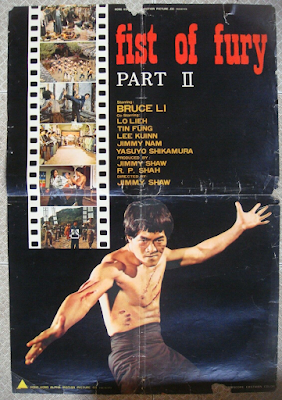
Fist of Fury, Part II (1977)

Fist of Fury, Part II (1977)
aka Chinese Connection 2; Fist of Fury 2
Chinese Title: 精武門續集
Translation: Ching Woo School the Sequel


Starring: Bruce Li (Ho Chung-Tao), Tien Feng, Lo Lieh, Chan Wai-Lau, James Nam, Jimmy Lung, Sit Hon, Lee Kwan
Director: Jimmy Shaw, Lee Tso-Nam
Action Director: Tommy Lee


Fist of Fury 2, another attempt to make a sequel to the Bruce Lee hit, makes for a fascinating example of divergent evolution next to the early Jackie Chan effort. Both films seek to tell the story of the Ching Wu School following the death of Chen Zhen, albeit from the points of view of different characters. In this case, we see what happens to the school’s teacher, played once again by Tien Feng, in the aftermath of the massacres of both the Japanese and Ching Wu schools that marked the last act of Fist of Fury. Interestingly enough, if not for a key moment in the film’s opening scene, this film could actually pass for a prequel to New Fist of Fury as well as a sequel to The Chinese Connection.

We open with the funeral procession of Chen Zhen, performed by the remaining students from the school. As the pallbearers are burying the casket, Ma Li’er (not played by Nora Miao, but by some actress whose face is obscured by the traditional Chinese funeral garb) throws her onto the coffin and commits suicide. This troubles an already-shaken Teacher (a returning Tien Feng), who soon finds himself turning to alcohol to deal with his problems, which are only just beginning.

Shortly after the funeral, some Japanese martial artists led by another interpreter, Mr. Wong (Chan Wai-Lau, filling in for Wei Ping-Ao), enter the Ching Wu school. They announce that their leader, Mr. Miyamoto (Lo Lieh, who had played the lead Japanese baddie in The Chinese Boxer), has acquired the school and now requires the students to vacate the premises. The students don’t take that very well and try to fight back, only to get whooped by the superior Japanese fighters. The Chinese students flee and try to hide out at the other local schools, but are hunted down by the Japanese and subsequently tortured.

A few months later, one of the remaining Ching Wu students sneaks by the grave of Chen Zhen, which has been cordoned off by the Japanese. He finds a stranger who claims to be Chen Zhen’s brother, Chen Shan (Bruce Li, aka Ho Chung Tao). The student warns Chen Shan to beat it, but too late, some Japanese karate fighters show up. Rather than leave, Chen Shan wipes the floor with the lot and forces them to pay respect to his dead brother. Mr. Miyamoto is really going to love that, isn’t he?

Miyamoto starts pressuring the local police inspector to arrest Chen Shan, although the inspector sympathizes with Chen enough to let him off the hook. The Japanese school reacts by using violence to coerce the other schools into turning Chen Shan in, which quickly puts the schools at odds with what little remains of Ching Wu, now that the Teacher is a useless drunk. Of course, it will only take but a few patriotic speeches to get the schools on Chen’s side, guaranteeing Miyamoto’s ire. Miyamoto declares the extermination of all schools in Shanghai, which his men handily carry out, even though two of the masters survive and go into hiding.

Obviously, the masters won’t be able to hide for very long, leaving it up to Chen to protect them. Moreover, the inspector can only stick up for Chen for so long until he puts him and his men in jeopardy. So Chen will eventually have to go on the offensive if he wants to save the kung fu students of Shanghai and his own tail.

Despite being a reworking of the film it’s supposed to be a sequel for, Fist of Fury 2 succeeds partially on the strength of its action and its rather bleak storyline. Like New Fist of Fury, the filmmakers try to continue the story of the Ching Wu school in a logical (well, at least according to the logic of kung fu movies) way, but here the villains are far more cruel and dastardly then Chen Sing and his daughter were in the other movie. The entire first act is devoted solely to showing people suffer—heck, Bruce Li doesn’t even show up until almost the 30-minute mark. Even after Chen Shan quickly establishes his fighting credentials, a lot of people are going to be unfairly walloped and snuffed before the curtain falls. That said, the major failing of the script is that the plot goes in circles for most of the second and third acts, following a pattern in which Chen Shan beats up some Japanese, the Japanese rough up some others trying find out where he is, Chen Shan argues with other Chinese about the validity of his actions, the Japanese rough up more people, Chen Shan comes to the rescue, rinse and repeat.

The movie also benefits from Tommy Lee’s action direction, which is a lot better than what we got in too many other Bruce Li films. Tommy Lee had offered his talents to the groundbreaking hit The Secret Rivals the year before and was already on his way to becoming one of Taiwan’s most talented fight choreographers of that era. He wisely avoids trying to fit Bruce Li completely into the Bruce Lee mold, giving him a similar, but distinctive style instead. Li (or Ho Chung Tao, if you will) kicks a lot better here than he has done in other films and his handwork is sufficiently complex to set itself apart from Bruce’s simpler punches. The main flaw to the action is that the group melees tends to be repetitive and uninteresting whenever Ho Chung Tao isn’t dishing out the hurt.

The storyline isn’t exactly original, and the movie loses a few points for its treatment of the Ma Li’er character. Watching her mature in New Fist of Fury was a refreshing piece of character development, so her suicide in this film’s first reel feels almost sexist and backward in comparison. Interestingly enough, after the funeral sequence, there are no women in the movie whatsoever (save a few extras, probably). Compare that with the Jackie Chan film, which had two strong female characters on both sides.

Criticisms aside, this is rightly considered to be one of the better Bruce Li vehicles out there. Interestingly enough, Li spent a good portion of his career as not only a Bruce Lee imitator, but on making movies that involved the Little Dragon himself somehow. Bruce Lee: A Dragon Story; Young Bruce Lee and Bruce Lee, the Man, the Myth were pseudo-biographical films about Bruce Lee. Bruce Lee’s Deadly Kung Fu tells a fictional account of how jeet kune do was founded, even though Li didn’t technically play Lee in the film. Exit the Tiger, Enter the Dragon; New Game of Death; and Bruce Lee, We Miss You were set in alternate universes following Bruce Lee’s death. Dynamo is essentially a Brucesploitation film about a man who becomes a Brucesploitation actor, if you can wrap your head around that.

Moreso than Bruce Le and Dragon Lee, Bruce Li’s films were, for better or worse, intimately related to the great star himself. Both men had similar martial arts training, especially in the wing chun style (I’m going to guess that Ho Chung Tao also trained a bit in tae kwon do). I suppose then that it’s only fitting that Bruce Li/Ho Chung Tao be cast in a sequel to Bruce Lee’s most revered film. And it should be fitting that it beats out all of the other attempts to make a sequel to Fist of Fury, including Donnie Yen’s recent Legend of the Fist: Return of Chen Zhen.

Friday, March 18, 2022

Story of the Dragon (1976)

Story of the Dragon (1976)
aka: Bruce Lee’s Secret; Bruce Lee’s Deadly Kung Fu; A Dragon Story; Bruce Lee’s Jeet Kune Do
Chinese Title: 詠春截拳
Translation: Wing Chun Jeet Kune (“Intercepting Fist”)


Starring: Ho Tsung-Tao, Carter Huang Chia-Ta, Hwang Jang-Lee, Dan Schwarz, Roy Horan, Chin Chi-Min, Wu Yen, Lin Hsiao-Hu, Lin Chong, Su Hsiang, Wei Ping-Ao, Chang Kuei, Tsang Ming-Cheong
Director: Chan Wa, William Cheung Kei
Action Director: Huang Fei-Long


1976 was an important year for Brucesploitation. First of all, Burmese actor Huang Kin-Lung found his calling as Bruce Le, which would define the vast bulk of his movies up through the end of the 1980s. It also saw the start of the acting career of Korean actor Chang Yi-Tao, who would work on a handful of Brucesploitation films under the moniker Bruce Lai. Above all, it was when James Ho Tsung-Tao, best known as Bruce Li, was at the top of his output and success. For starters, his movie Exit the Dragon, Enter the Tiger was an international hit. Moreover, he made no fewer than four unofficial biopics about the life of Bruce Lee, including Young Bruce Lee and Bruce Lee – The Man, the Myth.

Story of the Dragon is fascinating in that it is obviously based on Bruce Lee, even if the dubbing suggests that it’s really about some guy named Bob[1]. The movie is an amalgamation of events from Lee’s life from 1959 to 1967: Lee did indeed live in California’s Bay Area—more specifically, Oakland in 1964—but his initial job as a waiter was from five years earlier 1959 when he arrived in Seattle from Hong Kong. The last act of the movie focuses on the creation of jeet kune do, but that wouldn’t happen until 1967 when he was living in Southern California.

The movie opens with Bob Lee working as a waiter at a Chinese restaurant run by Ruby Chow (Wu Yen, who played a brothel madam in Green Dragon Inn; The Incredible Kung Fu Mission; and The Great Chinese Boxer—the same personage was played by Flower Drum Song’s Nancy Kwan in Dragon, the Bruce Lee Story). Bob and his friend, played by Chang Kuei, get fired after Bob fights with a couple of aggressive customers, including Robert Kerver (of Snuff Bottle Connection). The two try to find work elsewhere, but Robert and his band show up at every interview to make sure they don’t get the job.

Bob and his friend eventually find work at the docks, working for a wealthy Chinese businessman (Su Hsiang, who played director Lo Wei in He’s a Legend; He’s a Hero). Coincidentally, the dock is ground zero for a territory war between the Chinese laborers and the local karate school (!), including the aforementioned Robert Kerver and friends. Bob eventually proves his mettle by beating the crap out of the karate fighters during one of their brawls. The laborers are so impressed by Lee’s skill that they encourage him to open a school. Bob does just that, and even invites non-Chinese people to study Jun Fan Wing Chun (as he calls it), too.

This angers his boss’s nephew—I’ll point out here that the subplot of Bob working at the docks is largely forgotten at this point—played by cult favorite Carter Wong (Hap Ki Do and Fatal Flying Guillotines). He’s against white people and black people learning Chinese martial arts, so he challenges Bob to a duel. He loses, but agrees to become an assistant instructor of sorts at the new school. Bob also continues to unload truckloads of whoop-ass on the thugs whenever they show their faces, which is surprisingly often. Finally, their boss, Mr. Grace (Dan Schwarz of Fists of Bruce Lee and Tower of Death) and his Yes-Man (Wei Ping-Ao, playing the same role he did in Fist of Fury and Way of the Dragon), decide to hire a top Chinese fighter to deal with Bob: Jin Yong-Ji (played by Legendary Superkicker Hwang Jang Lee). Jin defeats Bob in their initial scuffle, causing Bob to determine that traditional wing chun isn’t enough: he’ll need a new style…a style that isn’t a style…perhaps one that he could refer to as jeet kune do.

Fudging historical details is nothing new to biographical movies, nor is it unheard of to compact several years worth of events into a smaller timeframe to maintain a sense of pacing and build-up to the proceedings. Story of the Dragon does just that, and compounds that by completely ignoring the character of Linda Lee, whom Lee would’ve already been married to (or at least engaged to) by 1964. That might have had a little bit to do with the fact that some Chinese people never accepted that the greatest martial arts star of all time was married to a gwailo girl.

And while it’s common for a character in a biopic to be a composite of several real-life personages, Story of the Dragon goes in the opposite direction by splitting the personage Wong Jack-Man into two characters. Wong Jack-Man was an expert at the arts of hsing-I and Northern Shaolin kung fu, who was called in by the local Chinese teachers to fight Bruce Lee when the latter refused to stop teaching kung fu to non-Chinese people. Accounts of the fight vary depending on who you’re talking to, but it’s generally accepted that this bout was a huge influence on Lee’s decision to develop jeet kune do. In this film, it’s Carter Wong’s charater who disagrees with Lee’s teaching kung fu to anyone, regardless of race. On the same token, it’s Hwang Jang Lee’s character who ultimately pushes Lee to develop his new style.

On the subject of fights and duels, the action here is helmed by Huang Fei-Lung, a Taiwanese choreographer who had almost two dozen credits to his name throughout the seventies. He worked with a lot of the well-known actors of the day, usually on their middle-of-the-road films. His collaborations include Jimmy Wang Yu (in Wang Yu, King of Boxers); Roc Tien Peng (The Champion of the Boxers); Dorian Tan Tao-Liang (Shaolin Deadly Kicks); Carter Wong (The 18 Bronzemen); and Don Wong Tao (Eunuch of the Western Palace). For the most part, Huang’s work could be characterized as being “solid” and “competent,” although for this film, Huang reaches the heights of “quite good.”

The action mainly consists of Ho Tsung-Tao beating up endless Caucasian karate thugs with his wing chun[2] skills. Only in the last fights does Ho really get into the whole Bruce imitation thing, complete with shuffling feet, nose rubbing, and loud caterwalling. This is one of Ho’s better fight movies, certainly surpassing his earlier work in New Game of Death and Bruce Lee: A Dragon Story. As wing chun was one of Ho’s main styles, he’s certainly at home with the choreography and acquits himself well to everything Huang Fei-Lung has him perform. Bruce Li can’t help but look goofy when he unleashes the Brucesploitation skills at the end, but the truth is, Bruce Lee’s onscreen style does sound silly when you think about it. The real Bruce simply overcame it by his charisma, physical prowess, and channel of pure emotion into his moves. As a good a fighter as Ho Tsung-Tao is, he lacks that same natural charisma and emotion and thus can’t sell the totality of his impression.

Matching Ho Tsung-Tao in the fighting department is Carter Wong, who gets three four fight scenes over the course of the film, including one against Legendary Super Kicker Hwang Jang Lee. Despite being a champion kickboxer, Wong spent the latter half of the 1970s using hung gar in his movies, which he does here. But playing a traditionalist master here, using a classical Southern style makes sense. Surpassing both actors is Hwang Jang Lee, who shows up in a goofy wig, biker gloves and a cape…a cape!!! Hwang had just achieved stardom that same year after playing the villain Silver Fox in Secret Rivals, and further cemented his status as one of the great movie villains here. He kicks like a mad man, although Huang Fei-Lung didn’t see the full potential in his bootwork, or didn’t want him to completely show up the star. As a result, some of Hwang’s most famous aerial kicks aren’t on display here.

A lot of fans point this out as being one of the better Brucesploitation films, but simultaneously one of the most hysterical. A lot of that has to do with the dubbing, although even then you can tell that the surplus of maniacal laughter and scoffing from the (mostly) Caucasian villains showed up in the original Chinese version. And speaking of Caucasians, the white people the filmmakers found for this are some of the ugliest people on record—I understand that most of them were hired on account of the filmmakers picking up everybody they could find, but man! And what’s the deal with the goofy perm wigs the characters wear? Was that long 70s hair not enough for the director? I’m pretty sure the real Ruby Chow would have had an aneurism had she saw herself portrayed as a portly woman who’d allow anybody and everybody to mistreat her employees in the name of “not causing any trouble.” Oh, and watching Wei Ping-Ao get his ass handed to him by an eight-year-old girl? Comedy gold!

Oh, and one more thing: if this is set in 1964, two years before Bruce Lee played Kato on “The Green Hornet”,  how does Bob Lee have a Bruce Lee poster on his wall?


[1] - The Hong Kong Database states that Bruce Li is, in fact, playing Bruce Lee. We also note that at there’s one scene in the dubbed version in which a character flat-out calls him “Bruce.”

[2] - Speaking of Wing Chun, there’s a brief Ip Man cameo in which Lee’s now-legendary teacher is played by Lo Man-Kam, Ip’s real-life nephew.

Ming Patriots (1976)

Ming Patriots (1976)
aka: Revenge of the Patriots
Chinese Title: 中原鏢局
Translation: Central Plains Escort


Starring: Jimmy Ho Chung-Tao (Bruce Li), Chia Ling (Judy Lee), Chang Yi, Carter Wong, Michael Chan Wai-Man, Cheung Kam, Lung Fong, Gam Tiu, Joh Yim-Yung
Director: Ulysses Au
Action Directors: Lau Kar-Leung, Lau Kar-Wing

Following the passing of Lau Kar-Leung, I've decided to do a two-part review session, tackling two of his most obscure 70s films, a pair of mercenary jobs he did in Taiwan between '76 and '77. To be honest, he worked on at least three independent films as action director during that period, but one of them is so famous today that there's nothing new I could possibly add to the dozens of reviews floating around on the internet. That film, my friends, is none other than Master of the Flying Guillotine. But since that film gets enough attention as it is, I thought I'd look into two movies he did with prolific kung fu director Ulysses Au.

Ming Patriots is a fairly standard entry in the Ming Patriot (natch) vs. Manchu dogs sub-genre, which had already gotten overstuffed with entries by 1976, despite having really taken off only two years earlier. The movie opens with the Qing Prince (Chang Yi of The Victim) ordering his men to seal off the city so that his forces can capture the last living Ming Princess (Cheung Kam, an adorable actress who showed up in The Snake Woman's Marriage), her father's will, and the crown jewels. The princess is in the custody of her teacher, Wu (Ma Chi), and a loyal general (Big Trouble in Little China's Carter Wong). The three try to escape via disguising themselves as peasants, but the Princess doesn't disguise herself thoroughly enough and the whole ruse is ruined. Cue a big kung fu fight. Exit the General.

Enter Ti Lung (the name of the character, not the actor, who'll be played by Jimmy Ho Chung-Tao, better known by B-movie fans as Bruce Li), a retired escort. Wu and the Princess show up at his house and ask him to accompany them to the west. He's initially reluctant, but decides to go when he remembers that Wu and his late father were close friends. Ti Lung and his partner (Lung Fong of The Rebellious Reign) escort the two, but are quickly cornered by the Qing soldiers. A fight breaks out (of course) and our heroes escape.

Ti Lung figures that the Qing forces are too much for just two men to handle and he's right; Partner Boy is sort of a martial pushover and Ti Lung is bereft of the mad fighting skills that come with being played by a Bruce Lee imitator. Ti decides to to enlist the help of his sister (Judy Lee, one of the original kung fu divas), who's working at a cook at an inn. Unfortunately, the inn is being run by an old romantic and professional rival of Ti Lung's (Michael Chan Wai-Man, a real-life Triad who used to smoke weed with Bruce Lee back in the day). Rival Dude initially thinks that Ti Lung is there to hit on his wife, but quickly figures out that he's carrying some especially valuable cargo. His wife (Joh Yim-Yung, who showed up in films like The Beggar and the Pretty Prostitute) despite having loved Ti Lung at some point, likes the idea of getting rich quick and has no moral objections to joining forces with the Qing in exchange for the jewels. Cue fight scene at the inn. Exit Teacher Wu, who gets beaten to death during the scuffle.

Since both the will and the jewels are of the utmost of value to our heroes, they decide that they need to protect them somehow. In a scene that would make Ruggero Deodato proud, the heroes buy a pig, kill it, gut it (onscreen), and stuff it with the jewels. They then float it downstream and resolve to pick it up at another point along the way. When the bad guys, including Rival and his wife, capture our heroes, the latter simply tell them that they're waiting for their contact, a fellow named Porky. My sides hurt. Anyways, there are several more fights, a few more deaths, and a final showdown between the good guys and the Prince, who's so powerful that four people need to gang up on him in order to kill him.

I'm going to guess that Lau Kar-Leung was hired to direct the action and not much else. That would technically make him the film's choreographer, as opposed to action director. Choreographers simply arrange the fights. Action directors play a more integral role in deciding what direction the film will go in, working closely with the real director and supplying ideas on how to do certain scenes. None of Lau's ideas and cinematic martial philosophies show up in this movie. There is no deconstruction different kung fu styles or meditations on the strengths and weaknesses of each. There's no illuminating moments in which the actors come to the conclusion that killing isn't the ultimate goal of fighting. There's no character development in the form the characters learning to adapt their fighting styles in order to overcome an external obstacle. It's just people killing the Manchus for 90 minutes.

Of course, there's nothing wrong with that in and of itself. The problem is that there's nothing to show that Lau Kar-Leung really worked on the choreography. While made a year before Lau would settle into his groove of making a genre masterpiece every two movies, he had made Challenge of the Masters and Master of the Flying Guillotine that same year and those had superior fight scenes, even if the former wasn't that great as a whole. The weapons fights are rather standard and the styles on display aren't all that impressive, save some brief hung gar from Carter Wong and Chang Yi's mantis style, which he has done better in other films. Judy Lee looks great, but she was more impressive in films like Iron Swallow and The Crane Fighters. In fact, Judy's energetic fighting and bad-ass persona are what make the movie watchable during most of its running time. Nonetheless, the fighting here is nothing that the likes of Taiwanese regulars like Chan Siu-Pang or Chan Muk-Chuen could pull off.

What's really strange is just how much of a loss Lau Kar-Leung and his brother, Kar-Wing, are at dealing with Ho Chung-Tao/Bruce Li. Jimmy Ho had lots of training in the wing chun style, plus a few others so that he could kick decently. However, the cheap films he showed up in often had subpar fight choreography and failed to show off his skills adequately. You'd think that Lau Kar-Leung, a master of Southern styles, could milk Ho's skills for all they were worth and come out with something impressive. Unfortunately, that's not the case and Ho's fighting is the most bland on display in the film. He uses no definitive styles and doesn't show off any impressive moves. Viewers should check out Dynamo and the kung fu-slasher film The Black Dragon Strikes Again for better showcases from Jimmy Ho.

The only moments of creativity in the action come in the form of a drunken master, two years before Jackie Chan and the Yuens made those characters famous; and the fact that the villain is a snuff addict, which the heroes end up using to their advantage during the final fight. Everything else is pretty paint-by-numbers and when all is said and done, Ming Patriots is one of the least impressive films on Lau Kar-Leung's résumé, especially by the standards of 1976.

Street Fighter (2026)

Street Fighter (2026) Starring : Noah Centineo, Andrew Koji, Callina Liang, David Dastmalchian, Andrew Shulz, Roman Reigns, Cody Rhodes, Cur...