Showing posts with label Jackie Chan. Show all posts

Thursday, February 5, 2026

Stage Door Johnny (1990)

Stage Door Johnny (1990)
Chinese Title: 舞台姊妹
Translation: Stage Sisters


Starring: Kara Hui Ying-Hung, Ann Mui Oi-Fong, Eva Lai Yin-Shan, Ida Chan Yuk-Lin, Pauline Wong Yuk-Wan, Wu Ma, Waise Lee, Lam Ching-Ying, Lau Siu-Ming, Chung Fat, Mars, Ken Lo, Lee Jun-Git
Director: Wu Ma
Action Director: Jackie Chan’s Stuntman Association


Stage Door Johnny is an interesting film from director Wu Ma. Apparently filmed on sets leftover from Mr. Canton and Lady Rose, it is a melodramatic tale of sisterhood among female Peking Opera performers set around the 1920s. It demonstrates a lot of Wu Ma’s strengths as a filmmaker, but it ultimately held back from being “Very Good,” let alone “Great,” by a tad too much melodrama and a needlessly bleak finale.

The movie opens at a train station in China where Peking Opera star Tsui Yen-Hsieh (Kara Hui, of
Burning Ambition and Widow Warriors) is waiting for her lover. Unfortunately, the man is too attached to his rich family to be willing to elope, thus leaving her and their unborn child to their own devices. Watch for a great scene of a depressed Tsui approaching a group of reporters with her head bowed in shame, only to lift it up and reveal a million-dollar smile for the cameras. Great acting from Kara Hui.

Somewhere in Shanghai, there is an all-female Peking Opera company led by Pops (Wu Ma, of
Mr. Canton and Lady Rose and Kung Fu of 8 Drunkards) and Boss Shen (Ann Mui, older sister of Anita, who had a small role in Police Story 2). This troupe is going through hard times, mainly because of a mixture of Shen’s insistence on performing pure dramas (as opposed to stories with martial arts in them) and the general chaste representation of the same—were there China Operas that revealed a bit of skin back in the 1920s?

At this point, Pops is so desperate for money that he’s pawning his own old costumes just to keep the troupe paid. The company has four star players: Shen; Boss Ching (Ida Chan, of
Shaolin and Wu Tang and On the Run), who is resigned to see the company go out of business; Boss Hsiao (Pauline Wong, but not the pretty one from Mr. Vampire, but the evil one from Mr. Vampire Part 3), who is “dating” a mid-level Triad named Pin San (Lee Jun-Git, of A Better Tomorrow II and Police Story 2); and Boss Sai (Eva Lai, who played the evil demon girl in Burning Sensation). There is also the troupe musician, Mr. Liu, played by Lam Ching-Ying (of The Prodigal Son and Eastern Condors).

Boss Sai becomes the object of affection of Pin San’s boss, Chang (Lau Siu-Ming, of
Royal Warriors and A Chinese Ghost Story). Chang really wants to get into her trousers, but before that happens, we have to meet some more characters. While out making purchases one day, Sai witnesses a gunfight between Chang’s gang another a group of gunman led by “benevolent” crime boss Lu (Waise Lee, of Wing Chun and Bullet in the Head). It’s suggested that Lu is one of those good crime bosses who doesn’t have a problem with extortion and prostitution, but drugs are a complete no-no. Lu and Sai sorta become enamored with each other during the fire fight.

While that’s going on, Pops decides to hire Tsui Yen-Hsieh to boost sales and direct the troupe’s repertoire to more action-oriented stories. That creates a lot of tension between the girls, especially when the gamble pays off and Pops pays Tsui a higher share of the profits than the other girls—these scenes definitely feel like the Peking Opera equivalent of the Caitlyn Clark controversy: all-girl’s association is just eking out a living, a new girl shows up and starts filling seats, the other girls feel jealous that their hard work had gone unnoticed until then, the same girls are equally angry that the person who is making them profitable for once is making more money than they are…

So, there is this conflict between the girls, plus each girl has her own issues (eg., Tsui is still pregnant and is considering an abortion; Hsiao is seriously considering marrying the scuzzy Pin San), some moments of unrequited love (like the rickshaw puller Kui, played by Mars, who is secretly in love with Boss Shen), and there’s the external conflict of the bad blood between Chang and Lu coming to a boil within the walls of the opera hall.

Stage Door Johnny
is a very melodramatic film. There are lots of overwrought emotions, especially in the second half as the film reaches its emotional crescendo. It gets so over-the-top near the end that I was wishing it kept the subtlety of that opening scene with Kara Hui. Probably the worst example is the scene where Mars’s rickshaw puller character breaks curfew in order to fetch a doctor for Boss Shen, who has lost her voice for some reason. He basically gets himself shot to death by the police in order get her medical attention, but she refuses to take the medicine. But in the same scene, Tsui is about to take a medicine that would induce abortion. The scene ends with Shen overcoming her severe laryngitis by screaming, “Mommy, don’t do it,” which causes Tsui to reject her medicine. What the heck? It completely invalidates Mars’s sacrifice. That said, the film benefits from strong performances around the board.

The Sing Ga Ban—aka Jackie Chan’s Stuntman Association—handled the action, which pops up sporadically throughout the movie. There are three major set pieces and two smaller action scenes. There is a short gunfight early on when Lu’s Men (including Ken Lo) are trying to stop Chang’s men (led by Chung Fat) from smuggling opium. Near the end, there is a fight scene between Ken Lo and Pin San’s men, which has some of his kicking (although it is a bit over-edited). The first big sequence is a fight during a performance at Chang’s house, where Lu’s men team up with the Opera performers to fight Chang’s men when he tries to kidnap Boss Sai. Later on, some rude men at a restaurant (including former Jet Li doubles Xiong Xin-Xin and Mak Wai-Cheung) start picking on Pops until the five leading ladies step up and beat the hell out of them. Then you get the big finale, in which five women in full Peking Opera regalia take on an entire Triad—spears and pole-arms versus choppers and hatchets. It’s a really well-staged fight sequence and should satisfy most fans of the genre.

I would recommend that most Hong Kong cinephiles and fight fans at least check out
Stage Door Johnny. There is a nice pristine copy of the film uploaded to YouTube via the Cinema No.8 - HK Movie channel. It’s one of Wu Ma’s better movies, all things considered.


Sunday, April 7, 2024

Drunken Master II (1994)

Drunken Master II (1994)
Aka: Legend of the Drunken Master
Chinese Title: 醉拳II
Translation: Drunken Fist II


Starring: Jackie Chan, Anita Mui Yim-Fong, Ti Lung, Felix Wong Yat-Wah, Lau Kar-Leung, Hoh Wing-Fong, Cheung Chi-Kwong, Andy Lau Tak-Wah, Hon Yee-Sang, Ho-Sung Park, Chin Ka-Lok, Bill Tung Biu
Director: Lau Kar-Leung
Action Director: Lau Kar-Leung, Jackie Chan’s Stuntman Association


I first learned of Drunken Master II back in 1995 when I picked up a special summer issue of “Inside Martial Arts” (not to be confused with “Inside Karate,” “Inside Kung Fu,” and “Black Belt”). There was an article in it about the Top Modern Martial Arts Movies, or in other words, the best martial arts films made from 1990 on. Four of the picks were Jackie Chan movies: Police Story 3: Supercop; Operation Condor; City Hunter; and Drunken Master 2[1]. Interestingly enough, this sounded like the least interesting of the bunch.

When I started collecting Jackie Chan films in earnest in the summer of 1997, I scooped up almost everything that was available (save the obvious Jackiesploitation VHS tapes). It was in the book Jackie Chan: Inside the Dragon by Clyde Gentry III that I learned that Drunken Master II not only featured one of his best fights, but was one of his best movies, period. It wasn’t until winter of 1998 that I found this movie at a Suncoast at the old K-Street Mall in Downtown Sacramento. It was right after Christmas, but my wonderful mom was still willing to fork over 20 dollars to pick up the Tai Seng VHS of Drunken Master II, in widescreen with burned-on subs. I watched it that night and was amazed. Some of the best martial arts fighting I had ever seen up to that point was on that tape.

When the film came out in 2000 as Legend of the Drunken Master, I had my dad take me to see it—he wasn’t the type that would brave normal subtitles, let alone burned-on ones. We watched it and he enjoyed it—he got a kick out of Anita Mui’s character. I also showed this to my friends and it entered the realm of the Classics. I actually lent to several friends from both groups, all of whom really enjoyed it. For the past thirty years, Drunken Master 2 has enjoyed a strong reputation among martial arts fans—casual and hardcore—and currently enjoys a 7.5 rating on the IMDB.

The film opens somewhere in Northern China, with healer Wong Kei-Ying (Ti Lung, of Opium and the Kung Fu Master and The Savage 5) and his son, Fei-Hung (Jackie Chan), and servant Tso (Cheung Chi-Kwong, of Midnight Caller and Model from Hell), on their way back to Foshan after a trip procuring medical supplies. While waiting to board the train, one of the soldiers declares that everybody has to pay taxes on their purchases. When Fei-Hung learns that the foreigners are exempt from taxation, he hatches a plan to hide a box of ginseng in a foreigner’s suitcase.

Sometime later, the train stops at a small town where the locals can hawk food to the passengers. Wong Fei-Hung sneaks into the foreigner’s baggage car via a clever gag involving geese and ducks and tries to get his box of ginseng. The thing is, there’s another man, Fu Man-Chi (Lau Kar-Leung, of My Young Auntie and Seven Swords), in the car who’s stealing a box with an identical cloth cover. The two get into a fight, with Fu muttering something about Wong Fei-Hung being a “traitor” (or “lackey”). They fight to a standstill, with Fei-Hung having to run back to the train before it leaves. This is where it gets interesting. The foreigners—mainly British, with a few Chinese employees—report something missing from their baggage and the head security officer orders his men to search all the passengers. When they reach the Wongs’ seats, Fei-Hung discovers that the box of ginseng actually contains an Imperial Seal. Before he (and his father) get into real trouble, a young Intelligence Officer (Andy Lau, of Drunken Master III and House of Flying Daggers) vouches for them.

Once back in Foshan, Wong Fei-Hung tells his stepmother, Ling (Anita Mui, of Miracles and The Heroic Trio), what had transpired on the train. This leads to an extended comic scene involving an oversized carrot (or radish) and tree roots passing as fake ginseng. Anyway, while Fei-Hung is mixed up in the search for a ginseng substitute, we learn that the British consulate also owns the local foundry. They want the Chinese workers to increase their hours without due compensation, and send the new foreman, Henry (Ho-Sung Park, who played Liu Kang in the Mortal Kombat video game), to beat them into compliance. Well, it works. We also learn that the British consul (Louis Roth, of Shanghai Shanghai and Ninja Commandments) covets the land that Po Chi Lam, Wong Kei-Ying’s clinic, sits on because it doubles as a kung fu school during the evening and interrupts the consul’s sleep. Uh, okay. Jerk.

Things start to get sticky because the Consul’s men, led by John (Ken Low, of Holy Virgin vs. the Evil Dead and Crystal Hunt), still suspect that the missing Jade Seal is still in Fei-Hung’s possession. One day, Ling is out with her mahjong friends pawning off her prized necklace in order to buy some new ginseng. One of John’s men steals the necklace, most likely to trade back for the seal. This leads to a huge fight between Wong Fei-Hung and the consul’s thugs, including Henry. Fei-Hung gets incredibly drunk thanks to his stepmother’s intervention and beats the hell out of everybody, but attacks his dad when the latter shows up to break up the fight. The results in a huge fight between him and his dad, ending with the latter disowning his son…again (you’ll understand if you’ve seen the first Drunken Master). That evening, John and his men find Wong Fei-Hung in a drunken bout of self-pity, which leaves him vulnerable to John’s kung fu, which is better than Henry’s. They beat him, strip him, and leave hanging from an arch as a message…

Despite the title and Jackie Chan reprising his role as Chinese folk hero Wong Fei-Hung, there isn’t any continuity between this film and the original Drunken Master that shot him to stardom. Historically, the film doesn’t make sense as it’s ostensibly set in the Republic Era, probably between 1912 and 1914. The real Wong Fei-Hung lived from 1847 to 1925, so he would’ve been in his mid-60s when this film is set. Instead, Jackie Chan, who was 39 at the time of filming, plays the character in his early 20s. So, Drunken Master II doesn’t present anything solid from a historical of film continuity perspective.

The film is famous for the falling out that Jackie Chan and director Lau Kar-Leung had during filming. A lot of their disagreements stemmed from how to approach the action. There were disagreements between Jackie and Lau Kar-Leung in just how much wire-fu should be included, in addition to things like camera angles and fight editing. Lau Kar-Leung has generally been a stickler for authenticity in technique over the aesthetic flourishes that his peers are known for. He himself played a drunken master in a cameo appearance in Heroes of the East (1978). It is quite probable that had he remained on board for the entire project, the fights might have been closer in spirit to Gordon Liu’s drunken duel with the Japanese karate master from that movie: true to the drunken forms of Hung Gar (and Lau Gar), but not necessarily something 90s audiences were looking for.

What I don’t know is how much their arguments over the action choreography impacted the final script. I say that because it’s clear that this movie has some notable story issues.  This is most notable in the disappearance of Andy Lau’s character from the film following the train sequence. I don’t know if his character was supposed to be a secret villain or an actual ally, and we may never know. I also think that some of the supporting good guys, like the ones played by Chin Kar-Lok (who has doubled for Jackie on a number of occasions) and Lau Kar-Yung, could have been better explained. In the final product, it’s like “Who’s that short guy with the chin-length hair fighting with the good guys?”

The external conflict is reminiscent of the plot of Dragon Lord (1982), Jackie’s last traditional kung fu movie—if you don’t count The Fearless Hyena 2. Something about the British smuggling rare treasures and antiques out of China to put on display at the notorious British Museum, which is involved in controversies over its artifacts to this very day. The internal conflict has more to do with his troubled relationship with his older, wiser, and more traditional father, Wong Kei-Ying. Interestingly enough, Ti Lung is only seven years older than Jackie. The two fight extensively over Fei-Hung’s use of both the drunken style and drinking in order to perform it. Anita Mui steals the show as Ling, Fei-Hung’s fast-talking stepmother, who is always trying to mediate things between the two conflicting generations of Wongs. She adds just the right amount of overacting to her role, whether she’s picking fights with John’s goons in public or trying to weasel her away out of culture-sanctioned spousal abuse with her husband. I think few people will watch this and come away not loving that woman. God give rest to her soul, that Anita Mui. I think the rapport between these three actors—Jackie Chan, Ti Lung, and Anita Mui—is enough to make up for the storytelling deficiencies.

Plus, you know, the action.

There are four major set pieces and a few smaller ones. The first big fight practically starts off the film and is a traditional kung fu fight between Wong Fei-Hung and Fu Man-Chi, i.e. the director himself. It is a meeting of supreme martial arts talent, not unlike Sammo fighting Lau Kar-Leung in The Pedicab Driver five years prior. The two duke it out with a spear and saber beneath a train, which is where the choreography shines. Shooting fights is cramped spaces is always a dicey approach, but these two treat it as if it were child’s play. They then go at it hand-to-hand in a barn (of sorts) and Chan uses his drunken boxing style, albeit while sober, performing moves like “Drunken Man Lying on the Battlefield.”

The next big fight is Jackie Chan versus Henry and the thugs in the public square. This is where he really busts out the drunken boxing, and is full of great moves and neat combinations. Fans of the first film will be happy to see him unleash all of the Eight Drunk Gods. Our favorite is Jun Holding the Pot (or Lan’s Waist Attack), where he spins his opponent’s head between his arms like a hula hoop. There’s also a nice seven-hit combo in perfect traditional form that Chan performs on a stuntman before he gets drunk. My friends and I always got a good laugh out of that one.

The third fight is the infamous Axe Gang fight, where Jackie Chan and Lau Kar-Leung team up to fight an entire army of Axe Gang members (led by Hsu Hsia, who played The King of Sticks in the first film) at a tea house. This fight feels like your typical 1980s Jackie Chan melee, complete with dozens (and I mean dozens) of stuntmen falling off railings, out of windows, off of roofs, and onto tables and other breakable furniture. At one point, Jackie Chan picks up a bamboo pole and starts fending off the nonstop onslaught of attackers. But he really gets the advantage when the hatchets break up the pole: broken bamboo is notoriously sharp, ya’ know.

The foundry finale has often been cited as one of the greatest fight sequences of all time. It’s broken up in three sections. In the first, Jackie Chan squares off with a muscular European man, played by Vincent Di Tuataane. Di Tuataane originally was a bodyguard for French officials, so I think that says enough about his martial arts capabilities. He fights with a chain, that he either swings or wraps around his arm to enhance his punches. Chan bests him with (sober) drunken boxing. The second part is more vintage Chan, where he faces off with a handful of low-level stooges armed with metal poles and hooks, while John and Henry throw obstacles at him. It is very much a video game-esque fight, but the choreography is phenomenal, especially as Chan has to fend off multiple armed attackers while simultaneously avoiding falling objects.

Finally, he throws down with John, played by his then-bodyguard, Ken Low. Ken Low was a Muay Thai champion in SE Asia before moving to Hong Kong and the man can kick like nobody’s business. My friends and I called them “Machine Gun Kicks,” because he of how many he could fire off in rapid succession without lowering his leg. At one point, Jackie is kicked onto a bed of hot coals, a stunt they had to do twice because he didn’t like the way he fell the first time. Famously, Chan can only get the upper hand after drinking methanol, or wood alcohol. The last part is reminiscent of the finale of The Young Master (1980), where Chan goes into complete rage mode, unleashing all the Drunk Gods in rapid succession, similar to the earlier fight in the town square.

It should be noted that Henry, played by Korean Taekwondo stylist Ho-sung Park, was supposed to be Chan’s final opponent. However, according to the IMDB, he sprained his angle and had his part in the finale reduced. Chan has said that Park couldn’t keep up with the Hong Kong style of fight choreography, especially when they were often hitting each other for real.

Some time ago, I did a poll at the Kung Fu Fandom forum about the members’ favorite fights from movies that multiple classic duels and melees. When I did Drunken Master 2, the fight between him and Lau Kar-Leung got 9.09% of the votes, the Axe Gang fight got 9.09% of the votes, and the finale got 81.82% of the votes for an easy win. And speaking of winning, Jackie Chan’s Stuntman Association and Lau Kar-Leung won two awards for Best Action Choreography: one at the Hong Kong Film Awards and another at Taiwan’s Golden Horse Awards. The entire movie is Jackie Chan fighting at his absolute best. He may have films with better plots. He may have films with better stuntwork. He may have films with better acting, although he does great here. But the fighting is second to…well, few, if any.


[1] - The Other films on the list were Double Impact; Lionheart; Yes, Madam! (yes, they got the year wrong); Once Upon a Time in China; Rapid Fire; Iron & Silk; Showdown in Little Tokyo; The Perfect Weapon; and Marked for Death.

Wednesday, November 15, 2023

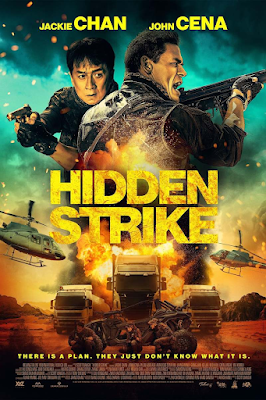
Hidden Strike (2018/2023)

Hidden Strike (2018/2023)
Aka: SNAFU; Project X-traction; Ex-Baghdad


Starring: Jackie Chan, John Cena, Ma Chunrui, Jiang Wenli, Xu Jia, Gong Jun, Rima Zeidan, Hou Minghao, Pilou Asbæk, Amadeus Serafini, Tim Man
Director: Scott Waugh
Action Director: Jackie Chan’s Stuntman Association, Bruce Law


This movie will be an interesting footnote in Jackie Chan’s career as the movie that took five years to see release, yet cost a hefty (by Chinese standards) 80 million dollars to produce. It was announced in mid-2017 as a collaboration between Jackie Chan and long-time friend Sylvester Stallone under the title Ex-Baghdad. The plot synopsis, which is essentially what we got in the end, was:


"When a China-run oil refinery is attacked in Mosul, Iraq, a Chinese private security contractor (Chan) is called in to extract the oil workers. He learns, however, that the attackers’ real plan is to steal a fortune in oil, and teams up with an American former Marine (Stallone) to stop them."


The director was announced to be Scott Waugh, who had previously directed Act of Valor and Need for Speed. He went on to direct Expend4bles, which also came out this year. Within a few months, it was announced that Stallone was no longer going to be in the film, him citing schedule conflicts with Creed 2. Nonetheless, the film was said to still be “in development.”

It took a year, but news finally broke in June 2018 that the movie was going to start production. Stallone would be replaced with actor-wrestler John Cena (The Marine and 12 Rounds). The title of the film changed to Project X, which I was skeptical about, considering that we already had three movies with that title, including a then-recent comedy about the house party to end all house parties. Filming had begun in August, with Inner Mongolia doubling for the Middle East. The official title was now Project X-traction (a slight improvement, and the title that Brazil maintained until today).

We may assume that by 2019, the film had finished production. Strangely enough, however, news of the production (and its release) went dead around May of that year. It wasn’t until 2021 that official images of the film were released. By that time, John Cena was showing up in the Fast/Furious franchise and pissing off China for referring to Taiwan as a country, while the ever-productive Chan had released no fewer than eight movies in that interval. Moreover, the English title of the film was changed to SNAFU, military jargon means “Situation Normal All F*cked Up.”

So what held the movie up? Well, initially, part of the reason can be traced back to COVID-19, which took the world by storm in 2020. By the time that quarantines and lockdowns were starting to be lifted, Chinese audience tastes were shifting in favor of local blockbusters, thus years of trying to pander to Chinese censors and audiences were swiftly going down the drain. So, nobody knew how an American-Chinese co-production would fare in this environment. This was compounded by the backlash about Cena and Taiwan, which caused further worry about how to market the film in China. It took another two years for the film to finally see release, where it went straight to Netflix in most Western countries under the new (and generic) title Hidden Strike.

The film is set in generic Middle-Eastern-stan, where a Chinese company runs a huge oil extraction and refinery outfit. We learn via the Plot Point Specific Radio Bulletin that different factions in said country have been fighting each other over oil rights, with the Chinese company getting caught in the middle. The fighting has gotten so bad that the Chinese government has sent a crack team of operatives, led by Dragon Luo (Jackie Chan), to extract all the Chinese nationals and whisk them away to safety.

Meanwhile, a former Marine-turned-mercenary, Chris (John Cena), is hanging out in some village, playing with the kids and befriending the locals. His brother, Henry (Amadeus Serafini), asks him to participate in a raid on the Chinese convoy in order to capture a wanted criminal among the fleeing nationals. Chris initially turns down the offer, but relents when he discovers that the village he lives in is not only out of water, but it will cost a cool hundred grand to get the equipment necessary to pump out water from deeper in the ground.

Chris, Henry, and the latter’s team use a special jet engine (?) to engineer a manmade sandstorm (??), during which they launch their raid on the convoy. Only two buses are hit, one that will serve as a decoy and another one housing a certain Dr. Cheng (Jiang Wenli, of Farewell, My Concubine and The Master ’15) and her entourage. They are kidnapped and taken to a “graveyard” of giant satellite dishes, where Chris learns the identity of his employer: Owen (Danish actor Pilou Asbæk). Owen is an employee of Unicorp, another company that has been extracting petroleum in the region. He has kidnapped Dr. Cheng in order to get the information from her in order to get the Chinese refinery back online, so he can steal the oil and make a fortune for himself.

Chris didn’t sign up for a kidnapping, however, so he’s out. But once he discovers that Owen has murdered Henry behind his back, he wants revenge. Meanwhile, Dragon Luo had been trying to find the attackers after leaving the sandstorm, even going so far as to trade firepower with them. The resulting firefight resulted in the death of some of his men, so he wants to find out who’s responsible. This leads him to Chris, which will ultimately result in an uneasy team-up with the men. Also, tagging along for the ride is the oil refinery’s head geologist, Mei (Ma Chunrui, of Fate of Swordsman), who happens to be Dragon Luo’s estranged daughter.

It's pretty straight-forward stuff, with the main plot hole being that there’s a traitor among the Chinese oil refinery employees who rats out on which bus Dr. Cheng is riding, but then is more or less ignored for the rest of the movie. I was curious to find out how that would solve itself, but in the end, it goes completely unaddressed. Bad writing there, folks. Everything else checks out, I guess. There isn’t a lot of background on Unicorp, the company the villain is said to work for. I think it’s a competing petroleum company, or at least a company that supplies oil extraction equipment to the region. All I know is that the villain, Owen, is one of those disgruntled “I do all the work and see none of the profits while the fat cats live in splendor” types.

Jackie Chan is playing Jackie Chan. Serious when he needs to be, but always with his trademark charisma and physical humor, even when he’s not fighting or firing guns. John Cena’s character is the “mercenary with a heart of gold, but with a past.” He stays in the village where he was supposed to carry out a job, which job cost him the life of his dad. He’s a good man who is driven to extremes by a need to help those he cares for, in this case, the inhabitants of the village torn apart by years of conflict. He does start falling for Mei, whom he describes as having a nice booty[1].

That said, the other characters are mainly one-dimensional. Jackie Chan has often tried to play the role of “leader of a competent team of action people” in his later movies, like this, Vanguard and CZ12. I understand that he’s getting old and needs to find someone to fill his shoes. But he never seems to find anyone that is equally charismatic, or a writer who can write these youngsters as such. So, he often shines above them while they fade into the background. Case in point, Dragon Luo’s team more or less disappears from the film following the bus convoy sequence. Once again, there is no “new Jackie Chan” promised in this.

The action, as expected, was staged by Jackie Chan’s Stuntman Association, with Bruce Law on hand to help with the car stunts. The action varies from gunplay to vehicular mayhem to fisticuffs and, of course, lots and lots of explosions. The assault on the bus convoy reminded me of
Mad Max: Fury Road, with mercenaries in dune buggies shooting grappling hooks into buses and whatnot…in the middle of a sandstorm. Talented B-movie fight choreographer Tim Man (Triple Threat; Ninja: Shadow of a Tear) gets to play one of the mercenaries and he gets to spar with Taiwanese actress Rima Zeidan during this set piece. There is lots of Ryuhei Kitamura-esque spinning camerawork during their short scuffle.

The first showstopper is the inevitable fight between Cena and Chan, which has the two throwing down at the satellite base before joining forces. Cena fights mainly by throwing Chan around or throwing oil drums at him, while Chan uses wire-assisted acrobatics against Cena. I’m not one of the people who complain about Chan using more wires as he gets older. I mean, you can only break your bones for our entertainment for so long before you need to rely more on that sort of assistance. Considering that Chan was 64 when production started, that’s fine by me. He can still throw a good kick, tumble and twirl a prop around during a comedic fight, but we can’t reasonably expect even a New Police Story performance out of him now, let alone an old Police Story performance. It is interesting to see Chan using more knife and ground fighting than he used to, especially considering his criticism of MMA during the 2000s.

There are some more martial arts when the two team up to fight some mercenaries raiding the village. There is some physical humor between the two leads involving hand signals, while Cena establishes himself as the strong man who will pull or shove his opponents through walls. Things get a bit more intense at the finale, which has Jackie Chan fighting machete-wielding guys in masks—I assume it’s Chinese stuntmen playing Arab henchmen—while balancing on pipes. The showstopper is the big fight between Chan and Tim Man. This should be a fight for the ages, considering that one was one of the best choreographers and screen fighters of all time while the other fits the bill for the last decade or so. Man does show off some impressive kicks, especially while the two are fighting in the computer room. However, it eventually gets bogged down in a gimmick fight involving bungee cords and a room full of soap suds. It’s still a creative fight, but I think all of us expected more unadulterated fisticuffs from the two. The movie then ends on a series of car chases and vehicular mayhem, not unlike Mr. Nice Guy and The Accidental Spy.

A lot of fans are dismissing this film as crap, and I can understand. It’s watchable and moves at a fast clip. Chan is as likable as he usually is, even if his trademark action style is watered down by wires and his advancing age. I personally still enjoy watching it. I watched this with my father-in-law and he liked a lot, so it does have an audience somewhere. It’s just no Operation Condor.


[1] - The strangest part in the entire film comes during the outtakes, when we get to see Cena’s Chris talking about how he’d like to perform anallingus on Ma Chunrui’s character, and even “reverse motorboat” her. Was that in the original dialog? Or was it ad-libbed by Cena and then cut?

Thursday, August 25, 2022

Police Story III: Supercop (1992)

Police Story III: Supercop (1992)
aka: Supercop
Chinese Title: 警察故事III超級警察
Translation: Police Story III: Super Cop


Starring: Jackie Chan, Michelle Yeoh, Maggie Cheung Man-Yuk, Kenneth Tsang Kong, Yuen Wah, Bill Tung Biu, Josephine Koo Mei-Wah, Kelvin Wong Siu, Phillip Chan Yan-Kin, Lo Lieh, Ailen Sit Chun-Wai, Ken Lo Wai-Kwong
Director: Stanley Tong
Action Director: Stanley Tong, Stanley Tong’s Stunt Group[1], Bruce Law


By the start of the summer of 1997, I had seen three Jackie Chan films. The first was Rumble in the Bronx, which I had missed in the theaters, but rented a couple of times after it came out on video. Not long after the first time I watched Rumble in the Bronx, my older brother and I rented Crime Story, which was released straight to video. Finally, it was around January of ’97 that my brother, his friends and I caught Jackie Chan’s First Strike (aka Police Story IV) at the dollar theater on a double bill with Beavis and Butthead Do America. I had missed watching Supercop in the theater and for whatever reason, hadn’t gotten around to watching it yet. My brother did buy the soundtrack, which featured Warren G and Adina Howard doing a hip-hop version of “What’s Love Got to Do With It?” and Tom Jones doing a Jackie-centric cover of “Everybody was Kung Fu Fighting.”

That summer changed everything. One Friday evening, my siblings were out enjoying their social lives while my Freshman-soon-to-be-Sophomore ass was just hanging out at home with mom. She took me to Blockbuster video on the corner of Pershing Ave. and Robinhood Dr., right behind San Joaquin Delta College. There, I rented both
Supercop and Jackie Chan’s Police Force, better known as Police Story. I watched both of them that evening. The next day, which was my personal clothes shopping day with my mom, we took the movies back. Low and behold, there was a copy of Jackie Chan’s Police Force (featuring the original international dub) on sale at Blockbuster for 10 bucks. Yoink! While buying clothes in Sacramento, my mom and I stopped by Barnes & Noble at Arden Fair Mall, where I picked up Jackie Chan: Inside the Dragon by Clyde Gentry III. There was no turning back at this point: I was now a Hong Kong cinephile.

The movie would be set about four years after the events of
Police Story II, although no mention is made of Kevin Chan (Jackie) saving Hong Kong from a bunch of mad bombers or bringing down a major drug dealer named Ku. The film opens with a bunch of high-level types from (presumably) Interpol and the Hong Kong police discussing Asia’s problems with drug smuggling, including anecdotes of carriers dying of overdoses while smuggling condoms filled with heroin in their stomachs. They discuss a “Supercop” initiative to have a Hong Kong cop collaborate with Mainland Chinese law enforcement to bring down one of the bigger drug dealers, a man named Chaibat (who’ll be played by The Replacement Killers’ Kenneth Tsang). For the record, this scene was cut from the American version, presumably to keep the pace breakneck.

Shortly afterward, Kevin Chan shows up at work to get his orders to patrol whatever park in Hong Kong his superiors think he’ll do the less damage at. It’s funny, Kevin Chan causes lots of property damage and he either gets demoted or some Mickey Mouse jobs in the most innocuous places. In the
Lethal Weapon films, Briggs and Murtaugh do property damage and they get promoted to the rank of captain. Anyway, Chan overhears his Uncle Bill (Bill Tung, of the previous two Police Story films) arguing with Commissioner Chan (Phillip Chan, playing essentially the same sort of role he did in Bloodsport and Hard Boiled) about whether or not they should recommend Kevin for the Interpol assignment. This is intentional, so as to guarantee that Kevin’s mouth will be watered for some real police work, as opposed to patrolling some Podunk park somewhere in Hong Kong. The plan works, and soon Kevin is kissing his girlfriend, May (Maggie Cheung, of Project A 2 and Twin Dragons), goodbye and flying to China.

After meeting with the top brass of China’s military, Chan is introduced to his opposite number in China and (though he doesn’t know it yet) partner in the mission: Captain Yang Choo-Kheng
[2]. That sly dog Kevin tries to put the moves on her, but her strict PRC discipline will allow none of that. In any case, their plan is to disguise Kevin as a local named Lin Fu Sheng (from Wuhan, no less) and have him assist a team of mercenaries in breaking one of Chaibat’s lieutenants, Panther (Yuen Wah of The Iceman Cometh and The Master), out of a prison labor camp. The plan is simple: while the mercenaries are rescuing Panther, Yang picks them off one by one with a sniper rifle while Kevin/Fu Sheng shows up at helps Panther. The two escape together and Kevin makes it into Panther’s good graces.

Panther has Kevin take him and his men to Yan Yu Village, where his alter-ego apparently hails from. There, they’ll lay low until it’s time to flee to Hong Kong. From a geographical point of view, this is interesting because Wuhan is located in the landlocked province of Hubei, in Central China. I’m guessing that they were somewhere in the Guangdong province, but for whatever reason, the people who made the English version just changed it some other random Chinese city. While at the village, which is apparently populated by undercover policemen, Kevin Chan/Fu Sheng meets his “family,” which includes his sister Hanna/Fan Hua (actually Captain Yang) and his mother (Uncle Bill in drag). There’s a funny bit where Kevin tells Panther that Hanna’s his wife, only for to show up and yell “Brother!”, making them look like inbred hicks.

While eating out that evening, some policemen who aren’t aware of the Interpol mission try to arrest Panther and his men, only for Yang to step in and beat the shit out of everyone. She also pretends to kill another policeman (who
does know what’s going on), which is enough to win Panther’s trust—he takes her along with him so she won’t get executed for murder. Panther takes both Kevin and Yang to Hong Kong to meet Chaibat. From there, the mission will take the two from Hong Kong to the jungles of Thailand and from there, to the streets of Kuala Lampur, Malaysia.

Supercop
is a pretty good example of the sway that Jackie Chan held over the Hong Kong and Pan-Asian film industry in the 1990s. After Armour of God 2: Operation Condor went way over budget and became the most expensive HK film up to that point, Golden Harvest wanted Chan to tone it down for the next few films. I’m guessing while a second Police Story sequel would have cost some money to make, it was expected that it would at least be a local production. That was probably the case, until stuntman-turned-choreographer-turned-director Stanley Tong got on board. With Tong’s Western filmmaking sensibilities and penchant for large-scale stunts, Supercop quickly became an international effort with scenes filmed on location in four different countries, with some of Jackie’s biggest stunts yet. Tong’s previous effort had been Stone Age Warriors, an action-adventure film set in New Guinea which put its lead actresses, Nina Li Chi and Elaine Lui, through the hell of falling down waterfalls, being attacked by Komodo dragons and being covered in scorpions. Although Chan has notoriously had problems in working with other directors, in Tong he found a kindred spirit: both men were downright insane.

In Clyde Gentry’s
Jackie Chan: Inside the Dragon, the author comments that Supercop was mainly Tong’s child. As a result, the fighting itself is toned down—unlike the first two movies, there is no all-time classic set piece in this one—while the stuntwork is ratched up past 11. The international settings also give this film a James Bondian film, which influence would be further felt in the subsequent Police Story IV: First Strike. Supercop would also become known as the first Hong Kong film to be filmed in synch sound in decades: because of the Hong Kong and Taiwanese markets, filmmakers often found it easier film movies silently and the dub them into Cantonese or Mandarin for whatever market the film was being released in. Supercop was filmed in Cantonese (for the Hong Kong scenes), Mandarin (for the Mainland China scenes), and Malay/English for the scenes in Kuala Lampur.

Completing the trifecta of crazy action people is Michelle Yeoh, who had just gotten out of retirement after her failed marriage to movie producer Dickson Poon. Yeoh had met Stanley Tong on the set of her pre-marriage swan song,
The Magnificent Warriors, when the latter was still cutting his teeth as a stuntman. The two apparently became good friends on set, so when the news came out that she was looking to get back into the business, Tong cast her in the role as the tough-as-nails Captain Yang. Yeoh has stated in interviews—see Top Fighter 2: Deadly China Dolls—that she likes the more physical action as opposed to the more flowery wire-fu of movies like Butterfly and Sword. In the end, she actually steals the show in terms of the fight scenes and performs two awesome stunts during the climax.

The action was choreographed by Stanley Tong and his crew. They were nominated for Best Action Choreography at the Hong Kong Film Awards the following year, but lost to Yuen Woo-Ping for
Once Upon a Time in China 2. The fighting itself is well staged, but the fights are very short and to the point. There are a handful of them, however, which include Chan in a demonstration with a Mainland instructor (Sam Wong), some tussles with prison guards and local policemen, a short scuffle with Chaibat’s men, and a few moments of fisticuffs against the Malaysian authorities. The Thailand sequence is mainly gunplay and explosions, inspired more by 80s right-wing action movies (like Rambo: First Blood Part 2 and Predator) than Hong Kong cinema.

The finale in an unforgettable mix of fighting prowess and bonkers stuntwork. After Chan and Yeoh beat up the local authorities, Yeoh finds herself atop a moving van while Chan following behind in a sports car. Chaibat and his men are following both vehicles in a helicopter, blowing up all the cars around them with a grenade launcher. Yeoh ultimately
falls off a moving van and onto the hood of Chan’s car, which stunt did not work out the first time. Yeah, ouch. Then you get to the part where Chan hangs onto the ladder of a helicopter as it flies all over the city while Michelle Yeoh follows it on a motorcycle. She finally rides the motorcycle onto a moving train, where she and Chan face off with Chaibat’s bodyguards, played by Ken Low and Ailen Sit.

From a pure stuntwork point of view,
Supercop is tops. Even Quentin Taratino agrees, putting this film on his top movies list on account of the stunts[3]. Fans of pure martial arts may be a little disappointed with the shorter fights, especially during the finale atop the train. Knowing just how good a martial artist Ken Low is, we wish that Tong would have let him unleash his kicking prowess in an extended demonstration against Chan, but that wasn’t his style. Moreover, by 1992, Yuen Wah had long demonstrated that he could be a badass given the opportunity: just watch his work in Eastern Condors and The Iceman Cometh. His character Panther barely fights and Yuen’s physical skills are wasted in this film. The same goes for blonde badass Kim Maree Penn (The Death Games and City of Darkness), who shows up in the Thailand sequence but doesn't get to throw down with Michelle. I’m sure that some people who were introduced to Chan through Rumble in the Bronx and loved the fight scenes there might have been disappointed with the slightly more “Westernized” action here. But if you come in with the right expectations, Supercop is a hoot and half and fun ride all around.


[1] -The HKMDB entry for this film lists them as: Dang Tak-Wing, Ailen Sit Chun-Wai, Chan Man-Ching, Sam Wong Ming-Sing, Mak Wai-Cheung, Ho Hon-Chau. The HKFA page for the 12th annual Hong Kong Film Awards lists the names for this film’s Best Action Choreography nomination as Stanley Tong, Dang Tak-Wing, (Ailen) Sit Chun-Wai, Chan Man-Ching and (Sam) Wong Ming-Sing.

[2] - This is actually kinda funny from a linguistic point of view. According to the HKMDB, Michelle’s character is name Yang Chien-Hua. However, in the American dub, she identifies herself to the authorities in one scene as Yang Choo-Kheng. Choo-Kheng is actually Michelle Yeoh’s Chinese name, albeit in the Hokkien language—Yeoh Choo-Kheng. “Yang” in the Mandarin pronunciation of the character 楊, which is pronounced “Yeoh” in Hokkien. Thus, the character’s name in the American dub is a mixture of both Mandarin and Hokkien words.

Tuesday, August 2, 2022

Twin Dragons (1992)

Twin Dragons (1992)
Aka: Brother vs. Brother
Chinese Title: 雙龍會
Translation: Double Dragon Club


Starring: Jackie Chan, Maggie Cheung Man-Yuk, Nina Li Chi, Teddy Robin Kwan, James Wong Jim, Sylvia Chang Ai-Chia, Kirk Wong Chi-Keung, David Chiang Da-Wei, Mabel Cheung Yuen-Ting, Alfred Cheung Kin-Ting, Johnny Wang Lung-Wei
Director: Tsui Hark, Ringo Lam
Action Directors: Yuen Woo-Ping, Stephen Tung Wai, Tony Leung Siu-Hung, Tsui Siu-Ming, Chris Lee, Jackie Chan

In Clyde Gentry’s Jackie Chan: Inside the Dragon, Gentry places his remarks about this movie in the chapter reserved for “Jackie’s other children.” That expression is used to describe the Jackie Chan movies that, up until 1997, had been directed by others who didn’t quite share Jackie’s approach to moviemaking. That would include Gordon Chan (Thunderbolt), Wong Jing (City Hunter) and Kirk Wong (Crime Story). Gentry more or less summed up the chapter by stating that Chan himself hated all these films, although he showed a bit of ambivalence toward Drunken Master II (directed by Lau Kar-Leung). The criticism with this particular movie is that despite having two critically-acclaimed directors running show—Tsui Hark and Ringo Lam—neither of the men’s style really show through. Instead, it feels like a standard Jackie Chan action comedy whose detours into goofiness rival the dumbest moments of My Lucky Star.

There is a certain reason for Twin Dragons feeling like less of a movie than usual. That is that it was meant as a fundraiser for the Hong Kong Director’s Guild, specifically to get said organization its own office. Despite the moving making 33 million HKD at the time—placing it at #9 for that year in a particularly strong year for domestic films—apparently the Director’s Guild didn’t get their office built. In any case, it is mainly a disparate collection of action scenes and sight gags, held together by a thin story and tinge of romance.

I came across this some time during my junior year in high school, circa 1999. I had stopped by the S-Mart Supermarket located behind my school and was just looking around when I noticed a bargain bin full of VHS tapes. Lying right on top of the pile of tapes was Twin Dragons, priced at $9.99. I don’t even remember why I was even at the market. I saw that and stroked my chin. I didn’t buy it immediately, but after re-reading Clyde Gentry’s remarks on the film, I went to S-Mart again the following Friday after school and bought it with my lunch money.

Now, the funny part is that a couple of months after I bought this, Dimension Films released this with an all-new dub—presumably with Jackie Chan dubbing himself—to American theaters. Although by this point, I was making it a point to support Asian stars in whatever they could get released in the States, I decided to not do that with this one. Instead, I got the gang together at my friend Peter’s house and we just watched my VHS (which had the international dub, plus 15 minutes of footage not to be seen in the new release). The movie only made 8.3 million dollars in the US and Canada (losing about 40 dollars in revenue because I didn’t take my friends to see it), but was successful in Pan-Asian markets, as Chan films were wont to be at the time.

I’ll forego my usual semi-detailed plot synopsis, both because I’m pretty sure my base has already seen it and because trying to sum up the “story” is a bit of thankless task. Needless to say, Chan plays a dual role as renown pianist, John Ma, and a kung fu-fighting car mechanic, Boomer. The latter has a run-in with the local Triads and as that problem spirals out of control, John is sucked into it as well. There is also a subplot in which John falls for Barbara (Maggie Cheung), a karaoke singer whom Boomer’s friend, Tyson (Teddy Robin Kwan) already has the hots for. Meanwhile, a series of mishaps involving mistaken identity places Boomer in bed with Tammy (Nina Li Chi), a hot young lady whose father is trying to marry her off to John for his own benefit.

Although the real-life Jackie Chan has never been a squeaky-clean guy, he always does a good job at playing that sort of role in his movies. At the very least, he’s a regular, likable Joe who happens to have awesome acrobatic kung fu abilities. Playing dual roles allows him to play up to that good boy image while simultaneously playing against type in the form of Boomer. Boomer is a working-class fellow with a ponytail, a smoking habit, and a penchant for getting into trouble with the wrong people. Early dialog suggests that he’s also active on the illegal driving circuit, which comes up later in the film, albeit not in the way one might initially imagine. As I understand it, Armour of God (1987) featured Jackie Chan’s first love scene, which he admitted was even scarier to him than almost dying. Twin Dragons would thus feature his second love scene, although it’s quick and played mainly for laughs. Later on, Nina Li drops her towel in front of John before getting into a bathtub with him. In other words, Jackie presumably got to see what Jet Li was seeing at that time. So, would that make Jackie Chan and Jet Li eskimo brothers?

Maggie Cheung plays the fourth side of the bizarre love “rectangle.” Despite Tyson’s attempt to “stake a claim” on her Barbara character, she initially falls for Boomer. That makes sense, as one is a martial arts dynamo and the other is an annoying klutz—I’m pretty sure 9 out of 10 people will agree that Teddy Robbin’s character is the low point of this movie. However, after meeting John (despite thinking he’s Boomer), she falls for him instead. What I like about this movie is that it didn’t make Maggie Cheung the nagging (or angry or concerned) girlfriend that the Police Story movies made her. She is given a meatier role than her recurring role as May in those films.

Villainy is provided by several actors. Initially, the Triad boss is Yung, played by actor-director Alfred Cheung. As a director—most of the cast are veteran HK directors—Cheung is best known for the Her Fatal Ways series[1]. Interestingly enough, Boss Yung is forgotten about some 30 minutes in after a goofy sight gag involving a mannequin bouncing back and forth against two vehicles. His cronies, played Shaw brothers veteran Johnny Wang Lung-Wei[2] and actor-director-producer Guy Lai[3], then pick up the slack. Then wait! In the last act, we learn that Boss Yung (who has since disappeared from the script) has a boss, played by director Kirk Wong[4]. Kirk Wong’s character was the same guy who caused the separation of the Ma twins at the beginning of the film. How coincidental is it for him to be the head of the same Triad some 27 years later!

As there are dozens of directors in supporting roles and cameos throughout, it comes without surprise that there are a half dozen action directors attributed to Twin Dragons, too. And it goes without saying that these men also had varying experiences as movie directors, too. Yuen Woo-Ping needs no introduction, having directed a number of classic old school movies and modern-day action films. Stephen Tung Wai had been working as an action director since the late 70s, and had directed his first movie, the supernatural action film Magic Cop, a couple of years earlier. Chris Lee, a former Sing Ga Ban member, had started his directing career the year before with Queen’s High. Tony Leung Siu-Hung, brother of Bruce Leung Siu-Lung, was a dependable B-list choreographer with A-grade potential, and had directed at least one movie by this point. Finally, Tsui Siu-Ming was a seasoned director, directing crazy stunt action fests like Mirage and Bury Me High.

Despite the combined talent of these men, much like the collaboration of Tsui Hark and Ringo Lam, there isn’t a whole lot of their individual styles that show through in the fights. It’s mainly Jackie Chan doing what Jackie Chan does best. An early fight at a karaoke club has some nice kicks and wince-inducing use of glass panes, including Wang Lung-Wei breaking a pane over Jackie’s back. A short fight against Tammy’s boyfriend, played by Shaw Brothers stuntman-turned director Jamie Luk[5], is played for laughs, although Chan once more does some nice kicks. After the first set piece, the fighting is turned down until the 15-minute climax, set at a car-testing center. In the meantime, there is a boat chase and a well-done car chase, full of nice car stunts and general vehicular mayhem.

The big climax is vintage Jackie Chan, complete with great martial arts and some neat stuntwork from Chan the man. The stunts include running onto a moving car as it races toward him. Some versions show the stunt at regular speed, while others show it in both slow motion and regular speed. Another stunt has Chan barely jumping out of the way as a car smashes against a wall behind him as part of a crash test. In another display of agility and timing, Chan rolls under a car and out the other side as the villains kick out the jacks holding it up, narrowly missing Chan on both sides. The first part of the climax, which involves a series of mistaken identity gags in a carwash room and heating room of the factor, goes on a bit long. But once they’re in the garage, there’s some neat stuff on display. But to get there, there is a lot of silliness that you’ll have to wade through. Is it worth the trip? Or did Dimension films have the right idea in streamlining the whole affair? You be the judge.


[1] - Cheung’s biggest hit was All’s Well, End’s Well ’97, which made more than 40 million HKD and came in at #3 at the domestic box office that year.

[2] - By this point, Wang had also established himself as a director, making brutal action films like The Angry Ranger; Widow Warriors; and City Warriors.

[3] - Lai’s most successful film as director was Sister Cupid, starring Maggie Cheung.

[4] - Kirk Wong was known for his gritty and brutal action films, like Crime Story and Organized Crime and Triad Bureau. In Hollywood, he directed the action-comedy The Big Hit (1998) and was originally slated to direct the project that became Snakes on a Plane.

[5] - Luk is best known for directing the cult film Robotrix. His most successful film, however, was the Carol “Dodo” Cheng ghost-comedy Guests in the House.


Monday, March 21, 2022

The Fearless Hyena (1979)

The Fearless Hyena (1979)
Aka: Crazy Monkey
Chinese Title: 笑拳怪招
Translation: Laughing Fist Weird Trick


Starring: Jackie Chan, James Tien Chuen, Yen Shi-Kwan, Lee Kwan, Chen Hui-Lou, Cheng Fu-Hung, Ma Chiang, Wang Chi-Sheng, Ricky Cheng Tien-Chi, Dean Shek Tin, Eagle Han Ying
Director: Jackie Chan
Action Director: Jackie Chan, Peng Kang, Wang Yao


It shouldn’t be surprising that after the monumental success of The Drunken Master, Jackie’s first item of business once he returned to Lo Wei studio with newfound clout would be to simply remake that same film. The Fearless Hyena is not much different from the film that inspired it, save a few unimportant plot details. Nonetheless, Jackie Chan was now ready to use his influence to start breaking down the limitations imposed by traditional kung fu styles and choreography. While the snake fist and drunken styles in his previous films were based around real styles, Chan would now start moving away from all that.

Much like Snake in the Eagle’s Shadow, the movie opens with a some masters being pursued and ultimately murdered by a kung fu master and his lackeys. The master, Yen Chuen-Wong (Yen Shi-Kwan, of Story of the Drunken Master), is a pawn of the Manchurians and is looking for any Han Chinese rebels. More specifically, he’s looking for a man named Chen Peng-Fei (James Tien), who has now retired and is raising his troublemaker grandson, Shing Lung (Jackie Chan).

Much like Drunken Master, Shing Lung is a pretty good fighter, if a bit of a troublemaker. This irritates his grandfather to no end, because any public display of kung fu may ultimately expose him to the Manchus. Grandpa Cheng asks his grandson to stop picking fights with the thugs who run the local gambling stall and get a real job. He ends up in the employ of a rich man (Lee Kwan) who pays Shing to beat up competitors and take their students…despite the fact that the man does not know kung fu and has no way of teaching them(?). This goes well until his grandfather finds out, which is about the time that Yen and his men catch up to old Cheng. Cheng might know kung fu, but in his old and sick state, he’s no match for Yen Chuen-Wong’s Eagle style. If Shing Lung is going to want revenge, he will have beef up his kung fu skills.

Despite some dumb humor[1] and highly derivative plotting, The Fearless Hyena demonstrates just how much Jackie Chan understood the mechanics of the very films that made him a success. Assuming multiple duties—Jackie served as writer, director, and fight choreographer—Jackie makes up for the lack of originality with a steady stream of creative fights that never repeat each other, right down to the finale in which Chan counters a stronger Yen Shi-Kwan by running at him while crying.

Some of the early fights, like Chan taking on a dumb trio of gamblers (including Taiwanese man-mount Cheng Fu-Hung) essentially amount to displays of choreographed “goofing off.” Once Jackie’s character is in Lee Kwan’s employee, the fights are a little more kung fu-flavored, like fighting off Gam Sai-Yuk with a pair of benches, or a staff/saber duel with Ricky Cheng of Five Element Ninjas fame. The training sequences, while not at the level of Chan’s Seasonal efforts, are still complete. General physical conditioning? Jackie Chan displays just how ripped his body was at its peak while dragging sacks of rock (or cement?) along the ground. Physical conditioning more specific to the style? How about a scene where Chan has to escape from his new master’s house while balancing on a bunch of pots and bowls placed strategically on the floor. Finally, we see Chan practicing “Emotional Kung Fu”, in which each form is based around a certain specific emotion (joy, happiness, sadness and anger).

The showstopper in the action in the penultimate fight, where Chan faces off with the main villain’s three henchmen. All three men are armed with kwan do with spearheads on the other tip. Much like Snake and Crane Arts of Shaolin, the men attack in tandem and Jackie must bob, weave, flip, and twist his way around the three fighters in order to not get sliced to pieces. He had certainly grown as an action director in the past year and this sequence is even more intricate than its inspiration. The level of physical skill on display is astounding, even if it may be heavier on the showy acrobatics rather than bone-crunching kung fu. But by 1979, local audiences had had practically every style imaginable crammed down their cinematic gullets, so it was time for something new. Chan was smart enough to depart from the norm, while still keeping it all recognizable. When Jackie jumped ship to Golden Harvest the following year, he was ready to push the boundaries even further back.


[1] - Surprisingly, the obligatory cameo from Dean Shek is far from the being the worst ofender in that regard.

Big Man Japan (2007)

Big Man Japan (2007) Starring : Hitoshi Matsumoto, Riki Takeuchi, Ua, Ryûnosuke Kamiki, Haruka Unabara, Tomoji Hasegawa Director : Hitoshi M...