Showing posts with label Chang Cheh. Show all posts

Thursday, March 9, 2023

The Shanghai 13 (1984)

Shanghai 13 (1984)
Aka: All the Professionals
Chinese Title: 上海灘十三太保
Translation: Shanghai Beach 13 Save


Starring: Chiang Ming, Jimmy Wang Yu, Ti Lung, Chiang Sheng, Chen Kuan-Tai, Danny Lee Sau-Yin, David Chiang Da-Wei, Chi Kuan-Chun, Wang Chung, Chan Sing, Lu Feng, Ricky Cheng Tien-Chi, Leung Kar-Yan, Andy Lau Tak-Wah, Wong Ching, Sonny Yue
Director: Chang Cheh
Action Directors: Ricky Cheng, Huang Kuo-Chu, Lu  Feng, Chiang Sheng


If Chang Cheh had ended his directing career with Shanghai 13, it would have been an appropriate send-off. The film is a synthesis of sorts of all Chang’s previous “cycles” up to that point, at least in terms of the cast. After a few false starts, Chang Cheh really kicked things off when he started making movies with Jimmy Wang Yu, a partnership that lasted about five years. The two parted ways in 1969, at which point Chan started his “Iron Triangle” phase, the other two legs being actors David Chiang and Ti Lung. That segued into his Shaolin Cycle in 1974, which defined the bulk of his output until the end of 1976, with the release of Shaolin Temple. I should point out that both Chiang and Lung played the same roles in the first and final entries in the Shaolin Cycle: Five Shaolin Masters (1974) and The Shaolin Temple (1976), even if they weren’t involved in the other films.

Nineteen Seventy-seven was something of a transition year, but in 1978, he entered his Venom Mob cycle, which started with the fan favorite The Five Deadly Venoms. With the Venoms—Philip Kwok, Lu Feng, Chiang Shen, Lu Feng, Lo Meng, Sun Chien and (occasionally) Wei Pai—Chang was able to make at least three or four movies per year. They kept up this pace until 1982. He left the Shaw Brothers in 1983 after the failure of The Weird Man. His final films for the studio (and next couple of Taiwanese movies) starred Taiwanese acrobatic actor Ricky Cheng, a contemporary (and classmate?) of the Venoms. And that’s where this film begins…

The movie begins with a notorious thief named Black Hat (Jimmy Wang Yu, of The Magnificent Trio and Trail of the Broken Blade) and a low-level official named Mr. Gau (Chiang Ming, of Swordsman with an Umbrella and Golden-Headed Eagle) breaking into a government office in Nanjing and stealing a letter from a safe. When Mr. Gau informs Black Hat that’s of the utmost importance for national security—we later learn that the letter reveals the plans of certain members of the Nanjing government to set up a puppet regime under the Japanese empire--the thief foregoes his usual fees and sends Mr. Gau on his way. The official flees Nanjing and heads for Shanghai, where he plans on taking a ship to Hong Kong.

Once in Shanghai, Mr. Gau goes to the house of a rich crime boss named Shin (Chen Kuan-Tai, of The Crippled Avengers and Boxer from Shantung). Shin promises to help get Gau to Hong Kong, although their initial plans to leave his estate are hampered by the arrival of a sniper (Danny Lee, of Bruce Lee & I and Super Infra Man). The sniper is a member of the “13 Rascals of Shanghai,” a group of hitmen, mob enforcers, fighters, etc. who are usually in the employ of Mr. Shin. However, the head traitor in the Nanjing government (Chang Feng, of The Beautiful Swordswoman and The Bride from Hell), has arrived in Shanghai and purchased the services of some of the 13 Rascals, although nobody knows which.

With the help of another member of the 13, Ping An (Chiang Sheng, of The Five Deadly Venoms and The Magnificent Ruffians), Mr. Gau is able to escape to a hotel. There, he’ll be transported to the house of “Millionaire” (Leung Kar-Yan, of Shaolin Martial Arts and Shaolin Avengers), another rascal who has enough money and clout to get Mr. Gau across town. However, the traitor and his killers are on Gau’s tail every step of the way. Once a fight breaks out at the hotel between Ping An and the killers, led by Cheung Tai-Lun (The Naval Commandos and Death Ring), the film basically goes into non-stop action mode as one rascal after another tries to protect Mr. Gau from an army of killers, including the other rascals.

This is less of an exploration of Chang Cheh’s usual themes of brotherhood, honor, Patriotism and more of a celebration of his career and the concept of heroic bloodshed in general. The opening scene sets up the conflict and there are a few scenes—at Shin’s estate, at the hotel, and at the table of a casino run by David Chiang (The New One-Armed Swordsman and Vengeance!)—that are meant to build up suspense, but the movie on the whole is just one big fight fest. This is also a celebration of the work of some of the best fight choreographers to come out of Taiwan, at least three of whom—Lu Feng, Chiang Sheng and Ricky Cheng—had been collaborators with Chang Cheh. Only Huang Kuo-Chu hadn’t previously worked with Chang, although he had a solid pedigree: Five Pretty Young Ladies; Moonlight Sword and Jade Lion; and Lung Wei Village.

The action kicks off with a fight between Chiang Sheng and a bunch of killers, which gives the former a chance to show off some of his legendary acrobatics and some decent kicks. The first showstopper, however, comes when one of the rascals, Tiger (Lu Feng, of Shaolin Rescuers and Invincible Shaolin), storms Millionaire’s mansion with an army of machete-wielding goons. The following fight between Leung Kar-Yan and the Tiger’s men is simply phenomenal, with Leung’s natural athleticism getting its best work out (arguably) since 1980’s The Victim. It’s just a great sequence all around. It’s immediately followed by a second slaughter at the mansion, this time involving the beau of Millionaire’s sister, played by a young Andy Lau. Lau’s martial arts experience was limited to studio training at that point, so you can tell he’s a little stiff. But like Keanu Reeves in the chateau fight of The Matrix Reloaded, he feels a lot more at home once he whips out a pair of sai-like weapons (probably a nunte) to counter Tiger’s “super” butterfly swords.

After a tense sequence at a casino, a huge fight breaks out involving three killers—Chi Kuan-Chun (of Men from the Monastery and Disciples of Shaolin), Wong Ching (All Men are Brothers and Heroes Two), and Taiwanese actor Chia Kai (Kung Fu of Seven Steps and Of Cooks and Kung Fu)—and two more “good” rascals, played by the aforementioned David Chiang and Lee Chung-Yat (of Attack of the Joyful Goddess). David Chiang shows that he wasn’t the best martial artist when compared to his contemporaries, but at least busts out some interesting “scarf-fu.” Chi Kuan-Chun, who usually played the hero in these movies, gets to play the bad guy named Panther. True to his name, he uses the actual Panther (or Leopard) style, complete with a fake claw of his hand for extra scratchin’.

The finale is a bonkers, 15-minute fest of fisticuffs set inside a warehouse at the pier. On the villains’ side is a returning Cheung Tai-Lun and a bulking karate bruiser played by Chan Sing (the sniper in Vengeance!). On the heroes’ side is the head of the docks, played by Ti Lung (Have Sword, Will Travel and Duel of Fists) and several dockworkers, including Taiwanese newcomer Sonny Yue (Raiders of the Shaolin Temple­—the one with the mechanical horses). Ti Lung gives probably the best wing chun display of his career, while Sonny Yue proves to be a good kicker. Chan Sing doesn’t do much more than look buff and throw people around, judo style, but at least gets involved in a complex three-way duel involving Cheung Tai-Lung and a pole-wielding Ti Lung. The wildcard of the fight is Ricky Cheng, an acrobatic fellow who’s a monster with the dagger, of which he has a few dozen stashed in his coat. There’s just so much martial excellence in this sequence that’s the perfect way to finish out a film that’s been one sequence of martial superiority after another.

Monday, March 21, 2022

Shaolin Rescuers (1979)

Shaolin Rescuers (1979)
aka Avenging Warriors of Shaolin
Chinese Title: 街市英雄
Translation: Street Market Heroes


Starring: Kuo Chi (Philip Kwok), Lo Meng, Sun Chien, Lu Feng, Chiang Sheng, Jason Pai Piao, Yang Hsiung, Yu Tai-Pang, Lau Shi-Kwong, Tam Jun-Tao
Director: Chang Cheh
Action Directors: Robert Tai, Lu Feng, Chiang Sheng

One thing that any kung fu fan, regardless of their genre preferences, must recognize and admire about the “Venom Mob” of the Shaw Brothers is that they were extremely prolific during their heyday, being able to churn out up to four or five movies per year. Unlike their modern cinematic equivalent, Steven Seagal, the movies they made were chalk-full of long, intricate fight scenes of the sort that’d take Jackie Chan three months to film. Seagal, on the other hand, makes a few movies per year, but with the sort of action that you could film in a couple of days if you wanted to, especially considering that the choreography in his movies is the same from film to film. Not the Venoms, however, They were always experimenting with new weapons, styles, or at least new twists on the old favorites. Few of their films, from The Five Deadly Venoms until their last unofficial movie, Ninja in Deadly Trap, are bereft of some memorable fight sequence, if not several.

Let’s take this movie for example. It was made in 1979, one year after their breakout hit, The Five Deadly Venoms. In 1979, the Venoms would release no less than four films: The Magnificent Ruffians, the fan favorite Kid with the Golden Arm; Shaolin Daredevils; and this movie. The Magnificent Ruffians holds its place in kung fu movie history for having apparently one of the greatest weapons duels ever filmed. Everybody loves The Kid with the Golden Arm for its eclectic mix of weapons, styles, and quirky characters. Shaolin Daredevils occasionally gets criticized for its lack of action, but few people can argue with its 20-minute-long climax set in a warehouse that is essentially the precursor for the sorts of fights that would litter action movies in the 1980s. That’s a pretty good track record for a single year’s output. Definitely better than what a lot of action actors are able to do per year.

And then there’s this movie, which also keeps the fights pretty low-key (albeit never without much downtime) until the huge climax. It can be argued that this film serves as something of a capstone on Chang Cheh’s Shaolin cycle, which started in 1974 with Five Shaolin Masters and would make up a huge portion of the movies he made until 1980. It’s set at the same time and in the same world as films like Men from the Monastery and Shaolin Avengers, but, instead of focusing on the big heroes like Fong Sai-Yuk (called by his Mandarin name Fang Shiyu in the movie) and Hung Hey-Kwun (called Hong Shi-Kwan and who is admittedly a major supporting character here), the movie focuses on a couple regular guys (well, not quite regular, them being kung fu bad-a**ses) who get caught up in a very epic struggle.

The movie begins with a rather low budget depiction of the burning of the Shaolin Temple; a bunch of bad guys fight against some of the surviving Shaolin laymen on a soundstage (which is very obviously a soundstage) with some simple structure burning in the background. One by one, the good guys are killed (including famed Shaolin monk San Te) until the only one left is Hung Hey-Kwun (Jason Pai Piao, Shaolin Intruders and Demon Strike). Hung takes on the infamous Pai Mei and his general (Lu Feng, Ninja Death and Flag of Iron), but is injured and escapes. This takes up the first few minutes of the movie, which then takes us to another town and introduces us to its main protagonists.

Those would be Lo Meng (Ip Man 2; Anna in Kung Fu Land) and Kuo Chi (Brotherhood of the Wolf and In the Line of Duty VI: The Forbidden Arsenal). The former is a super-strong laborer working for a bean curd seller and is secretly a master of the Souther Praying Mantis style. He’s also a bit dumb, but good-natured. The latter is a disciple of the Black Tiger style, which is an actual kung fu style from the North that, unlike the Southern Tiger styles, is more about acrobatics and flashy moves than the simple, clawing attacks we see from actors like Gordon Liu or Chen Sing. Kwok works as a waiter at a local restaurant and is friend’s with Lo; the two are always sparring wherever they go and often dine at the restaurant after it closes. One evening they’re eating dinner when they get on the subject of what they want to do with their lives and they come to the conclusion that they’d be willing to give their lives to be heroes, or at least be a part of something big. That, my friends, will be the theme of tonight’s movie.

We’re eventually introduced to our third “regular” protagonist, a dye worker (Sun Chien, Angry Ranger and Invincible Shaolin) who studies at one of the local kung fu school. Evidently, the school’s specialty is preparing its students to fight in situations that are EXTREMELY unlikely to happen in real life, but always show up in these kung fu movies. To be more specific, the school trains its students to fight while balancing on wooden poles. That’s fine if you’re trying to develop your sense of balance, but considering that none of the students end up being very good in a fight and Sun Chien’s character only gets the upper hand when he’s able to convince his opponents to follow him onto the poles, the teacher would’ve been better off with something more practical. So Sun’s character is picked on by both his teacher and his colleagues, despite the fact that he’s clearly the most talented pupil at the school. He finds a little solace in his friendship with Lo Meng and Kuo Chi.

All of this takes up about the first thirty minutes of the film, after which the writer remembers that there was another thread established at the beginning of the movie. An injured Hung Shi-Kwan finds another group of patriots, including the famed Fang Shiyu, who give him a prescription for some special medicine for his wounds and tell him to look for an Opera Troupe leader (who will be played by Chiang Sheng, Nine Demons and Shanghai 13), whose boat is anchored in the local harbor. Shortly after Hung leaves the hideout, the same place is raided by Pai Mei and his men, who promptly kill everybody, including Fang. What is notable about this scene is that the way in which Fang is slain is the same way he dies in Shaolin Avengers and The Men from theMonastery. To give the uninformed reader an idea: Legend has it that Fang Shiyu was, as a child, boiled in a special bath of herbs, which granted him complete immunity to any sort of blow, be it from a fist or from weapons. He did, however, have an Achilles’ Heel: his poop chute. Thus, when he bites it, it’s especially uncomfortable to think about.

Hung Shi-Kwan meets up with another friend, played by Wang Li, the so-called “Sixth Venom.” It’s while they’re talking that they’re cornered by the General and his men. Wang sends Hung away, staying behind to fight off the General and his men until he ultimately loses his life. At this point Hung arrives in the city, and seeks shelter at the school Sun studies at. The master, whom we’ll learn later is in cahoots with the the government, sends Hung away. After a brief restaurant encounter with Kuo, Hung passes out in public and is rescued by Lo, who takes him into his room at the bean curd store and tends to him. The prescription for his medicine is expensive enough that Lo and his friends soon have to resort to stealing in order to buy enough doses to save him. He eventually gets better, but by this point, Sun’s kung fu school rival has found out their secret and has ratted them out to the General. The three friends, Hung Shi-Kwan, and the Opera Troupe leader all escape and head back to the school to teach the local master a lesson in patriotism. They then hole themselves in the school’s courtyard for the evening, while the General sends one of his top assassins to mobilize the local garrison for back up. The next morning, the General and his men storm the courtyard and our big climax begins.

For most of the first two acts, Avenging Warriors of Shaolin plays like two entirely different films, one consisting of the three good Venoms and their kung fu horseplay, the other consisting of Hung Shi-Kwan and his flight from Manchus (led by Pai Mei). It’s about an hour into the movie before the threads finally meet up; until then, we’re given an attempt by Chang Cheh to do what Jackie Chan had made so popular the year before (i.e. acrobatic kung-fu comedy) with a lower-budget version (i.e. one could argue that Jason Pai Piao is second-string compared to Chen Kuan-Tai and the actors who play Fang Shiyu and Pai Mei certainly are not of the same caliber as Alexander Fu Sheng and Lo Lieh) of what Chang Cheh AND Lau Kar-Leung had done already (Han patriots against the Manchus who burned the Shaolin Temple). Granted, it’s all very entertaining, but it’s nothing we really haven’t seen before in other movies. The big twist in the Hung Shi-Kwan plot thread is that the role of Pai Mei has been reduced to that of a cameo. To those of you who are unfamiliar with Chinese kung fu history (or whose only exposure to Pai Mei has been through Quentin Tarrantino’s Kill Bill Vol. 2), Pai Mei was a high-level monk at Shaolin who left the temple to form his own sect. According to some legends, he sold out to the Manchurian government and participated in the “purging” of the temple, being responsible for the death of a number of important kung fu stylists, including Hung Shi-Kwan himself. That particular legend is the subject of Lau Kar-Leung’s classic Executioners of Shaolin (let me note here that people who practice the Pai Mei style don’t believe that he was a traitor). In any case, Pai Mei only shows up in two scenes and then disappears from the film, leaving Lu Feng to take the spotlight as the film’s formidable villain.

Speaking of Lu Feng, he apparently won a Best Actor Award for his performance as the general, which sort of mystifies me. I mean, he sells himself well as a ruthless villain with absolutely no concern whatsoever for the people whose lives he and his men are taking, but the truth is that Lu Feng has played that role (or variations of it) so much that it’s not really much of a stretch for him. Invincible Shaolin and Five Deadly Venoms were far better displays of his acting, especially since in the the former he’s not really the villain, even though he’s a target of the main protagonists. That said, Lu Feng acquits himself quite well in the fight department and, once he picks up the kwan do in the finale, his display of prowess goes from “solid” to “absolutely wonderful.” The man is a straight-up demon with the kwan do, a weapon he has used in numerous films, including The Magnificent Ruffians; The Shaolin Daredevils (where he does kwan do techniques with a shovel); and Sword Stained with Royal Blood. He really sells the idea that he could take on four armed men simultaneously, his skills are that refined.

Philip Kwok and Lo Meng, who had such great chemistry in The Five Deadly Venoms and The Crippled Avengers, get to work the same magic again. Once again their relationship has a changed; in the former they were two righteous friends and in the latter, the fact that one was blind and the other was deaf/mute made them compliment each other quite well. Here, they play kung fu master friends, Lo Meng being the slightly-dumb one and Philip Kwok playing the more arrogant Jackie Chan type, although like Chan, Kwok is able to play it likably without making us want to hit him. Their chemistry helps drive the first half while their characters remained divorced from the main conflict. Of course, their skills are not to be forgotten. Lo Meng, who was trained in chow gar, or Southern Mantis, give us another showcase of his style and, to top things off, gets to do some solid work with the three-pronged fork (or trident) at the end. It’s been written that Lo Meng didn’t get a lot of roles in the later Venom Mob wuxia films because he wasn’t able to perform weapons chores, but here he makes a good enough showing for himself that I wonder if said affirmation isn’t inaccurate. Philip Kwok uses the Northern Black Tiger style, which he also would use in the later Rebel Intruders. He mixes it up by fighting with benches, stools, bowls, and finally, the Tiger’s Head Hooks.

The other two Venoms, Chiang Sheng and Sun Chien, get less of a showcase here, especially Chien. Chiang Sheng plays the righteous troupe leader who’s job is to smuggle Hung Shi-Kwan to safety, but after a brief appearance in the first hour, he doesn’t after anything to do until the last act, where he gets involved in a restaurant brawl alongside Philip Kwok before participating in the climax. Chiang almost always played a very likable and acrobatic type, sort of like a Taiwanese Yuen Biao. Here he isn’t given much room to show off his charisma, although his acrobatics and weapons skills are on full display at the climax. Sun Chien gets to show off his acting skills playing put-upon student who has to watch the good guys eradicate his schoolmates, much like he did in Invincible Shaolin and The Five Deadly Venoms, but his tae kwon do kicking is very downplayed, which is this film’s major flaw. That, to be honest, is the big flaw of most Venom Mob films: Sun Chien’s kicking is never utilized as much as it should be. The Five Deadly Venoms; Invincible Shaolin; Rebel Intruders; and Kid with the Golden Arm all gave us brief, but brilliant glimpses into the man’s talent. This film, however, gives us very little to look forward to, except a demonstration of his sense of balance while fighting atop the poles. I’m big fan of fancing film kicking, which has endeared me a lot to Sun Chien. That’s why it breaks my heart to see so many films with him promise to let him give an exhibition of his talents on the level that most of Donnie Yen’s, John Liu’s, or Legendary Superkicker Hwang Jang Lee’s films did, only to give him a single fight scene or one that de-emphasizes his skills.

Rounding out the cast is Jason Pai Piao, a genre veteran whom I can’t help but wonder if he was casted on the grounds that he wore a mustache that made him look like Chen Kuan-Tai, who had defined the role of Hung Shi-Kwan during the 1970s. Pai Piao was a talented actor and fighter and, although this film doesn’t represent his best work, he does make a likable Hung Shi-Kwan and is a bit more likable than Chen Kuan-Tai’s Hung.

The choreography is provided by Robert Tai, assisted by Lu Feng and Chiang Sheng. Tai was the Venom’s main choreographer up until the end of 1979, when a dispute between him and Chang Cheh caused him to go Taiwan for more money and stranger movies, usually about ninjas. Robert Tai is considered a pioneer in field of wire-fu, which can be seen in his numerous loopy ninja movies. There’s none of that here; all of the action is acrobatic Peking Opera-style fighting and weapons work. As commented before, one gets the distinct impression that the Shaw Brothers Studio were under pressure by Jackie Chan’s success to put comedy into their films in order to continue competing, and thus the early fights are very Chan-esque in their presentation. Thankfully, the choreographers and actors themselves are up to task.

Assisting the Venoms in the action are a group of actors, most of whom have also shown up in Venom Mob movies, who play Lu Feng’s cohorts. Tam Jun-Tao (Cheetah on Fire and Rebel Intruders) plays Tiger Boy, who uses his fists and feet to great effect. Sadly enough, Tai seems to put more trust in him than in Sun Chien, because he kicks up more of a storm than Sun does (this would also happen in Rebel Intruders). Lau Shih-Kwong (Two Champions of Shaolin and Masked Avengers)plays his brother, Leopard Boy, who uses the metal ring, which is an awesome weapon which needs more attention in these movies. Yu Tai-Pang  (Five Element Ninjas and House of Traps) uses a rattan shield and a saber. Finally, Yang Hsiung (Heroic Fight and Island of Fire) uses the melon hammer, another exotic weapon that doesn’t get a whole lot of attention in these movies. I think the only movies that have gotten a lot of mileage out of that particular weapon are this, The Tai Chi Master; True Legend, and the Ninja Death movies.

The final blowout makes me incredibly giddy; I rank it up with Legendary Weapons of China and a few other films as one of the greatest demonstrations of Chinese weaponry on film. While there have been films with better choreography, few movies have had such a great collection of weapons used in a single set-piece: the pole, the melon hammer, the ring, the kwan do, the halberd, the hooks, the saber, the trident, the shield, and numerous found objects find their way into this blistering-long fight. It’s really a must-see moment. And at seventeen minutes, the fact that the final fight never gets boring is a testament to the ingenuity of the actors, the action directors, and director Chang Cheh for knowing how to draw out a fight so much without losing our attention.

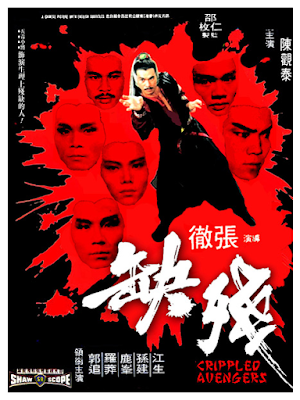
The Crippled Avengers (1978)

The Crippled Avengers (1978)
aka Mortal Combat, Return of the Five Deadly Venoms; Avengers Handicapped
Chinese Title: 殘缺
Translation: The Deformed


Starring: Kuo Chi, Lo Meng, Chiang Sheng, Lu Feng, Sun Chien, Chen Kuan-Tai, Johnny Wang Lung-Wei, Yang Hsiung, Yu Tai-Ping, Tony Tam Chun-To, Ching Miao, Helen Poon
Director: Chang Cheh
Action Director: Robert Tai, Lu Feng, Chiang Sheng


The Crippled Avengers was released about a month after Invincible Shaolin. One may assume that shooting schedules for both movies either overlapped, as with pre-production activities for this film. The tight deadlines for filming also imply choreographers Robert Tai, Lu Feng and Chiang Sheng—Leung Ting did not join the Venom Mob for this film—were simply action directing geniuses who were able to create the long, complex fight sequences for this movie on the fly and keep things on schedule. The Venom Mob films have often been lauded by fans for their intricate choreography, graphic violence, and preference for exotic weapons—or traditional arms that simply got less attention than your usual swords, staves and spears. Moreso than The Five Deadly Venoms and Invincible Shaolin, The Crippled Avengers serves as a model for things to come.

As the movie opens, three fighters storm the manor of a local warlord, Black Tiger Dao (Chen Kuan Tai, of Iron Monkey and Dragon Tiger Gate), for whom they harbor ill feelings. Not finding him there, they take his wife and son and proceed slice cut off her legs and his arms. The presumably wife dies of shock and blood loss, although the son, Dao Chang (who’ll be played by Lu Feng as an adult), seems to take it in stride. Young Dao receives a pair of prosthetic arms made of steel, which he periodically changes as he gets older. Him and and his dad also become tyrannical kung fu wackos as the years pass.

One day, a local blacksmith, Wei (Lo Meng), starts mouthing off to the two at a restaurant. When a travelling salesman, Chen Shuen (Phillip Kwok), agrees out loud to the blacksmith’s insults, Dao Chang pokes his eyes out. Dao’s men, led by Keeper Wan (Johnny Wang Lung-Wei), invite Wei for tea at Dao’s manor. There, Wei is forced to drink a draught that makes him mute…and then has his ears boxed in a way that leaves him deaf. Another poor shmuck (Sun Chien) bumps into the son on the street and gets his legs cut off…you know, as a reminder to watch where he is going.

It comes to a head when a would-be knight errant, Wang Yi (Chiang Shang), tries to stop Black Tiger Dao and company, only to get captured. Black Tiger has an iron headband placed on Wang Yi’s head and tightened with leather cords. This causes his brain to swell, ultimately rendering him a childlike imbecile. And thus we reach the end of the first half hour (and Act One).

Act Two sees our our four handicapped protagonists discovering a letter on Wang Yi’s person addressed to his teacher. They decide to take Wang Yi back to Master Li Jing-Ying (Ching Miao), taking advantage of the opportunity to ask him to teach them kung fu. While initially reluctant to adjust his curriculum to a blind man, a deaf-mute and a guy with no legs, he eventually agrees on the grounds that Black Tiger Dao’s crimes are so heinous that someone has to take him out. Chen Shuen uses his undistracted hearing to throw darts at falling leaves, plus assorted acrobatics and weapons forms. Blacksmith Wei trains his eyesight with a device that is a wooden wheel on fire: Wei must punch through an opening on the wheel as it is spinning to strike a pot on the other end. Finally, Sun Chien must learn how to walk on prosthetic legs, and then uses the strength developed in his upper legs by lifting them to improve his kicking.

Crippled Avengers is a violent and sadistic film, moreso than I remember it being the first time I watched it. It is about as bad as The Five Deadly Venoms if not worse, considering that the opening scene has an innocent child and a woman get bloodily maimed. There are some moments that I don’t know if they are supposed to be harrowing or blackly funny. Another early scene has Dao Chang celebrating his birthday by mutilating the sons of the men who had cut off his arms. In a few moments, they’re all writhing on the ground with broken limbs and severed tendons.

My favorite moment of dark humor comes later in the film revolves around an old colleague of Dao’s, Master Chiu (Yang Hsiung). Master Chiu is a large, muscular fellow whose specialty is qigong, which has made him almost invincible. Chiu challenges Chen Shuen and Blacksmith Wei to a contest: if they can make him flinch in three punches or three kicks, he’ll allow them to stay in town without fear of reprisal from Black Tiger Dao. If they can’t, the agree to take three punches and kicks from him, which they presumably would not survive. Sun Chien’s character eventually appears and asks if he could have a shot. Wang Yi, in his childlike innocence warns Master Chiu that Sun Chien has “legs of iron”. Thinking that “legs of iron” is the name for some fancy-yet-exaggerated technique, Chiu allows Sun Chien to compete. Sun Chien proceeds to kick a hole in the guy’s stomach, killing him.

The major artistic flaw of the movie, which indicates the presumably rushed nature of the production, is that Ni Kuang and Chang Cheh’s script is awfully repetitive in the last forty minutes. Several scenes end with our characters, mainly Blacksmith Wei and Chen Shuen, back at the inn, fighting Dao’s men to a standstill before Keeper Wan calls off the attack. Those scenes never feel like they are truly escalating the conflict, simply because neither side is taking losses at that point. Thus, the movie feels like it is spinning its wheels until the final blowout, which is something to behold.

The action itself is truly spectacular. Chiang Sheng, Lu Feng and Opera schoolmate Robert Tai pull out all the stops here for some of the most complex choreography of all time. The first notable fight is the one between the sword-slinging Wang Yi and Johnny Wang Lung-Wei, who’s armed with a meteor hammer, which is sort of like a flail or morning star that the user whirls around his body. The meteor hammer is an uncommon weapon to see in these movies, simply because rope or cord-based weapons are so difficult to choreograph. Notable movies to feature this particular weapon are Yao’s Young Warriors and Yellow River Fighter. There are some interesting fights involving two villains who fight with flashy kicks, daggers, and bow that shoots iron balls. The latter is referred to in the dub as the “ball-shot technique,” while the subtitles call it “projectile kung fu.”

The final fight is a blizzard, filled to the brim with wild choreography. Lo Meng, Phillip Kwok and Chiang Sheng take on a small army of henchmen armed with sabers led by Johnny Wang Lung-Wei and his meteor hammer. Kwok fights with his walking stick, which is actually a metal staff that he can wield with one hand. Chiang Sheng fights off bad guys and kills them with their own weapons, while acting like it is just a game. Lo Meng then pits his deaf boxing—his usual chu gar mantis style—against Chen Kuan-Tai’s black tiger style. Meanwhile, Chiang Sheng and Phillip Kwok square off with Lu Feng and his dart-shooting metal arms. This particular fight really exemplifies what people either love or hate about the Venom Mob. On one hand, once our heroes start fighting with the metal hoop, the whole skirmish turns into an over-the-top display of synchronized gymnastics. It is indeed impressive to see just how many acrobatic moves all three performers can pull off in a single take. On the other hand, some more serious-minded viewers with actual martial arts backgrounds will dismiss the entire sequence as a circus routine and not an actual fight. It is certainly a sight to behold and martial arts fans will probably never see anything like it again in genre film.

A second downside to the film is that the third act establishes a plot point in that Sun Chien’s iron legs must be kept a secret until the right moment. What that translates into is that he spends most of the last forty minutes on the sidelines until the final stretch of the big fight against Chen Kuan-Tai. I really wanted to see him kick a swatch through a contingent of lackeys like a reaper in a wheat field, but alas, that was not to be. However, with so many craziness and creativity on display, The Crippled Avengers still comes with a strong recommendation. It just misses the ranking of all-time classic on account of its wasting Sun Chien and its meandering third act.

Invincible Shaolin (1978)

Invincible Shaolin (1978)
Aka: The Unbeatable Dragon
Chinese Title: 南少林與北少林
Translation: South Shaolin and North Shaolin


Starring: Sun Chien, Chiang Sheng, Lu Feng, Lo Meng, Phillip Kwok Chun-Fung, Wai Pai, Johnny Wang Lung-Wei, Suen Shu-Pau,  Chan Shen, Wong Ching-Ho, Ching Miao, Niu Niu, Yau Chui-Ling, Kara Hui Ying-Hung
Director: Chang Cheh
Action Director: Robert Tai Chi-Hsien, Lu Feng, Leung Ting


With the (relative) success of The Five Deadly Venoms, Chang Cheh and his new troupe got to work within the Shaw Brothers assembly line pumping out one film after another. Within months, they released two more films, both of which are widely regarded among fans of the genre. The first of these was Invincible Shaolin, a semi-remake of Chang Cheh’s own Shaolin Martial Arts (1974). And while the original was a flawed film, Invincible Shaolin ends bordering on “Masterpiece” status, mainly because it manages to justify its existence by correcting all of its counterpart’s flaws.

The movie sets the main conflict on the table right off bat: Manchurian General Xu (Johnny Wang Lung-Wei, of The Martial Club and Lady is the Boss) recognizes the threat that Shaolin poses to the Qing Dynasty, but has his hands tied to do anything about it. The reason is that the Emperor has more or less established an uneasy ceasefire with Shaolin with the caveat that Shaolin kung fu masters serve as the army’s fighting instructors. To get around this, he decides to hire three Northern Shaolin fighters to take the place of his current instructors, a trio of men from the Southern Shaolin School. The three new instructors are: Master of the Spinning Kick Xu Fang, played by Sun Chien; Master of the King Kong Palm Bao Shanxiong, played by Lu Feng; and Master of the Two-Section Staff Yang Zhongfei, played by Chiang Sheng.

General Xu has the three new instructors test their skills against the previous teachers under the ruse that whomever loses will have to become the other’s assistant. The South Shaolin masters are defeated. But before they can pack up their bags and leave—in order to save face, of course—General Xu murders them and places the blame on the Northern fighters. The dead students’ teacher, Master Mai (Chan Shen), sends three of his students, including his son, to the barracks to get revenge on their fallen brethren. Only one of them walks away alive from the scuffle, and he commits suicide shortly afterward out of embarrassment. The Northern students begin to suspect foul play from someone in the army, but as lambs in a wolf’s den, they have to tread carefully.

Meanwhile, Master Mai gathers his younger son, Mai Feng (Wei Pai), and two former students, Ho Zhangcheng (Lo Meng) and He Yingwu (Phillip Kwok), and sends them to train to defeat the Northern Students. Master Mai will teach pole techniques to Yingwu; Mai Feng will learn wing chun under the tutelage of Master Liang (Wong Ching-Ho); and Zhangcheng will learn the Mantis style as a student of Master Zhu (Ching Miao).

The major structural flaw of Shaolin Martial Arts is that first half focuses on the training of two characters, only to kill them off and shift the story to two other characters. Although two of the main characters—He Yingwu and Ho Zhangcheng—show up in the latter part of the first half, the film keeps the focus on them once they are introduced, in addition to Mai Feng, who’s around from the beginning. Moreover, the film also treats their eventual adversaries—the Northern Shaolin instructors—as main characters as well. The two villains in Shaolin Martial Arts were just one-dimensional baddies, with barely any personality trait. The fact that we spend time with them as they court lovely women gives them an extra-dimension, including the impulsive and arrogant Bao Shanxiong. So even though two-thirds of the main “heroes” don’t show up for almost 30 minutes, the film never wastes time with Expendable Meat characters.

The unintended flaw of Shaolin Martial Arts script is that switching protagonists halfway through also truncated the training sequences in both halves of the film. At the same time, the training sequences are also rather bland, owing probably to Lau Kar-Leung and Tong Gaai’s relative inexperience with shapes-based action in 1974. By having an extended second act featuring on the characters’ training routine, Chang Cheh gives his action directors more time to explore creative ways of learning familiar styles. For example, Wei Pai’s character learns wing chun, but has to practice its narrow stances by performing techniques while balancing a series of increasingly taller (and narrower) poles. There is the obligatory one-inch punch training, although having Wei Pai train by trapping him in a series of cramped boxes is far interesting than watching Chi Kuan-Chun standing in front of wall for thirty minutes.

The most complete training sequence is Lo Meng studying the Praying Mantis style. However, instead of the more popular Northern Praying Mantis, Lo Meng learns Southern Praying Mantis. That in and of itself is a novelty, and the fact that Lo Meng himself studied the Chu Gar variation of the style means that what we’ll see onscreen will constitute the most authentic representations of the style in martial arts cinema. But back to the training, Lo Meng’s arc most accurately covers the standards set by films like Snake in the Eagle’s Shadow. He begins with strength-building exercises, mainly finger push-ups that go down to one finger. He progresses to practicing striking techniques on a spinning apparatus that strikes him in the back when he hits it from the front. This develops a technique called the jinzhongzhao, or Golden Bell Shroud, which would protect him from Lu Feng’s King Kong Palm. Finally, his teacher ties surgical tubing to his body and requires him to walk a distance and lift weights, known as the but saan gong, or “Lifting the Mountain” set.

A third flaw with Shaolin Martial Arts is that the wing chun on display was not very authentic. In fact, it mainly consisted of Bruce Lee’s infamous one-inch punch, albeit performed in reverse. The reasons are threefold: actor Chi Kuan-Chun was not a wing chun practitioner, nor was choreographer Lau Kar-Leung, and the film was still made when utilizing pure technique-driven fighting was still in its infancy. Chang Cheh overcame this hurdle by bringing in an actual wing chun master, Leung Ting, to assist with the action direction. Leung Ting has claimed[1] to be Grand Master Ip Man’s final student—Ip Man being best known in the West for having trained Bruce Lee. Leung had joined Chang Cheh’s oeuvre in 1978, assisting with the martial arts sequences for The Brave Archer Part II and The Five Deadly Venoms, in addition to 10 Tigers of Kwangtung and Heaven and Hell. Leung Ting taught wing chun to Wei Pai, who lacked formal martial arts instruction. As such, the concepts behind the training sequences and Wei Pai’s big fight with Sun Chien are a lot more authentic here than they were four years prior.

If there is any real flaw to Invincible Shaolin, it is that Phillip Kwok’s training does not feel entirely original. While the training sequences are fine, the later emphasis on the so-called “light skills” is more or less recycled from Kwok’s earlier films, namely Marco Polo and The Shaolin Temple. Even The Five Deadly Venoms stated that “light skills” was a characteristic of that film’s Lizard Style. While it makes sense that for Kwok, who was trained in Peking Opera and acrobatics, I think it would have been better if they had found another Southern style for him to focus on. He was certainly a talented martial arts performer and could have faked any skill he wanted.

But despite my own misgivings regarding the above, the training sequences come to a head with a brilliant 15-minute finale which gives us the only time that all six original Venom Mob troupe members fought at the same time. Wei Pai uses his wing chun skills to close in the gap between him and Sun Chien, a supreme kicker. In that sense, their fight is the reverse of the finale of The Himalayan, in which Angela Mao and Tan Tao-Liang used their legwork to maintain a distance from Chen Sing. Sun Chien often found his skills being underused, and in many of the Venom films, he would only get a short fight or two before dying—see The Daredevils; The Magnificent Ruffians; and Two Champions from Shaolin. Sun Chien gets plenty of opportunity to show off his kicking prowess in the finale. Meanwhile, Lo Meng and Lu Feng go at it in a whirlwind of handwork: the King Kong Palm vs Southern Mantis Boxing. Finally, Phillip Kwok and Chiang Sheng have a prolonged staff duel, propped up by impressive acrobatics from both men. The choreography here is top notch and is one of the best Venom Mob moments, bar none.

In the end, Invincible Shaolin is an excellent addition to Chang Cheh’s lengthy list of classics, not to mention a superb sophomore effort for the Venom Mob troupe on the whole. Each of the six Venoms put in great performances, both acting- and fighting-wise. And, as stated above, it is the only time to see all six Venoms putting their skills on display at the same time. It is indeed one of the classics of 1978: a year that was dead-set on making as many of those as was possible.


[1] - Ip Man’s son, Ip Chan, disputed that this was not the case. Leung Ting did indeed study under Ip’s student Leung Sheung.

The Five Deadly Venoms (1978)

The Five Deadly Venoms (1978)
Aka: The Five Venoms
Chinese Title: 五毒
Translation: Five Poisons


Starring: Chiang Sheng, Phillip Kwok Chun-Fung, Sun Chien, Lu Feng, Lo Meng, Wai Pai, Johnny Wang Lung-Wei, Dick Wei, Ku Feng
Director: Chang Cheh
Action Director: Robert Tai Chi-Hsien, Lu Feng, Leung Ting


Director Chang Cheh’s “Shaolin Cycle” ended in 1976 with the release of the super-production The Shaolin Temple. The following year was something of a transitional period, which saw him switching action directors from Hsieh Hsing and Chen Hsin-I to Robert Tai. He also produced a variety of different projects, including The Brave Archer, an adaptation of the wuxia novel The Legend of the Condor by popular author Jin Yong (or Louis Cha). This was most likely Chang’s response to the slew of wuxia movies directed by Chor Yuen for the same studio based off the works of Gu Long, a contemporary of Cha’s.

When 1978 rolled around, Chang Cheh kicked things off by directing a second Brave Archer movie—it would take three-and-a-half films to cover the source material. Then, in the second half of the year, Chang directed The Five Deadly Venoms, which kicked off his “Venom Mob” cycle. The name derives from the same troupe of actors—Chiang Sheng, Phillip Kwok (billed as “Kuo Chi”), Lu Feng, Sun Chien and Lo Mang[1]-- starring in the movies and taking on action director duties alongside Robert Tai, who had studied at the same Peking Opera school as Chiang Sheng, Lu Feng and Phillip Kwok.

The movie is set in the Song Dynasty (A.D. 960 to 1279). We open with a young man, Yang De (Chiang Sheng), taking care of his sickly master (Dick Wei, of Heart of Dragon and Yes, Madam!). The master, knowing that his time is up, informs Yang that he had previously taken on five students and trained them in the individual Venom styles: Centipede, Scorpion, Snake, Lizard and Toad. The school, known as the House of Venoms, has a horrible reputation for crime and violence, and the teacher suspects that some of his former students might be perpetuating that reputation. Yang De thus receives the mission to find the good students and eliminate the bad eggs. Since all the students wore masks during their training and took on assumed names afterward, finding them will be a bit of a challenge. The only hint that the master can give him is that the former treasurer of the House of Venoms now lives in a small town and may be targeted by the students at some point.

So Yang De heads over to the unnamed town, where he assumes the guise of a beggar. Meanwhile, a local constable, Ho Yuanxin (Phillip Kwok), is out doing his rounds when a stranger slips him a piece of paper with a toad painted on it. That stranger is Li (Lo Mang), the Toad Venom. Li has reason to believe that the Snake and Centipede Venoms are in town looking for the treasure. The problem is that neither of the two knows who the former treasurer is, nor who the Snake and Centipede are.

But we the viewer learn their identity in short order. The Snake Venom is Mr. Hong (Wei Pai, of The Young Master and Cheeky Chap), a young businessman and one of the wealthiest men in town. He receives a visit from the Centipede (Lu Feng), who has since discovered the identity of the treasurer: Scholar Yuan (Ku Feng, of The New One-Armed Swordsman and Dynamo), a lowly civil servant working for the governor. Both men raid Yuan’s house and murder him and his family, but are unable to find the map. While the police are baffled by the incident, there was a witness: a young street gambler named Menfa (Lau Fong-Sai) who saw the Centipede and recognized him as a friend of Mr. Hong. Menfa confides this to Yang De, who in turn passes the information to Constable Ho and Li.

A trap is set for the Centipede, who is arrested after a scuffle with Li. That’s where Hong steps in. He uses his money and influence to bring the governor (Wang Lung-Wei, in a non-fighting role) to his side. They convince Menfa to change his story so that Li is incriminated, and the governor sends Ho on an errand to another town so no one is around to corroborate Li’s alibi. And as all of this is going on, the Scorpion Venom is lurking in the shadows, manipulating people and events to his own benefit.

The Five Deadly Venoms is considered one of the all-time genre classics. Part of the reason is its historical value as the first movie in the infamous Venom Mob “series”, which has many fans to this very day. It is also one of the more intricately-plotted kung fu movies outside of the wuxia films that Chor Yuan was making at the same time, and even those tended to be more convoluted than complex. There’s also the gimmick of five fighters who may or may not know each other’s identities, trained in animal styles that, for the most part, aren’t your average Tiger, Crane, Dragon or Panther techniques. And each of those Venom styles has its own unique gimmick, which makes the action—when it does occur—even more interesting.

While Chang Cheh indulges in his usual love of male bonding—Phillip Kwok spends the climax shirtless for no good reason and the other Venoms eschew period garb for clothes that leave their chests exposed—the film deals with the snowball effect of evil and greed. Even one of the villains laments that with each step on the path to the treasure, he needs to kill more and more people just to protect his interests. And those that are hardened to the carnage are some horrible human beings, too. People die in some messed-up ways, like a hook that is stuck in the mouth to slit the throat from the inside.

In addition to violent kills, there is also a fair amount of torture on display in this film. One character is thrown into an iron maiden and his entire body perforated with needles. In another scene, a device called “the red stomacher”—half a breastplate of armor heated in a fire—is placed on a character to brand him, leaving third-degree burns all over his back. While not awash in red paint like many of Chang Cheh’s other films, the movie on the whole is just mean and brutal.

The action duties went to Robert Tai, Lu Feng and Leung Ting. The first two were Peking Opera buddies, while Leung Ting was a real-life wing chun master. The action is actually rather sparse: after the opening demonstration of each Venom’s abilities, the plot kicks into gear and the first real fight—Lu Feng (Centipede) vs. Lo Mang (Toad)—doesn’t occur until the halfway point of the movie. The fight choreographers were endlessly creative, giving each style its own character. The Centipede style is known for its lightning-quick handwork and short, quick kicks; in one scene, we see dead bodies with dozens of hand-shaped bruises on their chests. The Toad style is much like qigong, in that the practitioner’s body becomes invulnerable to attack. Actor Lo Mang was trained in chow gar, also known as the Southern Praying Mantis style, and uses hand-based attacks as well. Wei Pai wasn’t as knowledgeable in martial arts as his co-stars, so Leung Ting taught him wing chun. The Snake style in this movie is different from other movies: Wai Pai uses his thumb, index and middle fingers to puncture objects (or human flesh) like a snake’s fangs.

The finale brings all the (still-living) Venoms and Yang De together for a huge free-for-all. Phillip Kwok as the Lizard (or Gecko) Venom has the ability to run up walls and stick to them with his feet. Much like Marco Polo (1975) and The Shaolin Temple (1976), Kwok’s character is also trained in “light skills,” which enables him to perform all sorts of flips and somersaults. Sun Chien, who plays another constable, was trained in tae kwon do and thus was a talented kicker. His skills are saved for the finale, where shows off his legwork and even kicks a hole in someone’s forehead! Chiang Sheng was one of the most acrobatic of the Venoms, but his skills are a little muted in this film. Later Venom Mob movies would serve as better showcases for his abilities. Nonetheless, it’s still a solid ending to an unique martial arts film and the movie on the whole deserves to been by all action fans.


[1] - The sixth Venom was Wei Pai, who played the Snake Venom. He made three films with Chang Cheh and other Venoms before jumping ship to Golden Harvest Studios in a failed bid to become a big star.

Sunday, March 20, 2022

The Chinatown Kid (1977)

The Chinatown Kid (1977)
Chinese Title: 唐人街小子
Translation: Chinatown Kid


Starring: Alexander Fu Sheng, Sun Chien, Phillip Kwok Chun-Fung, Lo Meng, Jenny Tseng, Shirley Yu Sha-Li, Siu Yam-Yam, Johnny Wang Lung-Wei, Yang Chi-Ching, Wong Ching-Ho, Lu Ti, Chiang Nan, Yue Wing
Director: Chang Cheh
Action Director: Lee Ka-Ting, Robert Tai


Chang Cheh is generally known for his action-packed, blood-soaked tales of brotherhood, loyalty and male bonding. The vast majority of his movies feature handsome, athletic men leaving dozens of villains lying in pools of blood as they passionately shake hands before or after the carnage: one may rightfully believe that the male leads’ penises would be in heroic embraces with each other should the camera be focused on their lower regions. Once in a while, however, Chang Cheh would tackle other heavy themes in his movies. For example, New Shaolin Boxers examined a culture that would allow injustice to run rampant because nobody “wants any trouble.” In The Chinatown Kid, we have an examination of the question of choice and free will, and the consequences of exchanging one’s integrity for convenience.

The film focuses on two characters. The first is Yang Jianwen (Sun Chien, the Scorpion Venom), a young Taiwanese man who has just finished his mandatory military service. Yang wants to study abroad, and in order to afford entry and plane fare, takes on different jobs as a drafter, a tae kwon do instructor, and a tutor.  The other is Tang Dong (Alexander Fu Sheng, of Na Cha the Great and Five Shaolin Masters), a native of Mainland China who has illegally entered Hong Kong. Tang Dong is a kung fu expert, and uses his strength to make freshly squeezed orange juice for the locals. His natural talents call the attention of a local gangster, Xu Hao (Johnny Wang Lung-Wei, of Invincible Shaolin and The Martial Club). The two get into a kerfuffle over a gold watch and Xu Hao retaliates by framing Tang Dong for drug possession. At that point, Tang Dong’s only recourse is to flee Hong Kong to the United States.

Both men arrive in San Francisco Chinatown at about the same time, which does not make sense considering that one was travelling by plane and the other by boat. They end up working at a restaurant owned by a old friend of Yang’s fathers, played by Yang Chi-Ching of Vengeance! The restaurant is located on the territory of one of the local street gangs, led by Green Tiger (Lo Meng, the Toad Venom). Tang Dong gets in a fight with the Green Tigers after they try to extort money from Yang Jianwen. He wins the fight, but gets fired from his job. His antics, however, get the attention of White Dragon (Philip Kwok, the Lizard Venom), a rival gangster. Tang Dong is hired to be White Dragon’s bodyguard, while Yang Jianwen’s hectic schedule of school and work will put him on the road to drug addiction. When the former decides that he has had it with sacrificing his personal values, he’ll discover that turning one’s back on the criminal element is not as easy as it sounds.

The best thing that Chang Cheh does with this movie is establish contrasts between different characters. Much like New Shaolin Boxers, Fu Sheng plays something of a simpleton with good kung fu schools and an overdeveloped sense of justice. However, his bumpkin roots prevent him from seeing his new employer for what he is—at least initially—and by the time he tries to do something about it, more lives will be at stake rather than his own. We still feel sympathy for Tang Dong after he goes to work for White Dragon, because we as the viewer understand that he has been dealt a bad hand in life. Even when he means well, he ends up erring due to his naivete or lack of street knowledge.

On the other end we have Yang Jianwen, played effectively by newcomer Sun Chien. While not exactly rich, Yang does indeed have more opportunities than Tang Dong ever had. He has had a good education, a good work ethic, and a better overall view of what he wants from life. However, he too is subject to pressure and outside influences once he arrives in the States, and briefly succumbs to them. He is able to overcome them a lot sooner than Tang Dong does. Ironically, it is through Tang Dong that he kicks his habit before it develops into an addiction.

Another parallel to the New Shaolin Boxers is the romantic subplot between Fu Sheng’s Tang Dong and a young lady named Yvonne (played once again by Jenny Tseng, Fu Sheng’s real-life wife). Yvonne plays the daughter of a laundromat owner who is initially charmed by Tang Dong’s kindness and simplicity. Unfortunately, that story goes nowhere once Tang Dong’s “new life” steps into the spotlight. Making for a contrast with Yvonne is Lana (Shaw Brothers sex symbol Shirley Yu), the worldly and materialistic daughter of the restaurant owner (and White Dragon’s girlfriend). One represents the filial and chaste young lady that Chinese people would expect their heroines to be, while the other is the same slutty character she played in other movies. In this case, the corruption of the latter can be pinned on Western decadence, as it applies to either the young woman or the male criminals that turn around and exploit women for their own gain. Other contrasts include the thuggish Green Tiger with the more refined White Dragon.

While Chang Cheh was filming Marco Polo in the 1975, he had a falling out with choreographer Lau Kar-Leung, who walked off the set. Bereft of his trusty choreographer—Tong Gaai had moved on to other things by the end of 1974—Chang Cheh picked up a pair of Taiwanese action directors: Hsieh Hsing and Chen Hsin-I. They worked together until the beginning of 1977, when Chang Cheh made another switch. The new duo consisted of Lee Ka-Ting (best known in the west for Jean Claude Van-Damme’s Kickboxer) and Taiwanese Peking Opera graduate Robert Tai. Robert Tai’s classmates included Philip Kwok, Lu Feng and Chiang Sheng, who would go on to become known as Chang Cheh’s Venom Mob troupe. While the works of the Hsieh Hsing and Chen Hsin-I represented a continuation of Chang’s “Shaolin Cycle”, efforts like The Chinatown Kid and Naval Commandos acted as a transition into Chang’s “Venom Cycle.”

Robert Tai was at the beginning of his career at this point. Lee Ka-Ting had a little more experience, having choreographed a handful of martial arts films, such as He Walks Like a Tiger and the third-tier Shaw Brothers film Rivals of Kung Fu. Lee Ka-Ting did not have that much experience in choreographing shapes-oriented fighting, and it shows. The fights feel like they were choreographed three years earlier, although with a bit more technique on display than the worst of basher movies. Alexander Fu Sheng gets a good showcase for his althetic abilities, as does Sun Chien, the kicker of the Venom Mob. Lo Meng and Johnny Wang Lung-Wei also get to throw down with Fu Sheng. Philip Kwok does get into a few limited fights. None of the fights particularly stand out, although it is fun to watch so many future Venom Mob troupe members in action before The Five Deadly Venoms was produced.

While not one of Chang Cheh’s better movies—his best films struck a perfect balance between story and high-quality action—The Chinatown Kid makes for a fascinating example of a transition period for the director. The action is serviceable, to be sure. But the emphasis on character development does make it stick out from a lot of Chang’s movies. Alexander Fu Sheng puts in a strong performance and he gets ample support from the Venom Mob troupe. That alone makes it worth a visit.

Saturday, March 19, 2022

Flag of Iron (1980)

Flag of Iron (1980)
Aka: Spearmen of Death; The Spearmen
Chinese Title: 鐵旗門
Translation: Iron Flag Gate


Starring: Phillip Kwok, Lu Feng, Chiang Sheng, Lung Tien-Hsiang, Chan Shen, Wang Li, Yu Tai-Peng
Director: Chang Cheh
Action Director: Phillip Kwok, Lu Feng, Chiang Sheng

This is a lesser Venom Mob film about a clan of fighters known as the Iron Flag. As expected, their martial specialty are flags with spear heads at the tip. In an altercation with a rival clan, the Eagle Clan (who walk around with feathers in their heads like a band of Ming Dynasty Native Americans), the Iron Flag leader is killed. However, the several members of the Eagle Clan, including their leader, are killed in the same scuffle. After the Eagle Clan complains to the police, Iron Flag member Lo (Philip Kwok) agrees to take the blame for the massacre, leaving Chao (Lu Feng) in charge of the clan.

After a year on the run, we find Lo working as a busboy at an inn in order to pay off his debts, as Chao had never sent him money as promised. Lo soon discovers that a band of professional killers are on his tail and must fight off each of them to stay alive. Lo also finds out from his friend, Yun (Chiang Sheng), that maybe Chao was behind the death of his master and that Chao has brought the criminal element into the clan. Lo and Yun team up with a mysterious assassin named the Spearman to take down Chao and restore the clan to its former glory.

I wanted to like this movie a lot, but ended up liking it only a little. There are three things that hampered my enjoyment of the film. First is the dubbing, which came across as either being badly acted or the dubbers were just overdoing things to the point of parody. It just didn’t sound natural like other dubs I’ve seen. Second is the absence of Lo Meng and Sun Chien in the cast. I’m not sure why they weren’t around for this one, but it hurts the film. Finally, the cut I saw was about 87 minutes or so. Supposedly, the original Chinese cut is around 110 minutes. So the story doesn’t develop as interestingly as I would’ve liked.

There’s a bit of action in this film. By this time, Robert Tai had stopped working on Venom Mob films, so the action director chores fell on the three leads. The action is well-choreographed and the final flag/spear battle between Philip Kwok, Lu Feng, and the guy who plays the Spearman is just wonderful. Chiang Sheng is underused, but looks good in the few fight scenes he does. There is a variety of exotic weapons on display, including a meat cleaver, sickles, an abacus that transforms into a pair of nunchaku, and the titular flags.

This is easily the most violent Venom Mob film I’ve seen up to this point. Losts of stabbings and slashing and red paint are on display in this film. There are some violent deaths that are over-the-top enough to be rather funny, in a black humor sort of way. In one scene, Kuo Chi stabs a guy in the stomach with some chopsticks and then hits the guy in the stomach with a tray, pushing the chopsticks out the guy’s back. Another violent moment, less funny, is a guy who takes a spear through his entire body. It is not a film for the squeamish.

Overall, a worthy but not great effort.

Hero Dream (1992)

Hero Dream (1992) Chinese Title : 淫妖豪情 Translation : Lewd Demon Passion Starring : Chin Siu-Ho, Chin Kar-Lok, Carrie Ng, Michiko Nishiw...