Showing posts with label Chin Kar-Lok. Show all posts

Saturday, February 22, 2025

Special Female Force (2016)

Special Female Force (2016) Chinese Title: 辣警霸王花 Translation: Spicy Police Bully Flower


Starring: Eliza Sam Lai-Heung, Joyce Cheng Yan-Yi, Jade Leung Ching, Jeana Ho Pui-Yu, Cathryn Lee Yuan-Ling, Anita Chui Pik-Ka, Chris Tung Bing-Yuk, Mandy Ho Pui-Man, Philip Ng, Shirley Yeung, Stephy Tang

Director: Wilson Chin

Action Director: Wong Chi-Wai, Chin Kar-Lok Action Team


Although the English title doesn’t suggest it, Special Female Force is actually a reboot of director Wilson Chin’s own The Inspector Wears Skirts series. The Cantonese title of those films was “Ba Wong Fa,” which was the name given to the female police unit. The last three characters of this film’s Chinese title are “Ba Wong Fa” (in Cantonese), thus letting us know that Wilson was once again visiting the world of light action comedy involving female police cadets. 


The original series played like a female-led version of the Police Academy movies, usually capped with a really good action sequence—the first one featured Cynthia Rothrock as a veteran police woman who duels with Jeff Falcon at the climax. The next two entries lost Cynthia Rothrock, relying on Girls n’ Guns veteran Sibelle Hu (and her stunt double) to carry the action. The fourth film traded Hu for Cynthia Khan as the hardline commanding officer of the team, with Moon Lee playing comic relief. That film actually had the most action of the original series, although Moon Lee doesn’t cut loose until the very end.


Special Female Force opens in Thailand during the mid-90s. The “Ba Wong Fa” team, led by Macy (Kung Fu Mahjong 3’s Shirley Yeung), is staking out the place, waiting for the arrival of a terrorist known only as “The President.” They’re on a joint operation with the Thai police and all is going according to plan until they mistake the wrong man for The President. A huge gunfight breaks out and all of the team are killed, except for Song (Stephy Tang). That includes Macy, who (get ready for this) was on her final mission before (you’ll never guess) retiring (guess why) to spend time with her daughter. Tragedy! Of Greek proportions!


Twenty years later, the Ba Wong Fa program is being restarted under the supervision of Madam Song (now played by Jade Leung, of Enemy Shadow). There are twenty-four cadets vying for positions in the six-woman team, but we’ll focus on the “D” team. Let’s meet our plucky band of inept would-be crime fighters:


  1. Tung (Jeana Ho, of Due West: Our Sex Journey) – She’s the ambitious and competitive one who hates the fact that her teammates are slackers. We later learn that she joined the police to spite her overly critical dad.

  2. Honey (Joyce Cheng, of Cold War) – The chubby comic relief—daughter of Adam Cheng and Lydia Shum—who becomes the heart and backbone of the team, despite her less-than-imposing physical demeanor.

  3. Fa (Miss Chinese Vancounter Eliza Sam) – The beautiful one who does sexy things like sleep in the nude. We later learn that she is the late Macy’s daughter.

  4. Ling (Anita Chui) – She’s the tall, fashionable one with big breasts. We learn that she joined the force after being molested a lot during her youth, so she wants to get those sort of evil men off the street.

  5. Cat (Cathryn Lee) – The mousy, weak-looking member of the team that’s there to prove to her chauvinist SDU boyfriend (Philip Ng) that she can be a cop.

  6. Ho (The Real Iron Monkey’s Mandy Ho) – The deep-voiced lesbian of the group who wants to prove to the world that a woman can do anything a man can do.


Initially inept, the girls learn to like each other and work as a team, even after Tung almost sells them out during a game of Capture the Flag. During a training exercise, Honey leads them off course and they end up getting caught in an actual kidnapping scheme, which leads to a lengthy gunfight between the girls and the kidnappers—the SDU eventually shows up to clean up the mess. That leads to their dismissal from the program. But then another policeman, Wong Sir (Evergreen Mak, also of Enemy Shadow), shows up and informs them that they have been chosen as the top secret “B Team” for a mission in Thailand: capture The President, who’s about to release a deadly virus into the world…(four years before COVID)


There are a handful of twists and turns during the last half hour. I think at least one of them you’ll guess. A second one I did not see coming. And I already spoiled the one about Fa’s real identity, although it doesn’t really affect the plot. Fa was the character we knew least about by the time came for her to reveal herself, so most viewers would have connected her to an otherwise irrelevant plot detail from the beginning of the film.


Special Female Force follows the story structure of the other movies: kick things off with an action sequence, followed by 50 minutes of light comedy as the unlikely heroines bumble their way through training, and then end with a series of action set pieces. I have not seen The Inspector Wears Skirts II, but parts I and III were rather light on the action in terms of quantity. This actually matches a little more with the fourth film. The second act ends with the mock rescue-turned-actual rescue set piece, complete with some martial arts and a lot of gunplay. The third act actually features several action scenes: a gunfight at the pier, a gunfight at the airport, and a series of fights between the girls and the main villains.


The acting is what you would expect from this type of film. Joyce Cheng seems to have inherited both her mother’s weight and knack for fast talking. She’s no Sandra Ng, but maybe if she works enough at her game she can reach that spot. The actresses playing Fa, Ling and Cat are mainly there to look pretty (thankfully, they are). That said, they lack the natural charisma of the likes of Ann Bridgewater, Ellen Chan, and Regina Kent. The real disappointment is Jade Leung, who phones in her performance as the stern Madam Song. When Sibelle Hu and Cynthia Khan played the part, they were rigid but often knew how to humorously deal with the cadets’ antics. Song and her two subordinates show absolutely no personality throughout the entire production, except for yelling. Even when Madam Song puts it all on the line to help the girls during the climax, it doesn’t register at all because Song hasn’t shown any real personality.


The action scenes were staged by Wong Chi-Wai, a veteran action director who got his start on the much-disliked Taiwanese film The Invincible Kung Fu Trio and worked his way up to collaborate several times with Johnny To (Election; Exiled; and Fulltime Killer). Backing him up is the Chin Kar Lok Action Team—Chin himself cameos as a former Triad who assists in a training activity—including Chan Chung-Fung as the knife-wielding psycho working for The President. The action is actually quite brutal and bloody, even sadistic in some places, which clashes with the overall tone of the movie. The first two films in the original series were choreographed by the Sing Ga Ban (Jackie Chan Stuntman Association), so they knew how to keep things intense while consistent with the rest of the movie. This film starts off violent, then switches to almost an hour of girls pouting, and suddenly becomes something akin to a John Wick movie. The brief smatterings of fight choreography during the last 15 minutes feel more like that—arm locks, take downs, knife fighting—than an attempt to pay homage to 1980s kickboxing choreography. There is a bit of that in Ho’s fight with the President’s female enforcer. Philip Ng shows up to throw a couple of kicks, but don’t expect much from him.


If nothing else, Special Female Force was better than Martial Angels, which brought in a whole cadre of cute girls and did nothing interesting with any of them. It’s fluff. Fluff occasionally stained in blood, but fluff nonetheless.

Thursday, February 1, 2024

Four Dragons (2008)

Four Dragons (2008)
Original Title: Kinta 1881
Translation: Kinta 1881 – Kinta referring to the valley where tin was discovered


Starring: Robin Ho, Kuan Jun-Fei, David Bao, Michael Chin, Albert Yuen, Patrick Teoh, Anita Kwan, Shawn Lee
Director: C.L. Hor
Action Director: Chin Kar-Lok


Starting in 2003, Southeast Asia joined the martial arts frenzy that was going worldwide (again) following the worldwide success of Crouching Tiger Hidden Dragon and the coming of big-name Hong Kong stars like Jackie Chan and Jet Li to Hollywood. As we all know, the SE Asia martial arts “renaissance” began with Ong Bak and Tony Jaa, who led the charge for the first few years. He was eventually joined by Vietnam, represented by Johnny Tri Nguyen and Veronica Ngo, who made quality martial arts films like The Rebel and Clash. Quickly getting in on the action was Indonesia. Silat masters like Iko Uwais and Yayan Ruhian, under the careful eye of Welsh director Gareth Evans, set the action genre alight with Merantau and The Raid films.

However, lost in the shuffle of the torrent of quality action to come out of that region was
Four Dragons, Malaysia’s first martial arts movie. Oh sure, there were Hong Kong movies filmed in Malaysia, like Supercop and Angel II. But this was the first one produced, written and directed by Malaysians, even though they brought in a Hongkie to do the action choreography. There is a good reason that this movie has a measly 3.5 rating at the IMDB while its contemporaries from Malaysia’s neighbors are revered to this day: this movie somehow manages to fail on every single level. It comes close to being the Birdemic of martial arts movies.

The movie is set in 1881, shortly after the discovery of tin in Malaysia. Much like the California Gold Rush, the promise of economic opportunity has attracted a lot of Chinese immigrants from Southern China—thus we get a movie in which most of the cast speaks Cantonese. Unfortunately, the tin mines are run with an iron fist under conditions that aren’t much better than slavery. The Chinese laborers are overseen and cared for by Tin Sok (Albert Yuen). “Uncle” Tin, for his part, answers to Master Hoong (Patrick Teoh, who was in the “Marco Polo” series for Netflix), who is part mining entrepreneur, part Triad.

Tin Sok has four “adopted” sons who not only assist him as a foreman, but were taught martial arts by him as well. The oldest is Dragon (Robin Ho, a four-time gold medalist in four different Wushu Championships), who is distinguished from his brothers by the fact he has mustache. Seriously, the only one of member of the titular “Four Dragons” who doesn’t get a backstory happens to be the guy named “Dragon.” Then there’s Ace (Kuan Jun-Fei, another wushu
taolu champion), who is distinguished from his brothers by being the guy with short hair, no facial hair, and thin eyebrows. We learn that he has a gambling problem, although it’s something he does to help the daughter of some random murdered immigrant. He’s followed by Blaze (Chinese tai chi chuan practitioner David Bao), who sports one of those late 1990s manes a lá Ekin Cheng. Finally, there’s Tiger (Michael Chin, yet another wushu champion), who has short hair, no facial hair, and thick eyebrows. His deal is that he is secretly in love with Dan Dan (Anita Kwan, who reminds me of a young Karen Mok), Master Hoong’s daughter.

Well, one day Master Hoong has the Chinese laborers attacked and murdered at the behest of Master Sam (Tsai Lex), a wealthy opium dealer. We never quite find out why Master Sam decided that they all had to die. Nor do we ever learn what sort of business venture that an opium dealer and a tin baron would want to join forces for. People just have to die because…well, that’s what villains do! The four brothers barely escape the bloodbath with their lives and are found by a Malay village chief and nursed back to health. Tin Sok also survives, albeit barely, and is eventually carried back to the village to recover. Meanwhile, Master Sam knows something that the brothers don’t: Tin Sok was responsible for Blaze’s father’s death years and years ago when they and Master Hoong were humble miners. That’s enough to turn Blaze turncoat against his brothers.

The first reason that
Four Dragon utterly fails is the story. What should be a simple revenge tale—the downtrodden immigrants rising up against their fellow Chinese oppressor (much like The Roaring Lion)—gets convoluted as flashback is piled upon flashback, subplot upon subplot, and yet nothing ever gets adequately explained. We never learn what happened between Tin Sok and Blaze’s dad; there’s a throwaway line to suggest that the guy was a bad apple. There’s a love triangle between Tiger, Dan Dan, and Forest, one of Master Hoong’s enforcers. That never gets mentioned after the scene that establishes it, though. It’s suggested that Forest would vent out his lust on Dan Dan’s British friend, Rose (Laura Jayne New), but once again, it’s forgotten as soon as it’s brought up. There’s also a bit about random Chinese immigrants being murdered and hung from bamboo stalks, but that’s never explored, either.

The structure of the film is also confusing. The entire second act is made up of numerous flashbacks, most of which serve to give us our heroes’ backstories. There are even some flashbacks within flashbacks, and some of the fights during the massacre of the Chinese miners are replayed verbatim. The problem is that the editing is terrible and less-attentive viewers will undoubtedly get lost, not being able to tell a flashback apart from a scene in the present. The editing also fails in setting up scenes, such that fights often start out of nowhere with no regard to space. Where are these people?
Who are these people? Why are they suddenly fighting?

Chin Kar-Lok was hired to stage the fights and initially, I was glad to see him working on a traditional kung fu film. For the past 20 years, Chin
Sifu has mainly worked in modern-day action films, setting up car chases, gun fights, explosions, and all the stuntwork that revolves around those sorts of set pieces. He has gotten LOTS of nominations for Best Action Choreography at the Hong Kong Film Award, but still hasn’t won one yet. After watching Four Dragons, Chin Sifu should really stick with modern action.

Chin Kar-Lok just doesn’t seem to have the talent for making
Taolu (i.e. forms) champions look like seasoned fighters. I mean, Jet Li has always looked believable. Vincent Zhao Wen-Zhuo has always been credible. Wu Jing has been solid for most of his career. But these guys just look soft boned in their fights, like some of those old wushu movies that Mainland China made in the 1980s. You know they have martial experience, but you need a certain sort of talent to translate that to credible screen fighting. The Four Dragons don’t. They are frequently outshone by the villains. Shawn Lee, who plays Forest, was a wushu sparring champion, so in addition to being big and muscular, he actually knew how to fight. And it shows in his fight sequences. The same goes for Chu Cho-Kuen, who plays Hoong’s other enforcer, Sand. That guy kicks major ass and shames our heroes. Those two should’ve been the lead performers.

The story is muddled, the editing is incoherent and the action is disappointing. Sadly, the film’s woes don’t stop there. Most of the fights are punctuated by the worst CGI blood on record, which looks like an optical effect that you would’ve paid your local video editing service to do on your shot-on-video movie circa 1985. Seriously, the blood in Mortal Kombat for the Sega Genesis was more realistic. There are serious acting and directing flubs, like Shawn Lee standing in front of a burning building for about twenty seconds and screaming for no reason. And to make it worse, that scene is replayed in one of the film’s many flashbacks. The animated opening titles and behind-the-scenes footage that plays over the closing credits are interesting, but not enough to prevent Four Dragons from becoming Four Brookesia Chameleons.


This review is part of "Month of the Dragon"

Saturday, August 12, 2023

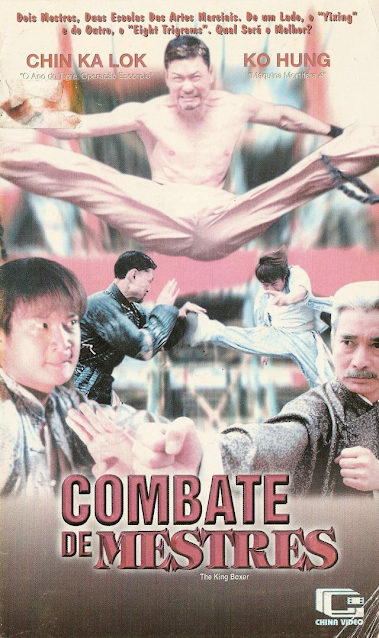
The King Boxer (2000)

The King Boxer (2000)
Chinese Title: 天下無敵掌門人
Translation: Invincible Head of the World


Starring: Chin Ka-Lok, May Kwong Man-Chun, Kiki Sheung Tin-Ngo, Eddy Ko Hung, Billy Chow Bei-Lei, Chun Yu Shan Shan
Director: Benny Ng Shiu-Hung
Action Director: Douglas Kung Cheung-tak


In some ways, I feel bad for Chin Ka-Lok. He never quite got his due praise for all of his skills and talents. Starting off his career for Sammo Hung’s Stuntman Association, we see him in supporting roles as early as 1985—he plays one of Jackie Chan’s SWAT buddies in Heart of Dragon. His relationship with Jackie Chan would lead him to be Chan’s occasional kicking double whenever the choreography called for something out of Chan’s skill set. He got his chance to really show his stuff onscreen in Mr. Vampire 4. Sadly, despite numerous attempts to be the Next Jackie Chan (Nite Life Hero; Little Hero on the Run) and the Next Jet Li (Martial Arts Master Wong Fei Hung; The Green Hornet), he failed at all attempts to become bankable lead actor.

Chin seemed to accept his lot in life and by 2002, was focusing his efforts mainly behind the camera (although he gets some good supporting roles here and there). He quickly rose to become one of the most respected action directors in the business and the head of the Hong Kong Stuntman Association. In the past twenty or so years, Chin Ka-Lok has been nominated for Best Action Choreography about 12 times, but has never taken home a single award. Heck, in 2013, he got three of the five nominations and still lost to Jackie Chan. Thankfully, it hasn’t all been for naught: he took home a Taiwanese Golden Horse Award for Best Action Choreography in 2012 for Motorway.

The King Boxer
was a co-production of My Way Film Company—a low-budget HK outfit that produced films like Angel on Fire and Love & Sex in Sung Dynasty—and the short-lived Wo Ping Creation Team (see Chinese Heroes). It is, as far as I can tell, the last real attempt for Chin Kar-Lok to make it as a leading martial arts hero. Sadly, the effort was mediocre at best.

Chin Kar-Lok plays the son of the wealthiest man in town, a banker. Dad would like Chin to follow in his footsteps and carry on the family name. Chin, on the other hand,
kinda sorta wants to be a martial arts hero, but is actually too lazy to really do anything about it. So, he goes around getting in fights that he either buys his way out of, or wins by sheer luck and coincidence.

Meanwhile, there is a big rivalry between the town’s two major kung fu schools. One of them is led by Eddie Ko Hung (
Hitman in the Hand of Buddha) and the other by Billy Chow (Fist of Legend). During a martial arts tournament, Ko Hung is defeated by Chow and kicked into a river, after which he disappears. The terms of the tournament is that the winner would get to take over the land belonging to the other school, so Ko Hung’s wife (TV actress Kiki Sheung) and his three daughters are really in trouble.

Chin Kar-Lok somehow bumbles his way into the Eddie Ko’s family, being named the inheritor of the family school despite not actually knowing martial arts. He actually falls for one of the daughters, Carmen (May Kwong, of
Wan Chai Empress and So Close), and is bamboozled, Old Testament-style, into marrying the older daughter thinking it’s her. The older daughter is actually in love with one of Billy Chow’s students. Chow also has a man on the inside in order to sew discord in the family. Chin starts learning kung fu from the matriarch, but is too much of a goof-off to really progress fast enough to face Billy in a few weeks. And then a masked fighter appears to teach Chin some moves.

Despite the title, the film doesn’t have anything to do with the original
King Boxer (or the Meng Fei film with the similar title). As you might notice, there are a lot of elements borrowed from The Prodigal Son, as we learn that not only Chin’s character, but his dad, pay for him to win fights. Much of the film is about Chin Ka-Lok goofing around and getting into the trouble, occasionally romancing Carmen when the opportunity presents itself. After a promising first 15 minutes or so, the film doesn’t really pick up the pace until the hour mark when Chin starts training with the masked fighter—really just Eddie Ko in disguise.

Because this is a comedy and Chin Ka-Lok is playing a fellow who never really learned kung fu for anything constant length of time, it generally looks like Chin is fighting below his actual physical abilities, which is unfortunate. He does display some decent comedic timing while staff fighting with a mouse in his clothing, but the rest is just silliness and mugging. There are some nice exchanges of moves here and there, but if you want peak Chin, go see
Martial Arts Master Wong Fei Hung and Little Hero on the Run instead. There’s some good choreography from the rest of the cast in the opening kung fu tournament sequence, with Eddie Ko and Billy Chow making the best showing for themselves.

The finale is set in and on top of a multi-level bamboo scaffolding as a bunch of fighters fight for the hand of Carmen in marriage, including Billy Chow. Chin Ka-Lok eventually joins the fray, having taught himself
tai chi chuan a few minutes earlier—the idea is that Chin’s character has a natural gift, not unlike Stephen Chow needing his Qi cleared in Kung Fu Hustle. Choreographer Douglas Kung wisely keeps the wire tricks to a minimum in this sequence and the site of Billy Chow fighting inside a bamboo platform will remind some viewers of the finale of Mr. Canton and Lady Rose. And like that film, Billy Chow and his superior kickboxing steal the show from the lead actor. There’s a brief Drunken Master 2/Young Master moment when Ka-Lok becomes invincible after eating wasabi, but it’s really just a pointless gag. And that really describes the film on the whole: some good choreography here and there, but derivative of other, better films and ultimately just unnecessary.

Thursday, September 1, 2022

Operation Scorpio (1992)

Operation Scorpio (1992)
Aka: The Scorpion King
Chinese Title: 蠍子戰士
Translation: Scorpion Warrior


Starring: Chin Kar-Lok, Lau Kar-Leung, May Lo Mei-Mei, Kim Won-Jin, Wu Fung, Victor Hon Kwan, David Lo Dai-Wai, Frankie Chan Chi-Leung, Yuen Shun-Yi
Director: David Lai Dai-Wai
Action Directors: Yuen Tak, Corey Yuen Kwai, Lau Kar-Leung


In my Dragon Inn (1992) review, I mentioned the rules of wuxia pian for the early 90s. Mainly that they had to be based on a wuxia novel and/or a remake of a Shaw Brothers movie. When it came to kung fu movies, the criteria was a little broader, albeit simultaneously more limiting: the movie had to be about a Chinese folk hero. Thus, the 90s saw numerous films made about Wong Fei-Hung, Fong Sai-Yuk and Hong Xiguan. Even a few lesser-known heroes, like “Iron Bridge” Saam, Beggar So, and Zhang Sanfeng (the fabled founder of Taiqi Quan) had their stories told.

The most notable exception to any of these rules was the 1991 production
[1] Operation Scorpio. Unlike Once Upon a Time in China and that film’s clones, there is no message of Chinese nationalism and evil foreigners here. Nor are there any Chinese girls in Western garb. And the villains aren’t those dastardly opium dealers, either. Instead, we get something of an update of the late 70s-early 80s Seasonal formula, with Korean bootmaster Kim Won-Jin standing in for Legendary Superkicker Hwang Jang Lee, and Chin Kar-Lok standing in for Jackie Chan. That last bit only makes sense, as Chin occasionally did stand in for Jackie when it came to executing some of the more advance aerial kicks in his movies.

Chin plays Fei Yuk-Shu, a student with natural drawing abilities who’d prefer to idle his time away drawing superhero comics than study. For the record, the film is set in 1920, predating Superman by 18 years and Batman, the Human Torch, and Sub-Mariner by 19. His dad (Wu Fung, of
Skinny Tiger, Fatty Dragon and City Cops) is sacrificing a lot just so his son can get a good education and honor the memory of Yuk-Shu’s deceased mother. It thus irks him to no end that Yuk-Shu is always getting into fights with the school’s jocks, who, in his defense, are a bunch of buttholes.

One evening, Yuk-Shu is out and about for some reason when he comes across a servant girl, Jade (
Lady Supercop’s May Lo, who often found herself playing characters named “May” in her movies). Jade works for a crime boss named Mr. Wang (Victor Hon Kwan, of City on Fire and Prison on Fire), who’s heavily invested in the human trafficking business. Wang is blessed with a super-kicking son, Sonny (Kim Won-Jin, of No Problem 2 and China Strike Force), who acts as his bodyguard. Wang also has the police in his pocket, in the form of Inspector Hua (Yuen Shun-Yee, of Dreadnought and Shaolin Drunkard). Yuk-Shu is snooping around the house for whatever reason when he overhears Mr. Wang offering to hand Jade over to Inspector Hua for his personal enjoyment.

Yuk-Shu tells Jade what’s happening and helps her to escape. Although he is ultimately able to escape—thanks to the assistance to a Western-style fitness club of bodybuilders—Wang and his men don’t give up so easily. An altercation on the street results in Yuk-Shu being expelled from school and Wang’s men attack his dad, injuring his leg with bamboo poles. Unable to return home, Yuk-Shu, his dad, and Jade take refuge in a restaurant ran by Master Lo (Lau Kar-Leung, of
My Young Auntie and Mad Monkey Kung Fu). Lo offers to teach Yuk-Shu a vocation: making noodles in giant woks. Although Yuk-Shu initially balks at it, he does start picking up some pointers. But he also finds himself sneaking out of the house to practice weightlifting at the club with Bull, the instructor (Full Contact’s Frankie Chan Chi-Leung). Of course, Yuk-Shu will eventually discover that Master Lo is a kung fu master himself and that his noodle-making routine was just a clever ruse for teaching him kung fu. That might come in handy when Yuk-Shu crosses path with the Wang family again.

As you read the synopsis above, did you not get flashbacks to any one of a number of kung fu comedies from the late 70s? A good-hearted protagonist who doesn’t know kung fu?
Snake in the Eagle’s Shadow. The hero’s family being dragged into the conflict? You can see that in Snake Fist Fighter and The Fearless Hyena. Kung fu through cooking? There’s a bit of that in The Incredible Kung Fu Master and The Mystery of Chess Boxing. The hero learning at least two styles in order to defeat the villain? Try Daggers 8; Buddha Assassinator; Snake in the Monkey’s Shadow; and numerous others will give you that. The hero creating a style of his own? Once more, that’s Snake in the Eagle’s Shadow and Goose Boxer right there. The only thing that really sets this apart from those movies is the slightly-more modern subplot involving Yuk-Shu’s artistry and some more complex wirework from action director Yuen Tak.

Filmed in 1991,
Operation Scorpio came out at a time when Chin Kar-Lok was making an earnest effort to come out on his own as a legitimate action star. Although he’d been working with Sammo Hung since the early 80s, it was usually as a stuntman and fight choreographer. His first real opportunity to show off his skills came in 1988 when he played Anthony Chan’s assistant in Mr. Vampire IV. Golden Harvest invested in him for the big-budget action blowout Bury Me High (1991) and this, but both movies flopped at the local box office. This year also saw Chin Kar-Kok starring alongside his brother, Chin Siu-Ho, in the quasi-porno film Hero Dream. Chin kept on making martial arts movies up through 2000, which saw him fighting Billy Chow in King Boxer, produced by Yuen Woo-Ping’s studio. By that point, it was clear that Chin was going to be neither the next Jet Li nor the next Jackie Chan—despite having doubled him on numerous occasions—and Chin focused his energy on action direction. To this day, Chin has racked up numerous Best Action Choreography nominations, albeit no trophies, for his contributions to Hong Kong action cinema.

As it is,
Operation Scorpio is not the best showcase for Chin’s acrobatic skills. While he does show off some of his flexibility at the climax with his made-up “Eel Style,” he spends most of the movie as the shlub who simply doesn’t know how to fight well. That’s unfortunate, as Chin was blessed with a kicking talent that resembles Jet Li on his best, non-wired days and, like many actors from that time, was trained in Peking Opera, different Southern styles (Wing Chun, Hung Gar), and probably tae kwon do, too. Chin gave a much better showcase for his abilities that same year in Martial Arts Master Wong Fei Hung, probably the first movie outside of Jet Li’s Once Upon a Time in China to feature that character.

Stealing the show from Chin Kar-Lok is newcomer Kim Won-Jin, who plays Sonny. Sonny practices a “Scorpion Style” of kicking. Unlike Sun Chien’s Scorpion style in
The Five Deadly Venoms, Kim took things several steps further and created his own style. This includes a stance where Kim crouches down on all four, and then lifts his leg over his back, making it resemble a scorpion’s tail. The man is insanely flexible and pulls off some impressive kicks, from spin kicks to jumping spin kicks. Moreover, sometimes he performs a jumping spin kick, only to fall backward and kick out with his other foot to hit his opponent on the way down. That requires some excellent timing. Some of Kim’s movements are enhanced by wires, as was the style of the time. Most aficionados, however, will note the man’s raw talent that shines past the special effects.

Although Yuen Tak is credited as the main action director at the HKMDB, the English-language credits of the international dub also state that Lau Kar-Leung and a “Yuen Fu” were fight choreographers, too. I’m guessing that “Yuen Fu” refers to Corey Yuen Kuei, who worked extensively with Yuen Tak during the 1990s. Tak shows up as one of the villain’s main henchmen, fighting our heroes in the last two set pieces. There is some Superman-esque wirework in the opening fight sequence that is very similar to
Saviour of the Soul, which Tak had worked on the year before. Lau Kar-Leung most likely choreographed his own fights, which is him doing his usual hung gar shtick with a heavy emphasis on martial philosophy. This includes Master Lo’s ability to defend himself against Sonny’s kicks by observing the movement of his shoulders. Lau also does a bit more kicking, using the infamous Mo Ying Geuk, or No-Shadow Kick. Unlike that year’s Once Upon a Time in China 2, where the No-Shadow Kick is portrayed as a flying side kick carried out by wires, the kick here is closer to the real thing (also portrayed in Master of Kung Fu and The Magnificent Kick): a very powerful (and fast, obviously) front kick.

Martial arts fans should watch this on the basis of Kim Won-Jin’s physical performance and Lau Kar-Leung’s application of martial philosophy, which he’d been doing since the late 70s. That’s worth the rental (or purchase) price alone. However, given that Tsui Hark and company were giving audiences spectacle, great acting, epic production values, and Jet Li at the time, some may find
Operation Scorpio lacking in those regards.


[1] - The ending credits of the international English dub show a 1991 date, although according to the HKMDB, the film wasn’t actually released until November of 1992.


Thursday, March 10, 2022

Little Hero on the Run (1995)

Little Hero on the Run (1995)
Chinese Title: 天子驕龍
Translation: Heavenly Dragon


Starring: Chin Kar-Lok, Ben Lam, Tso Chung-Sing, Jennifer Chan, Yip Fong
Director: Lee Chiu
Action Director: Danny Chow


I’m not sure how the Taiwanese movie industry functioned after the death of the traditional kung fu film in the early 80s. I mean, Taiwanese audiences apparently still enjoyed these movies after Hong Kong stopped caring, since they kept churning them out. At some point, Taiwan jumped onto the Ninja Craze Bandwagon and started producing some of the most insane examples of the sub-genre (that is, until the Japanese decided that ninja movies were the perfect outlets for women who could fire energy weapons from their private parts), thanks to the efforts of Alexander Lo Rei and Robert Tai. What’s really interesting is that around the mid-80s, Taiwanese filmmakers found another niche that defined a huge portion of their action/martial arts output: the martial arts children sub-genre.

While butt-kicking kids had already been showing up here and there in kung fu movies for years, the Taiwanese built their own cottage industry around the little high-kicking tykes, starting with the hugely-popular Kung Fu Kids series. That movie spawned numerous sequels and rip-off’s/cash-in’s, like the 7 Lucky Ninja Kids and whatnot. Then in the 1990s, Taiwan gave us the Shaolin Popey series, which I haven’t seen, although I know that it gave us a kid performing drunken fist boxing after sucking on the breast of a well-endowed woman in a superhero outfit. I have yet to wrap my mind around that one.

At first glance, Little Hero on the Run feels like it will be one those movies. It isn’t quite that, although it features a handful of young kids trained in wushu. It feels more like a transplant of the previous year’s New Legend of Shaolin from the Qing Dynasty to the Republic Period, with a lot of the vulgar humor and over-the-top action sensibilities excised. The new setting, combined with the presence of super-kicker Ben Lam wearing a Western suit, gave me the impression that the spectre of Drunken Master 2 (also made the year before) was also hanging over the proceedings.

I’m no expert on Chinese history, but I know that after Dr. Sun Yat-Sen helped overthrow the Qing Dynasty and install a government based around Western sensibilities, it didn’t take long for the country to descend into chaos, with warlords taking over entire provinces and waging bloody battles against each other in a quest to consolidate their power. It is against this backdrop that LHOTR is set, as the children of some five murdered generals are on the run from a warlord named Yuen, whom I’m guessing is Yuen Shih-Kai. Kung fu fans might recognize as the villain from Sammo Hung’s Blade of Fury. Asian history buffs will know him as the yahoo who proclaimed himself emperor of China during the Republic era and who is largely responsible for the country descending into warlordism in the first place.

Anyway, so there are some loyal supporters to the dead generals trying to protect the kids from Yuen and his hired killers. Caught in the middle is a young martial artist named Fok (Chin Kar-Lok), who’s trying to cross the country in order to carry out his father’s dying wish that he’d collect an old debt and marry the daughter of said debtor. Fok doesn’t really want to help, but he ends up promising the dying brother of a female patriot that he’ll help her and the kids get to safety (there are a lot of dying promises in this film). It turns out that the city the kids are going to is the same city Fok’s bride-to-be lives in and it won’t be long before everybody’s path crosses in the most violent way possible.

That last sentence sums up a huge difference between Chinese and American filmmaking sensibilities: Chinese filmmakers traditionally have never flinched at surrounding little kids with violence in an action film, whether they be the ones dishing out the hurt, witnesses to the fact, or even the ones getting ruthlessly slaughtered. It’s like that crappy Extreme Crisis film: I dare you to make a Hollywood popcorn action flick in which the terrorists gun down a little child in cold blood in front of the camera. In the case of LHOTR, we have a plot revolving around the attempts to protect a group of little kids whom the villains unambiguously want to kill, whom are constantly placed in danger of life and limb and in situations where characters—often the good guys—die violent, bloody deaths. The fact that the kids are often goofy/annoying makes the contrast all the more jarring, especially to anyone who might be new to Hong Kong cinema. I’m not, so it was more or less business as usual.

While I’m practically immune to Hong Kong films mixing brutal violence and goofy kids, I won’t hesitate to take points away from this movie for making the child characters into practical non-entities. I mean, the kids had absolutely no personality at all. While the analogous characters in New Legend of Shaolin were no paragons of three-dimensional characterization, those kids at least at some defining trait: Tse Miu was the righteous butt-kicker who loved his dad, was a loyal friend, and (understandably) wanted his dad to have the privilege of sleeping with Chingmy Yau; Ma’s son was the arrogant troupe leader; Fong was the put-upon fat kid; etc. The kids in LHOTR just whine, eat, and occasionally beat someone up. I wish the writer had done a little more with them.

I’m sure the problem stems from the fact that there are just too many characters for the film to deal with. There are no less than four main villains: Yuen Shih-Kai, his two sons (played by Ben Lam of Police Story II and Tso Chung-Sing, who was assistant director of Van Damme’s Knock Off), and the leader of the assassins; two love interests (Rock n’Roll Cop’s Jennifer Chan and Yip Fong); a greedy father-in-law; five kids; and the main hero, Fok. Other than Fok and Ying (Yip Fong’s character), not enough time is spent with the other characters to really make a difference. Yuen Shih-Kai just shows up a few times to berate his men for failing to kill the kids; you could’ve written him out of the film and it would’ve been better for it. The big misstep the film makes with regards to the characters is spending a good portion of the second act on a broadly comic battle of wits between Fok and his would-be father-in-law (Kwan Bun, who showed up a year later in 3 Kung Fu Kids). It kills the pace of the movie and could have been used to develop the characters and their conflicts more.

LHOTR’s biggest claim to fame is that it is a Chin Kar-Lok film. Chin Kar-Lok is an especially fascinating name in Chinese cinema. During the 1980s, he worked mainly as a stuntman and supporting actor for the Hung Ga Ban—his biggest claim to fame as a stuntman, as I understand it, is that he often doubled for Jackie Chan when it came to performing some of the more showy kicks. Although he had some notable roles in the 1980s, such as Mr. Vampire 4, it was in the 1990s that he really tried to break out and become the next Jet Li. Chin showed up in movies like Martial Arts Master Wong Fei Hung (a poor man’s OUATIC); Shaolin Avengers (a poor man’s Fong Sai Yuk); and The Green Hornet, which seems to be a poor man’s Black Mask. He even showed up in a remake of King Boxer, better known by B-movie lovers as Five Fingers of Death. However, none of those movies were the hits that would transport him to stardom, so in the early aughts, Chin changed his approach. He focused more on action direction (and meaty supporting roles) and has since become one of the critically-acclaimed action directors of recent years. Although he has yet to take home a Best Action Design Award from the Hong Kong Film Awards, he has racked up a more-than-respectable number of nominations for movies like Star Runner; Protégé; Viral Factor; Motorway; One Nite in Mongkok; and others. So bully for him for finding his place, even if he never became the next Jet Li.

Under the direction of former Sing Ga Ban (Jackie Chan Stuntman Association) member Danny Chow, Chin Kar-Lok delivers a fantastic physical performance that ranks up there with his best work. Chin was obviously an excellent kicker, although his style was a lot more fluid and rounded then, say, co-star Ben Lam or Ken Low. His jump kicks don’t reach dizzying heights here, but they are executed with a speed that makes them look practically effortless, which is impressive in itself. The first couple of fights are a little more chaotic and Chin seems to be mainly on the defensive, but he really cuts loose after the hour mark. Ben Lam (best known to me for outfighting Jet Li in High Risk) shows off some powerful kicks, especially in a fight near the end where he lays waste to his own lackeys.

Danny Chow thankfully limits the use of wires in the action, saving them mainly for villain Tso Chung-Sing, who performs some flying kicks and punches that look more at home in a Fong Sai Yuk film. Beyond that, he lets the other actors be their own special effects. There is some weapons work (swords, staffs, etc.) to shake things up, but it’s mainly fisticuffs without any of the wire-enhanced, environment-based fighting that defined that decade.

Little Hero on the Run is ultimately a flawed film, but it certainly doesn’t deserve the MIA status that has followed it throughout the years. Much like King of the Sea, it either never got a DVD release, or got an extremely limited one (the copy my friend sent me suggested that it got a bare-bones DVD release with the theatrical burned-on subtitles intact). It was mainly available on VHS from Tai Seng up until a few years ago. A search on Google turned up no results save its entry on the HKMDB and a short review on the now-defunct Martial Artist’s Guide to Hong Kong Films (I miss that place, the author’s unpopular opinions notwithstanding). If you’re a martial arts fan and can track down a copy (presumably through…*cough*…legal means), it’s worth a watch.

Wednesday, March 9, 2022

Dragon Squad (2005)

Dragon Squad (2005)
aka: Dragon Heat
Chinese Title: 猛龍
Translation: Fierce Dragons


Starring: Vanness Wu Chien-Hao, Shawn Yu Man-Lok, Xia Yu, Eva Huang Sheng-Yi, Lawrence Chou Chun-Wai, Sammo Hung Kam-Bo, Michael Biehn, Heo Jun-Ho, Li Bing-Bing, Maggie Q, Simon Yam Tat-Wah, Isabella Leung Lok-Sze, Andy On Chi-Kit, Kent Tong Chun-Yip, Hugo Ng Doi-Yung, Gordon Liu Chia-Hui, Liu Kai-Chi, Sammy Hung Tin-Chiu, Philip Ng Wan-Lung
Director: Daniel Lee
Action Director: Chin Kar-Lok

Most people agree that Hong Kong action cinema had started to decline in the second half of the 1990s. Others before me have discussed the reasons in at length, but suffice to say that by this period, a mixture of rampant movie piracy, the Triads bleeding much of the industry dry, and the fears of the 1997 handover of Hong Kong back to the PRC driving much of its talent to Hollywood resulted in a declined quality (and interest) in the product the local studios were releasing. I think that was also about the time that the modern Hollywood blockbuster business model was really taking shape, with each year having multiple big-budgeted CGI epics to compete with the local films.

That doesn’t mean that Hong Kong stopped making action movies. It was clear that international audiences were starting to wake up the works of Jackie Chan and Jet Li, and many theaters tried to make films that might have natural worldwide appeal, full of slick effects and pretty faces. Thus, we got a lot of Hong Kong films trying ape Hollywood, like Downtown Torpedoes and that execrable Extreme Crisis. Jet Li movies made money as long as they were set in period and Jackie Chan was…well, Jackie Chan. His movies from both sides of the Pacific continued to be reasonably (and sometimes outrageously) successful.

But it was clear that the magic of the 1980s and the first half of the 1990s was gone. Many of the new “photogenic” actors lacked the charisma of the likes of Chow Yun-Fat, Jackie, Sammo and Yuen. Sammo was rebuilding his career after numerous flops and bad press in the first half of the 1990s, first as a director and then as an actor. Yuen Biao had been appearing in Filipino films, but was starting to make his way back as a respected supporting actor. But the people who took their place on the action front—Ekin Cheng, Aaron Kwok, Nicolas Tse, etc.—were still a little wet behind the ears. They have grown over the past two decades, but they couldn’t make us forget the good ol’ days at that time.

Despite some winners coming out of the Jade Screen in the early aughts, like Crouching Tiger Hidden Dragon; Hero; and So Close, things were getting pretty dire in Hong Kong by 2003. The following year showed some signs of improvement. Jackie Chan’s image had been blighted by the one-two punch that was The Tuxedo and The Medallion, but his Hong Kong film New Police Story showed us that he still had it in him. House of Flying Daggers, Zhang Yimou’s follow-up to Hero, was a beautiful film with some of choreographer Ching Siu-Tung’s best work. And Stephen Chow’s Kung Fu Hustle, made a killing at the Hong Kong box office.

The year 2005 is often considered the comeback year for Hong Kong action. Most of the credit goes to Donnie Yen, who had been slumming in the late 1990s with low-budget directorial films of varying quality. Unlike Jackie, Chow Yun-Fat and Jet Li, his forays into Hollywood were a lot more low key, doing bit parts and choreography in films like Highlander: Endgame and Blade II. However, he was able to use Hollywood on his résumé to get him some more prestigious action directing gigs on films like Twins Effect, which eventually led to his comeback in front of the camera. His two movies from that year, Sha Po Lang (or SPL or Killzone) and Seven Swords, were successful in Asian markets and both won him best Action Choreography Awards in Hong Kong and Taiwan, respectively. Dragon Squad sometimes comes up in conversation about important action films from that period, although it hasn’t quite stood the test of time like its contemporaries have.

We open with a news report that a big-name drug dealer, Panther Duen (Hugo Ng, of Jiang Hu: The Triad Zone and Bloody Buns), has been arrested after a sting operation that took the lives of three police officers. Because the empire shared by Duen and his brother, Tiger (Kent Tong, of The Dragon Family and Chasing the Dragon), has its reaches all over the world, Interpol has sent a crack team of agents to help the police escort him to his trial to guarantee nothing goes wrong.

Enter the titular Dragon Squad: Wang Sun-Ho (Vaness Wu, who was in Daniel Lee’s Star Runner) is a former American Army Ranger and sort of the brains of the outfit; Hung Kei-Lok (Shawn Yu, of Reign of Assassins and The Guillotines) is a Hong Kong cop whose specialty is daredevil driving—he infiltrates illegal races; Luo Zai-Jen (Xia Yu, who “fought” Bruce Lee in Rise of the Dragon) is the sniper of the outfit; James Lam (Lawrence Chou, of Forest of Death and The Death Curse) is…well…there; and finally there’s Ashley Pak (Kung Fu Hustle’s Eva Huang), a Hong Kong cop who specializes in going undercover as Triad molls.

On the day of Panther Duen’s trial, the Dragon Squad is assigned by Commander Hong Sun (Simon Yam, of Exiled and Election) to lead a decoy convoy in order to distract Tiger’s men from trying to free him. What nobody knows is that there is another group at work in all this. That would be a mercenary force led by North Korean exile Colonel Ko (Volcano High’s Heo Jun-Ho). His team consists of Colombian drug lord Petros Angelo (Michael Beihn, of Aliens and The Terminator); Vietnamese sniper Yuet (Maggie Q, who was in Daniel Lee’s Three Kingdoms: Resurrection of the Dragon); the musclebound Joe Pearson (Mark Henderson); and the shotgun-toting Lee (Philip Ng, who fought Xia Yu in Rise of the Dragon).

So, why are they involved in all this? Well, a few years before, they were apparently contracted by the Duen Brothers to perform a high-stakes bank robbery. The Duens betrayed them, getting away with all the money and leaving one of the mercenaries—Petros’s brother—dead in the street. So, they want revenge of the Duen Brothers and to get their cut of the money. They find out where the real convoy is, kill a whole bunch of police officers, and make off with Panther Duen in tow. Now, they have a bargaining chip.

Meanwhile, the Dragon Squad is taken off the case by Commander Hong, who has disgraced officer Kong Lung (Sammo Hung, who was in Daniel Lee’s Three Kingdoms and 14 Blades) babysit them until the police can “handle” the mercs. Why was Kong Lung demoted? He was in charge of the Special Anti-Drug Unit during the aforementioned robbery. His ego led him to disobey orders and take the robbers head on, which resulted in the deaths of some six officers. One may assume that his obsession with this case also led to his estrangement with his wife and daughter (Isabella Leong, of The Mummy: Tomb of the Dragon Emperor). Of course, the Squad initially goes behind the HK Police’s back in following the different mercenaries.

Ultimately, the Dragon Squad’s intervention in a negotiation between Tiger and the mercs results in the apprehension of Tiger Duen (and two of the Dragon Squad team members). But when Commander Hong holes Tiger Duen up in an abandoned building in order to ferret out the mercenaries, he’ll learn the hard way that he’s no match for these professionals. Dozens of cops bite the dust in the ensuing chaos, including one member of the Dragon Squad. Now, with nobody to stand in their way and nothing to lose, the Dragon Squad and Kong Lung will make a final stand against the baddies…

Director Daniel Lee is a mainstream director, but he often tries to put in some artistic flourishes in his films, despite the commercial subject matter of his films and frequent use of over-the-top violence in them. This is one of the goriest movies to come out of Hong Kong since Lee’s own Black Mask: so many cops get shot that you’d think this was a Benny Chan movie, plus there’s some torture, nasty looking cuts and stabs, and lots of splattered blood from people getting blown away. Sadly, it’s the mainstream nature of this film that I think prevents it from going all the way: at least two characters are shot in the head with sniper rifles (in slow motion), but we don’t see any bullet entry wounds. It’s almost as if Daniel Lee didn’t want to make his pretty face actors look…well…unpretty.

While the violence is nice and intense (much like that same year’s Sha Po Lang), it’s the artistic flourishes that drag down the film. Whenever there’s an action sequence about to break out, or a character is in the processing of biting the dust, there is a hard-cut, black-and-white flashback to the character that just interrupts the flow of the scene. These flashbacks do nothing to give the characters more depth or make us feel anything more for them, and thus are completely pointless. The occasional use of light ballad music during death scenes is also irritating.

That said, I’m glad that Daniel Lee tried to make these newbies likable and give some of them a backstory. Shawn Yu has a crippled brother he likes to visit. Eva Huang holds regrets for falling in love with a former quarry (cue a cameo from Andy On, of Star Runner and Three Kingdoms). Lawrence Chou’s James is the most one-dimensional of the lot, but he has a mother at home he has to check up on. Sammo’s Kong Lung has a semi-tragic backstory and a running rivalry with Col. Ko, so you know those two will have to face off at the end. They’re still a bit green when it comes to acting, but some of them would improve their game over the years. They are certainly a step up from the forgettable newbies that Jackie Chan tries to introduce every now and then, in films like CZ12 and Vanguard.

Speaking of Jackie, let’s talk about the action. Daniel Lee employs the talents of Chin Kar-Lok, who had worked with him on the kickboxing drama Star Runner. Chin was still reinventing himself as an action director of note at this point, and has since reached Stephen Tung Wei’s level as one of the main go-to guys for modern gun-driven action. He does a good job with the gunplay, although Daniel Lee and editor Azrael Chung go the Bourne Identity route and fill the action with quick cuts and shaky cam. The action is quite “kinetic,” although you wish they’d keep the camera in one place at times.

The highlight set piece is the ambush of the Hong Kong police by the Colonel Ko’s gang at the abandoned building, plus the tense and closed quarters showdown between the Dragon Squad and the bad guys in the alley way outside the building. Simon Yam and his team are completely ill-equipped to take on the one-two punch of Petros and Colonel Ko, but once they get within the scope of Yuet the sniper, they are completely screwed. Hundreds of shots are exchanged when the bad guys try to escape into a nearby alley, as the Squad team exchanges fire with them while Luo Zai-Jen and Yuet get into a long-distance sniper duel. I don’t think we’d gotten anything remotely this good in the gunplay department since the finale of Jet Li’s Hitman, or Purple Storm.

The martial arts is limited, but there are some moments here and there. There is a brief fight between Sammo Hung and Heo Jun-Ho early on, where Hung goes all Jackie Chan on Heo, who attacks him at the police station locker room with a machete. Hung uses every object that isn’t bolted down, including a metal teapot, in order to deflect his opponent’s attacks. Their rematch occurs at the climax, set initially inside an abandoned power plant. Once again, the two fight with machetes, although Sammo is prepared this time. Sammo is still agile and, when he’s disarmed, is able to switch combat strategies. He fights with long 2x4s (like a bo staff), short 2x4’s (like escrima), and even a nice dose of close-quarters wing chun. Daniel Lee’s artistic flourishes get in the way sometimes, but it’s still a nice fight. I think if you removed all of the unnecessary flashbacks, stupid ballad music during character deaths, and some of the more intrusive editing, this could have been a great action thriller, instead of merely a good one.


Chinese Heroes (2001)

Chinese Heroes (2001)
Aka Dragon Hero; The Top Secret
Chinese Title: 中華丈夫
Translation: Chinese Husband


Starring: Max Zhang, Chin Kar-Lok, Leila Tong, Lee San San, Ken Wong, Kwok Nga-Cheung, Sik Siu-Lung
Director: Douglas Kung
Action Director: Douglas Kung


Chinese Heroes was one of a handful of movies made by Yuen Woo-Ping’s production studio during the early 2000s. The most infamous of these are the Shaolin vs. the Evil Dead films, although I have to say that I really enjoyed The Undiscovered Tomb, which I’ll review some day. Despite the fact that few genre fans remember (or have actually seen this), and that it seems to be more of a footnote now in the career of its star, Max Zhang (The Brink and Master Z: The Ip Man Legacy), it’s actually a decent film with some great martial arts—arguably the best to be seen in a HK film from 2001.

We open with a Chinese man, Kimura (Kwok Nga-Cheung) , and his Japanese wife fleeing through the forests of China with their daughter, Sakura (Leila Tong, who showed up in City Hunter and Bride With White Hair as the lead female protagonists when they were children). The three are being pursued by a clan of ninja, who eventually catch up to them. A fight breaks out, and the beleaguered family receives help from a country bumpkin named Brother Yen (Max Zhang). Yen escapes with Sakura, the wife gets away later, and Kimura blows himself up in one of the most outright bizarre CGI effects I have ever seen in my life.

The wife arrives at the town and is attacked yet again by the ninja, but is saved by a mysterious fighter in a mask (we later learn that it’s Master Shen, played by Chin Kar Lok of The Green Hornet and Nite Life Hero). Meanwhile, Brother Yen and Sakura are also in town, looking for a place to stay and something to eat. Yen inadvertently gets involved in a competition between rival kung fu schools and becomes the champion of one of the schools. A duel is set up between him and the other school’s champion, Rocky. Rocky is a rural migrant who has come to town with his mother looking for work. Rocky and his mother graciously take in both Yen and Sakura until the day of their duel.

The competition itself was organized by Madame Ho (Lee San-San, from Cop Shop Babes and Jiang Hu: The Triad Zone), the owner of the local casino, and Nakata, a Japanese businessman who’s actually a ninja. Those two fall in love, and Nakata respects Brother Yen from afar, but it doesn’t really go anywhere. The duel eventually takes place, and Brother Yen lets Rocky beat him. Rocky gets rich off the winnings, and Yen is ostracized by the townsfolk because they had lost their savings betting on him. Meanwhile, Yen falls in with Master Shen and his band of orphans and learns kung fu from him. We also learn that Master Shen has been treating Sakura’s mother, who went into a coma from the wounds she sustained in the beginning. Eventually, those pesky ninja show up once more and a final battle is in order.

From a story perspective, the best way to describe Chinese Heroes is “meandering.” It spins its wheels for the majority of its 99-minute run time, jumping back and forth between various character subplots. And there are a lot. So many, in fact, that the main external conflict only accounts for about a third of the movie’s duration, that being the first 10 minutes and the last 20 (or so). The rest of the time jumps back and forth between the martial arts competition, the love story between Madame Ho and Nakata, Rocky becoming a rich snob, Sakura getting work dying cloth, Yen’s training, and God knows what else. There’s a lot happening, but little of it matters in the grand scheme of the story.

The story was written by producer (and former Girls n’ Guns starlet) Sharon Yeung Pan Pan and Ho Yiu-Wang, who also contributed to all the other films produced by Wo Ping Creation Time. In some ways, it feels like they’re shooting for the epic scope of the Once Upon a Time in China films on shoestring, which is why there are so many characters to keep track. Unfortunately, the external conflict has to mean something, and a clan of ninja running around China looking for a secret MacGuffin message whose content we never actually learn is essentially meaningless. Were the Japanese planning a surprise attack? Was it the secret to Chinese kung fu? I dunno. Without us knowing why we should care about the message, it’s difficult to care about the danger of it falling into the wrong hands. Of course, when a major character is sacrificed at the end to destroy the message, it deflates much of the little suspense that had been generated before.

Thankfully, the action is quite good and becomes the film’s saving grace. Director-choreographer Douglas Kung has never been a household name, even at the Shaolin abodes of us kung fu movie fans, but he has solid experience behind him. He spent most of the 80s and 90s working on Girls n’ Guns films, like Princess Madam; City Cops; and Mission of Condor. His last major job was Wushu: The New Generation with Sammo Hung in 2008. I actually liked his work here and am disappointed he hasn’t done more well received films.

Despite being a period piece made in 2001, Kung wisely keeps the wirework to a minimum, cranking it out mainly to have our characters to some exaggerated flips and somersaults. He also insists on not speeding up the actors, or so it appears. He has an especially good eye for weapons choreography, and the sword-on-katana duels that begin and end the film are quite good. One character wields a pair of kama for variety, which is always a nice touch. The group fights consist of simpler moves and less-complex exchanges, but the one-on-one battles are a lot more intricate. There’s one CGI-heavy fight—a dream sequence—where the ninja start throwing shuriken at their opponent, which transform into scorpions that burrow inside their victim. Weird stuff.

The first highlight is the opening ninja ambush, where Kwok Nga-Cheung uses the saber, or dao, against a bunch of ninja wielding katana. Max Zhang throws a few kicks in this fight as well, but mainly spends the scene fleeing with Sakura. The second highlight is the one-on-one duel between Max Zhang and the actor who plays Rocky, which is long and brutal. Both actors lay on the shapes in addition to more modern kicks and it looks great. The finale is a big group duel against the ninja, which features some more good swordplay from Max Zhang. Sadly, Chin Kar-Lok gets injured and doesn’t perform as much here. The climax ends with a great one-on-one between Max and the lead ninja, starting with a sword fight and ending with a brutal hand-to-hand duel. Great choreography and moves from the two actors.

2001 wasn’t an especially good for martial arts films in HK, Taiwan and the PRC. I mean when your top examples are the stunt-heavy The Accidental Spy and My Schoolmate is a Barbarian, you know that things aren’t going well for the genre. Despite the story shortcomings, Chinese Heroes at least delivers the goods in its fight sequences, and should be remembered for doing that during an era where the industry was living far below its potential.

Big Man Japan (2007)

Big Man Japan (2007) Starring : Hitoshi Matsumoto, Riki Takeuchi, Ua, Ryûnosuke Kamiki, Haruka Unabara, Tomoji Hasegawa Director : Hitoshi M...