Showing posts with label Lam Moon Wah. Show all posts

Saturday, August 26, 2023

Dragon the Master (2001)

Dragon the Master (2001)
Aka: Enter the Dragon Master
Chinese Title: 戰龍
Translation: Battle Dragon


Starring: Roy Cheung Yiu-Yeung, Dragon Sek Tin-Lung, Edmond So Chi-Wai, Karen Cheung Bo-Man, Huang Yang, Billy Chow Bei-Lei, Xing Yu, Jewel Lee
Director: Ray Wu Wai-Shing
Action Director: Lam Moon-Wah, Lung Sang


Brucesploitation as a “legitimate” sub-genre of martial arts movies started within a year of the Little Dragon’s death with the sleazy (albeit somewhat accurate) Bruce Lee: A Dragon Story. It didn’t take long for these films to become big all over the world. Bruce Li (aka Ho Tsung-Tao) was the first legitimate Brucesploitation actor. Within two years, he was joined by Bruce Le (aka Huang Kin-Lung), and then Dragon Lee (aka Bruce Lei aka Keo Ryong) the year after that. Meanwhile, Leung Siu-Lung and Michael Chan Wai-Man were being marketed as Bruce Liang and Bruce Chen, respectively—the latter having that moniker in the overseas releases of his movies.

It is a matter of contention when the last Brucesploitation film came out. Bruce Li was already tiring of the gig by the turn of the decade. Dragon Lee stayed in the game up until around 1983 or so. One may argue that Bruce Liang was never a true Brucesploitation actor, with the exception of The Dragon Lives Again. And that was in 1977, while these movies still had some gas. Bruce Le seemed to stay in character the longest: his last credited Brucesploitation film is Bruce’s Secret Kung Fu from 1988, which I know little about save it cribbed footage from his first entry in the sub-genre: Bruce’s Deadly Fingers. That may very well be the last “official” Brucesploitation of that original cycle.

The 1990s were relatively light on that sort of thing. Stephen Chow often found ways to reference the Little Dragon in his movies, like the God of Gamblers sequels and The King of Comedy. Jet Li’s Black Mask is an overt reference to Kato, whom Bruce played in the 1960s. More importantly, Jet remade Lee’s classic Fist of Fury in 1994 as Fist of Legend. The following year, Donnie Yen adapted the same source material into a popular TV series of the same title. Hollywood also applied its decades of experience in making sleazy, inaccurate biopics to Bruce with Dragon: A Bruce Lee Story.

The Brucesploitation revival (if you may call it that) started in 2001 with Dragon the Master, starring a newcomer named Dragon Shek. It appears that the man studied both jeet kune do and Lee’s mannerisms, and has even gone on to teach the former at a kung fu school in Beijing. He made a handful of movies in the aughts, but has since dropped out of a sight as far as I can tell.

Dragon the Master
tells the story of…well, I don’t know. The script has a difficult time focusing on a single character, so there are a number of different plot threads competing with each other for dominance. In fact, the least important character in all this is Master Tin Lone (Dragon Shek, of Iron Lion and Big Boss Untouchable), head of an important martial arts school in Hong Kong. He just hangs around his dojo and berates his students until it is time to dish out the kung fu justice in the third act.

More important is Master Tin’s sister, Shally (Huang Yang). She’s a developer for a video game company and is working on a new, realistic fighting game that I guess will make Mortal Kombat look like Gumbi. The movie opens with a cool fight between two mo-cap actors, one of whom is Master Tin’s student, Cherwood (Karen Cheung, of Big Boss Untouchable and The Bravest Escort Group). We then learn that the producers of the game are debating which style they should glorify in the game: Kung Fu? Muay Thai? Shally obviously favors kung fu, specifically jeet kune do. We also learn that her co-worker, Colewell (Ray Cheung, of The Mission and Avenging Fist), is kind of jealous of Shally.

Colewell is so jealous, in fact, that he teams up with a mysterious fellow named Mr. Tong (Takakazu Nishiwaka, of The Story of Freemen and Shadow Mask) to steal Shally’s program before she can finish developing it. To that end, Tong sends his female bodyguards (Shadow Mask’s Ritsuko Nagai and No Problem 2’s Seina Kasugai) to hack into her computer and steal it. Although the bad guys acquire the program, they can’t do anything about it without a disk and some of her passwords. So, they need Shally. And when Cherwood suspects her hustler boyfriend, Miles (Edmond So, of Dragon Heat and Kung Fu Police), of being involved, they end up at the nightclub where Mr. Tong and his entourage hang out. Shally is kidnapped and Cherwood must team up with her master to get her back.

Meanwhile, there’s a parallel subplot involving a hick kickboxer named Gordon (Billy Chow, of
The Pedicab Driver and In the Line of Duty V) who has showed up in city looking for fame and fortune in the ring. More specifically, he wants to participate in some McGuffin tournament that Master Tin Lone is hosting. He initially goes to work at a rival kung fu school (whose teacher appears to be played by Lam Moon-Wah, the film’s action director), but leaves after they relegate him to menial labor. He also goes to Tin Lone’s school, but eventually gets kicked out for beating up all the students in a huff. So, he ends up throwing in his lot with Colewell and Mr. Long.

From the storytelling perspective, the major flaw of
Dragon the Master is that it can’t decide who the main character is. It really jumps back and forth between Gordon’s attempt to find a kung fu school to sponsor him—you’d think there’d be more than two schools in Hong Kong and one of them would appreciate his talents—and Shally and Cherwood’s attempts to get the former’s computer program back from the bad guys. As I said before, Dragon Shek’s Master Tin Lone doesn’t really do anything within the bounds of the story until the final half hour or so. Interestingly enough, he is joined by Master Chan of the rival school for the final battles, even though the latter has no real reason to want to help him.

The fight choreography was brought to you by Lung Sang (who choreographed Shek’s other films) and third-string action director Lam Moon-Wah, whose career I covered in a separate article. Some reviews suggested that Lam was able to up his game to Yuen Woo-Ping levels in this film, although I didn’t really see it. At best, it resembles some of the early 1990s cheapies that Donnie Yen made to keep the lights on. Most of the action is grounded, with only the occasional use of wire-assisted trickery. This is especially true for Karen Cheung’s sword fights, which often go into
Crouching Tiger territory despite the modern setting. Cheung’s fights often suffer from unnecessary undercranking, especially her fight with Naked Weapon’s Jewell Lee early on. The undercranking peeks its ugly head during Dragon Shek’s final duel with Billy Chow, which is really out of place. That’s a shame, because both men were displaying some solid bootwork and didn’t need the extreme speeding up at all.

That said, Dragon Shek, Billy Chow and Lam Moon-Wah look really good in their fight sequences. Some think that the showstopper is the duel between Shek and Lam, in which the latter performs drunken boxing. Also joining the action is a pre-Kung Fu Hustle Xing Yu, who plays a Thai boxer in Mr. Tong’s employ. He participates in a handful of fights and demonstrates the kicking prowess that would serve him well in future movies. The group melees are pretty decent and display some 80s style choreography, although I have to wonder why Dragon Shek randomly shows up in the infamous yellow track suit in one of them.

The fight choreography is pretty good for the most part, but cheapened by the aforementioned undercranking, quite a bit of shaky cam, and some bad lighting. I’m not quite sure about that last one, if it’s a problem with the transfer, the film stock, or if it indeed the fault of Mr. Kirk Wong (the
Erotic Journey one, not the Crime Story one). However, much like Extreme Challenge, traditional martial arts films have grown scarce in Hong Kong over the course of the past few decades and Donnie Yen and Andy On can only do so much by themselves. I do think fans should watch Dragon the Master, despite its flaws.


Friday, October 7, 2022

Lam Moon Wah: A Career in Crime

Lam Moon Wah: A Career in Crime 

by Blake Matthews

The crime drama has long been a fixture of cinema. It has taken many forms, from the silent Fantomas films coming out of France to the American film noir and Italian poliziesco. Movies have been made in numerous countries glorifying and mythifying organized crime, while others have deconstructed the genre and sought to show us the squalor and sleaze behind the racketeering. Many a classic has sought to show us the world criminals live in. Hollywood has given us everything from Francis Ford Coppola's
 Godfather series to Brian De Palma's The Untouchables and Michael Mann's Heat. From Japan we've seen the stylish action outings of Takeshi Kitano, like Hana-Bi and Sonatine, to the Kinji Fukasaku's not-so-glamorous Battles Without Honor and Humanity films.

The Jade Screen has never been far behind in the crime film. After all, China has been home to the Tongs and the Triads. Funny about the latter, huh? What started out as underground patriot organizations hellbent on kicking the ruling Manchurians out of power and restoring Chinese rule to the Chinese themselves has now become one of the more famous collective groups of organized crime.

The 1980s saw the growth of the Triad and crime drama, much the way it saw the growth of the stunt-driven action film and the FX-heavy fantasy film. There have been a number of hallmark crime films made in Hong Kong, especially in the 1980s. The Long Arm of the Law told the story of Mainland crooks trying to pull off a job in Hong Kong, only for their plans to go wrong at every turn. John Woo built his own Triad world in the hugely popular and iconic A Better Tomorrow, in which Triads were honorable guys in trenchcoats and sunglasses who used guns against the more dishonorable members of their kind. But the first important Triad film of the era was the 1981 film The Club.


The story is extremely simple. A Triad running a popular club is looking to expand his repertoire into the field of real estate. When he refuses to sell his joint to some rivals (including old school kung fu star Philip Ko Fei), they have him brutally murdered instead. Unfortunately for them, their attempts to kill his lead enforcer, played by real-life Triad Michael Chan Wai-Man, are less successful.

What sets this movie apart from the others is the action and the approach to it. Lam Moon-Wah and Michael Chan seek to bring a sense of realism to the action that is often overlooked and ignored by filmmakers in exchange for sizzle and style. The movie opens with a series of monochrome scenes in which Michael Chan, Norman Tsui and Fong Yau fight their way to the top of the local Triad territory. Instead of lengthy gunfights in warehouses and piers performed by Asian men in suits, we have guys in regular clothes getting in violent knife fights on basketball courts and inside cramped apartments. People are tackled, kicks rarely go above belt level, and punches are not crisp demonstrations of martial handwork, but Mississippi haymakers thrown with manic intensity. Michael Chan was not only a trained martial artist, but he'd had experience as a boxer (presumably a kickboxer) and had gotten involved in many Triad melees over the years. So even if the moves on display aren't as well-executed and flowery as one might see in a Sammo Hung or Jackie Chan movie, they give a better idea of what it would have like to participate in a Triad brawl circa 1981.

The action calms down after the opening series of brawls, only to start up again after the 50-minute mark. That leads us to the finale, which was once chosen by the now-defunct website Wasted Life as being one of the 100 greatest fight scenes of all time. In a sequence reminiscent of Japanese chambara films (and would be redone to much bloodier effect in Wang Lung-Wei's Hong Kong Godfather), Michael Chan storms the rival Triad's club armed with a long tanto dagger and proceeds to hack every single thug present to ribbons. He is soon joined by Norman Tsui, who would also like to settle the score for the death of his former Triad brother. The two punch, kick, slash and stab their way through everybody present until there's nobody left. Lam Moon-Wah avoids unnecessary stylishness for the most part, save a few nimble jump moves from Michael Chan. The flowery and balletic exchanges we have become accustomed to seeing in Chinese swordplay films is ditched in favor of a more direct and violent approach: the faster you are, the more likely you'll be able to slash the guy in front of you before he does the same. If you fall on the ground, chances are someone will tackle you and plunge a knife in your chest before you get a chance to get up. Unlike many of the Triad brawls that Lam would direct in his career, this sequence benefits from revolving entirely around two people. The choreography is thus less chaotic and more focused. This goes up there with the finale to Vengeance!, the finale to Sword of Swords and the Donnie Yen/Wu Jing showdown in SPL as one of the great knife fights in cinematic history.

The Club was Lam Moon-Wah's fourth film as action director, having only worked on three traditional kung fu movies before. His work on Killer of Snake, Fox of Shaolin was boring and lamentable, giving us one of the more lackluster displays of Carter Wong's skills. Lam had fared much better in Kung Fu Master Called Drunk Cat, where, working as assistant action director, he helped milk John Chang and Sharon Yeung Pan-Pan's skills for all they were worth. He also did a more-than respectable job on Story of the Drunken Master, although the uninterested direction and badly-writen script cast a negative shadow on the more-than-competent choreography. With The Club, Lam Moon-Wah reached an early peak in his work, which he would spend the rest of his career trying to live up to, but without much success. Lam was often the victim of low budgets, hurried shooting schedules, inept scripts, bland direction and what we might infer as being an inability to lift the material around him up to his level.


The first offender was Lam's immediate follow-up to The Club, the 1983 period piece/Triad/comedy caper, The Pier. In it, Philip Ko Fei and genre veteran Tien Feng play rival Triads involved in human trafficking, with Leung Kar-Yan as a bumbling cop trying to bring them down. Norman Tsui shows up as a good-for-nothing Casanova who comes into possession of a tape detailing one of the Triad's plans. The film spends most of its running time going absolutely nowhere and once the action does get started, it's too generic to leave anything resembling an impression. Norman Tsui gets to show off his athleticism for a few unremarkable fight scenes. The final Triad brawl is chaotic, with dozens of people swinging choppers and sticks at each other at the same time. There is some decent stuntwork in the form of people getting thrown through furniture, but let's face it: Jackie and Sammo did the same thing with a lot more spectacular results in Winners and Sinners and Project A, made the same year.


Just as bad, if only a little better, was the 1989 Chow Yun-Fat film Triads: The Inside Story. Despite the title and Chow Yun-Fat's fame for his bullet ballet films like the A Better Tomorrow films and Flaming Brothers, there's no two-fisted gunplay and heroic bloodshed to be seen here. That shouldn't be a problem in itself, but HK cinephiles expecting to see Chow do anything interesting at all will be sorely disappointed. The only action Chow sees is crashing a truck into a car at the very end. The rest of the action is made up of group battles involving choppers and blunt objects like hammers and metal bars, with the most impressive performance going to Michael Chan. There are some decent stunts, like Chan jumping from a window and onto a scaffolding, and then off the scaffolding to tackle an opponent. Also, there are at least two scenes in which someone running is broadsided by a moving car, which has got to hurt. Unfortunately, a dead script and the lack of a good climax, plus Chow Yun-Fat being removed from the action, just kills the film dead.
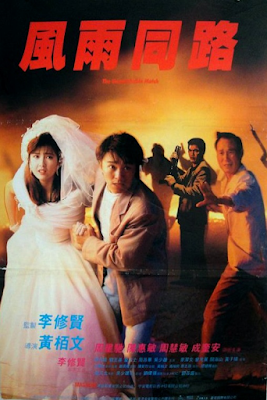


Much better was the following year's Unmatchable Match [1], starring a pre-fame Stephen Chow and once again, the always-dependable Michael Chan. Chow is an undercover cop who is thrown in the same jail cell as Chan, who's a suspect in a big diamond heist that was actually committed by Shing Fui-On (who also had a meaty role in Triads: The Inside Story). The escape and form an uneasy alliance, after which they become real friends. Lam Moon-Wah went the John Woo route for this movie, going more for the gunplay then the choppers this time around. There's a fight about midway through where Michael Chan fends off a number of thugs armed with choppers and wrenches at a car garage, so people wanting their fix of seeing stuntmen getting punched and kicked and thrown into car windows can look forward to that. The gunfights themselves never reach the level of a John Woo movie, but are fun enough. There's a tense chase sequence early on with Chow and Chan fleeing from Shing and his men through the narrow hallways of a building. In a touch of black humor, when the actors reach the roof, there are two other Triad gangs carrying out a drug deal. It ends in a gunfight that leaves everybody dead. The movie ends with a tense and well-mounted gunfight inside an abandoned building, with the heroes depending more on strategy and their surroundings rather than pumping countless rounds at their enemies.


Lam Moon-Wah reached the critical apex of his career the following year when working on Ringo Lam's Prison on Fire 2, which brought Lam his first and only Hong Kong Film Award nomination for Best Action Design. He would lose to Yuen Cheung-Yan, Yuen Shun-Yee and Lau Kar-Wing for their on Tsui Hark's epic Once Upon a Time in China, which really kicked off the wire-fu boom and helped turn Jet Li into an international action star. The ironic thing about this Chow Yun-Fat prison drama is that the action was rather generic. There are few fisticuff exchanges and scenes where people get stabbed with shanks made from toothbrushes, but nothing that Lam hadn't done better before or after and failed to get recognition for. The film is more an actor's movie, with Chow Yun-Fat and Elvis Tsui Kam-Kong putting in winning performances.

Don't Fool Me, a Triad comedy made the same year, could have been a good opportunity for Lam to lampoon the sort choreography that he had been doing since 1981. The story follows a Triad negotiator (Andy Lau), who switches places with an insurance salesman (Tony Leung Chiu-Wai), after the latter finds out that he has a brain tumor. Fight action is relegated to a single scene early on where Lau gets the trash kicked out of him by Anthony Wong's bodyguard, played by Mainland wushu stylist Yau Gin-Gwok (South Shaolin Master). There's also a game of chicken played with cars between Tony Leung and Bruce Law, who would later go on to be the go-to guy for vehicular mayhem in Hong Kong cinema. In the end, it's a pleasant, but instantly forgettable timewaster. The most memorable scene is a jarringly violent scene where Tony Leung imagines his pregnant girlfriend getting her hands smashed at a casino, which doesn't belong at all in an otherwise goofy comedy.


One of Lam Moon-Wah's most successful movies, financially speaking, was 1992's Prince of Temple Street. Andy Lau plays a low-level Triad working on Temple Street, a collection of stalls and shops (with a few brothels and opium dens hidden from public view). When an old rival is released from jail, he finds his territory under attack. There are several chopper brawls to be seen here, one of which features a nice "oh cool!" moment where a motorcycle is broadsided by a car, which sends the driver flying, whom is then cut down mid-air by the main villain, played by Chin Ho. The second-to-last set piece features a lot of vehicular mayhem and random explosions, but little in the way of actual physical combat. That's reserved for the end, where Andy Lau infiltrates the Chin Ho's hideout and goes all out with the machete and drop-kicking moves. He then has a vicious one-on-one with Chin Ho, complete with throws, punches, take-downs, and surprisingly enough, some wire-assisted jump kicks, too. All of this inside a building that is already on fire! It's a shame that the movie waits so long to get moving. And much like The Club, the decision to focus the finale on just one person makes the action more satisfying the previous brawls, which don't stand out because so much is happening at once.

While certainly not the worst of Lam's choreography jobs (although he makes a lot of bad decisions here), the 1993 girls n' guns stinker Lady Super Cop is widely regarded as being among the worst of its ilk, which is saying A LOT. Carina Lau plays a career-oriented policewoman whose new team includes her cousin, played by Teresa Mo. Mo's character is a veteran cop who's more worried about selling gadgets to members of the force than catching crooks. That all changes when the boyfriend of one of Mo's informants is brutally murdered by a psychopath involved with some bank robbers. The main problem here is that Lau's character is pretty incompetent and unthreatening. I mean, the woman is incapable of chasing down a guy who's just gotten broadsided by a van (a recurring theme in Lam Moon-Wah's works)! To be honest, the police in the film are largely useless and spend more time getting fired on and beaten up than anything else. Early on there's a martial arts sequence between Teresa Mo and Lam regular Michael Chan, who plays Mo's mechanic neighbor. Both are dressed in kung fu student clothes and are wielding weapons. But instead of fighting, the camera just switches between the two in different poses like an anime fight. It's really stupid. The big set pieces occur in the last act, beginning with a violent gun battle at the girls' apartment. Watch for a game of Wack-a-Mole played with a pistol and some brief fight action from Michael Chan, who steals the scene. The finale is a big fight between Teresa Mo, Carina Lau and the main villain in which the women let themselves get whooped. I mean, what kind of girls n' guns film allows the female characters to get beaten down like that? The idea of the women dishing out the hardcore martial punishment is why HK cinephiles love the sub-genre to begin with! Bad move, guys.


Like any third-string choreography, Lam Moon-Wah found himself having to pay the bills with a myriad of mercenary projects. One of them was the softcore sex comedy Girls Unbutton (1994). In a completely random scene, actress Loletta Lee goes on a date with local extortion gang leader Elvis Tsui Kam Kong. While they are dining, some rivals arrive and start cutting up his men. After an improptu round of alleyway sex, Tsui takes on the rivals. The choreography, like The Club, is very chambara in its presentation, with single slashes and speed being the rule of the duel. The scene lasts about a minute and is promptly forgotten about for the rest of the film.

We end this article with the 1994 crime drama Gambling Baron. This is actually a decent movie about low-level Triads, played by Roy Cheung and Max Mok, running the local racket, only to run afoul of a rival, played by old school kung fu actor Jimmy Lee. The fight scenes aren't bad and Max Mok has enough action experience to sell himself as one of the more powerful and intimidating fighters in the territory. The highlight is a fight in a narrow construction area between Roy, Max, kickboxer Billy Chow and a bunch of stuntmen armed with metal bars and choppers. Billy Chow gets in the best moves with his high kicks. Roy, in all of his action sequences, looks gangly and uncoordinated, convincing only when he has a gun in his hand. This fight, surprisingly enough, ends with the heroes getting broadsided by a moving van! Who would have thought? The movie mainly falters in the finale, which tries to tie up all the loose ends in about 8 minutes. I'm guessing the filmmakers simply ran out of money by this point. Thus, instead of a big set piece where Max Mok dishes out the justice only a sharpened machete can, we have him standing still firing an AK-47 until everybody is dead. It's an unsatisfying way to end an otherwise satisfying crime flick.


So despite having reached dizzying heights of action direction accomplishment with The Club, none of Lam Moon Wah's later movies were quite able to reach that height. Some came close, others even received official recognition for whatever merits they possessed. But none them made the mark in Hong Kong cinema like that film did. That isn't to say that Lam never again worked on a great movie. His work on the Mainland kung fu film Young Hero of Shaolin 2 is one of the hallmarks of Mainland Wushu on film, sitting comfortably next to the likes of the Shaolin Temple films. He also directed the fight scenes to the underrated gem Hero of Swallow, one of the last wire-fu films of the 1990s and one of Yuen Biao's last great kung fu performances. Lam has since become inactive in the Hong Kong film industry, having worked on nothing since 2004. He may not have ever reached the heights of Sammo, Corey and the Yuens, but at least he can say that he did something important for Hong Kong cinephiles to remember him by. Lam Moon-Wah, we salute you!


[1] - This article was written in March of 2015. At the time, the HKMDB listed Lam Moon-Wah and Samo Wong as the action directors of Unmatchable Match. Sometime around 2020 and 2021, the page was altered and Lam Moon-Wah's name was removed from the HKMDB credits for that film..

Monday, March 21, 2022

Story of the Drunken Master (1979)

Story of the Drunken Master (1979)
aka Drunken Fist Boxing
Chinese Title: 醉俠蘇乞兒
Translation:  Drunken Man Su Qi Er (“So Hat Yee” in Cantonese)


Starring: Sharon Yeung Pan Pan, Casanova Wong, Simon Yuen Siu-Tin, Yuen Lung-Kui, Yen Shi-Kwan, Dean Shek, Fung Gin-Man, San Kuai, Johnny Cheung
Director: Ngai Hoi-Fung, Hu Peng
Action Directors: Lam Moon-Wah, Liu Hok-Ming


Story of the Drunken Master is a strange beast. It barely qualifies as a drunken kung fu movie, let alone a kung fu movie. Should we bring the Truth in Titling Act of 1971 into the picture, this movie would be a guilty party indeed. Not only does it skimp on the drunken boxing, it’s also pretty low on plot, despite there being only three real fight scenes during the film’s 82-minute running time. Even more deceptive about the film is that it was once marketed as a Jackie Chan movie, released on VHS under the moniker Drunken Fist Boxing. Of course, this wasn’t a Jackie Chan movie in any sense of the word, but that didn’t stop the good folks at Xenon from inserting unused training footage from Drunken Master into the film, sticking a picture of Jackie from Drunken Master 2, and reaping a small profit from gullible newbie fans hungry for anything Jackie.

That last part shouldn’t be a detractor from enjoying this film. After all, it has a solid cast including female fighting diva Sharon Yeung Pan Pan, Korean superkicker Casanova Wong, and veteran kung fu villain Yen Shi-Kwan (who played a good bad guy in the Drunken Master rip-off The Fearless Hyena that same year). Co-director Ngai Hoi-Fung has done some reasonably entertaining films, like Young Hero of Shaolin 2 and his frequent choreographer partner Lam Moon-Wah has shown us that when given the right cast, he can be pretty darn good action director. Unfortunately, something went extremely awry while making this movie and the end result is a thoroughly worthless film save the last 15 minutes.

The movie begins promisingly…well, sort of. The famous “General’s Mandate” piece begins playing and we get to see Simon Yuen Siu-Tin (Sleeping Fist and The Mystery of Chess Boxing) perform a drunken boxing routine. Joining him are his three students: Casanova Wong (The Master Strikes and Warriors Two), Sharon Yeung (Angel Terminators and Angel Enforcers), and Yuen Lung-Kui (whom I suspect is one of Simon Yuen’s sons, considering how much he looks like a thinner version of Yuen Yat-Chor). Lots of acrobatics are performed and Sharon Yeung performs some snake fist. The scene also goes on quite a while, which will set the precedent for almost every other scene in the movie.

After that long opening sequence, we meet a fellow named Cougar (San Kuai) who’s on his way to the local casino. As most characters are in these movies, Cougar is a pretty crappy gambler and soon loses all his money. Unexpectedly, instead of leaving the establishment with his head down, he loudly accuses the casino of cheating him, grabs the money, and takes off. A big chase ensues, but nothing really comes of it, beyond us learning that Yuen Lung-Kui’s character is a noodle maker by trade.

We cut to a pawn shop, where Cougar shows up and tries to sell a piece of old leather for an exorbitant amount of money. When he starts making a ruckus about it, the shop’s owner, Chi Wai (Casanova Wong), shows up and tries to calm him down. A fight breaks out between the two, and then between Cougar and Beggar So (the English dub is interesting in that Beggar So is actually called Beggar So and not Sam Seed). Beggar So recognizes Cougar as the student of Bill Chan (Yen Shi-Kwan), a fellow whom he humiliated years before.

In the next scene we learn that Beggar So’s female student, Gam Fa (Sharon Yeung), is a professional entertainer of sorts. She works at her uncle’s restaurant, performing acrobatics while spinning plates on her fingers. I hope you like plate spinning, because the film will treat us to several interminable scenes of them, including a long, dull comic segment where Gam Fa shakes off the romantic advances of some rich guy, played by comic vortex Dean Shek.

Meanwhile, Cougar reports back to his master, who appears to be making a living as some sort of extortionist. Bill Chan and Cougar head over to the casino where they strike up an alliance with the casino owner (Johnny Cheung Wa, who made a living playing background thugs in films like Dragons Forever and Fight Back to School II). Casino guy has the hots for Gam Fa, and Bill Chan is more than willing to help force her into a marriage with the guy, if it means shaming Beggar So. At one point, Bill proclaims that his goal is to show Beggar So just how successful he really is and make die alone.

Now wait a cotton-pickin’ minute here! What sort of low-grade kung fu villain has a revenge scheme whose ultimate scheme is to make the good master jealous and lonely? This is a post-One Armed Swordsman kung fu movie, not sort of a half-baked soap opera! Now, just stick with me and I’ll start assigning blame in a moment.

Bill’s first item of business is to get Beggar So’s landlord to evict him. Considering that Beggar So is…well…a beggar, I’m sure being homeless isn’t really going to screw with his head that much. Casino guy then picks a fight with Gam Fa. Chi Wai steps in and the two give him a nice thrashing. When Bill Chan shows up demanding retribution, Beggar So is forced to dislocate Chi Wai’s shoulder in order to save face. This leads to a laughably melodramatic where Beggar So himself almost breaks down into tears when he has to explain his actions to Gam Fa. Apparently our writers wanted a kinder, gentler drunken kung fu master this time around.

Casino boy then shows up at Gam Fa’s doorstep, making her father an offer he can’t possibly refuse. So now Gam Fa is engaged to Casino dude, much to everyone’s dismay, and if her father goes back on his word for any reason, there’s going to be good reason to have a fight scene…finally.

Compared to Drunken Master and Dance of the Drunk MantisStory of the Drunken Master is incredibly pokey when it comes to pacing. Non-fighting sequences are often dragged out way past the point when the audience stops caring, so unless you like long scenes of people gambling or spinning plates, you’re probably going to consult your watch often while watching. Of course, this is worsened by the general lack of fight action in this movie. If you ignore both the training sequences and the Dean Shek cameo, there are really only three fights in the entire movie. Compare with Yuen Woo-Ping’s classics about Sam Seed/Beggar So, both of which have three fights in the first ten minutes. This one takes longer than that just to reach the first fight scene, and then another half hour to get to the second.

I’m willing to place the blame for this on co-director Hu Peng. This movie was one of two capstones on Hu Peng’s forty-year career, which started in 1939 and spanned nearly 200 films. However, a bulk of those were made during the 1940s and 1950s, including numerous films about Wong Fei-Hung. Hu Peng only made a few films in the 1970s and before this one, his last film had been in 1973. I can only surmise that he was at a loss at how to direct a kung fu movie in 1979 when the rules had changed so much from his heyday. Endless scenes of people talking and women twirling plates around might’ve easily entertained audiences a few decades before, but by 1979, audiences wanted more. The 1940s filmmaking mentality simply didn’t have a place in 1970s kung fu films, even a relatively goofy 1970s kung fu comedy.

The kicker is just how insubstantial the plot of the movie is, considering how much attention it’s given. Beggar So is given not one, but three students this time around, but none of them have much personality. Casanova Wong’s Chi Wai is practically a non-entity, showing up mainly when there’s a fight to be had. Sharon Yeung’s character a bit more meat, even though she spends good portion of her non-fighting scenes weeping, which is unbefitting a kung fu diva, save when her father, husband, or son is killed. The other student just sort of takes up space when you get right down to it.

Hu Peng’s lackluster direction also robs the film of any forward momentum. There’s no sense of rising action in terms of what Bill Chan does to Beggar So. In a better movie, the villain would persecute the hero at every turn. By the time the movie reached the climax, we’d all be rooting for the protagonist to break every bone in the guy’s body. In this movie, Bill Chan’s attempts to torment his foes are met with a strangely casual attitude. I’m pretty sure that Ngai Hoi-Fung only stepped in order to give the film a bit more energy after the producers saw what Hu Peng was doing.

Even the training scenes are almost completely botched. Action directors Lam Moon-Wah and Liu Hok-Ming stage the training sequences competently, but they completely disengaged from the plot itself. There’s no training for revenge or redemption or anything like, nor are we given any motives as to why or how Beggar So got these particular students. The film simply cuts to random scenes of Beggar So training with his students at random intervals with no regard whatsoever as to how they connect with the preceding scene. It’s also bit strange for a film about Beggar So with the word “Drunken” in the title to not have any drunken boxing training.

That said, it must be pointed out that there’s almost no drunken boxing whatsoever in the movie. After Simon Yuen’s initial demonstration, the style only shows up during the last fight, when Yuen Lung-Kui inexplicably gets drunk and starts using it on Yen Shi-Kwan’s mantis boxing character. There’s nothing explicitly wrong with its execution, but it feels shoehorned into the fight, as if Lam Moon-Wah and company just had to do it, not because it really had a place in the action.

The final fight is the only worthwhile part of the film. I’m sure that Ngai Hoi-Fung was more actively involved with this portion of the film than he was the rest. Casanova Wong, aka The Human Whirlwind (not to be confused with the Human Tornado, played by Rudy Ray Moore), is known for his fast and furious spin kicks. They get some showcase here, and it’s a bit ironic that a Korean superkicker is the hero instead of the villain here. Watch for a aerial kick that starts as a splits kick and ends in a flying front kick. Casanova gets to take on Johnny Cheung before teaming up with the others against Yen Shi-Kwan. Sharon Yeung’s acrobatic snake fist is a lot more entertaining to watch. But then again, Sharon Yeung is infinitely more fun to watch than Casanova, what with his limited acting abilities, hairstyle that was popular back in Ancient Egypt, and strange-looking face. Simon Yuen does get to fight a bit, too, even if he is obviously doubled for the acrobatics. Yen Shi-Kwan’s mantis style looks great, a nice compliment to the Eagle Claw he used in The Fearless Hyena. At one point, he uses his belt as a rope-dart, which is actually pretty cool. The choreography is occasionally cheapened by some undercranking, but Lam Moon-Wah and company do a good enough job that you wonder why their talents were wasted so much during the first hour.

Friday, March 11, 2022

Young Hero of Shaolin II (1986)

Young Hero of Shaolin II (1986)
aka: Iron Man; New Fong Sai Yuk Part 2
Chinese Title: 新方世玉續集
Translation: New Fong Sai Yuk Sequel


Starring: Xun Feng (billed as Shut Bo-Wah), Chen Yong-Xia, Li Zhi-Zhou, Cheung Wang-Mui, Maggie Lam Chuen, Chui Ngai, Ko Fung, Chi Ke-Chuan, Chow Kung-Kin
Director: Ngai Hoi-Fung
Action Directors: Poon Yiu-Kwan, Lam Moon-Wah


I complained at length in my review of the first Young Hero of Shaolin film that the movie, in its attempts to fit in as much of Fong Sai-Yuk’s life as possible into the running time, became an episodic collection scenes, several of which were completely unrelated to the rest of the film around it. Moreover, the film was rather stingy on the fight, especially during the first fifty minutes or so. Despite some ambitious gimmicks to the fights, most of the choreography was uninspired until the final tournament.

Young Hero from Shaolin 2
goes out of its way to correct most of these flaws and is generally successful at doing so. There are two parallel plot threads established early on that intertwine by the end of the first act, so that we have an overarching conflict for the entire film. This is a major step forward from the first film, which sets up the two villains in the first scene and then keeps them out of the story until the last twenty minutes. The plot is also ambitious enough to include a villain who’s the brother of a character Fong Sai-Yuk fought in the previous film, which serves as a link between the two films.

One of my major issues with
Young Hero from Shaolin was how it treated the supporting characters. Characters often showed in film simply because they “needed” to, but were quickly forgotten by the narrative. That was especially true with Wu Wai-Kin and Fong Sai-Yuk’s mother. This movie doesn’t make that mistake to such a degree, as the film is just about as much about Wu Wai-Kin as it is about Fong Sai-Yuk. While Miu Chui-Fa (Fong’s mother) doesn’t have a lot to do, she at least gets to participate in the film’s major set pieces.

Speaking of which, veteran director Ngai Hoi-Fung eschewed the inexperienced Mainland choreographers in favor of a couple of a third-string Hong Kong action directors. The movie is that much richer for it. Poon Yiu-Kwan worked on a dozen or so low budget films during the early 1970s, his main claim to fame being assistant action director in King Hu’s masterpiece
A Touch of Zen. Lam Moon-Wah, who worked with Ngai on Story of the Drunken Master, is known around these parts for his superlative work on Yuen Biao’s Hero of Swallow. Quite frankly, this features some of the best choreography I’ve ever seen in a Mainland Chinese martial arts film.

The movie’s not perfect, however, but we’ll mention bring up the film’s flaws as we discuss the plot.

The movie starts out at the ShaolinTemple, where we meet Fong Sai Yuk (a returning Shut Bo-Wa, also of
Yao’s Young Warriors). The opening scenes are rather confusing. We start with the Shaolin abbot gathering all of the monks together and saying that he has something to tell him. Suddenly, the film cuts to another part of the temple, where Fong Sai-Yuk is practicing his two-finger strike. Instead of striking things with his fingers, he prefers to do a one-handed handstand, but with only his index and middle fingers supporting his weight. Strangely enough, the abbot is watching, despite his declaring before that he had a declaration to make. I’ll also point out that the change in music is as abrupt as the scene change itself. After Fong’s demonstration, there’s another jarring cut to the Shaolin monks walking around the temple. I think this was taken from the earlier scene.

The next scene establishes Principle Plot Thread #1. The local Qing magistrate, Chang Bill (Yes, his name is Chang BILL!), is told by his boss that the Emperor is growing suspicious of Shaolin. Chang Bill is tasked with rooting out the rebels. Okay, that’s all well and good. After all, the Shaolin Temple was purged by the Qing government during Fong Sai-Yuk’s lifetime, at least according to contemporary literature. The problem is the scene after that, where Chang Bill goes to Wudan to solicit their services in this endeavor.

There’s nothing wrong with the Wudan subplot. It’s shown up in films like
Two Champions of Shaolin and Showdown at Cotton Mill. While modern Wudan student typically deny that Wudan ever collaborated in the Qing’s campaign against Shaolin, it’s enough of a folk story that there may be some kernel of truth to it. The problem is that the Wudan school figure little in the story until the final series of battles. It certainly adds a level of scope to the film, but it’s hardly developed.

A bigger problem with the scene between Chang Bill and the leader of the Wu Tang Clan (yes, Wu Tang and Wudan are one and the same) is that Chang Bill specifically singles out Fong Sai-Yuk as their single target. He also seems extremely bent on killing Fong. That’s all well and good, but the other official had alluded to their being multiple rebels. So if you’re told to purge a temple because of rebel activity, why would you focus on a single layman who’s not even a full-time student anymore? Now if Fong Sai-Yuk were a rebel leader, that would make some degree of sense. But there’s nothing in the film that establishes Fong Sai-Yuk as a rebel in the first place. Yes, we know he was a big Ming patriot in real life, but the film more or less expects the viewer to be familiar with the history. That would be less of a problem if it weren’t for a piece of dialogue of Fong’s: “I never thought I’d see a government official who acted like a villain.” As silly and naïve as it is, it shows that Fong was never much of a rebel to begin with, nor did have any inherent dislike of the Qing rulers.

The next ten minutes of the film or so are made up of a bunch of random fights, which is always good. First we see Fong Sai-Yuk beating some of Chang Bill’s cronies, who are out terrorizing the populace. Then Wu Wai-Kin (now played by
This is Kung Fu’s Li Zhi-Zhou) gets in a fight with a couple of bozos at a restaurant who mistaken him for Fong Sai-Yuk. That fight is followed by one set at Wu’s uncle’s (Chan Dung, Dragon from Russia and The God of Cookery) kung fu school, in which a bunch of thugs working for Dragon Head show to intimidate the school into not participating in the upcoming lion dance. The teacher’s daughter, Wu Wai-Jan (Cheung Wang-Mui), unleashes some pa-kua and helps keep the men at bay. Later on, a bunch of random hoodlums try to jump Wu Wai-Kin on his way home, all of whom are no match for Wu and his eagle claw style.

Wu Wai-Kin arrives at the Ngo school and the resulting dialogue between him and his uncle reveal Principle Plot Thread #2. Wu Wai-Kin’s parents were murdered by Dragon Head, who then used his influence to take over Wu’s family business: a clothes dye factory. Wu was then sent to Shaolin to train in kung fu in order to avenge his parents’ murder. This is a big part of the Wu Wai-Kin legend, since it shows up in Chang Cheh’s
Men from the Monastery and Shaolin Avengers. The movie quickly establishes Dragon Head as being in cahoots with Chang Bill, thus sparing us a pair of underdeveloped plotlines. There’ll be plenty room for that with the introduction of villain #3.

Said villain is Lu Tai-Pang (Li Yu-Wen,
The Undaunted Wudang), also known as the “Iron Mantis.” He’s Tiger Lu’s brother, whom I assume to be the same as Lui Hung, the main villain from the first film. He’s understandably upset that his brother died in a duel with Fong Sai-Yuk and wants his revenge.

So there’s an extended lion dance sequence, which ends in a huge brawl between the rival schools. During the lion dance, Chang Bill decides that he rather likes 
Wu Wai-Jan and asks Dragon Head to kidnap her for him. I like how in this scene, Chang Bill’s wife is listening in on her husband’s plans and her only reaction is a monotone “Oh, not another one.” Dragon Head employs Lu Tai-Pang’s services in kidnapping Fa-Kiu at some night festival, which is part of a trap to catch both Fong Sai-Yuk and Wu Wai-Kin.

Wu Wai-Jan is indeed kidnapped by Dragon Head and his gang, although not after a well-choreographed fight between her, Lu Tai-Pang, and Dragon Head’s men. And sure enough, Fong Sai-Yuk and Wu Wai-Kin are donning their “ninja gear” (yes, they use this term, even though there are no ninja in China, save the Lin Kuei) and going to Dragon Head’s place. They follow Dragon Head and Lu Tai-Pang into the forest, where they fall into a trap. The only reason they leave the forest alive is because of the sudden intervention of Fong Sai-Yuk’s mother (still played by Chen Yong-Xia, who was old enough to be Fong Sai-Yuk’s sister). 

After another random fight at a dye factory, Fong Sai-Yuk is challenged to a duel by Lu Tai-Pang. The locale just happens to be the sacred mountain retreat of Pai Mei himself (Chui Ngai, of
Murky Shadows over the Gorges). Everybody knows it’s a trap, there’s no doubt about that. The problem is that even if they survive the next series of fights, there’s still the chance they’ll have to deal with an irate Pai Mei.

The scope of the plot here is far more ambitious than that of the last movie, since it tries to incorporate the events of the lives of not one, but two Chinese folk heroes into a single story arc. That’s a pretty tall order for a movie that’s less than a 100 minutes long, and obviously some subplots are going to suffer. The obvious underdeveloped subplot is that involving Pai Mei. According to most legends, Fong Sai-Yuk really did face off against Pai Mei, who may or may not have betrayed Shaolin. While their duel in the film is foreshadowed, Pai Mei doesn’t actually show up onscreen until after the real villains have been eliminated. It feels more like a historical coda than a legitimate plot development.

Then there’s the business with the Shaolin Spinning Palm technique. There’s a brief interlude from the main plot where Fong Sai-Yuk and Wu Wai-Kin go to Shaolin to inquire of the technique from San Te. For those of you who don’t know who San Te is, let me explain. San Te was a Shaolin monk who’s credited as being the guy responsible for opening up the Shaolin Temple to laymen. He’s the subject of several films, most notably the Lau Kar-Leung classic
The 36th Chamber of Shaolin. Anyway, San Te gives the two a brief explanation of how the technique would work. Suffice to say that there’s some payoff in that Fong gets to use the technique twice at the end. The problem is that we never actually seem training to use it, despite it being a lost style that not even the Shaolin Abbot could figure out.

Most of this is forgivable because there is so much action on display that the flaws in the story don’t stick out until later viewings (the sudden cuts in scenes being the main exception). Action directors Poon Yiu-Kwan and Lam Moon-Wah really outdo themselves here. Lam has been criticized before for not being a great action director. I think he proves here that his career has been a victim of time and talent restraints. There are action directors out there who can do wonders in a couple weeks’ shooting time, like Donnie Yen in
Legend of the Wolf. Lam isn’t one of them. And while Poon has a pretty extensive résumé, most of his movies were cheap Taiwanese wuxia films, including The Samurai, which was one of the first old school movies I ever saw. I assume that Poon contributed to wire stunts in the film. There aren’t a lot of them, but they are executed with a great deal more panache than most Mainland films of that era.

Lam and Poon choreograph the fights in such a way that it never feels like the actors are performing sets on each other. The punches and kicks have more impact in this film than in the last few Mainland films I’ve seen. Speaking of which, both Shut Bo-Wa and Cheung Wang-Mooi have some nice aerial kicks, especially Cheung during the fight against the Wu Tang Golden Formation. The showdown between Fong Sai-Yuk and Chang Bill is one of the more brutal fights in a Mainland film, right up there with the finale of
Holy Robe of Shaolin. It’s only undermined by a few seconds of unnecessary undercranking. I also call attention to Maggie Lam’s baguazhang in an early fight, which is executed with more power and crispness than what we saw in The Undaunted Wudang.

While most of the fights are hand-to-hand, Lam and Poon keep things varied like most self-respecting Mainland films do. Chan Wing-Ha, who did little of interest in the first film, gets to perform some nice tai chi sword play in three set pieces this time around. The fight at the dye factory has numerous attackers trying to tie up Fong Sai-Yuk with long strips of cloth, which is an interesting touch. Then there’s the showstopper: Fong and company take on an army of Wudan monks armed with razor sharp symbols. It’s referred to as the Golden Formation and is a reference to the Lo Han Formation of the last film, but on a larger scale. The choregraphy, while a bit chaotic, is far more interesting here than it was in the last film. Watching dozens of extras move in unison is just too cool for words.

All things considered,
Young Hero of Shaolin 2 corrects most of the mistakes made in the first film. With that in mind, the filmmakers can field proud of themselves knowing that it is worthy to stand beside other adaptations of the Fong Sai-Yuk legend. It easily stands in the upper echelon of Mainland Chinese kung fu movies, thanks to two choreographers who, like Wu Wai-Kin, always stood in the shadows of their contemporaries. That should be reason enough to watch this film. If not, I’m sorry, but I don’t know what else I can do for you.

Hero Dream (1992)

Hero Dream (1992) Chinese Title : 淫妖豪情 Translation : Lewd Demon Passion Starring : Chin Siu-Ho, Chin Kar-Lok, Carrie Ng, Michiko Nishiw...