
Showing posts with label Alexander Lo Rei. Show all posts

Saturday, March 19, 2022

Shaolin Temple Against Lama (1980)

Shaolin Temple Against Lama (1980)
Chinese Title: 紅衣喇嘛
Translation: Red Lama
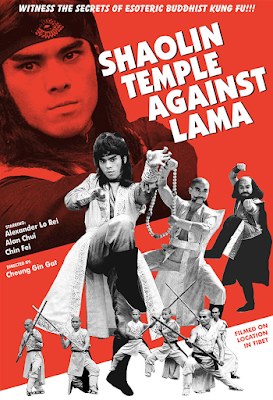


Starring: Alexander Lo Rei, Alan Chui, Chang Chi-Ping, Miu Ho, Wang Hsieh, Lucifer Li Hai-Hsieng Yang Hsiung, William Yen
Director: Chang Chien-Chi
Action Director: Alan Chui, Wang Chi-Sheng


The move I'm reviewing is not Shaolin vs. Lama, which was directed by the great Taiwanese director Lee Tso Nam and is considered one of the all-time great kung fu movies. However, before we begin, let me point out that in both films, the evil Tibetan Lama villains are masters of styles that make their bodies impervious to any sort of harm (except for a few weak points). You know, if Tibetans today would stick to their martial roots and practice these styles, maybe they wouldn't have so many problems with the Chinese commies. That said, let's talk about the plot (such as it is).

In Ancient Tibet, the Lamas are divided into five factions and are ruled over by one emperor. The Tibetan prince (Alexander Lo Rei, the Taiwanese Michael Dudikoff who appeared in films like Shaolin Dolemite and the Ninja Death trilogy) is studying martial arts with the Red Lama faction and will soon assume his throne. At the same time, the leader of the Black Lama Faction, Cha Siu (Alan Chui, Kung Fu vs. Yoga and Last Hero in China, who's also the action director here) is trying to get the martial arts manuals from all of the kung fu schools in the country so that he may be all powerful and take over Tibet.

Unfortunately, there are two schools who haven't given in to him so far: the Ching school and the Shaolin Temple. So he sends his men to the Ching School and they kill everybody and get the manual. They are less successful, however, at the Shaolin Temple. One of the high officials tries to talk Cha Siu out of his quest for power, which Cha Siu responds to by sending his men to kill him. Luckily, he's protected by the Shaolin Monks and a drunken master (who's really a Shaolin monk in disguise).

At the same time, Cha Siu is sending his assassins to kill the Prince, who has just left the Red Faction monastery. One funny part is that the Red Lama leader tells the Prince to resolve the conflict between the Black Faction and the Shaolin Temple, telling him, "Not all Black Faction members are evil and not all Shaolin monks are good." Well, at the end of the film, all of the Shaolin monks were good and all of the Black Faction members are both evil and dead. Some wise leader you are.

Not being able to kill the Prince, Cha Siu decides to deceive the Prince into thinking that the Shaolin monks are evil, by staging assassination attempts by bald guys with white dots on their heads. The Prince goes to the Shaolin Temple to challenge the monks and gets his booty handed back to him, and is forced to stay at the temple and train. While all this is going on, Cha Siu hires the Persian Killers to kill off the Red Lamas and the Shaolin monks. Several high-octane throwdowns ensue.

Well, that's the plot. Before I talk about the action, let me mention that this film is a prime example of the cheap chopsockey film that was made in Taiwan. Cha Siu's lair is pretty threadbare with a silly multi-armed statue adorning his throne/altar. The costumes are these silly, bright, multi-colored kung fu outfits I can't imagine anyone in their right mind using, not even during the Ming Dynasty (or whenever the film is set). There are some nice exterior shots of Tibetan temples and people and stuff, although if you compare the Taiwanese actors to the people you see in the establishing shots, they look nothing alike.

Let's discuss the action. This is one of the most action-packed films I have ever seen. There are no less than 19 set pieces which take up more than half of the film's running time. Alan Chui's choreography is a lot better here than in a lot of other low-budget Taiwanese films. There is some occasional excessive undercranking which cheapens things a bit, although it gets less prevalent as the film progresses. The main problem is that the Alan Chui could have (and should have) made the action a lot more varied. It's kind of the same thing over and over again (and after 19 set pieces, it is a bit hard to remember one fight from the other). There is some weapons work (spears, poles, sabers, and assault blades), but none of it is particularly memorable.

Nonetheless, most of the actors are in top form. Alexander Lo Rei looks particularly good in this movie, especially in the last two fights (the best in the movie) when he starts pulling of some bootwork that'd make Legendary Superkicker Hwang Jang Lee proud. Alan Chui doesn't see much action until the end, but he's a talented onscreen fighter and makes the perfect villain for Lo Rei to fight. Everyone else is pretty solid, even if their fights aren't particularly memorable.

I do recommend this film for fans of the genre, although naysayers will probably be bored after the fifth or sixth fight scene.

Friday, March 11, 2022

Death Cage (1989)

Death Cage (1989)
Aka; Bloodfight 2; Mortal Combat 2: Death Cage


Starring: Robin Shou, Joe Lewis, Steve Tartalia, Mark Long, Kam Seung-Yuk, Wayne Archer, John Ladalski, Toby Russel
Directors: Chan Man-Sam, Robert Tai
Action Director: Robert Tai, Alexander Lo Rei


I don’t really have an intro to this particular piece of work. It’s such a shoddily-plotted time-waster that it’s hard to comment on it beyond its fight scenes. It does, however, occupy an interesting place in director/choreographer Robert Tai’s filmography. By 1989, his Shaw Brothers days were long behind him, and his ninjasploitation era had apexed with Ninja: The Final Duel only a few years earlier. I guess this film was a transition in this Tai’s final period, which saw ever-so scant returns during the 1990s. The last time I’d heard about him was when he teamed up with Chi Kuan-Chun and the Wu Tang Clan to make a wuxia film during the late 90s/early 2000s, although that film never saw distribution. I find it rather odd that one of the genre’s highest-paid choreographers (according to an interview he gave at the now-defunct Kung Fu Cult Cinema website years ago) had practically drifted into obscurity by the late 90s (unless he was a regular on Taiwanese TV).

In the city of Bangkok, there are two very “important” schools, those being the Wai Chai School (whose master is a real sissy) and the Kents School, ran by farang Joe “I beat Chuck Norris” Lewis. During a tournament, a Kents fighter named Lai Chai (Kam Seung-Yuk, who looks like Lam Ching-Ying on steroids) beats the Wai Chai’s top student, See Hom (Robin Shou, of the Mortal Kombat films), by cheating. While working See Hom’s leg over with brass knuckles, his master tries to intervene and gets his leg permanently broken for his troubles. The Wai Chai school is disgraced and closes down, although to be honest, we never had much evidence that the school had any more than three students.

Some months later, See Hom’s master and his worthless adopted daughter is living with him at his car garage, when they are visited by the master’s brother-in-law, Tang Chuan (the Ghost-Faced Killer himself, Mark Long). Tang Chuan decides to pass his wushu and tai chi skills on to See Hom via exercises that involve objects at the car garage. So See Hom is slowly becoming a real kung fu master, while the lack of decent competition for the Kents school means lower betting profits for its owner, Mr. Hunter (Joe Lewis). Thus, a rematch between See Hom and Lai Chai is in the works. And what will happen when See Hom proves to be more than a match for Lai Chai *and* the Kents star fighter (Steve Tartalia)? Then we’ll see just how dirty these farangs are willing to play.

Death Cage is little more than The Karate Kid with a few extra helpings of stage blood for our actors to be doused in and spit up. Beyond that basic premise, not very much in this movie makes any sense. I don’t know how the Wai Chai school could have become so popular when the master is so against fighting that he encourages See Hom to *let* a bunch of random Thai thugs wreck his garage in front of his face. How could a sissy like that run a school capable of producing the only competition worthy of the Kents Gym fighters? Oh, yeah, I remember now: bad writing.

If you were to judge the film on the first three fights or so, you’d wonder how Robert Tai ever reached the exalted position at the Shaw Brothers that he once did. The first fights in the ring, especially those between Robin Shou and Kam Seung-Yuk, who wears a lion’s mane wig and is decked out in leopard print, are rather lackluster. Shou’s punches and kicks are pretty basic, broken up by the occasional drop kick or throw. Still, Shou did better work in the American Mortal Kombat films than he did here. Things pick up a little during his first fight with Tartalia, since the latter is a more dynamic fighter. We didn’t see much of his skills in Once Upon a Time in China (1991), but Tartalia is actually a first-class kicker. His moves are more stylish than Shou’s, who turns out to be a more economical fighter.

The movie picks up in the second half, with several 1-on-2 and 1-vs-many fights. These dwarf those earlier ring fights, and choreographers Lo Rei and Robert Tai feel much less restrained in their choreography. We see Robin Shou take on a bunch of machete-wielding Thai thugs (probably the only Thai people in Thailand we see in this film), with a rhythm that recalls some of Jackie Chan’s better group fights. Shou’s moves are still pretty basic, but the direction itself is solid. Mark Long gets two fights, his main one being against Mr. Hunter’s two bodyguards, a white girl and a black girl (both of whom are blonde, if you care). Those two girls have a lot of acrobatic moves and moving-in-tandem choreography, which is really neat and comes close to representing the high point of the movie.

Later, Mark Long’s daughter, whom we saw practicing baguazhang earlier, takes on the two female bodyguards in a brutal and vicious fight in closed quarters. The movie ends with a rematch between Robin Shou and Steve Tartalia and then a final fight against Joe Lewis. These two fights are set in a bamboo cage adorned with sharpened stakes. By this point, Tartalia’s character has trained in classic kung fu as well (watch for a cameo by the late John Ladalski as one of his teachers), so the two are better matched. Shou gives the best wushu-centric performance of his career in this fight, with lots of traditional handwork and forms being integrated into his kickboxing. Tartalia, while still showing us some great bootwork, backs it up with some more classical kung fu movies as well. It actually becomes less interesting when the legendary Joe Lewis steps in, since he’s obviously over the hill (although he’s still pretty built) and his moves are even less flashier than Shou’s (Lewis does try to make up for it with some bizarre overacting). Things get outrageously violent as characters get impaled in different ways and nobody faints from blood loss, Thai people, where muay thai was invented (or at least popularized), aren’t even worth mentioning.despite the red paint being splashed about. But when these characters die, boy, do they die hard.

The Super Ninja (1984)

The Super Ninja (1984)
Chinese Title: 影子軍團
Translation: Shadow Legion


Starring: Alexander Lo Rei, Eugene Thomas, Chang Yi-Tao, Jack Long, Tong Lung
Director: James Wu Kuo-Ren
Action Director: Chu Ko, Jack Long

My recent foray into Alexander Lo Rei's ninja films (I believe this is the 5th that I've now seen) comes to an end with this one, which could've been my absolute favorite if not for a few things, which I'll discuss in a moment. Lo Rei plays John, a recently-graduated ninja who's working as a cop in the USA (we know it's America because he has a black partner and the every room at the police station has an American flag on the wall). He gets in hot water with his racist white boss for busting a group of thugs trying to gang rape a girl because one of the thugs is the son of a senator (nevermind that the thugs are also guilty of assaulting a police officer). His boss and his corrupt white cop friend frame John for drug dealing at the behest of the evil ninja Mr. Tong (Chang Yi-Tao, who briefly was a Bruce Lee imitator with the moniker "Bruce Lai"). Mr. Tong also commands the super powerful "Five Element Ninja" formation, who carry out most of his negotiating and assassinations. Anyway, after being tortured by the cops trying to extract a confession and watching them molest his girlfriend (I'm told it's a late-period Doris Lung), John escapes from prison and the film briefly becomes a First Blood clone. When the ninja attack his girlfriend and her family, John must use his ninja skills to defeat them.

First things first, the fighting is magnificent. It's choreographed by both Jack Long (who also plays Lo Rei's master) and Chu Ko, who also helped choreographed Chang Cheh's classic 
Five Element Ninja. I've rarely seen Alexander Lo Rei's tae kwon do skills get such a great showcase, but man, he's great here. He approaches the level of Legendary Superkicker Hwang Jang Lee here. The ninja fights are also lots of fun, if a little cheesy, which isn't surprising, considering Chu Ko's involvement in the film. There are a lot of fights and most of them are varied: a Rambo-esque sequence where he hunts the corrupt cops, numerous one-on-one fights, one-on-many fights, two-on-one fights, etc. Alexander Lo Rei gets to match skills with frequent collaborator Eugene Thomas and Korean fighter Chang Yi-Tao, who practically steals the show during the lengthy finale. Great stuff all around. My only caveat with the fighting is that some of it is undercranked to early 90s Donnie  Yen levels, namely his fight against Eugene Thomas.

Ninja fans will get more than there fair share of wire-assisted ninja madness, plus lots of fighting with katana, yari (spear), shuriken, kama (sickles), and sai swords. Moreover, it's pretty clear that Chu Ko recycled his ideas from Five Element Ninja, but slightly different. The five elements here are Metal, Wood, Fire, Earth and Water. The metal ninja, who wears a shiny gold costume, is mainly distinguished by his being highly durable; it takes quite a bit to bring him down. The wood ninja does crazy wire tricks jumping from tree, as opposed to dressing up like a tree in the Chang Cheh film. The water ninja can swim at outrageous speeds and use his sword as a surf board, much like Duel to the Death. The earth ninja can burrow underground, again, like some of the ninja in Duel to the Death. Finally, the fire ninja can set his hands on fire and use them as weapons. It's similar to Chang Cheh's film, but does enough different to set itself apart.

The main problem with the film is its treatment of racism, which is both silly and over-the-top. I'm pretty sure that by 1984, people couldn't call their subordinates 'chink" and "colored people" without suffering some sort of legal retribution. Speaking of legal, at no point is Alexander Lo Rei given any sort of legal representation when he's framed for drug possession, although he's a cop and thus should both know his rights and some of the finer points of the law dealing with this sort of thing. Nor do his wife and her scientist dad consider the legal ramifications of both his incarceration or the policemen forcefully feeling her up. The characters ramble on about it being a 'white man's world" and that's that. Yes, racism still exists, but I'd assume that by 1984, a white person in power couldn't quite get away with the things they could do twenty years before.

Finally, the HKMDB doesn't state who plays the girlfriend, but I've read numerous reviews suggesting it's Doris Lung. If it is her, it's really weird watching her in a martial arts film where her main contribution to the film is an explicit, four-minute-long sex scene that includes loving (heh) close-ups of the actress's breasts and buttocks as she and Lo Rei go through numerous positions. I've read that Doris Lung's career petered out after personal problems made her difficult to work with, but it's a sad cap to a career of a kung fu diva if the only work available is shtupping Lo Rei.

(Obs: There are at least three versions available on Youtube. The English dub, posted at the Wu Tang Collection, is missing all of the interaction between Lo Rei and his girlfriend after he breaks out of jail, including her shower scene and their lovemaking. The Mandarin version, also posted by the Wu Tang Collection, has part of the shower scene and the two's post-coital conversation. Finally, there's a French dub posted that has the girlfriend's shower scene and the love scene in all their sleazy glory)

Big Man Japan (2007)

Big Man Japan (2007) Starring : Hitoshi Matsumoto, Riki Takeuchi, Ua, Ryûnosuke Kamiki, Haruka Unabara, Tomoji Hasegawa Director : Hitoshi M...