Showing posts with label Leslie Cheung. Show all posts

Sunday, June 29, 2025

The Bride with White Hair (1993)

The Bride with White Hair (1993) Aka: Jiang-Hu, Between Love and Glory Chinese Title: 白髮魔女傳 Translation: The Legend of the White-Haired Demoness


Starring: Leslie Cheung, Brigitte Lin, Francis Ng, Elaine Lui, Law Lok-Lam, Bao Fang, Eddy Ko Hung, Joseph Cheng King-Kei

Director: Ronnie Yu

Action Director: Phillip Kwok


When it comes to contemporary (i.e., 20th century to the present) wuxia authors, there is apparently a trifecta of important authors: Gu Long, Jin Yong, and Liang Yusheng. There are two other important ones, in my esteem: Wong Ying and Wang Dulu. Gu Long’s ginormous bibliography essentially defined Shaw Brothers director Chor Yuen’s career during the late 1970s and early 1980s. Jin Yong needs no introduction: he wrote a handful of humongous novels which have been adapted to film and TV and continue to be until this very day (see Donnie Yen’s Sakra and Tsui Hark’s Legends of the Condor Heroes: The Gallants).


Wong Ying did a number of novels that were adapted to film by the Shaw Brothers, like Web of Death; The Bastard Swordsman; Portrait in Crystal; and Bat Without Wings. He also did a number of screenplays and story treatments for film, like Encounter of the Spooky Kind; The Loot; The Sword; and Opium and the Kung Fu Master. Sadly, he died in 1991 at age 35. Wang Dulu is best known for his Crane-Iron quintet of novels, of which Crouching Tiger Hidden Dragon is book #4. 


That brings us to Liang Yusheng, whose works place him alongside Gu Long and Jin Yong. Liang is credited with starting the “new school” of wuxia writing with serial publication of his novel Longhu Dou Jinghua, which was based on a famous public match between a White Crane and a Tai Chi master at the time. He ended up publishing some 35 novels during his lifetime, the most famous of which are Mount Heaven series, from which we got both Bride with White Hair (book 1) and Seven Swords (book 3).


The movie opens in the earliest days of the Qing Dynasty, around 1654 A.D. The Qing Emperor is dying and has sent four his generals to search for a mystical flower said to bloom once every 20 years. The flower is said to have curative properties and the Emperor wants to extend his life just a little more. The generals learn that the flower is being guarded by Wudan swordsman Cho Yi-Hang (Leslie Cheung), who refuses to give up the flower. He kills the generals and then starts narrating his story. (This bit is covered at the beginning of Legend of the White Hair Brides, a Singaporean series from 1996 that adapted Book 2 in the series: Sawai Qixia Zhuan).


Cho Yi-Hang is an orphan who was raised by the head of the Wudang Sect, Tzu Yang (Bao Fang, of Blood-Stained Tradewinds and Heroes Among Heroes). Cho Yi-Hang is the most talented swordsman among the clan’s children, although his own personal code of morals clashes with the more prudish ideals of the sect. This is especially true with the Wudan Clan’s second-in-command, Pai Yun (Law Lok-Lam, of Ten Tigers of Shaolin and Dragon Strikes), who does all he can to discredit Yi-Hang. His reason? He wants to install his daughter, Ho Lu-Hua (who’ll be played as an adult by Yammie Lam, of Witch from Nepal), as the next leader of Wudan. 


One evening, Cho Yi-Hang is out saving a goat from one of the local farms from a pack of wolves when he finds himself surrounded by said canines. He is rescued by a young woman playing a flute, whom we’ll discover later is Lien, the film’s Wolf Devil Woman (if you will).


Years pass and Cho Yi-Hang grows into a righteous young man, although he is aloof from the politics of the Eight Clans and the ambition of the taking over Wudan. At the time, the Ming Dynasty is in its death throes: the Qings are making inroads into the Northeast and General Wu San-Kuei (Eddie Ko Hung, probably playing a character based on Li Tzu-Cheng) is getting ready to rebel and take over the Ming Dynasty from within. But the Wudan has more pressing issues at the moment:


We witness a massacre of peasants by the Ming army on account of their stealing food from the palace. The soldiers are in turn slaughtered by Lien (now played by Brigitte Lin, of Swordsman II and Ashes of Time), who is now a powerful martial artist. Lien is in the employ of the Magic Cult (that’s how the subs on my DVD refer to her), which is led by a Siamese-twin duo (Exiled’s Francis Ng and Angel’s Elaine Lui) who had been kicked out of Wudan some 20 years earlier for practicing black magic. The Magic Clan wants to destroy the Eight Clans and sends Lien to do their dirty work; Wudan wants to destroy the duo, collectively named Chi Wu-Shuang, and put an end to the Magic Cult. 


But then Cho Yi-Hang and Lien meet and fall in love. But as their clans are destined to destroy each other, this forbidden love can only result in tragedy…


In a short “Making Of” video on my DVD, Ronnie Yu and his producer commented that Liang Yusheng’s writing style gets very deep into the characters’ emotions, which they wanted to portray onscreen. As a result, the film is a lot less about the story proper—the subplot involving Wu San-Kuei is handled offscreen more than it is handled onscreen—and more about the love of the two main characters, the ambitions of Wudan, and the male-half of Chi Wu-Shuang pining over Lien. Thank goodness for this approach, they got some great actors (Leslie Cheung, Brigitte Lin, Francis Ng) for the job. Leslie Cheung could play this sort of role in his sleep: passionate, but flawed and aloof. Brigitte Lin can go from giddy-young-girl-in-love to violent wuxia murderess in 0,5 seconds flat, having already honed the latter in the Swordsman sequels. The only liability among the actors is Elaine Lui, who does so much cackling over her brother’s unrequited love for Lien that she becomes irritating after a while.


If I were to be glib about this, I would say that The Bride With White Hair is Kung Fu Cult Master, but with more sex and nudity (including a brief glimpse of Elaine Lui). The visual approach is very similar. The fights seemed to have been filmed by fiddling (or mis-timing) with the camera’s shudder and then undercranking the footage (or shooting at a slower speed). It gives the action a blurry, sped-up, jerky effect that makes the fights look like “human stop-motion animation,” which is trippy. This is similar to a lot of the action in Kung Fu Cult Master, although that used more overcranking for a slow-motion blur effect. That film also brings up the Eight Clans, although Shaolin is nowhere to be seen in TBWWH


Instead of going to China to film, Ronnie Yu and his team stayed in Hong Kong and built all the sets. This gives the film a very theatrical feel, which actually works for what is an intimate story set to the backdrop of more sprawling historical events (i.e., the entire fall of the Ming Dynasty). You might say that this movie strives for a Neo-Shaw Brothers stage look, which makes for a great counterpoint with films like New Dragon Inn and Ashes of Time, which were both filmed in the deserts of Western China. From a visual standpoint, I really like the film.


The action was staged by Phillip Kwok, who had also worked on wuxia movies at the time like Zen of Sword and Handsome Siblings. The action is pure fantasy wire-fu, with scenes of Lien pulling people in half with her bullwhip or slicing people up with super-long strands of her white hair in the end. There is some actual swordplay, but don’t expect a whole lot. This is all about the wire-work. Chi Wu-Shuang’s skills are ascribed to magic, so he can kill people simply by screaming at them and can essentially perform telekinesis. The fight scenes are also a bit short and there are no classic wuxia moments here, like what one might find in Kung Fu Cult Master or Butterfly and Sword. But for the purpose of the story and visual aesthetic, the action generally works.


Some reviews focus on the more erotic aspects of the film, which are there, although I think they are overstated. There is some nudity from a random dancer at a meeting of the Magic Cult and we briefly see Elaine Lui’s breast when we learn that her and her brother are Siamese twins. Leslie Cheung and Brigitte Lin’s big sex scene is torrid and passionate, but also no more revealing than Zhang Ziyi and Chang Chen’s scenes in Crouching Tiger Hidden Dragon. So if you tune into this hoping to see Brigitte Boos, you’ll probably be disappointed. But if you want a wuxia movie in which every frame can be framed as a painting--the fight scenes are Impressionist, the sex scenes Rococco, other scenes being Baroque—then you should enjoy The Bride with White Hair.

Saturday, December 14, 2024

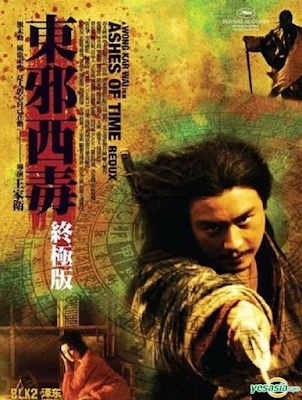
Ashes of Time Redux (1994 / 2008)

Ashes of Time Redux (1994 / 2008) Chinese Title: 東邪西毒 Translation: Evil the East, Poison in the West


Starring: Leslie Cheung, Tony Leung Kar-Fei, Brigitte Lin, Tony Leung Chiu-Wai, Jackie Cheung, Charlie Yeung, Maggie Cheung, Carina Lau

Director: Wong Kar-Wai

Action Director: Sammo Hung


Way back in the old days of Youtube, almost twenty years ago, people would upload Hong Kong movies to the platform in smaller-video increments of 10 minutes. It took a while for the videos to upload with the Internet capabilities of the day, so I often would open a bunch of windows for each part and let them load for an hour or so before sitting down to watch it. That is how I ended up watching Ashes of Time for the first time. I actually thought it was pretty good: not as boring as some reviews suggested (“Dragon Inn minus ‘good’, plus ‘suck’”), with just enough action to satisfy a fight junkie like myself.


A couple of years later, Wong Kar-Wai released his “Redux” cut, which ended up seeing release here in Brazil. I ended up buying a copy at some point, although it took me a few years to actually sit down and watch it—the problem with having money as an adult is that you have more to splurge on movies than you did as a kid, so it’s more probable that you’ll buy more than you have time to watch at a given time. I think I was just nervous about watching Ashes of Time Redux because of some reviews that suggested that the action quotient had been reduced to almost zero. That’s not really the case: the fighting montages that bookend the film are all but removed, but the fight scenes in the story proper itself are still there.


The movie was filmed in 1992 and took two years to edit, which was such an exhausting experience for director Wong Kar-Wai that he made guerilla-style arthouse Chungking Express as a way to unwind from that experience. Ashes of Time was not a huge box office success, although it was a critical darling: Christopher Doyle won awards at three different venues for Best Cinematography; Wong Kar-Wai was nominated for Best Director in Hong Kong and Taiwan (and won at the Hong Kong Critic’s Society Awards); William Chang won awards for both Art Direction and Costume Design; and even Sammo Hung was nominated for Best Action Choreography…to name a few. Director Wong also produced a parody of the source material, Eagle Shooting Heroes, during the editing process for this film. I haven’t seen the film yet, but apparently it features antagonist Ouyang Feng being defeated by a man in a rubber dinosaur costume at the end(!).


Ashes of Time is a prequel to Jin Yong’s Legend of the Condor Heroes, a super-important wuxia novel that has been adapted to film (like the Brave Archer series) and television numerous times over the decades. Set several decades before Jin Yong’s novel, the film tells the origin stories of some of the older kung fu masters in the book, most specifically the main antagonist, Ouyang Feng. Ouyang Feng here is played by Leslie Cheung, one of Wong Kar-Wai’s “muses”—he had been in Days of Being Wild and later in Happy Together. Ouyang Feng has recently left White Camel Mountain after the love of his life (Maggie Cheung, As Tears Go By; Days of Being Wild; and In the Mood for Love), has married his brother. He ends up in the desert in Western China and sets up a little post where he hires out swordsman for different jobs—usually hunting bandits. He is periodically visited by an old friend, Huang Yaoshi (Tony Leung #2, i.e. Leung Kar-Fei, of New Dragon Inn and Bodyguards and Assassins). On one visit, Huang Yaoshi presents him with a wine said to cause a person to forget their past. Huang drinks it, but Ouyang Feng refuses to, presumably for fear of forgetting about his past love.


The narrative then goes into a sort of anthology format, telling the stories of three people who show up at Ouyang’s post. The first is a woman (or man?) named Murong Yang (Brigitte Lin, of Chungking Express) who wants to hire Ouyang’s services to kill Huang Yaoshi. Apparently, Huang had promised to marry Yang’s sister, Murong Yin (also Lin), but stood her up. Murong Yin then shows up and asks Ouyang to kill Yang instead. It soon becomes apparent that they are the same person. According to the Wikipedia entry on the film, Murong Yin and Murong Yang are basically a representation of the character Dugu Qiubai, who is a fabled “greatest swordsman” in the novels whose stances can defeat any possible style.


The second story involves a swordsman who is slowly going blind, played by Tony Leung #1 (i.e. Leung Chiu-Wai, who is Wong Kar-Wai’s other muse: Happy Together; Chungking Express; In the Mood for Love; 2046; and The Grandmaster). He wants to make enough money to be able pay for medicine that will enable him to see the “peach blossoms” in his hometown one last time before he goes completely blind. We later learn that “peach blossoms” is his wife’s name. She is played by Carina Lau (Days of Being Wild and 2046) and she has apparently been seduced by Huang Yaoshi, too.


The final story involves a young swordsman, Hong Qi (Jackie Cheung, of As Tears Go By and Days of Being Wild). He arrives at the place looking for work in order to boost his reputation in the Martial World. He takes on two jobs, including a request by a poor girl (Charlie Yeung, of Fallen Angels) to avenge her brother’s murder, in exchange for some eggs. Hong Qi is the character Hong Qigong in the novel, who is the Head of the Beggars Clan and Ouyang Feng’s mortal enemy.


It has been almost twenty years since I saw the original version of Ashes of Time, so although I remembered the general story and individual scenes and character interactions, I didn’t remember enough to make a full-blown comparison between the Redux cut and this one. Reviews say that the story is more cohesive the second time around, the editing flows better, and the score was completely rehauled from Frankie Chan’s synethesizer score to something more orchestrated, complete with music from Yo-Yo Ma (that post-Crouching Tiger Hidden Dragon influence).


Fellow B-movie critic Scott Hamilton once made the joke that Wong Kar-Wai movies often feel like they could be the origin stories of a serial killer. In the case of Ashes of Time, that really is the case. Leslie Cheung’s Ouyang Feng is not evil here, but is definitely callous and hurting from his rejection by his (new) sister-in-law. By the end of the film, his unhealed emotional wounds have festered to the point that he is becoming toxic…quite literally: his character in the Condor Heroes novels is known as the Poison of the East.


Like most (all?) Wong Kar-Wai films starting with Days of Being Wild, there is a running theme of amnesia and forgetting the past. In this case, it is quite literal and comes in the form of a special wine that causes people to forget their past. The wine is given to Huang Yaoshi by Maggie Cheung’s character, who wants Ouyang Feng to forget about her and move on. Huang himself drinks it as a way of forgetting his own woes: he never found someone who truly loves him and was jealous of Maggie’s undying love for Ouyang (her rejection notwithstanding), of which his constant womanizing was an ill-chosen coping mechanism. The wine itself is hinted to be a temporary solution at best: those who drink do indeed forget, but are forever haunted by specters of the past that they simply cannot identify.


There is a lot in this film about love and how people do stupid things to those they love, only to regret it later. That is basically the entire story of Maggie Cheung’s infamous monologue at the end. We also see it to a lesser degree with the little-seen Peach Blossom character, who is introduced by an image of her “sensuously” sitting atop a horse, with her bare feet dangling in a way that would make Quentin Tarantino happy (note: it was Tarantino’s love for Chungking Express that helped Wong Kar-Wai become known in the West outside of HK cinephile circles).


The action sequences are few and far between, staged by Sammo Hung during his most difficult professional period. As filming took place in 1992, it would have been at the same time that Sammo had directed the wuxia fan favorite The Moon Warriors. Sammo later worked with Wong Kar-Wai on Eagle Shooting Heroes the following year. This is the film where Sammo really developed his art of blurry slow motion, which would later show up in films like Kung Fu Cult Master; Thunderbolt; and even Mr. Nice Guy. Wong Kar-Wai is not really an action director, so his goal was not to one-up any of the films that Yuen Woo-Ping or Ching Siu-Tung were making at the time. Thus, the short sword battles are more like Impressionistic displays of motion more than complex ballets of traditional Chinese fencing augmented with wires. For the film’s purpose, they do their job. But if you want Sammo doing wuxia, stick with Blade of Fury or Kung Fu Cult Master.


This is one of those movies that I think all Hong Kong cinema fans need to watch at one point, even if it ends up not being their cup of tea. It is well acted by a wonderful cast of Hong Kong legends. It looks great, especially in the Redux version. The direction and editing are very good. It’s just good filmmaking altogether, even if it is a bit slower than what mainstream audiences might be accustomed to.


Thursday, December 12, 2024

O Cinema de Wong Kar-Wai

 O Cinema de Wong Kar-Wai


Last September, I reviewed the DVD set “Cinema Yakuza Volume 1,” which was released by Brazilian niche distributor Versátil Home Video. This year, they released a number of nifty sets for Asian movie collectors, including “Sci-Fi Japonesa Vol. 3”; “Obras Primas de Terror: Terror Asiático Volume 2”; and “Cinema Policial: Hong Kong.” Among these sets was “O Cinema de Wong Kar-Wai,” which compiled some of his films, which had previously been released on individual discs in the 2000s by Wonder Media/Continental. Those are out of print, but you can still find some of them for about R$ 40 (about 8 dollars) per film. This one cost me R$ 100, which ended up being a bargain compared to the older discs.


As Tears Go By (Hong Kong, 1988: Wong Kar-Wai) - So far, I have only seen Ashes of Time (the original cut) and The Grandmaster as far as Wong Kar-Wai films are concerned. I recently purchased a Brazilian set of his films and will be working my way through it over the course of these next few weeks. I'll watch them in order, so I'm starting off with this one. There isn't a real plot per se. It's mainly about the travails of low-level Triad Wah (Andy Lau) as he has to deal with fallout of the actions of his impulsive and hot-headed dai-dai Fly (Jackie Cheung, in the sort of unhinged performance that would serve him well later in Bullet in the Head). Most of these problems have to do with another Triad, Tony (Alex Man), to whom Fly owes money. At the same time, Wah finds himself developing feelings for his (second?) cousin Ngor (Maggie Cheung), who has come to his flat from the sticks (Lantau Island) for a few nights seeking medical treatment.

The film goes back and forth between the three leads. At one point, Fly becomes such a liability that Wah encourages him to get a real job as a street vendor in order to stay out of trouble. Of course, Fly is not able to stay on the straight and narrow for long--it doesn't help that Tony is a douchebag. Near the end, it feels like that Wah may be willing to tone down his Triad activities in order to stay with Ngor, but when Fly volunteers to carry out a hit against a stoolie, Wah has to choose between love and brotherhood. I'm guessing this is a Wong Kar-Wai thing (or an arthouse director thing), but there are lots of quiet scenes of people smoking cigarettes and staring off into the distance.


Some people label this a Heroic Bloodshed film, and it does have three action directors--Stephen Tung Wai (who helped invent the Bullet Ballet), Poon Kin-Kwan, and Benz Kong--but there really isn't much action aside from a few Triad beatings and a brief shootout at the end. My favorite scene comes right before the climax where Fly has a final confrontation with Tony. It is actually a very intelligent moment for an otherwise irresponsible nutjob, as he leverages his temporary "Triad Hero" status to destroy his adversary's credibility. A lot of people also enjoy phone booth kissing scene, set to the Cantonese version of "Take My Breath Away." The direction is good, the performances are good, and I like Andrew Lau as a cinematographer more than I do as a director. But beyond that, I'm guessing that contemplative dramas are not really my cup of tea.


DVD Extras - "Extended" ending - Not really different from the one we got. "Happy" ending - Probably for the Malaysian and Singaporean markets, which dictated that films about criminals (and vigilantes) should end with them answering to the law and going to jail.


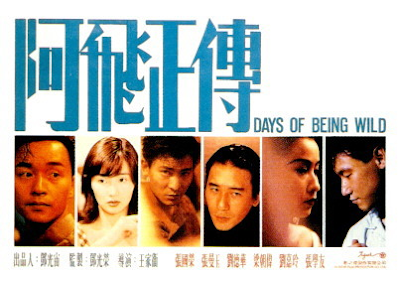
Days of Being Wild (Hong Kong, 1990: Wong Kar-Wai) - Wong Kar-Wai's sophomore effort is a (very) leisurely-paced character drama set in Hong Kong in the early 1960s. Yuddy (Leslie Cheung) is something of a womanizer, the sort who will seduce anyone who catches his eye, but will casually move on to the next, even after the femme-du-jour has fallen for him. When we meet him, he's doing just that to a young woman, Sou Lai-Zan (Maggie Cheung), who works in a snack bar. He discards her when she asks to move in with him, moving onto a dancer named Leung Fung-Ying (Carina Lau). Leung is determined to make an honest man out of him, however. Sou Lai-Zan vents her feelings to a lowly policeman working the graveyard shift, played by Andy Lau. We learn that Yuddy was raised by a prostitute (Rebecca Pan), who refuses to tell him who his birth mother is, leading to a toxic tug-of-war between them. Yuddy eventually goes to the Philippines in search of his mother. 


There isn't much of a narrative. It's mainly characters meeting and interacting. The film is mainly a tour-de-force for Leslie Cheung, who is really good at playing a prick. Andy Lau and Jackie Cheung, who plays Yuddy's friend, play their roles the complete opposite of their characters in As Tears Go By. Jackie's character is essentially a Beta Simp. A nice one, but a simp nonetheless. The actresses acquit themselves well; both Carina Lau and Rebecca Pan were nominated for Hong Kong Film Awards. There is a brief outburst of violence at the end, which is out of step with the rest of the film. And like most Wong Kar-Wai films, there is talk of memories and forgetting things and that sort of thing.


Chungking Express (Hong Kong, 1994: Wong Kar-Wai) - So, I finally watched this. It sat in front of me at Blockbuster Video on the corner of Pershing and Robinhood in Stockton, CA for years, but I was too interested in renting The Killer and Hard Boiled for the upteenth time. I think I would not have appreciated it back then, so maybe it's better I saw it now.

Like the other Wong Kar-Wai dramas I've seen over the past couple of weeks, this is more of a character interaction film than something with a standard beginning-middle-end narrative. The first story involves a brief meeting between a lovelorn cop (Takeshi Kaneshiro) and a female criminal (Brigitte Lin), who uses Indian immigrants as means of transporting heroin. Then there's the meat of the film: a beat cop (Tony Leung Chiu-Wai) and the quirky fast food clerk (Faye Wong) who becomes (non-violently) obsessed with him.

Although Tony Leung won a HKFA award for Best Actor for this film, the real praise goes to Faye Wong, who simply magnetic in her role. The way she moves her body as she listens to LOUD music at the restaurant and interacts with Tony and her co-workers is hypnotic. And it's not even in a sexual way. She has a quirky air about her that is just fascinating. I honestly just loved watching her mill about Tony's apartment (played by Christopher Doyle's apartment) and do random stuff. I loved the scene where Tony was half-heartedly looking for his ex in the pad while Faye was hiding from him, often in plain sight. The entire sequence makes me wonder if it's a commentary on modern women being more attracted to the "idea of men" than men themselves. And now I can't get "California Dreamin'" out of my head. Thanks, movie.

Scott Hamilton, one-half of the duo that was Stomp Tokyo (a popular B-movie review site in the late 1990s and early 2000s), one (facetiously) pointed out in his blog ("My God, It's Full of Nerds") that Wong Kar-Wai movies often come across as the origins of a serial killer. He mentioned in a post about My Blueberry Nights that Jude Law's character had a lonely routine of closing his bar, collecting misplaced keys and putting them in a jar, and watching security footage of his patrons from that evening. He said that "taking home a prostitute and murdering her" almost felt like the next logical step.

I got that vibe from both Takeshi Kaneshiro's and Faye Wong's characters. With the former, had he not gotten the birthday message from Brigitte Lin, one can (humorously) imagine him going off the deep end and stalking women in Tsim Sha Tsui and murdering them (starting with his unseen ex and then the girl at the fast food place), especially after all that obsessive business with the pineapple. The same goes for Faye Wong: if she had never gotten found out, you can (once again, humorously) imagine her obsession growing to the point that she would start stalking and stabbing flight attendants* to avenge her man (or her idealized idea of him).


* - And for the record, Faye looked hot in a flight attendant outfit.


Fallen Angels (Hong Kong, 1995: Wong Kar-Wai) - WKW's follow-up to Chungking Express originally started life as a proposed to third story to that film, although I'm guessing that the Tony Leung/Faye Wong segment from the earlier movie took on a life of its own and this was one was left on the chopping block. The two films are a bit similar while being completely different from each other. On one hand, both films are set in and around Tsim Sha Tsui and have scenes set in Chungking Mansions and the show the Midnight Express restaurant. Moreover, there is a recurring theme involving Takeshi Kaneshiro and canned pineapple, although his character here at an expired can and has to pay the price (in Chungking Express, he ate them before the expiration date).


The film is a series of interconnected tales of emotionally-isolated (and downright kooky) people living among the dregs of society. One of them involves a hitman (Leon Lai, of Seven Swords and Bullets of Love) and his assistant (Michelle Reis, of Fong Sai Yuk and Swordsman II) and the latter's obsession for the former, despite never having formally met him. Her job is to stake out the locales where he is to perform hits and fax layouts over to him, in addition to keep his base of operations clean whenever he's not around. She yearns for him, but their professional relationship prevents them from having any sort of personal contact. He eventually falls in with a manic pixie girl, played by Karen Mok (Black Mask and God of Cookery) with blonde hair. However, unlike Faye Wong's adorable character, Mok's character is 90% manic and only 10% pixie, if you catch my drift.

There is also a mute kid (Kaneshiro, of Hero and House of Flying Daggers) who prowls the streets at night, opening businesses and forcing his fellow nightcrawlers to buy his services. He falls in with a wack-job, Charlie (Charlie Yeung, of High Risk and New Police Story), who is jealous that an old boyfriend has moved on.

The film is often criticized for being so emotionally distant and an exercise in camera work experimentation more than a compelling narrative. I can see that. There is some gunplay in it, staged by Poon Kin-Kwan (Dragon Chronicles - Maidens of Heavenly Mountain and Return to a Better Tomorrow), but nothing special. As with most WKW films, this is more about the visuals and acting and less about plot and action.

The best performances in my opinion belong to Takeshi Kaneshiro and Charlie Yeung. The latter was especially interesting because her character was so delusional in her first scenes that I had a hard time watching her, but her performance was so good (such a far cry from her squeaky-clean character in New Police Story) that I couldn't look away. The same goes for Michelle Reis, playing a 180º opposite of her proper and dutiful wife of Jet Li in the Fong Sai Yuk films. She is not the most relatable, but it's Michelle Reis in tight black leather and fishnet stockings playing with herself on a couple of occasions. That alone is worth the price of admission.


Hero Dream (1992)

Hero Dream (1992) Chinese Title : 淫妖豪情 Translation : Lewd Demon Passion Starring : Chin Siu-Ho, Chin Kar-Lok, Carrie Ng, Michiko Nishiw...