Showing posts with label Lee Tso-Nam. Show all posts

Friday, March 7, 2025

Capsule Reviews - Brucesploitation Movies

The Dragon Lives (1976)
aka King of Kung Fu; He's a Legend, He's a Hero 
Chinese Title: 詠春大兄
Translation: Wing Chun Brother


Starring: Bruce Li, Betty Chen Pei-Zhen, Su Hsiang, Hsueh Han, Yam Ho, Lee Wan-Chung, Han Su, Hu Chi
Director: 
Wang Hsing-Lei
Action Director: Huang Kuo-Chu

Strange biopic from Bruce Li--one of 
five he made between 1974 and 1976--that jumps around tonally. Bruce heads to San Francisco as a young man and then hitches a ride, hobo-style, to Long Beach for the infamous Long Beach International Karate Championships, which is portrayed like the tournament scene in Master of the Flying Guillotine. Bruce takes on the heavyweight boxing champion and wins, which earns him a place on "The Green Hornet." When Bruce has a dispute with the director of the latter's insistence that he wear a queue, Bruce heads back to Hong Kong and becomes a movie star. He has an affair with Betty Ting Pei (Chen Su-Chen) and starts training himself to death, especially when he gets invited to work on a (fictitious) film co-starring the aforementioned boxer.

Bruce Lee - A Dragon Story
 was more accurate, but had so little action that American distributors had to splice in fights from Superior Youngster and Little SupermanYoung Bruce Lee really just did its own thing. This one pays lip service to events in Bruce Lee's life, and jumps back and forth in tone between happy-go-lucky, somber (whenever he's pondering the treatment of Asians in Hollywood), and even dark (whenever he's over-training himself). The recreations of fights from his movies are better than those in Dragon Storyespecially the Fist of Fury dojo scene. Strangely enough, the movie ends with him having sex with Betty Ting Pei: Yep, a kung fu movie whose climax is also the lead actress's.

All that said, you're better off sticking with 
Bruce Lee's Secret and Bruce Lee - The Man, the Myth.


Bruce and Shaolin Kung Fu (1977)
Aka: Ching Wu & Shaolin Kung Fu; Fist and Fury Part 2; Bruce and Shao-Lin Kung Fu

Chinese Title: 達魔鐵指功
Translation: Demonic Iron Finger


Starring: Bruce Le, Chan Sing, James Nam Seok-hoon, Kim Jeong-ran, Bae Soo-cheon, Chiang Tao, Bolo Yeung Sze, Jang Il-shik, Lee Hang, Nick Cheung Lik
Director: James Nam, Cho Seok
Action Director: Tang Tak-Cheung

I think some consider this one of the better Bruce Le films out there, alongside Enter the Game of Death and Clones of Bruce Lee. This is arguably one of the more competent films he made, sticking with the familiar Fist of Fury template. In some territories, the film is known as Fist of Fury Part 2 and is presumably set at a time after the events of the original in which the Ching Woo school has spread beyond Shanghai and is actually doing quite well for itself. Le plays Ching Ling, one of the top students of the Ching Woo School, who has been up in the mountains practicing kung fu with a Shaolin master (Chan Sing, in an extended came). Upon finishing up his training, Ching Ling and his friend, Kang Jin (Nick Cheung Lik), return to Shanghai, where things are heating up under the command of Japanese General Yae Ho (Bae Soo-cheon, in yet another scenery-chewing performance). Yae Ho and his advisors want to eliminate kung fu schools in China in order to put down any possible rebellion. The General has his son, a lieutenant in the Japanese army and a karate master, is tasked with defeating Chinese martial arts.

When Ching Ling comes back to Ching Woo, he finds the school in shambles. He challenges the Lieutenant to a duel and humiliates him, resulting in the latter committing hara-kiri. Now a persona non grata in Shanghai, Ching Ling departs for Korea, which is already a Japanese colony. He hooks up with Master Po Sai Lam (James Nam), a martial brother of Ching Ling’s master. He starts learning Taekwondo and a special fist style. Meanwhile, the Japanese send a group of killers (including Chiang Tao and Bolo Yeung) to Korea to look for Ching Ling. Lots of fights break out. When the General arrives in Korea for a military conference, Ching Ling and Master Po’s daughter (Kim Jeong-ran), try to assassinate him.

There is quite a bit of fighting, staged by Tang Tak-Cheung (best known for Tiger Over Wall and Kung Fu Zombie). As usual, Bruce Le tries to mix his Bruce Lee impression with his own hung gar training. I don’t know why, but his shtick in movies often grows old very quickly. He’s a decent athlete, but if he doesn’t have a good choreographer, his fights easily get repetitive. I think it has to do with the fights themselves often about dodging and evading, instead of complex exchanges of techniques. Obviously, a style like hung gar lends itself out to elaborates shapes fighting, but Le tries to do something a little more “Bruce-y” with it and it just doesn’t work.

Bolo Yeung fights with a strange gorilla style (which I assume is the inspiration for the German title, “Die Gelbe Gorila” – The Yellow Gorilla), but it’s not particularly interesting. Kim Jeon-ran, best known for playing Jackie’s tomboy friend in Snake and Crane Arts of Shaolin, does some good fighting, especially when she’s trying to murder a room full of military officials. Nick Cheung Lik’s talents are completely wasted, unfortunately. Chan Sing fares better, getting a fight with Chiang Tao and his goons and showing off both his signature tiger style and a smattering of crane, too. Too bad he didn’t get more fight time in the film.

The penultimate fight pits Bruce Le in a lengthy duel with Chiang Tao, which is broken up by frequent running (almost more than Little Godfather from Hong Kong). He finally defeats him by attacking a bunch of pressure points, which was the basis for his training at the beginning of the movie. His final match is with a pair of white-haired fighters armed with metal poles with detachable claws at the end. It’s at this point that Bruce gets to use nunchaku as we expect in this sort of film. In one loopy moment, the two fighters (I think they’re father and son) stand behind one another and start waving their arms and ducking and weaving in an attempt to confuse Bruce. Bruce and Shaolin Kung Fu is a pretty decent, if unoriginal film. On a sliding scale of Bruce Le films, that would put it somewhere as a three (out of five). The film ends in an obvious nod to the original Fist of Fury, but a sequel was made the following year.


Return of the Tiger (1977)
Chinese Title: 大圈套
Translation: Big Trap


Starring: Bruce Li, Angela Mao Ying, Chang Yi, Blacky Ko, Lung Fei, Hsueh Han, Cheng Fu-Hung, Wang Chi-Sheng, Wang Yung-Sheng, Hsieh Hsing
Director: Jimmy Shaw
Action Director: Hsieh Hsing

The film starts off promisingly: the credits are set over the training regimen of a bunch of men inside of a gym. Angela Mao then enters the place and beats everyone up for several minutes, 
Hapkido-style. We then learn that she's working for Chang Hung (Bruce Li), who has a beef with the owner of the gym, Paul (Paul L. Smith). He says that Paul killed his dad and he wants him to shut down his gym and film studio. Paul has his number one flunkie, Peter Chan (Chang Yi), talk to Chang Hung into switching sides, but to no avail. Chang Hung gets the attention of Paul's rival, the crime boss Sing (Lung Fei), who tries to woo Chang Hung to his side.

He has Chang Hung fight Paul's bodyguard, Tom (Cheng Fu-Hung, who spends the film wearing a sweatshirt with 'TOM' embroidered on it), in order to prove his worth. He sort of joins Sing's gang, but we find out that he is actually a hitman hired by Paul to eliminate Sing, and so the blood vendetta with Paul is just a ruse. But both sides, who turn out to be rival heroin dealers, start to get suspicious of Chang Hung. And Paul tries to sell his unsold heroin stash (to quote Chris Rock: "People don't sell drugs, drugs sell themselves") to Sing, leading in a huge brawl. And then it turns out that Chang Hung and Angela are actually working for the law. A big brawl, replete with double crosses, ensues.

Compared to a lot of kung fu films from the period, it is interesting that there isn't a whole lot of action in this. There is a 
Yojimbo quality to the plot, with Chang Hung kinda-sorta playing both groups against each other, although even if Chang Hung didn't get involved, both sides would've suffered mutually-assured destruction by the end. It takes about 30 minutes for Bruce Li to have his first fight scene. There was a nice dojo sequence, with Huang Kuo-Chu doing some great kicks. Bruce Li has a brief scuffle with choreographer Hsieh Hsing, who plays an assassin hired by Sing. He then fights some would-be motorcycle assassins, led by Blackie Ko in a mullet. The finale is a huge free-for-all. It is interesting watching Chang Yi, always the intimidating villain, getting manhandled by a burly white guy. Bruce Li's scuffle with Paul L. Smith is long and brutal, full of found objects being used as weapons. Angela Mao is wasted in the finale, unfortunately. She should've gotten a good throwdown with Hsieh Hsing and Lung Fei.


Edge of Fury (1978) 
Aka: Blood on His Hands
Chinese Title: 撈家撈女撈上撈
Translation: Fishing for the family, fishing for the daughter, fishing for the top


Starring: Bruce Li, Michelle Yim, Gam Ming, Dana, Yasuaki Kurata, David Cheng Dai-Wai, Wai Lit, Kao Yuen, Ng Tung
Director: Lee Tso-Nam
Action Director: Gam Ming (Tommy Lee)

One of Bruce Li's lesser films, mainly because the film is kind of dull. There is fighting to be had, thanks to Tommy Lee, but much less of it than your average Brucesploitation potboiler, and of a lesser quality than one might expect. We do get a brief glimpse of Dana's tits, if that's any sort of consolation. Between this, Storming AttacksBruce Li in New Guinea, and his sex scene with a hot gwailo chick in Dynamo, Ho Chung-Tao must have been the happiest man working in 1978.

Bruce Li plays Fong Pao (or Ah Fong), a kung fu expert and chaffeur for a tycoon named Mr. Chun (Pak Man-Biu, of The Blade Spares None). One day, Fong is at work when he is visited by the police. Chun has been arrested in Thailand for drug smuggling and the police need to question Fong to see how much he knows about his boss's activities. The answer is "Very little." However, that doesn't stop the neighbors from talking smack about Fong and mistreating his mother, those lazy talebearing bitches. Fong is assaulted by Gau Jai (Tommy Lee), who was Chun's second-in-command. Initially, the question revolves around "What do you know and how much did you tell the police?"

At this point, the film breaks off into three stories. One of them revolves around Fong Pao's travails as people turn their backs on him because he worked for a criminal. A second subplot revolves around Chun's widow (Dana, of Inframan and Storming Attacks)--the guy is eventually executed--and her attempts to get her hands on her husband's will. She wants all of his assets to share with her lover, played by Wai Lit. Finally, Gau Jai and Chun's business partner, Mr. King (Yasuaki Kurata, of Win Them All and The Angry Guest), are trying to find where Chun used to hide "the stuff." They are convinced that Fong Pao knows and Mr. King even goes so far as to employ Ah Fong in order to get the information out of him. When he insists that he doesn't know, Gau Jai kidnaps Ah Fong's girlfriend (Michelle Yim) in order to force him to talk.

Edge of Fury is a very talky film. And there is no real interaction between the two main story threads of the missing "stuff" and Dana trying to get her hands on her husband's wealth. I think most viewers will be impatiently counting down to the next fight scene or wondering if Dana will doff the duds--there is a shot of her from behind a shower box and later where she tries to seduce the guy administering her husband's estate (Kao Yuen, of Fingers that Kill and The Blind Boxer).

The action is just okay. Lee Tso-Nam and Tommy Lee had obviously done some great work together: The Hot, the Cool, and the Vicious and Challenge of Death, to name two. Tommy Lee and Lee Tso- had worked with Bruce Li on Fist of Fury, Part II and did a pretty good job there. Edge of Fury is all three men working below their respective potential. Li's fighting is in Bruce Lee imitation mode, but the way he maintains a pose after punching or kicking someone is just distracting here. Tommy Lee can't seem to decide if he wants to choreograph a Bruce Lee imitation, traditional shapes, or early 70s basher style. His work is all over the place here. The finale with Yasuaki Kurata is brutal, but sloppy. Both men have done far better work in other movies. The entire film consists of talented people working at their most mediocre...not their worst, but their most average.

Sunday, July 7, 2024

Kung-Fu Wonder Child (1986)

Kung-Fu Wonder Child (1986)
Aka: Kung Fu Wonderchild
Original Title: 靈幻童子
Tranlation: Spirit Magical (Psychic) Boy


Starring: Lin Hsiao-Lu, Yukari Oshima, Chang Shan, Jack Long Shi-Chia, Lin Yu-Chieh, Lee Gwan-Sin, Li Hai-Hsing, Yang Hsiung, Ma Hok-Man, Sam Ching-Wai
Director: Lee Tso-Nam
Action Director: Alexander Lo Rei, Lucifer Li Hai-Hsing


Taiwanese actress Lin Hsiao-Lan is an interesting footnote in the history of the Jade Screen. The diminutive young lady started career at age 13 in the film The Orientation, in which the poster implies that she was playing a young boy, not too unlike Angie Tsang Sze-Man of Iron Monkey. That would become a theme for the first part of career: her short stature and boyish facial features placed her in roles as adolescent or young adult males, usually in comic martial arts-fantasy films. The first of these is the deliriously odd Kung-Fu Wonder Child, pairing her with genre veteran and cult favorite Jack Long, along with an up-and-coming Japanese actress named Yukari Oshima. Heard of her?

The movie begins with a magician (Sam Ching-Wai, of Magic of Spell and Retreat of the Godfather) and his daughter running afoul of an evil sorcerer known only as “The Priest” (Li Hai-Hsing, Shaolin Temple Against Lama and Ninja vs the Shaolin Guard). The two engage in a battle of skills that involve wire-assisted leaps, controlling objects via telekinesis, and shooting lasers from their hands.
The Priest proves to be the stronger, and makes off with his victims’ souls and a magical artifact known as the Silver Skull.

Switch to the local Taoist temple, where the bumbling instructor (Wong Kwan-Hung, of Return of the Bastard Swordsman and Rape in Public Sea) is teaching Maoshan magic to the students.
This includes singing and dancing while chanting cheerleader-esque spells and making objects appear out of nowhere. There are two upstarts among the students (played by William Yen and Tang Heng-Wu), whose antics get them constant beatings from the teacher and Senior Brother Chang Kong (Yang Hsiung).

Their only respite is their friendship with the Hsiu Chuen (Lin Hsiao-Lan, of Child of Peach and Magic of Spell), the grandson of the temple cook, Hua Won (Jack Long, of The 7 Grandmasters and The Mystery of Chess Boxing). Hsiu has learned by magic and kung fu from her grandfather, who is secretly a master of the Southern Maoshan, of which the ill-fated master from the beginning was also a master.
She helps the two poor saps get their comeuppance on the teacher and his assistant, usually in comic fashion.

In a third subplot, we are introduced Hai Qiuxue, the daughter/sister of the victims from the first scene. She is played by Yukari Oshima, who was in the earliest stages of her film career at this point. Qiuxue is wandering the countryside looking for her father and sister, unaware of their recent tussle with The Priest.
In a sequence that has nothing to do with the rest of the movie. Hai Chi-Hsue comes across a pair of jiangshi, or hopping vampire, children who are looking for their dad. She lets them accompany her until dad shows up and tries to kill Miss Hai. She does not take too kindly to that and unleashes her lethal legwork on him until he relents. Apparently, the jiangshi had received a message from “The Priest” to kill her, but nothing is made of that afterward.

The Priest’s two “wardens”—The Legend of Wisely’s Chung Shui-Fuk and Magic Warriors’s Chu Kwan-Yeung-- are sent to keep tabs on Hai Qiuxue, and Hsiu Chuen and his friends from the temple come to her rescue. Our heroes eventually discover the Priest’s hideout, where he keeps the souls of his victims in urns, guarded by a green-haired zombie, the Ghost King, who is also a kung fu dynamo.
Their first encounter with the Priest—who is also the abbot of the Temple—almost costs them their lives, although it alerts the grandpa to the Priest’s evil plot: use the Silver Skull and his own Gold Skull as conduits for him to drain the lifeforce from the souls of the magicians whose souls he has captured. Acquiring their abilities, he will become the most powerful sorcerer in the world!

Of course, that synopsis glosses over most of the second act, which is mainly a series of comic interactions between Hsiu Chuen, his two friends, and Senior Brother, who always bullies them. In one scene that would not fly in the @MeToo era, Hsiu Chuen casts a love spell over the basket seller that Senior Brother Chang is smitten with—his own
sister-in-law! Once she’s in his embrace, Hsiu retracts the spell. The basket seller, horrified that Chang Kong is so closer to her, has him arrested for sexual assault!

That would be the biggest problem with the film, is that it really doesn’t have an actual story. There’s a conflict that needs to be resolved in the final half hour, but most of the movie is made up of magical shenanigans and comic non-sequiturs. The lack of the story keeps the film from being as memorable as it should be, since it would be easy to the supernatural hijinks without the context of a story to place them.

Magic fans will surely get their fill with
Kung Fu Wonder Child. The movie opens with an explosion of flying fabrics, animated qi blasts and pyrotechnics. Riding on the coattails of the popular Mr. Vampire, the three aforementioned Jiangshi show up in the first act, undoubtedly to attract fans of that film. Beyond that, the film gives us love spells, heat spells, cold spells, invisibility spells, magic that turns people into kung fu marionettes and more! At one point, Lin Hsiao-Lan is shrunk to the height of three inches and has to fight a Facehugger and a giant centipede!

And then you get to the finale, which is brimming with craziness: our heroes fight a zombie; a character grows a second head from his forehead; the protagonists attack the Priest with literal hand cannons and a multi-barrel gun made of bamboo; and finally, the villain turns into a dragon.
Not a dragon puppet. Not a stop motion dragon. But a 2-D, cel-animated dragon that interacts with the characters like a low-budget Roger Rabbit. It’s just plain nuts.

There is a fair amount of fighting, courtesy of Taiwanese actor Alexander Lo Rei and Li Hai-Hsing.
The best action belongs to Yukari Oshima and her awesome legwork. Jack Long gets to bust out a few moves, mainly in a later fight against the Priest’s Wardens. Lin Hsiao-Lu fights mainly using wire-assisted acrobatics, but the choreography around them is pretty decent. There are some decent moves on display during the climax, although the choreographers play down the protagonists’ abilities in order to demonstrate just how powerful the main villain is.

In the end, the film is solid trip into the realm of weirdness that is Chinese fantasy. Fans of Shaw Brothers classics like
Battle Wizard and Boxer’s Omen, or Yuen Woo-Ping’s Miracle Fighters and Drunkard series, should easily find something to enjoy. Hong Kong neophytes may either be put off by the “anything goes” attitude, or get sucked into it all. And if you do get sucked into it, be comforted that Lin Hsiao-Lu made a few more of these films. 

Tuesday, October 11, 2022

The Hot, the Cool and the Vicious (1976)

The Hot, The Cool and the Vicious (1976)
Chinese Title: 南拳北腿活閻王
Translation: Southern Fist, Northern Leg and Living Hades


Starring: Don Wong Tao, Tan Tao-Liang, Tommy Lee (Gam Ming), George Wang, Sun Chia-Lin, Wan Chung-San, Yeo Su-Jin, Wan Lei
Director: Lee Tso-Nam
Action Director: Tommy Lee (Gam Ming), Lung Fong


Despite the success around Asia that Secret Rivals enjoyed, the creative team didn’t last. Upset that director Ng See-Yuen had gone back on his word to make him the sole protagonist, Wong Tao left Seasonal Films and took fight choreographer Tommy Lee with him. This turned out to be a smart move on Wong’s part, as his return to his native Taiwan paid off and the man became one of the most important leading men in martial arts films for the rest of the decade. Likewise, Tommy Lee set the standard for Taiwanese fight choreography until the early 80s, when he retired from filmmaking. 

Whatever uncertainty the men may have felt after heading to Taiwan was probably allayed by their teaming up with Lee Tso-Nam. Lee has since become known as one of the most important martial arts directors in all of Asia. He’d worked on a handful of movies in the first half of the 1970s, and had found considerable international success that same year with the Brucesploitation film Exit the Dragon, Enter the Tiger. Interestingly enough, the first collaboration of Don and Tommy with their new director was a variation on Secret Rivals, the very film that had jumpstarted Wong Tao’s career. Instead of John Liu, Wong’s co-star would be Liu’s own teacher, Dorian Tan Tao-Liang. With that sort of talent—two tae kwon do champions, a seasoned fight choreographer, a successful director—it’s little wonder that the resulting film turned out to be better than its inspiration in a number of regards.

Tan Tao-Liang plays Captain Lu Tung-Chun, head of the “security force” of a small village during China’s Republic Era sometime after 1911. The place is run by Mr. Yuen (George Wang, the film’s producer and  Don Wong Tao’s dad), the richest man in town and Lu’s benefactor. Although Lu is doing a good job of maintaining order in those parts, a conflict of interests arises when Mr. Yuen’s wastrel son (Wang Chun-Shan, of Dragon Inn and Moonlight Sword and Jade Lion) tries to rape Lu’s fiancée (Wan Lei) and ends of killing her mother. Although neither Yuen Jr. nor his flunkies are any match for Lu and his kicking skills, he at least has daddy and his money to keep him hidden until it all blows over.

Enter Southern Fist Bai Yu Ching (Don Wong Tao, of Secret Rivals and Iron Swallow), an infamous fighter who’s just gotten out of the slammer for murder. Although Bai claims to be just passing through, Mr. Yuen seizes the opportunity to hire some extra muscle to deal with Lu. This is especially important once Mr. Yuen strips Lu of his rank and the latter refuses to leave town. But Bai Yu Ching isn’t interested in killing a local lawman; he has other motives, motives which involve some curiosity about his new boss’s dealings. And just who is this “Mr. Lung” that Yuen and his men always talk about?

In addition to having a title that sounds like a play on the Sergio Leone classic The Good, the Bad and the Ugly, this movie feels very Spaghetti Western in terms of the plot and storytelling. You could replace the kung fu with six-shooters and you’d a classic old west tale: a cattle baron controls the town; his son or nephew commits a dastardly crime like rape; the local sheriff wants to bring him in; the cattle baron’s men are no match for the sheriff so he hires a mysterious gunslinger to deal with him; said gunslinger has his own agenda; etc. While we’re perfectly fine with rival kung fu styles, rebel name lists, evil opium dealers, and evil Japanese occupiers, the plot to The Hot, the Cool and the Vicious feels like it could happen in real life. It’s far more grounded in reality—at least a reality whose internal logic reflects our own—than most kung fu movies, which is indeed refreshing.

A good story with equally-solid storytelling is buoyed by a strong cast. Don Wong Tao is not only a great martial artist, he’s a good actor. He’s one of the more charismatic male leads to highlight Taiwanese kung fu cinema, and his jumps between happy-go-lucky and determined do-gooder are believable. Tan Tao-Liang is far more limited as an actor, but “unwaveringly righteous” falls well within Tan’s range. Both men receive ample support from the other characters: Yeo Su-Jin, who played the Korean love interest in Secret Rivals, plays the seductive inn owner who may be hiding a secret or two; Sun Jia-Lin (Against the Drunken Cat’s Paws) as a woman with a bone to pick with Captain Lu; George Wang is the scheming Mr. Yuen. On top of that, we have Tommy Lee as Mr. Lung, our protagonists’ final opponent. Tommy Lee is no Hwang Jang Lee and Tommy knows not to try to be him. Instead of trying to out-kick the Silver Fox, he out-quirks him, portraying the final boss as an albino hunchback with a gimp leg and a particularly powerful Mantis fist.

Tommy Lee’s choreography is also a lot more grounded, save a handful of superhuman leaps which were unavoidable in kung fu movies in 1976. Lee opts not to speed up the footage, something that even Jackie Chan and Sammo Hung did a little in their best films. This gives the action a further sense of realism. The bulk of the fighting is hand-to-hand—one vs. many, one vs. one, two vs. one—with the only weapons being used being a couple of sticks and knives here and there. I feel like Tommy Lee had matured as a choreographer after working on Secret Rivals and the two-on-one choreography of the finale is a lot more complex, if less manic, than the Wong Tao and John Liu facing off against Legendary Superkicker Hwang Jang Lee in that film.

Don Wong Tao’s original martial arts training was in tae kwon do, and he started training in hung gar under Tommy Lee’s tutelage. Both styles are worlds apart: tae kwon do emphasizes fancy footwork and high stances, while hung gar is all about the handwork, low stances and animal forms. Watching Secret Rivals, you can tell that Wong Tao’s hung gar skills were still nascent and that he often fell back on his original tae kwon do training in his fights. In the months that elapsed between finishing Secret Rivals and filming The Hot, the Cool and the Vicious, Wong had progressed quite handily in his hung gar training. He uses the low stances and tiger claw strikes without any of the kicking flourishes he used before. Very impressive for what amounted to a year’s worth of training.

Tan Tao-Liang is his usual dependable self. His bootwork doesn’t reach the intensity of his Sammo-choreographed efforts from that yeah, but he still kicks high and kicks often. Although Tan tends to focus on his left left for his usual roundhouse, spinning and side kicks, he does manage to balance it with a fair amount of bootwork from his right leg, too. He does a few jumping kicks here, too. Both he and Don Wong Tao are ultimately shown up by Tommy Lee as the physically-disabled villain. Lee is a maniac with the mantis style and even gets in a few impressive aerial kicks, too. At one point, Lee fights with a blade hidden in his sleeve, much like how Lam Ching-Ying would do three years later in The Magnificent Butcher. And any movie in which the albino hunchback villain with a bum leg can convincingly hold his own in a seven-minute battle royale with two tae kwon do champions in bound to achieve some degree of classic status.


Monday, March 21, 2022

Shaolin Invincible Sticks (1979)

Shaolin Invincible Sticks (1979)
Aka: Fist of Shaolin
Chinese Title: 棍王
Translation: Stick King


Starring: Don Wong Tao, Chang Yi, Kam Kong, Hsia Kwan-Li, Jimmy Lung Fong, Cliff Ching
Director: Lee Tso-Nam
Action Director: Tommy Lee


I’ve talked about this briefly in other reviews, but I’ll repeat again that one of the best things to happen to Taiwanese martial arts cinema was director Lee Tso-Nam. Mr. Lee has a very strong reputation among of traditional kung fu films for making very entertaining films on the cheap, combining stellar choreography with solid casts and, often, with good stories. Sometimes Lee Tso-Nam chose to walk down the already-trodden path of films about rival schools and styles, changing or including enough details to make it look at least a little fresh; other times he made his kung fu movies as period-piece crime thrillers, where the characters happened to solve their differences using kung fu.

Shaolin Invincible Sticks falls in the former category; this is a pure kung fu movie for people who appreciate pure kung fu. The story is old school and the premise expects the viewer to swallow two important points: the first one, a common trope of the genre, is that a kung fu master can wander around the countryside, killing dozens of rivals in unfair duels without the intervention of the law. The second one, which is even more hard to swallow to anyone who is familiar the diversity of martial arts styles in China, is that, within a limited geographical area, there could be not one, not two, but many schools dedicated to teaching fighting styles based on a single weapon, in this case, the pole/stick/staff/whatever. If you can suspend disbelief on these two facts, giving Lee Tso-Nam the benefit of the doubt in that he was trying to make a Lau Kar-Leung-esque meditation on a specific fighting style (or weapons style), then  you have a fairly entertaining kung fu movie on your hands.

The story, such as it is, deals with the exploits (or misadventures) of a certain young pole fighter named Ku Yung (Don Wong Tao, Challenge of Death and Slaughter in San Francisco). Ku Yung is the sort of “heir” to a special, all-powerful pole and the accompanying technique to use it, but instead of spending his days practicing to be an all-around bad-a**, he wastes his time gambling and flirting with girls, getting into the occasional street fight. This earns him the ire of his three uncles, who challenge him to a duel. When he loses, he’s kicked off the family property and practically becomes a pauper.

Meanwhile, another pole fighter named Lu Tai-Yeh (Chang Yi, Fatal Needles and Flying Fists and Super Manchu) is trying to prove to everyone that he’s the best stick fighter in the country. To this end, he goes around challenging fellow stick masters to duels and killing them. Actually, what he does is have his two assistants fight first, who are usually able to kill their opponents via treacherous means. If it looks like that the fighter in question is too good to be defeated by them, Lu jumps in and makes short work of the guy. I’m no expert in martial honor, but proving you’re the best by winning unfairly seems to defeat the whole point of the exercise.

So Ku Yung is wandering around trying to survive. He comes across a large fellow, Tai (Kam Kong, A Girl Called Tigress and Master of the Flying Guillotine), who is also a pole fighter and the survivor of an attack by Lu Tai-Yeh earlier in the film. After a brief fight between the two, they become friends and Tai tells Ku Yung that they should visit his uncle so Ku Yung can resume his training.

They meet up with Tai’s uncle, an old man, who’s an expert at convincing everybody around him that he’s a kung fu master despite the fact that really don’t see him fight during the entire film. The man has a daughter, Yu Yu (Hsia Kwan-Li, Woman Avenger and The Leg Fighters), a beautiful kung fu fighter who has attracted the unwanted attention of the annoying son of a local stick fighter. Although she’s able to handle herself in a fight, she eventually gets kidnapped by the idiot’s father who wants to force her to marry his worthless son. As beautiful as Hsia Kwan Li is, and she’s a looker, I can’t imagine what an annoying, effeminate, girly man like that guy could want with a wife like her. She could own him in a fight with her eyes closed and, not demonstrating any sort of quality of value, the guy would probably be consigning himself to a lifetime of spousal abuse at her hands.

Anyways, Ku Yung, Tai, and the girl’s father go to the rival school and Ku Yung to challenge the master. Ku Yung takes up the challenge and is able to win, beating the master in front of his students. As the students believe that Ku Yung was the student of the old bluffer, they all leave the master’s school and go to study with Yu Yu’s father. Ku Yung and Tai, after getting in an argument with Yu Yu’s mother, leave the school and go to work at a local inn/restaurant.

Unfortunately, the fame of Yu Yu’s father attracts the attention of Lu Tai-Yeh, who shows up and kills the old man and Tai in a bloody duel. Ku Yung and Yu Yu flee. Lu Tai-Yeh also eventually finds his way to the house where Ku Yung’s uncles live and kills two of them, leaving only one alive. At this point, Ku Yung must train himself for the eventual showdown with Lu Tai-Yeh.

From a story point of view, there’s not much to set this film apart from others of its ilk (Snake in the Eagle’s Shadow, for example) save for the aforementioned fact that every single martial artist in this film is a pole fighter of some sorts. That in and of itself makes this movie more valuable to the more devoted chopsockey fan than to the layman, who might get board from watching people beat each other with sticks for 90 minutes. I have no problem with this, to be honest, especially considering that this is a movie that I had wanted to see for the express purpose of seeing how it would treat its premise.

Being a kung fu movie made after 1978, you can expect a fair amount of KOMEDY to be supplied by the supporting actors. Most of the odious comic relief comes from Hsia Kwan-Li’s annoying and effeminate suitor, who actually doesn’t die, even when Chang Yi and his men kill his dad right in front of him. Chang Yi, you could’ve made yourself a sympathetic villain by removing that irritating little jerk from the gene pool. But you didn’t, so Don Wong Tao had every right to kill you in the final duel. That said, there’s quite a bit of comedy to be derived from the dubbing, as we get lots and lots of dialogue from the males characters droning on and on about how long and powerful and hard their sticks are. I suppose the only film that could beat that is Peculiar Tricks and the Boxing Master, which, according to my friend Dave Thomas, has a cockfighting subplot and thus lots of scenes of the actors talking about how powerful their cocks are.

Being a Lee Tso-Nam movie starring the dynamic duo of Don Wong Tao and Chang  Yi, you can expect a solid amount of quality action in this film. As I said before, practically all of the action is relegated to pole fighting, although we do get the occasional open-handed fight, mainly from Hsia Kwan-Li, who briefly gets to show off her flexibility early on. The action chores are handled by Taiwanese choreography powerhouse Tommy Lee, who doesn’t quite reach the level of attained by Lau Kar-Leung and Sammo Hung, but still shows himself to be one of the more talented Taiwanese action directors out there. Most of the variety can be seen in the types of sticks being used: regular poles; short, thick poles; long, whip-like poles; twin short sticks; stick and rattan shield combinations; etc. The main complaint I’ve seen of this film is that the final fight is too short—it lasts about 3-4 minutes, which is very short by old school fight standards. It’s still a solid fight, just like all of the others in the film, so no complaints there.

Wong Tao and Chang Yi were much like John Liu/Hwang Jang Lee; Jackie Chan/Ken Low; and Yuen Biao/Dick Wei in which they were a hero-villain team that really brought out the best in each other. Wong Tao was trained in both hung gar and tae kwon do and thus was as good with his fists as he was with his feet, not to mention was no slouch in the weapons department. Wong Tao was one of those “next Bruce Lee” types early on in his career, but thankfully people like Ng See-Yuen and Lee Tso-Nam saw him as more than that and allowed him to carve out his niche as one Taiwan’s important leading men.

Chang Yi’s career goes back to the late 1960s and early 1970s, where he started his career making swordsman films (including a few musicals!) and early “swingy-arm” chopsockey films, usually as the hero. Then, for some reason, he became one of the go-to guys if you wanted a white-haired or mustached villain, much like Hwang Jang Lee, Lo Lieh, Chen Sing, and others. I’m not sure why, but we should be glad for it, because he did his best work as a villain, in films like Challenge of Death, this one, and The Victimwhich I will review shortly. This film doesn’t represent his best work, but it’s fun nonetheless.

Shaolin Invincible Sticks should find its audience among fans of Don Wong Tao, Lee Tso-Nam movies, kung fu movie purists, and some more serious-minded martial artists, who might glean a lesson or two in stick fighting from this film. Heck, even the more casual fans of kung fu movies or B-movie fans who like a bit of unintentional humor in their chopsockey films will definitely find something to enjoy here. It’s not the best movie that this these people have made together, but it’s a fairly solid one.

Challenge of Death (1978)

Challenge of Death (1978)
Chinese Title: 龍拳蛇手鬥蜘蛛
Translation: Dragon Fist and Snake Hand vs. Spider


Starring: Don Wong Tao, Dorian Tan Tao-Liang, Chang Yi, Lung Fong, Ma Chiang, Hsieh Han, Shih Ting-Ken, Liu Ming
Director: Lee Tso-Nam
Action Director: Gam Ming (Tommy Lee), Lung Fong


Despite The Hot, the Cool and Vicious establishing Don Wong Tao as one of the major kung fu protagonists in Taiwan, it was two years before him and fellow tae kwon do expert Tan Tan-Liang teamed up for a rematch. Don Wong was extremely busy the previous year, showing up in no fewer than thirteen films. It almost makes Dorian Tan’s seven-film output look paltry in comparison. Nonetheless, it was only a matter of time before they joined forces with director Lee Tso-Nam and choreographer Gam Ming for the aforementioned film’s spiritual successor. Gam Ming did step down from the lead villain position in favor of Chang Yi, who had taken on Don Wong the year before in Eagle’s Claw.  

The movie is set around the time of Warlord Era of the Chinese Republic, which lasted from 1916 to 1928. Lu Siao-Yun (Tan Tao Liang, The Leg Fighters and The Himalayan) is a security officer on the tail of a gang of munitions smugglers whose client is one of the warlords in the region. While trying to get to the brains behind the operation, Lu arrests a womanizing gambler named Chiang Hsiao-Lang (Wong Tao, Phantom Kung Fu and Death Duel in Kung Fu), known in the martial arts community as the Golden Snake. Cheng's old lover, Wu Ching-Wah (Liu Ming of New Fist of Fury), is a courtesan who supposedly works as a mediator between the smugglers and their clients. While traveling across the desert, the two strike a deal that if Chiang helps Lu find the head smuggler, he'll let him go free.

Arriving in "the town", Cheng is looked up by Wu. An interesting character trait of Miss Wu is that she is enamored with Mongolian culture, including wearing their clothing and living in a Mongolian style tent. We find out that Chiang and Wu have a get-rich scheme involving the Warlord's agent (Hsueh Han, of The Killer Meteors), who is due to arrive in town with the payment for the next shipment in a few days. That night, when Chiang and Lu go to the inn to get some shut-eye, they run afoul of a couple of thugs working for the town's richest man, Mr. Sung (Chang Yi, Ming Patriots and Eagle's Claw). After beating them up, they report back to their boss and complain about their beating. Mr. Sun sends more men out to kill the two, but they too are unsuccessful.

We find out that Chiang and Wu's plan is to delay the meeting between the agent and Mr. Sung for a day, during which period Wu will set up a gambling match between Chiang and the agent. Chiang will win all of the agent's money—as opposed to Wu earning only half of it on the arms deal--and him and Wu will become quite wealthy and get married. The agent arrives and all seems to be going according to plan, until Lu shows up at the gambling match dressed as on old woman and ruins their plans. It does not take long before Mr. Sung starts taking a more active role in the proceedings and soon the bodies start piling up.

One thing that you might notice is that the film actually has a plot that doesn't hinge entirely on revenge, the Japanese, superiority of kung fu styles, or rival masters. It's a crime story about a cop trying to bring down a smuggling ring set in a time and world where everybody important knows kung fu. If you think about, there are actually a number of similarities between this film and Jackie Brown. Both films feature characters who are out to cheat an arms dealer out of his money. Both films feature law enforcement officers who are more interested in bringing down the arms dealer than the other characters’ plans to betray him. The difference here is the the arms dealer, Mr. Sung, is a lot smarter than Samuel Jackson's Ordell and is able to catch on to what's going on a lot quicker than his Tarantino-scripted counterpart...that and the copious fight scenes, of course.

Nonetheless, the real-world context becomes one of the film's greatest strengths. So many films in the genre seem to take place in a world where martial arts clans and schools have unlimited power and can kill each other off without any involvement from law enforcement. I love Snake and Crane Arts of Shaolin to death, for example. Nonetheless, if that film is set in the Qing Dynasty, where are the government officials in that? Challenge of Death feels a lot more realistic and said approach to the story actually makes some of the more fantastic elements of the fight scenes easier to swallow. One of the reasons Lee Tso-Nam is considered such a great director is that he was able to put a real world context into his films, often times dealing with lawmen and criminals, and thus give his movies a realistic feeling. The Hot, the Cool and the Vicious was one example of this. Challenge of Death is another.

The action here is solid and feels quite realistic, too. Gam Ing had a knack for choreographing traditional styles in a way that seemed natural and believable. The movements are authentic, but he does not use undercranking or an access of acrobatics that make the fight scenes seem over-choreographed. Wong Tao’s style of choice is the Southern Snake Fist, as opposed to tiger and crane forms of hung gar or tae kwon do, which he originally trained in. Wong Tao was an especially versatile martial artist, at least on the big screen.

Tan Tao-Liang uses his usual kicking skills and compliments his kicking with some handwork taken from the Southern Dragon style, which he does convincingly. I do admit to being glad that they chose the Dragon style to compliment Tan's kicks with, since the Dragon style gets very little attention in film, at least as an individual style. The big gimmick to the action here is villain Chang Yi, who uses the mysterious Northern Spider style. The style itself looks like a combination of the Eagle and Mantis style, but the hook is Chang Yi can shoot out cords from his sleeves, which he uses to hoist himself in the air and swing around and kick or grab people. He's the Spider-Man of the martial world here, and it's quite entertaining and original.

There are a few minor quibbles about the film: The wirework used in Chang Yi's fight scenes is a bit awkward at times. There's a scene early on where Tan Tao Liang and Don Wong Tao dress up as an elderly couple in order to win a bunch of money at a casino. It is only tangentially related to the main plot, but it is a bit silly. I guess it could be seen as being one of the signs of the times, as comedy was becoming increasingly important in kung fu by late 1978.

Moreover, one of the strengths of The Hot, The Cool, and The Vicious was that the film didn't simply stop after the main fight; the film made an effort to show what the characters do after beating the villain. That's not the case here, as we simply see our heroes walking away after killing the villain, leaving one plot thread unresolved.

Challenge of Death comes as a breath of fresh air after watching so many cookie-cutter kung fu films that depend on the quality of their fights to make up for the lack of originality (or sense) in their plots. The story is complex and the fighting is quite good. The actors are casted according to their strengths: Tan is better suited to playing the righteous cop; Wong is a bit meatier as the gambler-turned-good guy; and Chang Yi is an excellent villain, as always. It's not quite a classic, but a very good film by genre standards.

The Tattoo Connection (1978)

The Tattoo Connection (1978)
AKA: Black Belt Jones 2; Black Belt Jones 2: The Tattoo Connection; Conexão Hong Kong
Chinese Title: 鱷魚頭黑煞星
Translation: Crocodile Head, Black Fiend


Starring: Jim Kelly, Dorian Tan Tao-Liang, Chen Sing, Kong Do, Bolo Yeung, Norman Wingrove, Cheung Fu-Hung, Lee Hoi-Gei, Cheng Suk-Ying
Director: Lee Tso-Nam
Action Director: Leung Siu-Lung (Bruce Liang)

This Review is dedicated to the memory of Jim Kelly (May 5, 1946 – June 29, 2013)

It was only natural that I should watch and review a Jim Kelly film following his tragic passing only a week ago. After all, the man was once the gold standard for horrible martial arts films back when I was a fledgling movie reviewer hanging out at Geocities. Indeed, for many years the movie Hot Potato was used as a point of reference for movie scores (i.e. how many times better than Hot Potato was the film in question). It was not a reliable way of judging movies, but it got the job done until I abandoned it in 2006. When my site was resurrected as a Cold Fusion Video affiliate in 2009, I switched over to the 5 Animals rating system, which felt more in line with the subject matter.

Strangely enough, I never actually reviewed a Jim Kelly during my tenure as a movie reviewer with his own ramshackle site/blog/webpage. Our very own Lyz once asked me if I would ever review Hot Potato, considering its use in my ratings system, but by that time, I was living in Brazil and lacked the financial resources to acquire it. Money was tight at the time, and if I were to spend money on an international film purchase, it sure as hell wouldn't be on Hot Potato. I could have reviewed Black Belt Jones a few years back had I not been teaching English still and thus have to wake up early on Saturday morning. To this day, I still haven't watched all of that film. Shame on me, I know.

I initially hadn't thought of watching this film now, but when I started watching obscure Lau Kar-Leung mercenary jobs in memorial to good ol' Pops, I figured I should review a Jim Kelly film, too. To neglect to do so would be very hypocritical of me on my part. Naturally, my choices were fairly limited. There's not a whole lot that I could write about Enter the Dragon that hasn't been written yet yet. Purchasing Black Belt Jones was a possibility, but I figured it would take to long to arrive at the house for me to review and still be relevant for the man's cause. I could find Black Samurai on the internet, but who really wants to watch that? So, I went for the next best (and easily-available choice), The Tattoo Connection.

We open with mob enforcer Dong Ho (Dorian Tan Tao-Liang, aka "The Flashlegs") entering a rival's territory, demanding that they hand over his boss's ex-account, a huge fellow named Fat Dog (Cheung Fu-Hung). Apparently Fat Dog had embezzled some money from Mr. Lu (Cheng Sing of Shaolin Plot) before leaving his employment. The rival gang is unwilling to give Fat Dog up, but after a blistering display of Dong's kicking prowess, they change their minds. We're then treated to a James Bondian credits sequence with some 70s band singing a disco track about diamonds being a girl's best friend. When we meet up with Dong and Fat Dog again, the former is pleading with his boss to spare the latter's life and break his arm instead. Mr. Lu relents.

We then cut to a scruffy-looking Caucasian male getting off a plane in Hong Kong. He gets into a funny-looking limo of sorts and is being taken to a secret place. Said man, George (Norman Wingrove), is a bit nervous to get to his destination as quick as possible, probably due to the contents of the suitcase handcuffed to him. Suddenly, truck pulls up in front of his car and a bunch of Lu's men pour out and start beating George and his colleagues with axes and hammers. They ultimately take the suitcase and get away.

Enter stock footage of San Francisco. There we learn that the suitcase contained a very expensive diamond. The Board of Directors of the company that insured the diamond mention that the stone is worth a good three million dollars, and that if it isn't retrieved in a week, they'll have to pay for it, which might make their company go broke. One of the directors brings in an ex-CIA agent named Lucas (Jim Kelly, who'll spend most of the film being called "Black Man" or "That Black Guy"), who has lots of work experience in the Far East. "I'm like the black Six-Million-Dollar Man," says Lucas when he meets the Board.

Lucas hooks up with George after arriving in Hong Kong. The club they go to on Lucas' first night is the place of employment of a hostess named Louisa (Cheng Suk-Ying, Dreams of Eroticism and Innocent Lust), who happens to be the girlfriend of a man who helped steal cars for the heist. Louisa, who wants the 100-grand reward for information leading to the diamond's retrieval, tells Lucas to talk to her boyfriend. Lucas goes to visit the boyfriend, who takes him out to the lumberyard where he had stashed the cars following the heist. A short fight and car chase ensue, with Lucas making it out alive and the boyfriend...well...not.

After the thug's body is pulled from the harbor, Lucas notices a peculiar eagle tattoo on the dead man's bicep. After checking out all tattoo parlours in town, Lucas finds himself at a Japanese-run tattoo parlour that looks like it caters to the local branch of the Yakuza (should they exist in any form in Hong Kong), not to mention naked women with tattoos on their breasts. The owner of the joint reluctantly points Lucas in the direction of the nightclub that Mr. Lu frequents. Lucas goes and falls for one of the strippers, Nana (Lee Hoi-Gei, Bruce and the Iron Finger), who just happens to Dong Ho's girlfriend (sort of). Nana turns down Lucas's advances on the grounds that a) she doesn't know him and b) he's black. Mr. Lu's men then corner him in an alley outside the club and proceed to get their arses kicked, except for Dong Ho, who's every bit Lucas's equal in the fighting department.

The next day Lucas receives a phone call from Fat Dog, who wants to give Lucas some information in exchange for fifty grand, half of the value of the reward money established by the insurance company. Their first meeting yields no results since Lucas doesn't have the money on him, but they schedule a second meeting the next day. Fat Dog doesn't make it, since a pair of Lu's enforcers (Kong Do and Bolo Yeung) kill him right after his initial encounter with Lucas. Lucas figures out that George is in on heist and is leaking information about Lucas's encounters to Lu at every turn. Before Lucas can pump George for information, Lu has him killed, too.

By this time, Mr. Lu just wants to be rid of Lucas, so he has Nana try to poison him. Lucas is smart enough to see through Nana's sudden flirting and reverses the situation. It doesn't take long for Lucas to find out where Lu is hiding. And then there's Dong Ho, who's not very happy about what Lu is doing to his woman...

The Tattoo Connection is easily the sleaziest film I've seen in a very long time. A Cold Fusion-style total list would yield a breast count of 14, which is almost to say that nearly every woman that shows up in the movie will doff her duds at some point. There isn't much titillation in these scenes, since all but one of the characters getting naked are being exploited in some way or another, such as the scene where an old jeweler is examining a prostitute's assets with his eye loupe. The movie is exceptionally misogynistic in how it treats Lee Hoi-Gei. There's a sequence midway through where she's essentially raped by Chen Sing, following another uncomfortable scene in which Tan Tao-Liang's antihero character slaps her around for being a whore, as if getting raped was her fault. Later on, she tries to kill Jim Kelly by slipping him a super Viagra drug and screwing him to death, only to take the drug herself and start stripping for him (with "funky" music playing in the background, of course). And just to make things even worse, she exits the movie via a rather brutal beating given to her by Chen Sing at the start of the climax.

The movie needed to focus on the action rather than the female exploitation. After an excellent display of Tan Tao-Liang's kicking skills, the action more or less slows down until the last 15 minutes, when Lucas storms Mr. Lu's private ship. There are a few small kerfuffles here and there, but they're never enough to make the film feel less slow that it really is. Former Bruce Lee imitator Bruce Liang handles the choreography, although he tends to make it a little too mannered and structured for a film set in the modern day. That sort of fighting is fine for period pieces, but it's jarring in more modern settings. Tan Tao-Liang actually gets one of his better showcases in his fights and easily the film's highlight.

Jim Kelly apparently choreographed his own fights, which are a lot simpler and Bruce Lee-esque in execution. His kempo skills are actually a nice complement to Tan's kicking, since kempo features some complex handwork that looks good on screen (just watch Jeff Speakman's The Perfect Weapon). His bell-bottoms interfere with some of his kicks, and he doesn't cut loose until the end, but Kelly's fights are more than adequate. Thankfully, we get two fights between him and Dorian Tan, with both skirmishes showing the fighters to be evenly matched. I have to point out that Jim Kelly is almost two heads taller than main villain Chen Sing, so it almost looks like he's kicking around a dwarf (albeit a dwarf who has a mean Tiger Claw technique) at the climax.

Apparently the film fared well enough that a follow-up was considered. Unfortunately, according to some sources, Jim Kelly didn't get along very well with the crew, especially Bruce Liang and Dorian Tan. Kelly apparently had a case of Steven Seagalitis and insisted that his character be more or less invincible in the film's fights. He also didn't like to be hit by the actors, but didn't mind hitting them himself while filming. 'Tis a shame, since Kelly once wrote on MySpace that this film gave him the best showcase for his physical talents. Had they made another film with the same level of choreography, but with more action and less misogyny, it might've surpassed Black Belt Jones and Enter the Dragon as his best work.

Sunday, March 20, 2022

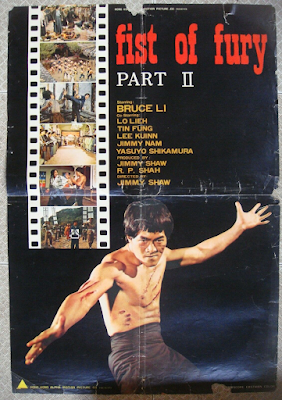
Fist of Fury, Part II (1977)

Fist of Fury, Part II (1977)
aka Chinese Connection 2; Fist of Fury 2
Chinese Title: 精武門續集
Translation: Ching Woo School the Sequel


Starring: Bruce Li (Ho Chung-Tao), Tien Feng, Lo Lieh, Chan Wai-Lau, James Nam, Jimmy Lung, Sit Hon, Lee Kwan
Director: Jimmy Shaw, Lee Tso-Nam
Action Director: Tommy Lee


Fist of Fury 2, another attempt to make a sequel to the Bruce Lee hit, makes for a fascinating example of divergent evolution next to the early Jackie Chan effort. Both films seek to tell the story of the Ching Wu School following the death of Chen Zhen, albeit from the points of view of different characters. In this case, we see what happens to the school’s teacher, played once again by Tien Feng, in the aftermath of the massacres of both the Japanese and Ching Wu schools that marked the last act of Fist of Fury. Interestingly enough, if not for a key moment in the film’s opening scene, this film could actually pass for a prequel to New Fist of Fury as well as a sequel to The Chinese Connection.

We open with the funeral procession of Chen Zhen, performed by the remaining students from the school. As the pallbearers are burying the casket, Ma Li’er (not played by Nora Miao, but by some actress whose face is obscured by the traditional Chinese funeral garb) throws her onto the coffin and commits suicide. This troubles an already-shaken Teacher (a returning Tien Feng), who soon finds himself turning to alcohol to deal with his problems, which are only just beginning.

Shortly after the funeral, some Japanese martial artists led by another interpreter, Mr. Wong (Chan Wai-Lau, filling in for Wei Ping-Ao), enter the Ching Wu school. They announce that their leader, Mr. Miyamoto (Lo Lieh, who had played the lead Japanese baddie in The Chinese Boxer), has acquired the school and now requires the students to vacate the premises. The students don’t take that very well and try to fight back, only to get whooped by the superior Japanese fighters. The Chinese students flee and try to hide out at the other local schools, but are hunted down by the Japanese and subsequently tortured.

A few months later, one of the remaining Ching Wu students sneaks by the grave of Chen Zhen, which has been cordoned off by the Japanese. He finds a stranger who claims to be Chen Zhen’s brother, Chen Shan (Bruce Li, aka Ho Chung Tao). The student warns Chen Shan to beat it, but too late, some Japanese karate fighters show up. Rather than leave, Chen Shan wipes the floor with the lot and forces them to pay respect to his dead brother. Mr. Miyamoto is really going to love that, isn’t he?

Miyamoto starts pressuring the local police inspector to arrest Chen Shan, although the inspector sympathizes with Chen enough to let him off the hook. The Japanese school reacts by using violence to coerce the other schools into turning Chen Shan in, which quickly puts the schools at odds with what little remains of Ching Wu, now that the Teacher is a useless drunk. Of course, it will only take but a few patriotic speeches to get the schools on Chen’s side, guaranteeing Miyamoto’s ire. Miyamoto declares the extermination of all schools in Shanghai, which his men handily carry out, even though two of the masters survive and go into hiding.

Obviously, the masters won’t be able to hide for very long, leaving it up to Chen to protect them. Moreover, the inspector can only stick up for Chen for so long until he puts him and his men in jeopardy. So Chen will eventually have to go on the offensive if he wants to save the kung fu students of Shanghai and his own tail.

Despite being a reworking of the film it’s supposed to be a sequel for, Fist of Fury 2 succeeds partially on the strength of its action and its rather bleak storyline. Like New Fist of Fury, the filmmakers try to continue the story of the Ching Wu school in a logical (well, at least according to the logic of kung fu movies) way, but here the villains are far more cruel and dastardly then Chen Sing and his daughter were in the other movie. The entire first act is devoted solely to showing people suffer—heck, Bruce Li doesn’t even show up until almost the 30-minute mark. Even after Chen Shan quickly establishes his fighting credentials, a lot of people are going to be unfairly walloped and snuffed before the curtain falls. That said, the major failing of the script is that the plot goes in circles for most of the second and third acts, following a pattern in which Chen Shan beats up some Japanese, the Japanese rough up some others trying find out where he is, Chen Shan argues with other Chinese about the validity of his actions, the Japanese rough up more people, Chen Shan comes to the rescue, rinse and repeat.

The movie also benefits from Tommy Lee’s action direction, which is a lot better than what we got in too many other Bruce Li films. Tommy Lee had offered his talents to the groundbreaking hit The Secret Rivals the year before and was already on his way to becoming one of Taiwan’s most talented fight choreographers of that era. He wisely avoids trying to fit Bruce Li completely into the Bruce Lee mold, giving him a similar, but distinctive style instead. Li (or Ho Chung Tao, if you will) kicks a lot better here than he has done in other films and his handwork is sufficiently complex to set itself apart from Bruce’s simpler punches. The main flaw to the action is that the group melees tends to be repetitive and uninteresting whenever Ho Chung Tao isn’t dishing out the hurt.

The storyline isn’t exactly original, and the movie loses a few points for its treatment of the Ma Li’er character. Watching her mature in New Fist of Fury was a refreshing piece of character development, so her suicide in this film’s first reel feels almost sexist and backward in comparison. Interestingly enough, after the funeral sequence, there are no women in the movie whatsoever (save a few extras, probably). Compare that with the Jackie Chan film, which had two strong female characters on both sides.

Criticisms aside, this is rightly considered to be one of the better Bruce Li vehicles out there. Interestingly enough, Li spent a good portion of his career as not only a Bruce Lee imitator, but on making movies that involved the Little Dragon himself somehow. Bruce Lee: A Dragon Story; Young Bruce Lee and Bruce Lee, the Man, the Myth were pseudo-biographical films about Bruce Lee. Bruce Lee’s Deadly Kung Fu tells a fictional account of how jeet kune do was founded, even though Li didn’t technically play Lee in the film. Exit the Tiger, Enter the Dragon; New Game of Death; and Bruce Lee, We Miss You were set in alternate universes following Bruce Lee’s death. Dynamo is essentially a Brucesploitation film about a man who becomes a Brucesploitation actor, if you can wrap your head around that.

Moreso than Bruce Le and Dragon Lee, Bruce Li’s films were, for better or worse, intimately related to the great star himself. Both men had similar martial arts training, especially in the wing chun style (I’m going to guess that Ho Chung Tao also trained a bit in tae kwon do). I suppose then that it’s only fitting that Bruce Li/Ho Chung Tao be cast in a sequel to Bruce Lee’s most revered film. And it should be fitting that it beats out all of the other attempts to make a sequel to Fist of Fury, including Donnie Yen’s recent Legend of the Fist: Return of Chen Zhen.

Big Man Japan (2007)

Big Man Japan (2007) Starring : Hitoshi Matsumoto, Riki Takeuchi, Ua, Ryûnosuke Kamiki, Haruka Unabara, Tomoji Hasegawa Director : Hitoshi M...