Showing posts with label Thailand. Show all posts

Sunday, July 19, 2026

3 Capsule Reviews - Non cut-and-splice IFD films

Raiders of the Doomed Kingdom (1983)
aka: Cobra Man (or แหกนรกเวียดนาม)
Director: Toranong Srichua


A more-or-less straight-forward Vietnam War action-adventure made in Thailand, but later picked up by IFD films for international distribution. And although the usual practice of inserting the familiar names (Godfrey Ho, etc.) into the opening credits, the actual film more or less remained untouched.

Popular Thai actor Sorapong Chatri plays Cobra, a Thai soldier working for the American forces in Vietnam. The film opens as the South Vietnamese--those that supported the Viet Cong--are about to storm the American embassy during the Fall of Saigon. Cobra is given the opportunity to flee along with the American diplomats, but he stays behind because he has been given a mission: rescue a South Vietnamese general, Chu (Peter Ramwa), and smuggle him (or his body) into Thailand. He gets together his commando group to rescue Chu, who has already been captured, and move him. The commando team eventually finds themselves on an island serving as a Leper's Colony, where they have to make a stand against the Viet Cong.

The film starts off as a pretty standard wartime action movie. There is a gun battle at the prison camp. Another gun battle on a bridge--where our heroes ruthlessly mow down female Viet Cong members, although one of them happens to be the General's daughter (Suriwan Suriyong) in disguise. One member of the team stays behind to keep the Viet Cong busy while the others escape alongside thousands of Boat People (whom are fired upon by the Viet Cong). Once they reach the Leper's Island, the commandos start succumbing to battle fatigue while the some of the refugees they picked up start thinking about turning in Cobra and his men in exchange for their lives. Things get graphic is the last half hour, as the Viet Cong murders and butchers the lepers and individual members of the commando squad.

I didn't think the film was bad, it was decent overall. Nonetheless, a remastered version would probably make it easier to enjoy. The film is notable for a random, lengthy, and graphic scene of cunnilingus that pops up out of nowhere while Cobra is wandering the streets of a fallen Saigon. As the version uploaded to Youtube is taken from a Japanese VHS, the full frontal shots (of which there are many) are all pixelated. A second, Thai-language version is uploaded to Youtube if you search for the Thai title. That version just cuts out the sequence entirely.


Commando Fury (Taiwan, 1983)
aka: Training Camp; Women Prison 1991


An IFD release of a Taiwanese WiP (Women in Prison) film that is surprisingly brutal, but without the rampant nudity and lesbianism that defines its European counterparts. The film is set in...I don't know...in the year...I don't know. I mean, one of the guards walks around in a U.S. Air Force outfit, so I'm guessing they did the typical Taiwanese thing of using whatever costumes they could cobble together. As for the location...I guess it's set in generic Asia-land.

The film is about a bunch of women who are in a prison and are routinely brutalized by the guards and the vicious warden (Richard Cui, billed as "Bernard Tsui"). The first 50 minutes revolve around the women being tortured, whipped, murdered, burned at the stake (!), stabbed, shot, worked to death, etc. In one scene, two women are forced into small cages and have iron bars stuck in said cages to force them into a compromising position and stay there for 24 hours. After that, the same women are loosed and made to fight for their food. Eventually, an inmate named Terry Yu (Juliet Chen) and the prison Queen Bee (Chiang Ching-Yen) team up to lead a breakout. Several of the girls go with them, including a political prisoner named Donna (Nancy Wen) who is supposedly in possession of some McGuffin microfilm. They flee into the jungle and are hunted by the guards, including a sadistic female guard named Helen (Liu Chia-Fen).

The entire film is just one long parade of violence against women and general brutality. And until we get to the scenes leading up the breakout, we never really know who the main character is. It turns out to be Terry Yu, who was hired by some mercenary to free Donna from the warden's custody. The last 25 minutes has some hand-to-hand combat and gunplay, ending with a huge betrayal and some major character sacrifices. Whether or not it is cathartic enough to make up for the other hour of general unpleasantness is up to you.


Pink Force Warriors (1985)
aka Women Warriors of Kinmen
Director:
Karen Yang


Taiwanese army propaganda film about a contingent of female soldiers being trained in a fishing community off the coast of Taiwan--the English dub (courtesy of IFD Films) makes it clear that they are not on the island of Taiwan. The film focuses on four characters: Mary (Lu Hsiao-Fen, of Black Rose: The Hong Kong Tigress), the serious one whose fisherman father disapproves of her relationship with a frogman (Don Wong Tao, of Secret Rivals); Susan (Shirley Lui, of Devil Fetus), who wants to date the captain of the male platoon, but is stopped by her asshole, overprotective brother; Angela (Ying Hsiao, of Girl with a Gun), the goof-off who is hit on by a daddy's boy rich kid soldier named Peter (Wong Fook-Sat); and Captain Joy (Teresa Tsui, of Pink Force Commando), the hard-as-nails squad leader.

Most of the movie is soap opera revolving around the girls' relationships. Early in the second half, Mary's father is murdered by Chinese spies, causing her to go crazy about finding and killing "Communists." She eventually confronts a pair of Mainland frogman spies and fights them. At the end, there are some war games and Susan and Angela finally take their jobs seriously. The fighting is limited to a couple of friendly scuffles between Lu Hsiao-Fen and Wong Tao, who teaches her how to knife fight. Then she gets to fight the frogmen, ending in a tragic sacrifice. The action is a mixture of Judo and knife-fighting, but nothing special here. Everything else is annoying soap opera and melodrama, plus some mock battles in the last 15 minutes.

Wednesday, July 2, 2025

The Big Boss Part 2 (1976)

The Big Boss Part 2 (1976) Chinese Title: 唐山弟子 Translation: Tangshan Disciples


Starring: Lo Lieh, Wang Ping, Preeva Prongernaug, Krung Srivilai, Michael Chan Wai-Man, Lee Kwan, Hung Wang, Bruce Le, Gam Biu, Ho Pak-Kwong

Director: Chan Chue

Action Director: Yuen Cheung-Yan


The Big Boss Part 2 for a long time was a lost movie. Or not necessarily lost, but pretty close. I believe there were a few copies in reel form floating around out there, some in the hands of African collectors—kung fu movies were huge business in Africa—and one that that some point found its way into Quentin Tarantino’s hands. A couple of collectors also had copies of the limited VHS of this, too. The Tarantino copy was shown at the New Beverly Cinema back around 2021, so a few fans lucky enough to live in Southern California were able to catch it. But for the rest of us, it wasn’t until Severin Films released their Game of Clones: Brucesploitation, Volume 1 box set in 2024 that it became available to the general populace—granted you got the limited collector’s edition directly from their website.


The movie picks up some time after the original film, with Cheng Chao’an (Bruce Le, of Bruce and Dragon Fist and Enter the Game of Death) rotting away in a small jail cell in Thailand after killing the titular Big Boss from the first film—the fight is partially recreated with new actors over the opening credits. An unspecified time later (this movie plays fast and loose with elapsed time), Cheng is visited by his younger brother, Cheng Chao-Jun (Lo Lieh, of Heroes of the Wild and Five Fingers of Death), who informs him that he’s there to avenge their father. This is a weird scene for two reasons: first of all, at no point in the original was an unjustly-murdered father ever mentioned. Second, the burned-on subtitles establish them as brothers, but then Chao-Jun starts talking about avenging his “father” and Chao’an’s “uncle,” so…they’re cousins?


Anyway, their conversation is overheard by another inmate (Ho Pak-Kwong, of Knockabout and The Magnificent Butcher) and his visitor (Gam Biu, of Cleopatra and the Casino of Gold). Those two men work for a Thai gang boss named Isabella (Preeva Prongernaug, of The Battle of Bang Rajan). Isabella is after a stash of gold belonging to another crime boss, who happens to be the Factor Manager from the first film (Chan Chue, the film’s director). This guy has gotten into the gold smuggling business and has accumulated some seven tons of the stuff, which Isabella wants. Her attempts to bring in outsiders to find it have come to naught, so when she learns that Cheng Chao-Jun is looking for vengeance against the same guy, she hires him to help her.


After an extended fight that starts at a casino and ends in a brothel, Cheng proves his mettle and starts the job. His job is to woo Wu (Wang Ping, of Vengeance! and Heroine Susan), the crime boss’s daughter. The two start seeing each other, but she never lets him visit her house because her dad’s a traditional guy, or so she says. At one point, the dad’s personal witch doctor (Lee Kwan, who played a different role in The Big Boss) tries to poison Cheng, but Wu saves him. Eventually, Isabella gets tired of waiting and has her second-in-command (big-time Thai actor Krung Srivilai, of H-Bomb and Tiger from River Kwai) kidnap Wu. They try to torture her into giving away the location of the gold, but Cheng saves her. 


All this results in a boat chase (set to Monty Norman’s theme for James Bond) and Cheng Chao-Jun wrestling with crocodiles, plus a gunfight between thugs from both gangs on different boats. Cheng learns that Wu’s dad is the same guy who killed his dad—Isabella had left out that detail when hiring him—and heads to the old ice factory to shore up accounts with him. Lots of kung fu ensues.


I know people say that a sign of a critic’s maturity is reviewing the film set before them and not the movie they wished they had seen. But watching this, I can’t help but think that it should have been something else. Not a completely different movie, but certainly a better movie in one of three respects. The Big Boss Part 2 should have either: a) cast a better martial artist in the lead; b) been more exploitative than it was; or c) been a lot weirder than it was.


Regarding item A, I like Lo Lieh as a martial arts actor, but as a martial arts actor, he is a bit limited. It doesn’t help that Yuen Cheung-Yan’s choreography—this guy went on to do The 7 Grand Masters and Charlie’s Angels—feels like it was elaborated in 1971 or early 1972. The fighting is pure “basher,” coming at a time when we had Shaolin shapes and Legendary Superkicker Hwang Jang Lee was starting to make his mark on cinema. Lo Lieh does his best, but his low kicks and nondescript handwork just don’t cut the mustard for 1976. It would have been better if Bruce Liang or Tan Tao-Liang had been cast in the lead role. Hell, if Bruce Le had been cast as Bruce Lee’s brother/cousin, it might have been an improvement.


Regarding item B, The Big Boss was pure exploitation, from the frequent bloody violence to the nudity from Thai actress Malalin Bonnak. This movie has some nudity in the first act: when the casino fight goes upstairs to the brothel, the combatants knock down a door and reveal a naked woman having sex with a man (we briefly see her breasts and buttocks). We get some more brief nudity when the prostitutes and their Johns start fleeing their rooms. And after that fight, Lo Lieh’s character is inexplicably seduced by Isabella, leading to a steamy sex scene. The camera placement is a bit odd, in that it just barely cuts off her bare breasts. If you’re going to tease it that extent, just go and show it. The violence in this film is also extremely tame, which is disappointing. The film alludes to one cool death at the very end, but we don’t see much. If the film were a bit more tonally consistent with the original in terms of blood and boobs, that might have helped a bit more.


Then there’s item C. Jimmy Wang Yu knew the value of out-weirding the competition when you couldn’t out-fight them. Compare the sequels to The Chinese Boxer and One-Armed Boxer to the originals, which were made when the bar was still relatively low for onscreen kung fu. The sequels were absolutely nuts, on the other hand. This film introduces a black magic wizard subplot, but needed that extra push to make it memorable. This came out a year after the Shaw Brothers horror classic Black Magic, which I understand had all sorts of nutty magical procedures. So, there was a template for that to follow This movie could have made more of that and would have found a way to set itself apart from both the original and all the other Brucesploitation films of the period. 


But as it lacks a strong exploitation, kung fu, or strange element, it makes all the problems in the story all the more glaring. I mentioned the bit about the dialog that makes it confusing whether or not the Chengs are brothers or cousins. At the end, we learn from Chao Chao-Jun that Wang Ping’s Wu is actually the daughter of the guy Cheng Chao’an killed…so is she the daughter of Han Ying-Chieh’s character. So, how many years after The Big Boss is this film set? Perhaps around 20? So Bruce Le has been lying around in the small cell for 20 years? They couldn’t transfer him to a prison that might at least have a prison yard to move around in? Moreover, how did Cheng Chao-Jun know the truth about Wu and her parentage? Nothing in the film established that he knew about it in the first place. 


I am glad that this movie is no longer lost. “Losing” movies is a terrible thing to happen to the art form. So, I’m glad that people like me can watch this. But other than the film’s curiosity value to one of the most influential martial arts films of all time, there is not a whole lot to recommend this. You would be better served re-watching The Big Boss, or if you need a Lo Lieh hit, Five Fingers of Death. Heck, Bruce Le’s maiden Brucesploitation voyage, Bruce’s Deadly Fingers, is miles ahead of this. And that also came out in 1976.

Thursday, October 3, 2024

Capsule Reviews - 1976 in film (Part I)

Killer Elephants (Thailand, 1976)


Original Title: ไผ่กำเพลิง
Aka: Rumble the Elephant; Bionic Heroes; Kill for the Truth

Starring: 
Sombat Methanee, Yodchai Meksuwan, Kanchit Kwanpracha, Pipop Pupinyo, Dam Datsakorn, Sayan Chantaraviboon, Kom Akadej, Aranya Namwong, Naiyana Shewanan, Mayurachath Muarnprasitivej
Director: Kom Akkadej

Thomas Weisser's Asian Cult Cinema has an entry for this in its traditional kung fu movie section, which is misleading. This movie is more of a general action film, with a few brawling-style fights complementing the other types of action. It is a Thai production, one of few that seemed to get picked up for international distribution the way it was, instead of chopped up and spliced with footage of Caucasian actors doing things, as Filmark often did. That said, some of alternate titles suggest that it did get picked up by IFD or Filmark at one point, which the website Thai World View confirms that it was IFD who had it dubbed and exported. I watched this via the Wu Tang Collection on Youtube, although viewers who do not wish to support that channel can find it as a double feature on the Brooklyn Zu Collection disc of Dragon Snake Fist

The film starts off with a bang, in the form of a policeman, Chow Ming (Yodchai Meksuwan), getting cut off on the highway by a bunch of hooligans in a truck. He tries to flag them down, but it quickly escalates into a gunfight(!), complete with the truck guys throwing barrels of gasoline into the road and blowing them up with shotgun blasts. Three gas explosions are enough to stop Chow Ming, who is visited on the side of the road by an old friend, Kau Fei (Sombat Methanee). Kau Fei tells them that these truck ruffians are working for The Boss, whom Kau Fei would like to eliminate. Chow Ming tells Kau Fei to stay out of police business, and Kau Fei directs his pal to the local lumberyard. Chow Ming goes there and a fight breaks out, with Kau Fei showing up at the last moment to save his friend's kiester.

From there on out, there is a semblance of a plot. The story is something like an old west film about rival cattle barons, except the good baron has a herd of elephants at his disposal. This is actually a great intimidation tool, although the dialog never clarifies whether it has to do with their size and durability, or if even Thai hoodlums are afraid to attack a sacred animal. The evil cattle baron--the Boss--does wicked things like burn down the local village and steal Kau Fei's girlfriend, Shu (Aranya Namwong). The movie never explains why his men burn down the village, I guess that is just something bad guys do. This leads to protracted gunfights in the sticks between the two sets of characters. Kau Fei eventually steals back Shu and gets her pregnant. When she has her baby, the police show up at the hospital to take her and bring her back to her "real" husband, the Boss. But Kau Fei has an elephant attack the hospital and get her to safety. The Boss is eventually killed by Evil Mustache Guy, Mau Tien (Dam Datsakorn), and he kidnaps Shu and the other village women.

All of this leads up to a climax on the border of Thailand and...another country (Vietnam? Malaysia?). The finale feels like two Jackie Chan movie setpieces squashed together, those being the monster truck destruction derby of Mr. Nice Guy and the Thai village shootout of Police Story III: Supercop. There are lots of thatched huts being blown up with grenades and shots being fired on both ends. Meanwhile, the titular elephants are also knocking over huts and causing general mayhem as well.

It is a little hard to talk about the story because it doesn't make a lot of sense. Chow Ming at one point is charged with arresting Kau Fei, partly because the police is corrupt, but also because he...uh....kidnapped(?) Shu. That part wasn't well explained. I'm guessing that Kau Fei had dated Shu, but she was forced to marry the Boss. And that would make her the boss's property. So, that would mean that when Kau Fei snatches her from the boss's mansion, that would be a form of kidnapping? Maybe it made more sense in Thai. The dubbing also doesn't explain the power dynamic between The Boss and the evil Mau Tien.

There are a few fight scenes, but they are staged more like a lively Western brawl (with a few kicks thrown in) than a martial arts film. There are lots of explosions, burning buildings to save people from, and lots and lots of firefights. You have villains who ride into action on horses and heroes who ride into action atop elephants while brandishing M-16s. The gunplay isn't John Woo, but it's more along the lines of the shooting in, say, Eastern Condors

The whole thing is just mediocre in the end.


Original title: Onna hissatsu godan ken 


Starring
Etsuko Shihomi, Mitchi Love, Ken Wallace, Masafumi Suzuki, Masako Araki, Iwao Tabuchi, Yoshiki Yamada, Takanori Oya
Director: Shigehiro Ozawa

The fourth and last film in the Sister Street Fighter series is actually unrelated to the other three. Lee Koryu, the half-Chinese, half-Japanese ass-kicker has now been replaced with Kiku Nagazawa (still Etsuko Shihomi), a young single karate instructor in Kyoto whose dad is a successful (if henpecked) kimono designer. Kiku gets dragged into the world of cops (represented by Takagi, played by Tsunehiko Watase) and drug dealers on account of a close friend, Michi (Mitchi Love, of the Super Sentai series "J.A.T.Q. Blitzkrieg Squad").

Michi is a half-white daughter of (presumably) an Okinawan prostitute. She has a half-brother, Jim (Ken Wallace), who is half-black. The two are very close, having both endured bullying in their hometown on account of their half-breed status. Unbeknownst to Michi, Jim is working as a karate hitman for a drug ring, who uses a low-budget movie studio as a front for their activities. When Jim is seen by Takagi murdering an American narcotics agent, his employers have him snuffed. Michi tries to kill one of the head drug dealers, but gets herself kidnapped instead. It's at this point that Kiku gets involved, going undercover at the movie studio in order to find Michi.

The first three films were fight fests that were plotted so that everywhere Shihomi's Lee Koryu went, she'd get ambushed and a karate fight would break out. This is more of a crime drama, with Kiku being a passive observer of the events going on until the last 20 minutes or so. There are some fights involving Ken Wallace in the first half, but most of it is trying to tell a story of drug dealers and the Law's investigation into them on a (relatively) realistic level. Sorry, I prefer bad guys with outrageous collections of martial arts enforcers--including a screaming "nunchuck" guy in a black mesh shirt--in my Etsuko Shihomi films. I liked the premise for the finale: the heroine taking on the cast and crew of a low-budget jidai-geki film, including guys with katana blades. But the camerawork is a bit obstructive, especially when they are fighting in close-quarters in the narrow hallways of the prop room. And there are no trademark Street Fighter deaths here. And the final shot is both ambiguous and unsatisfying. 


Original title: Shorinji Kempo: Musashi Hong Kong ni arawaru


Starring: Ken Kazama, Junko Igarashi, Henry Yu Yung, Wu Chung-Hin, Chui Meng, Yi Feng, Tien-Hsi Tang, Simon Yuen Siu-Tin, Chow Siu-Loi, Fung Ngai
Director: Nanbu Hideo
Action Director: Ng Ming-Choi

The IMDB lists this as a sequel to Sonny Chiba's famous The Killing Machine, although this was produced by Shikoku Ofuna, as opposed to Toei. Our hero is Musashi Yamanaka (Kenji Kusuma, of The Street Fighter and When Taekwondo Strikes), a shorinji kempo expert who has left Japan for Hong Kong in search of a worthy opponent. Musashi quickly falls in with millionaire Chow Yin-Nin (Fist of Fury's Fung Ngai), who has been a harrassed by a kung fu gang led by Wu Chung-Hin (Henry Yu, of Fists of the Double K and The Awaken Punch). Musashi accepts a position as Yin-Nin's bodyguard and also strikes up a friendship with a Japanese singer, Reiko (Junko Igarashi, of Hito Goroshi).

Musashi and Wu Chung-Hin eventually have a throwdown, which leaves both men seriously injured. The circumstances behind the fight lead Musashi to suspect that Reiko has some sort of connection with Chung-Hin--they're ex-lovers. Musashi learns that his boss is actually the owner of a series of opium dens throughout Hong Kong. Also, Chung-Hin is seeking revenge against Yin-Nin for murdering his father years before. Musashi is captured and tortured by the bad guys, and eventually switches sides...

There are a handful of fights in this, possibly choreographed by Seven Fortunes member Ng Ming-Choi (King Hu's Legend of the Mountain and Raining on the Mountain). The best fight is between Musashi and Wu, which is pretty good. The other fights are pretty short, including the finale, which is underwhelming. After all the stuff that the good guys go through, I was hoping for a longer, more violent climax with our hero crushing heads and taking names. He dispatches all of his opponents in a couple of hits, which is boring. There is a chaotic fight in the hallways of an apartment building, featuring guys with nunchaku. Also, Yuen Siu-Tin shows up in an extended cameo as a wise monk.


Original Title: 대탈출 (Daetachul)
Translation: The Great Escape


StarringKao Chiang, Hwang In-Shik, Choe Min-Gyu, Kim Ki-Joo, Lee Ye-Min, Han Myung-Hwan, Lee Seok-Goo, Jang Jeong-Guk, Jo Choon, Hong Seong-Joong
Director: Kim Shi-hyeon
Action Director: n/a

Two men are riding through Manchuria, carrying what appears to be a coffin on one of their horses. After riding through a village in which all the inhabitants appear to have been slain, they stop to rest. They get in a fight and there is only one survivor, whom I think is played by Lee Ye-min. He arrives in a town and visits a nightclub, where the singer, Grace (Jang Soon-ja), gets his attention. This angers the club owner, Mo-Kei (Kim Ki-joo), and a fight breaks out. Although the stranger is initially victorious, the tables turn when the local Japanese official, Suzuki (Hwang In-sik), shows up with his men. The stranger is ultimately imprisoned.

Also imprisoned with him is a fellow named Kang (Kao Chiang), who turns out to be a member of the Chinese resistance. The stranger gives him a map to where the gold--the contents of the coffin--has been hidden. Shortly thereafter, the stranger is executed, but not before Kang escapes. Kang finds the gold and takes it to a farm, where he steals a pig, kills it, guts it, and hides the gold inside, transporting it downstream--something similar happens in Ming PatriotsKang is captured by Mo-Kei and Grace, who want the gold for themselves. They travel downstream, with Suzuki and his men following behind...

The HKMDB mistakenly identifies this with the South Korean film A Wandering Hero (1975), which has the same director, some of the same cast, and a similar premise. The two movies are different, with A Wandering Hero known in Korean as 방랑의 영웅 (Banglang-ui yeong-ung). This movie is available on Youtube via the notorious Wu Tang Collection, although I wonder if the censor blurs in the film's sex scenes were added by them, or by Korean censors. Pity, since Jang Soon-ja is very pretty in this.

The action is okay, but spoiled by the frequent excessive undercranking. I mean, it reaches levels that makes Donnie Yen's 1990s output look restrained in comparison. Hwang In-sik kicks up a storm at the end, fighting Kim Ki-joo and then Kao Chiang, but ends up being less impactful than his other films because he is unnecessarily sped up. The film also suffers from a lot of missing frames, which makes regular scenes (and their accompanying music or sound track) look choppy. Thankfully, those flaws become fewer as the film progresses.


aka Martial Mates 
Original Title: 흑룡강 
Translation: Black Dragon River


Starring: Casanova Wong, Legendary Superkicker Hwang Jang Lee, Jo Choon, Jang Jeong-Guk, Lee Ki-Yeong, Kwon Il-Soo, Jeong Jin-Hwa, Jang Choon-Eon
Director: Kim Seon-gyung
Action Director: Richard Nam Choong-Il

This film is notable for being the first starring role for Wang Ho aka Casanova Wong, whose only earlier credit was a smaller supporting role in Gate of Destiny (1974). It is also notable for being one of Hwang Jang-Lee's first projects after The Secret Rivals and probably the earliest film to have him in a nominal good guy role. The director, Kim Seon-gyung, did a number of martial arts films in the 1970s, like Black DragonFour  Masters; and Magnificent Wonderman.

The film is set in Manchuria circa 1932, when the Japanese are still trying to set up Manchuko. There is a farm owned by a Korean Taekwondo master (Hong Seong-joong, of Stoner and The Skyhawk), whose laborers are also his students--the senior student is Il-jae (Legendary Superkicker Hwang Jang-Lee). The only laborer on the farm that is not allowed to study is Gyung (Casanova Wong, of The Mighty Four and Duel of the 7 Tigers), who is an orphan adopted by the master. He is betrothed to the master's daughter, Oh-kran (Jang Soon-ja), and the heir to the farm, but the master refuses to teach him. That does not keep him from learning in secret and getting good at it. But after a fight with the local Japanese thugs, Gyung is more or less forced to pack his bags and leave.

Gyung wanders around and finds himself at a Japanese karate dojo run by Jo Choon (Kill the Ninja and Kill the Shogun). Jo, for once in his career, actually wins a fight and takes Gyung as a student. Sadly, his "karate" "training" consists of him running and screaming blind-folded through a forest trying not to run into trees. When that's done, Gyung becomes a tool of the Japanese (led by Jang Jeong-guk, of Duel at Devil Hill and Hand of Death) to beat up the local masters and harrass the local farmers into giving up their land. The farmers go to the Korean Master to help them, but having been kicked out of Korea, he doesn't want to risk getting kicked out of Manchuria, too. But when the farmers find out that the Japanese secret weapon is a Korean, they come down hard on the Master. He sends Il-jae and Oh-kran out to find Gyung and bring him back. And if they can't convince him, Il-jae has to kill him...

The film's structure is a little strange. The first act revolves only around Gyung, played by Casanova Wong. The second act focuses on Il-Jae and the daughter's journey, with only a few cut-aways to Gyung, who's gotten into drinking to make up for his loneliness. The third act focuses on the build-up to the characters' final showdown, which is partly derailed by Jang Soon-ja's (and her dubber's) overracting and screaming. There is a fair amount of fighting, choreographed by Richard Nam, who also plays a samurai. Casanova Wong gets the best showcase, with his spin kicks and forward-jumping spin kick getting showcased. "Human Tornado," indeed. Legendary Superkicker Hwang Jang-Lee gets more fight time than in his other Korean movie appearances up to this point and does well, although he doesn't quite get the showcase for his infamous aerial boots like in his best Hong Kong movies. There are a few token attempts for Korean Taekwondo actors to fake kung fu, since the film is set in Manchuria. But fans of Korean Taekwondo cinema should enjoy this.

Friday, April 5, 2024

Time Rush (2016)

Time Rush (2016)
Aka: Bangkok Rush; Reflex


Starring: Dean Alexandrou, Selina Lo, Ron Smoorenburg, Byron Gibson, Kecha Khamphakdee
Director: Daniel Zirilli
Action Directors: Kecha Khamphakdee, Jaika Stunts, Ron Smoorenburg, Dean Alexandrou, Charlie Ruedpokanon


Ong Bak
meets Edge of Tomorrow.

I’m not sure if this was what was pitched to investors, but if you wanted to describe Time Rush (renamed Bangkok Rush for “dumb” American audiences) in a few words, I believe that would suffice nicely. This film is a vanity project—or at least of labor of love—for martial artist Dean Alexandrou, who wrote, produced, edited, starred in, helped choreograph and did the second-unit directing for this movie. It’s a neat idea, even if it doesn’t quite succeed in the end.

The movie begins with Alex (Alexandrou) waking up in time to see three armed soldiers capture and murder some guy (Byron Gibson). The three men then start chasing Alex through the streets of Bangkok until one of them, the Captain (Ron Smoorenburg, of Who Am I?), is able to shoot him down following a boat chase.

Flashback to London, six months before. An executive for a pharmaceutical company, Michael (Richard Dee-Roberts, of Jurassic Predator), is approached by a shady government goon named Williams (Michael Ashton, of Symbiont and Hitman’s Wife’s Bodyguard). Williams tells Michael that the government knows that his company has set up a laboratory in Thailand in order to experiment on the locals in a way that is legal, but still unethical. In exchange for their silence, the government wants them to develop a theoretical drug called Prevara.

Suddenly, Alex is waking up again to the same sight of the random guy getting his head blown off. Another foot chase begins, ending with Alex entering a restaurant where Jane (Selina Lo, of Haphazard and The Scorpion King 3) works. Apparently, she is his girlfriend, although he cannot remember and she’s upset that he had been incommunicado for an entire month. Before either of them can figure out what is going on, there is a struggle between him and the Captain. Jane is shot and killed, but suddenly time reverses itself and Alex is able to save her at the cost of his own life.

After another flashback to three months earlier, which details how Alex and Jane met, the former wakes up again, just in time to see the same guy get gunned down, execution style. The same foot chase commences, ending with Alex trying to hide out at the gym in Bangkok where he works. A huge fight breaks out between the gym employees (and martial arts students) and the soldiers, but the soldiers prevail and the Captain beats Alex to death with a steel weight-lifting bar. Following a flashback explaining how Jane had to return to Thailand (where everybody speaks English) and that Alex decided to follow her there, he wakes up again in the same place as always…

Of course, all of this is linked to the Prevara drug, and not a Dr. Strange-esque time loop. The explanation for the repetition of events is a little more cerebral. Long story short: the drug transforms its users into Alice Cullen from Twilight. There, I said it. I actually like that idea, even if the film’s low budget prevents them from doing anything real creative with it. The foot chase sequence that occurs at the beginning of each iteration is played almost completely identical to a certain point before it deviates. On one hand, that means that they could’ve just shot several takes and used a different take for each successive iteration. But we still have to see the same scenery for each repetition, which is redundant. And three iterations end with Alex in Jane’s apartment, which feels like it’s going in circles (quite literally).

Thankfully, the action itself is not repetitive. Each iteration results a different set piece. One of them is a brawl at a restaurant between Alex, the soldiers, and a Thai gang. Another one is the aforementioned melee between the gym and the soldiers. There’s a neat cat-and-mouse chase at an abandoned building that has two brief one-on-one scuffles between Alex and the Captain, and Alex and the Commander (Kecha Khamphakdee). The cream of the crop is an extended fight between Alex and the Captain in the final iteration, which has some great choreography. It’s fast, complex, and Ron Smoorenburg can still bust out the moves some 18 years after Who Am I? I almost expected him to quote that film and say, “Take it easy. We have plenty of time” when he lifts his kicking legs into the air. It would’ve made sense, given this movie’s theme.

The action was staged by Ron Smoorenburg, Dean Alexandrou, Kecha Khamphakdee, and Charlie Ruedpokanon. Ron needs no introduction, and between this, Haphazard and Triple Threat, it seems like he’s settled down permanently in Thailand to make martial arts films. Dean is certainly a talented athlete, a black belt in Taekwondo and a student of Parkour, it would seem. Thai martial artist Khamphakdee appears to be busy on the Indian movie scene, serving as stunt coordinator and fight choreographer in a number of Bollywood productions.  Finally, Charlie Ruedpokanon is also a veteran stuntman, having worked on Haphazard and Tremors: Shrieker Island, in addition to the Disney+ series “Ms. Marvel.” It is very much obvious that with the parkour and crazy aerial kicks and displays of acrobatics that they are going for an Ong Bak vibe. Heck, there’s even a scene where a guy is performing acrobatic kicks while his pant legs are on fire, just like in Ong Bak. I just wish the fights were all a little bit longer.

I’m debating on whether or not to keep this in the collection. There are some good fights. And I could ogle Selina Lo all day. I may have to give it another view to be sure. But I liked it more than the 3.2 rating on IMDB would suggest, even if the acting leaves a bit to be desired. Make of that as you will.

Saturday, October 7, 2023

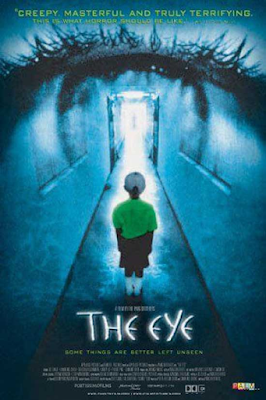
"The Eye" trilogy

The Eye (2002) 
Chinese Title: 見鬼
Translation: See Ghost


Starring: Angelica Lee Sin-Je, Lawrence Chou Chun-Wai, Candy Lo Hau-Yam, Fong Chin-Fat, Chen Chi-Choi, Chutcha Rujinanon, So Yat-Lai
Director: Danny & Oxide Pang


We fans of HK cinema often joke about the Anglican names of HK celebrities often being names that are obsolete here in the West--Mavis? Bosco? But, where the heck did "Oxide" Pang get his name? Anyway, this film seemed to be a minor hit in the pan-Asia market, at least enough to merit two sequels and a wedding between lead actress Angelica Lee and Oxide Pang. You know you're working with something good or memorable when Hollywood opts to remake it.

The movie begins with a young blind lady named Mun (Angelica Lee) musing to herself whether or not the world is a beautiful place. She's about to undergo a cornea transplant, so she's going to find out about it for herself. The surgery is a success and, after a few days of recovery, she is taken to a room in the hospital to remove the bandages in front of her sister (Candy Lo) and grandmother (Ko Yin Ping). She sees three blurry images in front of her: her sister, grandma and...well, someone. Gradually, her vision is restored, although she has an interesting experience with a shadow figure coming to visit the old lady in the next bed over.

Once out of the hospital, she begins to start her life anew. She begins to learn calligraphy. She undergoes therapy with a certain Dr. Wah (Lawrence Cho), a psychologist who wishes to ease her back into the world of the vision unimpaired. She continues playing the violin for a special blind orchestra, although she learns that they have a bit of prejudice toward the recipients of new corneas. On the other hand, she also starts having some peculiar experiences: she meets a boy on her floor who has lost his report card; she has nightmares set at another hospital; sometimes her bedroom temporarily changes into one unfamiliar; and finally she sees a shadowy figure hovering over the body of a kid hit by a car...whom had just spoken to her a few minutes before. Thus, the question arises: just 
who donated the corneas to Mun?

The Eye
 is Hong Kong's answer to The Sixth Sense by way of films like Blink (1994) and The Hands of Orlac. The first half is mainly horror, as Mun's new gift in life comes with a terrifying side effect. Although the ghosts she sees are not physically dangerous, they are common enough to scare the bejesus out of the poor young lady at regular intervals. By the final act, she has come to terms with her new powers and seeks to find the truth behind the person whose corneas she inherited, at which point the film becomes more of a tragic supernatural melodrama. The Eye is well-acted and there is an awful sense of inevitability to the climax, which brings Mun's story full circle. In some ways, The Eye is sort of a retelling of the Greek myth of Cassandra.

Following this film's success, several low-budget films about eye transplants gone wrong were made in the States before it was remade with Jessica Alba. See films like 
Deadly Visions and Jill for similar premises. The movie is creepy at times, but not extremely scary, and lacks a good 11th hour twist to make it memorable.


The Eye 2 (2004) 
Chinese Title: 見鬼2
Translation: See Ghost 2


Starring
Shu Qi, Phillip Kwok Chun-Fung, Eugenia Yuen Lai-Kai, Jesdaporn Pholdee, Rayson Tan, Lam Chi-Tai, Derek Tsang Kwok-Cheung
Director: Danny & Oxide Pang

 I think when it comes to a premise like this, talk of a sequel immediately invites the fear that any follow-up will simply be a remake of the original. And while this film obviously shares the same basic structure as the first one, it thankfully is it's own little creature. In some ways, I think the film is better than the first one, stumbling only at the climax. The Eye 2 is very much The Sixth Sense, but through a purely Buddhist lens--although a Hindu lens would probably present one with a similar output.

We open in Bangkok with a young lady, Joey Cheng (the luscious Shu Qi), going on a buying spree. As things progress, it becomes clear that Joey is in the middle of a messy break-up that has left her more than a little unstable. So unstable, in fact, that her plan for the evening is to max out all her credit cards and then overdose on barbitrates in her hotel room. She does go through with her plan, although she does end up surviving, thanks to the hotel employees who entered her room for a wake-up call. While she was in her near-death throes, she noticed that there were a lot of people showing up in her hotel room, although she doesn't recognize the significance of it. Following her recovery, she does witness a Buddhist ritual cleansing of her previous room: a maid informs her that when the act of suicide invites the presence of ghosts to the hotel.

Back in Hong Kong, Joey starts having seeing people that other people cannot. Moreover, she witnesses phenomena like random objects falling over. At the same time, she discovers that she is pregnant with the child of her ex-boyfriend, who has been avoiding her.  As she wrestles as to whether or not she wants to keep the baby, a chance encounter with a rapist results in her going all "Rats in the Walls" on the "poor" scumbag and nearly eating his face off. Someone, or something, really,  really wants her to have that baby.

Although the first film was a serviceable, well-acted variation on The Sixth Sense, it sort of felt like two separate movies. In that case, the real plot didn't start until the second half or so. The Eye 2 feels a lot more focused, even if a lot of the ghostly encounters are the random consequences of being able to see spirits. The focus is Shu Qi's Joey Cheng learning to deal with both her powers and an unwanted pregnancy, with the stakes being raised as Joey realizes that both are connected. The Eye 2 tackles heavy topics like suicide, infidelity, and guilt, and at its very core, it is a strongly Pro-Choice film. Even if I don't agree with the sociological implications of this film's religious beliefs, I credit for doing a good job in developing the ideas onscreen.

The Eye 2 is also more visceral and frequently scarier than the first film, with several scenes that made my heart skip a beat. The finale is quite bloody, although not in a way you might imagine (without me giving spoilers). The problem is that once it is revealed what the stakes are, the climax isn't particularly scary, and it's executed in a repetitive manner. The final two scenes are practically maudlin, with a brief "spooky" final image to justify the ominous music playing over the final credits. But given the spiritual explanations for what's going on in the film, there's nothing creepy about that final image if you think about it for two seconds. 


The Eye 10 (2005)
aka: The Eye 3
Chinese Title: See Ghost 10


Starring: Wilson Chen Bolin, Kate Yeung Ki, Ray MacDonald, Isabella Leung Lok-Sze, Kris Gu Yu, Bongkoth Kongmalai
Director: Danny & Oxide Pang

So yeah, there is no The Eye 3...or 4, 5, 6, 7, 8 or 9. The Pang Brothers close out their Eye trilogy with The Eye 10. The title refers to a Thai book about black magic that references ten different ways one may see a ghost, with haunted corneas and suicide-while-pregnant being two of those. This film explores the other eight ways, which is definitely interesting. On one hand, the Pang brothers are not repeating themselves. Unfortunately, while the first two films were serious horror films, this one goes full Hong Kong Movie in its execution.

The movie opens with a Buddhist exorcism in Thailand of a woman possessed by spirits, which involves her body levitating and then licking(!) the monks with a giant CGI tongue. Cue the opening credits, set to upbeat music with graphics that make one think of an early 90s TV series about teens (or twenty-somethings) having fun over the summer. Four friends--April (Isabella Leong), May (Kate Yeung), Teddy (Wilson Chen) and Kofei (Kris Gu)--are spending their vacation in Thailand, where they've made friends with a local, Chongkwai (Ray MacDonald). One evening, the group decides to tell each other ghost stories, at which point Chongkwai whips out a book he recently bought about how to see ghosts. Being the idiots they are, they decide to try out several of the rituals, like "Spirit in a Cup" (the Thai version of Ouija) and "Invitation to Dinner." 

Both ceremonies do allow them to see ghosts, although May is "left out." Determined to see a ghost for herself, she convinces Chongkwai to do another ritual, which is basically "hide-and-seek in a forest at night while carrying a black cat." On one hand, May doesn't get to see any ghost. On the other, Kofei goes missing. April, his girlfriend, goes into hysterics and, convinced he might be dead, performs 
yet another ritual in which she annoints her eyes with the soil from a cemetery, which almost gets her killed. At this point, May and Teddy go back to Hong Kong...but their experience with the supernatural is not over yet.

When I said that 
The Eye 10 is pure HONG KONG, I think fans of the Jade Screen know what I'm getting at: jarring tonal inconsistencies, inappropriate music that suggests comedy or action where things should be scary, ghost possessions played for laughs, and just an overall sense of weirdness to the whole endeavor. In one scene, a character is chased down the hallway by a sentient basketball. In another, a pair of B-Boys have a dance off with one of the characters, who has just been possessed. The finale has our characters raiding the spirit world and fighting off malignant ghosts with their breath, which they project toward their foes as if they were hadouken from Street Fighter II. While things don't get to Wong Jing levels of looniness, the film is impossible to take seriously.

In addition to the schlocky tone that's at odds with the serious approach of the previous two movies, 
The Eye 10 just looks tacky overall. The CGI is woeful. The photography looks late 90s UPN series, complemented by the crappy special effects. The ghosts are meant to look scary, with their white make up and black highlights, but lack the atmosphere to make them truly scary. Even the opening credits deflates much of the tension that was suggested in the opening scene. It's strange to consider that this film was made by the same people who made the other two movies, which boasted genuine scares, great photography and strong performances. This has none of that and gives credence to the belief that the third part of a trilogy (or series) is always the worst.

Hero Dream (1992)

Hero Dream (1992) Chinese Title : 淫妖豪情 Translation : Lewd Demon Passion Starring : Chin Siu-Ho, Chin Kar-Lok, Carrie Ng, Michiko Nishiw...