
Showing posts with label Brigitte Lin. Show all posts

Sunday, June 29, 2025

The Bride with White Hair (1993)

The Bride with White Hair (1993) Aka: Jiang-Hu, Between Love and Glory Chinese Title: 白髮魔女傳 Translation: The Legend of the White-Haired Demoness


Starring: Leslie Cheung, Brigitte Lin, Francis Ng, Elaine Lui, Law Lok-Lam, Bao Fang, Eddy Ko Hung, Joseph Cheng King-Kei

Director: Ronnie Yu

Action Director: Phillip Kwok


When it comes to contemporary (i.e., 20th century to the present) wuxia authors, there is apparently a trifecta of important authors: Gu Long, Jin Yong, and Liang Yusheng. There are two other important ones, in my esteem: Wong Ying and Wang Dulu. Gu Long’s ginormous bibliography essentially defined Shaw Brothers director Chor Yuen’s career during the late 1970s and early 1980s. Jin Yong needs no introduction: he wrote a handful of humongous novels which have been adapted to film and TV and continue to be until this very day (see Donnie Yen’s Sakra and Tsui Hark’s Legends of the Condor Heroes: The Gallants).


Wong Ying did a number of novels that were adapted to film by the Shaw Brothers, like Web of Death; The Bastard Swordsman; Portrait in Crystal; and Bat Without Wings. He also did a number of screenplays and story treatments for film, like Encounter of the Spooky Kind; The Loot; The Sword; and Opium and the Kung Fu Master. Sadly, he died in 1991 at age 35. Wang Dulu is best known for his Crane-Iron quintet of novels, of which Crouching Tiger Hidden Dragon is book #4. 


That brings us to Liang Yusheng, whose works place him alongside Gu Long and Jin Yong. Liang is credited with starting the “new school” of wuxia writing with serial publication of his novel Longhu Dou Jinghua, which was based on a famous public match between a White Crane and a Tai Chi master at the time. He ended up publishing some 35 novels during his lifetime, the most famous of which are Mount Heaven series, from which we got both Bride with White Hair (book 1) and Seven Swords (book 3).


The movie opens in the earliest days of the Qing Dynasty, around 1654 A.D. The Qing Emperor is dying and has sent four his generals to search for a mystical flower said to bloom once every 20 years. The flower is said to have curative properties and the Emperor wants to extend his life just a little more. The generals learn that the flower is being guarded by Wudan swordsman Cho Yi-Hang (Leslie Cheung), who refuses to give up the flower. He kills the generals and then starts narrating his story. (This bit is covered at the beginning of Legend of the White Hair Brides, a Singaporean series from 1996 that adapted Book 2 in the series: Sawai Qixia Zhuan).


Cho Yi-Hang is an orphan who was raised by the head of the Wudang Sect, Tzu Yang (Bao Fang, of Blood-Stained Tradewinds and Heroes Among Heroes). Cho Yi-Hang is the most talented swordsman among the clan’s children, although his own personal code of morals clashes with the more prudish ideals of the sect. This is especially true with the Wudan Clan’s second-in-command, Pai Yun (Law Lok-Lam, of Ten Tigers of Shaolin and Dragon Strikes), who does all he can to discredit Yi-Hang. His reason? He wants to install his daughter, Ho Lu-Hua (who’ll be played as an adult by Yammie Lam, of Witch from Nepal), as the next leader of Wudan. 


One evening, Cho Yi-Hang is out saving a goat from one of the local farms from a pack of wolves when he finds himself surrounded by said canines. He is rescued by a young woman playing a flute, whom we’ll discover later is Lien, the film’s Wolf Devil Woman (if you will).


Years pass and Cho Yi-Hang grows into a righteous young man, although he is aloof from the politics of the Eight Clans and the ambition of the taking over Wudan. At the time, the Ming Dynasty is in its death throes: the Qings are making inroads into the Northeast and General Wu San-Kuei (Eddie Ko Hung, probably playing a character based on Li Tzu-Cheng) is getting ready to rebel and take over the Ming Dynasty from within. But the Wudan has more pressing issues at the moment:


We witness a massacre of peasants by the Ming army on account of their stealing food from the palace. The soldiers are in turn slaughtered by Lien (now played by Brigitte Lin, of Swordsman II and Ashes of Time), who is now a powerful martial artist. Lien is in the employ of the Magic Cult (that’s how the subs on my DVD refer to her), which is led by a Siamese-twin duo (Exiled’s Francis Ng and Angel’s Elaine Lui) who had been kicked out of Wudan some 20 years earlier for practicing black magic. The Magic Clan wants to destroy the Eight Clans and sends Lien to do their dirty work; Wudan wants to destroy the duo, collectively named Chi Wu-Shuang, and put an end to the Magic Cult. 


But then Cho Yi-Hang and Lien meet and fall in love. But as their clans are destined to destroy each other, this forbidden love can only result in tragedy…


In a short “Making Of” video on my DVD, Ronnie Yu and his producer commented that Liang Yusheng’s writing style gets very deep into the characters’ emotions, which they wanted to portray onscreen. As a result, the film is a lot less about the story proper—the subplot involving Wu San-Kuei is handled offscreen more than it is handled onscreen—and more about the love of the two main characters, the ambitions of Wudan, and the male-half of Chi Wu-Shuang pining over Lien. Thank goodness for this approach, they got some great actors (Leslie Cheung, Brigitte Lin, Francis Ng) for the job. Leslie Cheung could play this sort of role in his sleep: passionate, but flawed and aloof. Brigitte Lin can go from giddy-young-girl-in-love to violent wuxia murderess in 0,5 seconds flat, having already honed the latter in the Swordsman sequels. The only liability among the actors is Elaine Lui, who does so much cackling over her brother’s unrequited love for Lien that she becomes irritating after a while.


If I were to be glib about this, I would say that The Bride With White Hair is Kung Fu Cult Master, but with more sex and nudity (including a brief glimpse of Elaine Lui). The visual approach is very similar. The fights seemed to have been filmed by fiddling (or mis-timing) with the camera’s shudder and then undercranking the footage (or shooting at a slower speed). It gives the action a blurry, sped-up, jerky effect that makes the fights look like “human stop-motion animation,” which is trippy. This is similar to a lot of the action in Kung Fu Cult Master, although that used more overcranking for a slow-motion blur effect. That film also brings up the Eight Clans, although Shaolin is nowhere to be seen in TBWWH. 


Instead of going to China to film, Ronnie Yu and his team stayed in Hong Kong and built all the sets. This gives the film a very theatrical feel, which actually works for what is an intimate story set to the backdrop of more sprawling historical events (i.e., the entire fall of the Ming Dynasty). You might say that this movie strives for a Neo-Shaw Brothers stage look, which makes for a great counterpoint with films like New Dragon Inn and Ashes of Time, which were both filmed in the deserts of Western China. From a visual standpoint, I really like the film.


The action was staged by Phillip Kwok, who had also worked on wuxia movies at the time like Zen of Sword and Handsome Siblings. The action is pure fantasy wire-fu, with scenes of Lien pulling people in half with her bullwhip or slicing people up with super-long strands of her white hair in the end. There is some actual swordplay, but don’t expect a whole lot. This is all about the wire-work. Chi Wu-Shuang’s skills are ascribed to magic, so he can kill people simply by screaming at them and can essentially perform telekinesis. The fight scenes are also a bit short and there are no classic wuxia moments here, like what one might find in Kung Fu Cult Master or Butterfly and Sword. But for the purpose of the story and visual aesthetic, the action generally works.


Some reviews focus on the more erotic aspects of the film, which are there, although I think they are overstated. There is some nudity from a random dancer at a meeting of the Magic Cult and we briefly see Elaine Lui’s breast when we learn that her and her brother are Siamese twins. Leslie Cheung and Brigitte Lin’s big sex scene is torrid and passionate, but also no more revealing than Zhang Ziyi and Chang Chen’s scenes in Crouching Tiger Hidden Dragon. So if you tune into this hoping to see Brigitte Boos, you’ll probably be disappointed. But if you want a wuxia movie in which every frame can be framed as a painting--the fight scenes are Impressionist, the sex scenes Rococco, other scenes being Baroque—then you should enjoy The Bride with White Hair.

Sunday, January 12, 2025

Love of the White Snake (1978)

Love of the White Snake (1978) Chinese Title: 真白蛇傳 Translation: True White Snake Legend


Starring: Charlie Chin Chiang-Lin, Brigitte Lin Ching-Hsia, Chin Chi-Min, Lee Kwan, Miao Tian, Sun Yueh, Chiang Ching-Hsia, Wu Te-Shan, Lin Chao-Hsiung

Director: Choe Dong-hoon, Si-Ma Ke


Sadly, the only versions of Madam White Snake—both the 1956 Shaw-Toho and 1962 Shaw productions—that I could find on the Internets were unsubbed. To bad, I would have liked to see both of those, assuming that their production values were a lot higher than the Korean version I viewed last. I guess I’ll have to wait for Green Snake for a more lavish take. This time around, we have a low-budget Hong Kong production, starring Taiwanese beauty Brigitte Lin. The “executive director” was Chen Chi-Hwa, best known for his collaborations with Jackie Chan, like Snake and Crane Arts of Shaolin and Shaolin Wooden Men. When Jackie hit stardom, he kept Chen around for a number of years, usually doing second-unit directing on his movies.


This adaptation is taken directly from the popular Chinese Opera interpretation of the fairy tale. We open with White Snake, aka Pai Suzhen (Brigitte Lin, of Ashes of Time and Swordsman II), and her younger sister, Green Snake (Chin Chi-Min, of The Best of Shaolin Kung Fu and Return of the Chinese Boxer), walking about the town. Pai Suzhen is looking for a young man named Hsu Hsien (Charlie Chin, of Winners and Sinners and My Lucky Stars). Hsu had rescued her years ago when she was in her snake form and now she wants to return the favor by marrying him and bearing his children. She gets permission from her master, presumably the bodhisattva Avalokitesvara, to remain in human form and marry Hsu. 


She arranges for a meeting during a storm while Hsu is crossing the river—like the South Korean Madam White Snake—and convinces him to take him and her sister, playing the role of the maidservant Hsiao Ching, to their home (since only he has an umbrella). Hsiao Ching uses her magic powers to transform an abandoned manor into a beautiful mansion and creates servants from stones and plants—I assume there is a form of animism in which they have spirits, but are simply given human bodies. Anyway, Lady Pai wastes no time in requesting marriage to Hsu Hsien, who is initially taken aback (since he’s a poor pharmacist), but ultimately agrees.


Shortly after their marriage, Lady Pai uses her magical powers to help him establish his own medicine shop. Hsiao Ching even spreads an influenza-like disease in order to give the residents stomach flus, which she helps prepare the medicine for (thus strengthening his reputation in town). The only person who can see through all of this is a wandering Taoist priest (Lee Kwan, of The Big Boss and Seaman No. 7). He tells Hsu Hsien the truth and gives him some talismans to place in the house in order to sus out the spirits (which are called “demons” and “devils” in the subtitles).  Hsu Hsien is pretty close to casting them when he makes a mistake and ends up repenting for doubting his wife and Hsiao Ching, who, by the way, is ready to kill him for his “unfaithfulness”. 


After that, Hsu starts ignoring the Taoist priest, who tries to face the snake sisters outright. They defeat him with their magic powers, and a little hope from their brother, who appears to be a Catfish spirit (Miao Tian, of Snake and Crane Arts of Shaolin and The Invincible Swordswoman). The Taoist priest runs back to his master, the Buddhist(?) monk Fahai (Sun Yueh, of The Pedicab Driver and Wu Tang Magic Kick). Fahai confronts Hsu Hsien and tells him to open his eyes to the truth, but Hsu ignores him (following his wife’s counsel to avoid monks and priests). Fahai warns that he’ll be sorry when the May Festival comes.


The May Festival arrives and one of the customs is for families to drink “Huang wine.” Apparently this wine has the side effect of revealing spirit forms. The smell of it is enough to send Hsiao Hsing into convulsions, which Lady Pai dismisses as “sunstroke” and has her shut into her room until she can regain her form. Unfortunately, an ignorant Hsu Hsien insists that his wife drink at least one cup, which causes her to revert back to her snake form, scaring Hsu Hsien to death. Lady Pai travels to Kunlun mountain to get a plant from the Fairy King that will revive her husband. She is successful and uses some BS story about white snakes called “store dragons” to explain the snake he saw.


At this point, things like “respect other peoples’ moral agency” is no longer even a mere suggestion and both the Taoist Priest and the monk Fahai resort to drastic measures. The Taoist pays a palm reader (Wu Te-Shan, of Spiritual Kung Fu and A Massacre Survivor) to write the word “Temptation” on Hsu Hsien’s palm. That allows the Taoist to hypnotize Hsu somehow, leading him out of the city and into the pagoda at Fahai’s temple. There, Hsu Hsien is locked up against his will while Fahai tells his wife some BS story about Hsu Hsien deciding to become a monk. They have a magic battle involving dragons, which culminates in the snake sisters and their brother causing a flood (presumably stock footage from the 1956 Madam White Snake). But the battle isn’t over yet…


In my review of the 1960 adaptation of Madam White Snake that as “romantic” the story is and as devoted the White Snake is to her husband, it is a fundamentally wrong relationship so long as she withholds the truth from him about what she really is. Yes, he eventually finds out and accepts her as she is, but it reminds me of the time I was spitballing ideas for stories years ago and I shared an idea about a guy who marries a Dr. Moreau panther-girl to a friend. She pointed out that if she doesn’t tell him right off the bat, then it is an unhealthy relationship. The same goes for here.


The difference between this and the previous version is that both religious characters—Fahai and the Taoist Priest—are portrayed as being just as bad, if not worse than Lady Pai is. After all, she may be ultimately dishonest at first, but she still loves her husband and wants him to succeed (even if she has to make the townpeople throw up a bit in order to secure business). The two antagonists, for all of their religiosity, are willing to lie, outright control, and break up families for their version of “justice,” which is simply not allowing spirits and human beings to intermingle. Lady Pai may stack the deck in her favor for her husband’s sake, but robbing him of all his moral agency is a few rungs lower on the moral ladder. Fahai at one point declares that he doesn’t care about families and familial relationships, which may apply to some extent to a Buddhist monk, but I’m sure that most religious types place great emphasis on tight-knit and happy families, even if they themselves don’t have one in order to serve a Higher Purpose. So when Lady Pai denounces these two as hypocrites, she is not wrong.


The character of Hsiao Ching also differs from both Madam White Snake and Panda and the Magic Serpent. She is portrayed as being more of a hothead and potentially violent woman, frequently threatening Hsu Hsien’s life whenever he has any sort of encounter with the priests. There are some throwaway lines early on that suggest she might too be sleeping with Hsu Hsien—something about a “7-3 split”—without him knowing it. Apparently, a sequel to this legend was written for the Peking Opera in which Hsiao Ching spends 20 years honing her magic skills, at which point she defeats Fahai and rescues her sister, allowing her to be reunited with Hsu Hsien and her son. I do not know if that part of the story has ever been adapted to film.


The film is filled with special effects, most of which are the primitive type you would see in a George Méliès short from the early 20th century. The snake sisters’ brother shows up as a large rubber catfish that spits water in a few scenes. The dragon duel between White Snake and Fahai uses scale puppets for the monsters. There are some primitive optical effects to represent the snake sisters’ energy, or the White Snake traveling at dizzying speeds. And there is the aforementioned stock footage. Yeah, so not a great fantasy, but it has its moments, plus Brigitte Lin looking beautiful for 90 minutes. Take that as you will.

Saturday, December 14, 2024

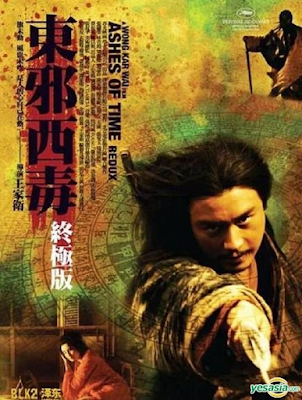
Ashes of Time Redux (1994 / 2008)

Ashes of Time Redux (1994 / 2008) Chinese Title: 東邪西毒 Translation: Evil the East, Poison in the West


Starring: Leslie Cheung, Tony Leung Kar-Fei, Brigitte Lin, Tony Leung Chiu-Wai, Jackie Cheung, Charlie Yeung, Maggie Cheung, Carina Lau

Director: Wong Kar-Wai

Action Director: Sammo Hung


Way back in the old days of Youtube, almost twenty years ago, people would upload Hong Kong movies to the platform in smaller-video increments of 10 minutes. It took a while for the videos to upload with the Internet capabilities of the day, so I often would open a bunch of windows for each part and let them load for an hour or so before sitting down to watch it. That is how I ended up watching Ashes of Time for the first time. I actually thought it was pretty good: not as boring as some reviews suggested (“Dragon Inn minus ‘good’, plus ‘suck’”), with just enough action to satisfy a fight junkie like myself.


A couple of years later, Wong Kar-Wai released his “Redux” cut, which ended up seeing release here in Brazil. I ended up buying a copy at some point, although it took me a few years to actually sit down and watch it—the problem with having money as an adult is that you have more to splurge on movies than you did as a kid, so it’s more probable that you’ll buy more than you have time to watch at a given time. I think I was just nervous about watching Ashes of Time Redux because of some reviews that suggested that the action quotient had been reduced to almost zero. That’s not really the case: the fighting montages that bookend the film are all but removed, but the fight scenes in the story proper itself are still there.


The movie was filmed in 1992 and took two years to edit, which was such an exhausting experience for director Wong Kar-Wai that he made guerilla-style arthouse Chungking Express as a way to unwind from that experience. Ashes of Time was not a huge box office success, although it was a critical darling: Christopher Doyle won awards at three different venues for Best Cinematography; Wong Kar-Wai was nominated for Best Director in Hong Kong and Taiwan (and won at the Hong Kong Critic’s Society Awards); William Chang won awards for both Art Direction and Costume Design; and even Sammo Hung was nominated for Best Action Choreography…to name a few. Director Wong also produced a parody of the source material, Eagle Shooting Heroes, during the editing process for this film. I haven’t seen the film yet, but apparently it features antagonist Ouyang Feng being defeated by a man in a rubber dinosaur costume at the end(!).


Ashes of Time is a prequel to Jin Yong’s Legend of the Condor Heroes, a super-important wuxia novel that has been adapted to film (like the Brave Archer series) and television numerous times over the decades. Set several decades before Jin Yong’s novel, the film tells the origin stories of some of the older kung fu masters in the book, most specifically the main antagonist, Ouyang Feng. Ouyang Feng here is played by Leslie Cheung, one of Wong Kar-Wai’s “muses”—he had been in Days of Being Wild and later in Happy Together. Ouyang Feng has recently left White Camel Mountain after the love of his life (Maggie Cheung, As Tears Go By; Days of Being Wild; and In the Mood for Love), has married his brother. He ends up in the desert in Western China and sets up a little post where he hires out swordsman for different jobs—usually hunting bandits. He is periodically visited by an old friend, Huang Yaoshi (Tony Leung #2, i.e. Leung Kar-Fei, of New Dragon Inn and Bodyguards and Assassins). On one visit, Huang Yaoshi presents him with a wine said to cause a person to forget their past. Huang drinks it, but Ouyang Feng refuses to, presumably for fear of forgetting about his past love.


The narrative then goes into a sort of anthology format, telling the stories of three people who show up at Ouyang’s post. The first is a woman (or man?) named Murong Yang (Brigitte Lin, of Chungking Express) who wants to hire Ouyang’s services to kill Huang Yaoshi. Apparently, Huang had promised to marry Yang’s sister, Murong Yin (also Lin), but stood her up. Murong Yin then shows up and asks Ouyang to kill Yang instead. It soon becomes apparent that they are the same person. According to the Wikipedia entry on the film, Murong Yin and Murong Yang are basically a representation of the character Dugu Qiubai, who is a fabled “greatest swordsman” in the novels whose stances can defeat any possible style.


The second story involves a swordsman who is slowly going blind, played by Tony Leung #1 (i.e. Leung Chiu-Wai, who is Wong Kar-Wai’s other muse: Happy Together; Chungking Express; In the Mood for Love; 2046; and The Grandmaster). He wants to make enough money to be able pay for medicine that will enable him to see the “peach blossoms” in his hometown one last time before he goes completely blind. We later learn that “peach blossoms” is his wife’s name. She is played by Carina Lau (Days of Being Wild and 2046) and she has apparently been seduced by Huang Yaoshi, too.


The final story involves a young swordsman, Hong Qi (Jackie Cheung, of As Tears Go By and Days of Being Wild). He arrives at the place looking for work in order to boost his reputation in the Martial World. He takes on two jobs, including a request by a poor girl (Charlie Yeung, of Fallen Angels) to avenge her brother’s murder, in exchange for some eggs. Hong Qi is the character Hong Qigong in the novel, who is the Head of the Beggars Clan and Ouyang Feng’s mortal enemy.


It has been almost twenty years since I saw the original version of Ashes of Time, so although I remembered the general story and individual scenes and character interactions, I didn’t remember enough to make a full-blown comparison between the Redux cut and this one. Reviews say that the story is more cohesive the second time around, the editing flows better, and the score was completely rehauled from Frankie Chan’s synethesizer score to something more orchestrated, complete with music from Yo-Yo Ma (that post-Crouching Tiger Hidden Dragon influence).


Fellow B-movie critic Scott Hamilton once made the joke that Wong Kar-Wai movies often feel like they could be the origin stories of a serial killer. In the case of Ashes of Time, that really is the case. Leslie Cheung’s Ouyang Feng is not evil here, but is definitely callous and hurting from his rejection by his (new) sister-in-law. By the end of the film, his unhealed emotional wounds have festered to the point that he is becoming toxic…quite literally: his character in the Condor Heroes novels is known as the Poison of the East.


Like most (all?) Wong Kar-Wai films starting with Days of Being Wild, there is a running theme of amnesia and forgetting the past. In this case, it is quite literal and comes in the form of a special wine that causes people to forget their past. The wine is given to Huang Yaoshi by Maggie Cheung’s character, who wants Ouyang Feng to forget about her and move on. Huang himself drinks it as a way of forgetting his own woes: he never found someone who truly loves him and was jealous of Maggie’s undying love for Ouyang (her rejection notwithstanding), of which his constant womanizing was an ill-chosen coping mechanism. The wine itself is hinted to be a temporary solution at best: those who drink do indeed forget, but are forever haunted by specters of the past that they simply cannot identify.


There is a lot in this film about love and how people do stupid things to those they love, only to regret it later. That is basically the entire story of Maggie Cheung’s infamous monologue at the end. We also see it to a lesser degree with the little-seen Peach Blossom character, who is introduced by an image of her “sensuously” sitting atop a horse, with her bare feet dangling in a way that would make Quentin Tarantino happy (note: it was Tarantino’s love for Chungking Express that helped Wong Kar-Wai become known in the West outside of HK cinephile circles).


The action sequences are few and far between, staged by Sammo Hung during his most difficult professional period. As filming took place in 1992, it would have been at the same time that Sammo had directed the wuxia fan favorite The Moon Warriors. Sammo later worked with Wong Kar-Wai on Eagle Shooting Heroes the following year. This is the film where Sammo really developed his art of blurry slow motion, which would later show up in films like Kung Fu Cult Master; Thunderbolt; and even Mr. Nice Guy. Wong Kar-Wai is not really an action director, so his goal was not to one-up any of the films that Yuen Woo-Ping or Ching Siu-Tung were making at the time. Thus, the short sword battles are more like Impressionistic displays of motion more than complex ballets of traditional Chinese fencing augmented with wires. For the film’s purpose, they do their job. But if you want Sammo doing wuxia, stick with Blade of Fury or Kung Fu Cult Master.


This is one of those movies that I think all Hong Kong cinema fans need to watch at one point, even if it ends up not being their cup of tea. It is well acted by a wonderful cast of Hong Kong legends. It looks great, especially in the Redux version. The direction and editing are very good. It’s just good filmmaking altogether, even if it is a bit slower than what mainstream audiences might be accustomed to.


Thursday, March 10, 2022

Deadful Melody (1994)

Deadful Melody (1994) 
Chinese Title: 六指琴魔
Translation: Six-fingered strings demon


Starring: Yuen Biao, Brigitte Lin, Elvis Tsui Kam-Kong, Carina Lau, Wu Ma, Lam Wai, Chung Fat, Siu Wing-Sang
Director: Ng Min-Kan
Action Directors: Meng Hoi, Lee King Chu

One thing you can say about the wuxia films coming out of Hong Kong in the 1990s is that they were distinctly Hong Kong films. They were made strictly for the local box office (well, probably the local Asian box office, but still) and, as a result, were free to be as weird, outlandish, and over-the-top as they wanted, because local audiences were more or less used to this kind of thing. I remember coming out Crouching Tiger, Hidden Dragon the first time I saw it the theater (yes, I went to the theater three times to see it) and listening to some middle-aged Caucasian couple asking themselves why everybody was flying during the film. If something as run-of-the-mill as people running up bamboo trees was befuddling to an uninitiated Western viewer, than a film like this would probably make said viewer’s head explode.

Like most wuxia films of the 1990s, the plot to Deadful Melody is a bit complex (although nowhere nearly as complex as other examples of the genre). The movie begins with several clans of martial artists surrounding the house of a family whose patriarch has abandoned the Martial World, but has now come into possession of a deadly lyre…yes, a deadly lyre. The lyre in question, when played correctly, can fire waves of energy that can make people explode. Anyways, the man is about to give them the lyre, as he doesn’t want any conflict. However, when they kill his friend and attack his family, then things get violent. In the resulting conflagration, the man and his wife are killed, their son disappears, and their daughter escapes with the lyre.

Years later, the daughter has grown up into Brigitte Lin (Bride with White Hair and Swordsman II) who somehow has become a) a master of the lyre, b) a kung fu master, and c) filthy rich. I’m still not sure about that last one, considering how she was orphaned and abandoned with no resources with which to become rich…but there you go. Brigitte, who’ll now be referred to as Snow, has hatched a plan to get revenge on the clans responsible for her parents’ deaths. But she needs a way to lure them out into the open.

Enter Lui Lun (Yuen Biao, Hero ’97 and The Peacock King), a young man who’s about to inherit his father’s escort business. Being young and inexperienced in running a company, Lui Lun doesn’t exactly inspire confidence in his father’s old friends. However, as luck would have it, Snow shows up his door the same night he takes the company’s reigns, offering him an incredibly handsome sum in order to transport the lyre somewhere. Apparently, despite having disappeared for about twenty years, the lyre still has something of a negative reputation among the people. Unfortunately for Lui Lun, he can’t go back on his word and now must do as he promised.

As Lui Lun is starting his journey, news of the lyre’s reappearance soon reaches the clans who showed up at the beginning of the film, notably the Ghost Master (Lam Wai, who played the corrupt police chief in Project A II), Fire Master (Wu Ma, who had supporting comic roles in most Jackie Chan, Sammo Hung, and Corey  Yuen films during the 1980s), Poisonous Witch (Siu Wing-Sang), and some other master with six-fingers. Lui and his father, who decided to accompany him for one last mission after finding out that the lyre was involved, are soon set upon by bandits, interestingly enough by the son of one of the clan leaders, who happens to be the person Snow wants Lui to deliver the lyre to.

Among the people who are trying to get the lyre is a young, feisty swordswoman named Tam Yuet-Wah (Carina Lau, Project A 2 and She Shoots Straight). Tam is Fire Master’s main disciple and, just for the record, Fire Master is decidedly less evil than the other masters. Instead of attacking Lui outright, Tam plays the role of an innkeeper in order to earn Lui’s trust, especially when the inn suddenly fills up with would-be robbers and Lui decides that he needs to protect the innkeeper as much as he needs to protect the lyre. Although Tam eventually tries to steal the lyre while Lui is sleeping (only to be foiled by the appearance of Snow, who is actually keeping close tabs on Lui’s mission), the swordswoman soon finds out that she’s falling in love with the amateur escort.

Let’s go back to Snow a little. I mentioned that she was keeping close watch on Lui. There’s a good reason for this: Lui may be a reasonably good fighter, but he’s clearly no match for the supernatural powers of some of the people out to get the lyre. Thus, when someone like Poisonous Witch for example shows up trying to steal the lyre, Snow steps in without Lui realizing it to make sure the lyre will make it to its destination. So, remember how I mentioned that the son of the guy that Lui was supposed to deliver the lyre to had tried to steal it earlier? Well, not too long after he did that, Snow decided to teach him a little lesson about the dangers of stealing. Unfortunately for Lui and his dad, when they present the lyre to Hon Suen (Chung Fat, Yes, Madam and Rosa) and Mr. Hon finds his own son’s head in the box, you can imagine things are not going to go well for them.

It’s a given that when watching a wuxia film from the 1990s, you’ll probably be bombarded with an absurd amount of characters, enough changing alliances to fill an entire trilogy, and lots of over-the-top craziness in terms of action. Deadful Melody has some of that, although thankfully it avoids making the plot so convoluted that you have to watch it multiple times in order for it to make sense. There are a lot of characters, but most of them are bad guys (the degree to which they are bad varies from character to character) and there are few shifting alliances, but the story is a lot easier to follow than, say, Swordsman or Kung Fu Cult Master.

Chinese wuxia films are generally based off of existing wuxia novels, or at least are steeped in genre conventions. I guess that one of those conventions is that the story is, by law, obligated to have an ending that ranges from bittersweet to soul-crushingly depressing. I find it interesting then that Deadful Melody has all the makings of a film that will end in such a way, but actually foregoes the downbeat path for the most part, making the end a lot more sweet than bitter, if you catch my drift. Throughout the film, Snow is shown growing more and more obsessed with her quest for revenge against the clan leaders, thus setting us up for a tragic death at the film’s climax. That actually doesn’t happen. She actually gets her revenge and gets away with it, which was rather unexpected. The only real bitter part about the ending is that Tam doesn’t really get to declare her love for Lui, because her master is more or less rendered an invalid for the rest of his days by the time the smoke clears from the final showdown, and so she is obligated by duty to take care of him. But even there it isn’t so sad because the subplot wasn’t developed a whole lot and the script left it somewhat ambiguous as to whether Lui felt the same way for Tam.

But enough about this. After all, we’re here for the action right? This is A Beautiful Film Worth Fighting For, right? Well, just an introduction to the action: it’s choreographed by Meng Hoi and Lee King Chu. Most of my readers will recognize Meng Hoi as being the lead actor in Hell’s Wind Staff and Buddha Assassinator and thus will know that Mr. Meng is an accomplished onscreen acrobat and a respectable screen fighter. Well, the man is also a very accomplished fight choreographer, having worked on such old school classics as the loopy Kung fu vs. Yoga and kicking classic Death Duel in Kung Fu. Back in the 1980s, Meng Hoi walked away with quite a few nominations alongside colleagues Jackie Chan, Sammo Hung, and Corey Yuen for best action design at the Hong Kong Film Awards, for films like Dragon Lord; Ninja in the Dragon’s Den; The Pedicab Driver; Royal Warriors; and Yes, Madam!

Lee King Chu is best known for having worked alongside Lau Kar-Leung for a number of his most beloved films, like Legendary Weapons of China, The Martial Club, and Eight Diagram Pole Fighter. That should in and of itself be a testament to the man’s ability to choreography legendary fights. But wait! There’s more. He also choreographed License to Steal, one of the best modern day action films of the late 1980s/early 1990s, featuring the inestimable talents of Yuen Biao, Joyce Mina Godenzi, Collin Chou, AND Billy Chow (how can you lose with a cast like that?). Most of his post-Shaw Brothers career, however, was dedicated to low budget horror films, didn’t seem all that befitting to a man of his caliber.

Like many wuxia films of the 1990s, Deadful Melody is more a choregrapher’s film than an actor’s film in terms of fight scenes. What I mean by that, of course, is that the success of the set pieces depends more on the ingenuity of the action directors than the physicality of the performers. The action here is not too different than what you’d see in a Ching Siu-Tung film from the same era, like Butterfly and Sword or something like that. It never quite goes as over-the-top as some of the films of that era, but there’s lots of flying people, some swordplay, a couple of brief moments of physical prowess courtesy of Yuen Biao, and lots of exploding people. The film’s main calling card is the Magic Lyre, which can reduce entire armies to mulch in a few seconds. There are more optical effects present in this film than a lot of other wuxia films and the set pieces are pretty fun, if not exactly memorable.

Deadful Melody is ultimately an entertaining, but unexceptional wire-fu film from the time when wire-fu was entering its first twilight—the wacky wire-fu film had reached its apex in 1993 and by 1994, only a few real important entries in the genre (Fist of Legend, Drunken  Master II, and New Legend of Shaolin) would make any sort of impact on the local box office. The action is entertaining and the story is easy to follow by genre standards; I haven’t mentioned the acting because I watched the English dub, which is quite bad, even by my (very) low standards. Still, as far as I’m concerned, Deadful Melody was 90 minutes well spent.

Street Fighter (2026)

Street Fighter (2026) Starring : Noah Centineo, Andrew Koji, Callina Liang, David Dastmalchian, Andrew Shulz, Roman Reigns, Cody Rhodes, Cur...