
Showing posts with label Roc Tien Peng. Show all posts

Thursday, March 14, 2024

A Girl Fighter (1972)

A Girl Fighter (1972)
Aka: Girl Boxer
Chinese Title: 女拳師
Translation: Female/Woman Boxer
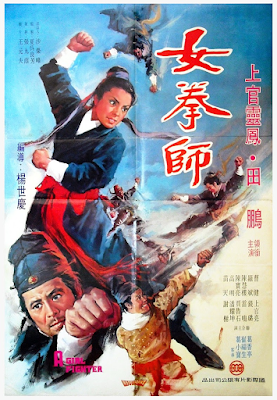


Starring: Polly Shang-Kuan Ling-Feng, Roc Tien Peng, Luo Bin, Ko Hsiang-Ting, Lui Ming, Ko Hsiao-Pao, Tsao Chien, Chan Wai-Lau, Wan Chung-Shan, Miao Tian
Director: Yang Shih-Ching
Action Director: Pan Yao-Kun


One of the unwritten rules of “basher movies”—kung fu movies made in the early 1970s in the wake of the success of The Chinese Boxer—was that most of them would take place in the Republic Era, and occasionally in modern times. A lot of that has to with the general cheapness of the production and the ability to save money on costumes, wigs, and complex sets. Exceptions were few. The most notable was The Prodigal Boxer (1972), which was set in the Qing Dynasty and was about Chinese folk hero Fong Sai-Yuk. Even more strange was A Girl Fighter, starring Taiwanese martial arts diva Polly Shang-Kuan.

Kuan had gotten her start in the wuxia genre in the late 1960s with films like Dragon Inn and Swordsman of All Swordsman. She stayed generally busy throughout the 1970s until her career waned in the final year of the decade. In any case, she was a prominent figure during the Basher Period, stuck around for the coming of Shapes, was there for the resuscitation of wuxia pian in the late 1970s, and even delved a little into Brucesploitation (in films like Magnum Fist). What makes A Girl Fighter unique is that it certainly feels like a wuxia pian (especially with its Ming Dynasty setting), but much of the fighting is open-handed, and yet it doesn’t quite reach Basher levels of crudeness in terms of choreography.

The movie begins with a couple enjoying some peaceful time together…until the unheralded arrival of a scoundrel named Chin Teng-Chiao (Luo Bin, of Swordsman at Large and Wang Yu, King of Boxers). Chin Teng-Chiao is the son of the richest and most influential man in town, so the little butthole thinks he can do whatever he wants, such as raping the daughter-in-law of the Liu family patriarch. When she puts up a struggle and her In-Laws step in to defend her, Chin just kills the entire family and that’s that.

Well, not quite. The magistrate, Hsu Chung-Huan (Ko Hsiang-Ting, of Struggle for a Vengeance and Fists for Revenge), and his advisor (Lui Ming, of Lightning of Bruce Lee and The Female Chivalry), have received an order from the capital to bring Chin Teng-Chiao in to be judged for his crimes. The problem is that this particular city does not have an actual police force. One assumes that law and order was maintained via private security funded by Chin Zhan-Peng. And since one assumes that Chin will not give up his son, the question of “Who will take responsibility for the job?” arises.

The question is answered by the arrival of a young lady named Sima Muyong (Polly Shang Kuan, of Seven to One and The 18 Bronzemen). Sima offers to bring in Chin Teng-Chiao. After dispatching a quartet of the magistrate’s guards in a display of her martial prowess, Magistrate Hsu figures that she’s as good an option as any other and gives her the job. It doesn’t take long for Sima to track Chin Teng-Chiao to a brothel and interrupt his merrymaking with a prolonged kung fu thrashing. She ultimately arrests him and takes him into custody.

But that is where things get complicated. Elder Chin (Tsao Chien, of Dragon Gate Swordsman and Chinese Kung Fu and Acupuncture) initially sends his flunkies to bribe the magistrate into letting his son go. But the issue has already reached the Top Brass, so even if Magistrate Hsu wanted to, there’d be no getting around that. However, the trial will not be held in town, but in the city of Zhending, which is located a few towns over and across the Black River. That means that Elder Chin has more than enough opportunities to ambush Sima Muyong and her men as they transport their prisoner through the countryside. And even if they do get that far, an attack by Chin’s men on the magistrate’s hall results in the theft of the Official Stamp, which means that Sima Muyong will have no way to prove who she is once (and if) she arrives.

Sima is undaunted, however, and soon takes the journey with six guards on her team. They are waylaid in the forest by Chin’s men, led by Chen Tianba (Chan Wai-Lau, of Showdown and The Fearless Hyena). They almost lose Junior Chin in the scuffle, but he is picked up by a wandering swordsman named Keng Tan-Hsin (Roc Tien, of The Samurai and The Tongfather). We later learn that Keng is the nephew of Liu Patriarch, and wants to kill Chin Teng-Chiao himself. But before he can do that, another entity shows up and steals Chin Junior. This new guy is Dong Qiming (Miao Tian, of Chivalrous Robber Lee San and Crazy Nuts of Kung Fu), a member of the guard from the destination town. He also wants to ensure that Chin arrives safely to his trial. In any case, they eventually all meet up an inn in the next town. It isn’t long, however, before Ching Zhan-Peng and his men have the entire place surrounded.

If you watch enough of these films like I do, you end up surprised when you see connections that you never saw before. For instance, the 1977 wuxia movie Green Dragon Inn is essentially a remake of A Girl Fighter. And that film also starred Polly Shang Kuan Ling Feng. There was a bit of a role reversal: Yueh Hua played the heroic captain and Polly Kuan played the vengeful niece of the murdered family, but the story for both films is essentially identical, including a prolonged sequence of the good guys and the prisoner trapped in an inn by the bad guys. The main difference is, like the title implies, this is Polly Shang-Kuan’s movie through and through. In Green Dragon Inn, she had to share the screen with genre veterans Yueh Hua and Lo Lieh. Here, she dominates practically every fight sequence there is, and the film is better for it.

The action was staged by Pan Yao-Kun, best known for the other half of the duo that gave us A Touch of Zen. He was pretty busy in Taiwanese cinema during the late 60s and early 70s, although he seemed to get less work as guys like Tommy Lee, Alan Chui, Robert Tai and Chan Muk-Chuen rose to prominence. He did make something of a comeback in the 1980s, even contributing to the superior action sequences of Young Hero of Shaolin 2. He does some okay work here, probably superior to the fights he did in Polly Kuan’s Rider of Revenge the previous year.

The action is mainly made up on group melees, often with the characters fighting with swords, with the exception of Polly, who mainly uses her bare hands. By this point, Polly had gotten her black belts in three different styles (karate, tae kwon do and judo) and it’s all on display here. Her blocks, punches and kicks are all performed with crispness. I could see the age yuke (high block) and moves that I myself performed back when I did karate. The fighting is interesting, because part of it is typical wuxia sword-slinging stuff, but then you have all these empty-handed fights as the title implies. This was pretty rare for a film with a wuxia setting back in 1972. And the moves and techniques are more genuine than the film’s basher contemporaries, so A Girl Fighter does feel like an outlier. The main problem with the action is that it is performed a bit slow: some of the speed and intensity that you’d find in the best bashers of that era is lost in favor of giving Polly Kuan’s skills a proper demonstration. The other problem with the action is Roc Tien (as usual), who is okay when he’s wielding a sword, but clumsy looking when he’s not. But there’s enough pure unadulterated Polly on display that I’m willing to forgive Roc’s awkwardness and Pan Yao-Kun’s lack of intensity with the hand-to-hand choreography.

Wednesday, May 18, 2022

Mask of Vengeance (1980)

Mask of Vengeance (1980)
aka: The Magic Sword; The Great Conspiracy
Chinese Title: 風流殘劍血無痕
Translation: Merry Remnant Sword without a trace of blood


Starring: Kao Chiang, Shih Szu, Nora Miao, Roc Tien Peng, Han Yu, Wang Lai, Chin Feng, cameos by Kam Kong, Dorian Tan Tao-Liang, Tsai Hung, Danny Lee, and Chang Yi-Tao (Bruce Lai)
Director: Pao Hsueh-Li
Action Director: Chen Mu-Chuan, Jacky Chen Shao-Lung, Samuel Suen Sau-San, Mao Ching-Shun, Li Long-Yin

Mask of Vengeance is not an easy film to review. The story is pure wuxia in that it feels like a thousand-page novel condensed into 99 minutes. Even in the last 15 minutes or so, new characters are being introduced, plot twists are popping up like rabid prairie dogs on crack, and when the smoke clears, you’re still not sure what exactly the movie was about. I admit I had that feeling when watching Kung Fu Cult Master and Butterfly and Sword, movies that took about three or four viewings for me to understand the story. But in the ensuing decades, I thought I had matured enough that I could decipher a wuxia film on my first try. I was wrong.

The movie begins with dozens of swordsmen (and fighters in general) descending upon a Pai Wah City for a big Knife Competition that the city’s head, a mysterious guy in a mask—in fact, his entire entourage, including the guys at the registration tables, wears masks—is putting on. Among the intended combatants are Tu Yuan-Chu (Kao Chiang, of Dragon Fist and Beauty Escort) and Shu Yu-Wen[1] (Shih Szu, of Heroes of Sung and Supermen Against the Orient), a young lady trying to pass off as a man. Tu Yuan-Chu draws attention after he reveals that his weapon for the contest is a peculiar jade dagger.

Tu Yuan-Chu goes to see the head of Pai Wah City and requests that he end the tournament to avoid a major bloodbath. You see, in addition to a lot of money, one of the rewards for the winner is a treasured martial arts manual about Knife Skills. Tu Yuan-Chu knows that there will inevitably be a bloodbath as the losers will try to jump the winner and steal the manual, and then turn on each other, too. The main mask guy agrees, but on the condition that Tu go seek out his old rival, a powerful martial artist who’s both lame and blind. Tu initially balks, but after losing a duel to the Pai Wah noble-mask-guy, agrees. The latter even gives Tu the manual and declares him the winner before the contest even starts. Tu goes on his way to track down the elusive Blind and Lame Master (who will be played later on by Chang Yi-Tao, of YoungTaosim Fighter and Clones of Bruce Lee).

It doesn’t take very long for different entities in the Martial World to start ambushing Tu. The first is a group of swordsman led by Shaw Brothers veteran Wong Ching (The Men from the Monastery and The Savage 5). Tu is saved by the intervention of two swordswomen, one of whom is Lady Shao (Nora Miao, of Snake and Crane Arts of Shaolin and Samurai Death Bells). We never really learn about Lady Shao’s motives for helping Tu, other than that they’re relatively honest. I guess her scabbard would to house his two-edged straight sword. Subsequent attacks on Tu are fended off by Shu Yu-Wen, who is a master of the throwing dart. Tu also makes the acquaintance of a bum who was at the contest. There is also a one-armed swordsman named Mei Hen-Tian (Han Yu, of Ninja in the Deadly Trap) who will play an important in the story.

We do learn that Tu Yuan-Chu is looking for his father, a famed swordsman known as “Chivalry” Tu Lin-Xiao. When Tu notices that his transient friend carries a familiar sword, he asks the latter where he got it. Visiting the locale—a cave on the side of a mountain—Tu finds his Uncle Chi (Kam Kong, of Snake and Crane Arts of Shaolin and The Crane Fighters). Uncle Chi informs him that his dad needed to sacrifice himself for the Crippled Party Clan, but that Chi sliced off his own arm in his stead. Other than that, no new clues about Chivalry Tu’s whereabouts.

A visit to the local Buddhist Temple reveals that Chivalry Tu had visited the temple a week before his disappearance ten years before to leave a picture of a girl in the abbot’s hands. Tu then discovers that the picture was later picked up by a member of another clan, who claimed that another man paid him to do it. Tu Yuan-Chu thinks that it might have been Mei Lin-Yen, whom we will discover later on is the Blind and Lame Master. Shu Yu-Wen shows up and reveals that she has been following Tu Yuen-Tu around. She suggests that Mei Lin-Yen’s wife had fallen for Chivalry Tu and given him her picture, which Lame-Blind Guy wanted to get back.

About this point, the movie becomes nearly incomprehensible as the revelations start piling up about people’s real identities. I’ll do my best to spell it out here, although anyone who wants to watch the movie can skip this paragraph. Long story short: Mei Lin-Yen was married to one lady (Wang Lai, of the Heaven Sword and Dragon Sabre movies), with whom he had one son: one-armed swordsman Mei Hen-Tian. He had an affair with Chivalry Tu’s wife, and their love child is Tu Yuen-Chu. Obviously, Chivalry Tu didn’t take that offense sitting down, so he became the head of the Crippled Party Clan in Pai Wai City and slaughtered most of the Mei Clan and maimed Lin-Yen, turning him to the Blind and Lame Master. He also raised his wife’s bastard child as his own, only to use him as a pawn to kill the Yuen-Chu’s own biological father. I think that Shu Yu-Wen is actually Chivalry Tu’s biological daughter, although she eventually falls in love with Mei Hen-Tian. Meanwhile, I still don’t know what the deal is with Nora Miao’s character.

If you want to get on my bad side early on, make a movie with Shih Szu and Nora Miao—two of the most beautiful women of the 1970s—, give them top billing and the make them supporting characters in someone else’s movie. Nora Miao fares the worst in that regard: she shows up in one scene during the first act, disappears for the entire second act, and then shows up out of nowhere near the climax. And once again, what exactly is her character’s motivation? Moreover, what was all that nonsense about Uncle Chi about? I’m still trying to figure that out. Maybe something was lost in translation. Or maybe screenwriter Katy Chin (the director’s wife and a scribe of dozens of 70s kung fu movies) should have simplified author Do Ku-Hung’s story just a smidgen more.

Another aspect of the story I didn’t like. The Chinese title refers to the main character’s jade dagger, which he claims has never drawn a single drop of human blood. Nonetheless, despite its small size, the weapon is capable of breaking other swords in half with incredible ease. You’d think with that pedigree, the weapon would definitely come in handy at the climax. I mean, the main villain is so powerful that it takes four characters ganging up on him to finally bring him down. It would have made perfect sense for our hero to finally bust out the jade dagger to cut down the bad guy for the GREATER GOOD. Nope. It feels like the dagger was supposed to be Chekhov’s gun…but simply goes forgotten for the rest of the movie.

Mask of Vengeance boasts no fewer than five action directors. Leading the pack are Taiwanese veterans Chen Mu-Chuan and Jacky Chen Shao-Lung (or Chan Siu-Lung). Chen Mu-Chuan is a well-known name around these parts, best known for his work on cult hits like The Iron Monkey; The Crippled Masters; and the awful Monkey Fist, Floating Snake (which he also starred in). Jacky Chen Shao-Lung was a talented martial artist and choreographer, although his career was fairly uneven (as opposed to Chen Mu-Chuan’s dependable mediocrity). Chen could blow you away with awesome choreography in something like The Fearless Dragons, and then underwhelm you with Tai Chi Shadow Boxing. Assisting them are bunch of veteran stuntmen with few choreographer credits. Samuel Suen did some stuntwork for a few Shaw Brothers movies that Chang Cheh produced in Taiwan (to get around quotas in SE Asian markets), plus did action direction for Night of the Assassins, which I’ll get around to soon. Mao Ching-Sun is better known as Angela Mao’s brother and had small fighting roles in scores of Taiwanese movies. Finally, Li Long-Yin is Lee Yi-Min’s brother and also spent most of his career as an extra, although he choreographed a few movies, including the aforementioned Night of the Assassins.

The choreography is grounded for the most part, despite this being a wuxia film. There are a few Superman flying moments, but those are few and far between. The action is mainly swordplay, which sometimes feels like a 50s Hollywood swashbuckler and sometimes feels more like a Peking Opera dance. There is some hand-to-hand combat at different moments, which is unremarkable in its execution. The film has two superkickers in the cast—Tan Tao-Liang and Chang Yi-Tao—but the former does no kicking and the latter throws a few kicks before running away. Bad use of great talent, people! There are a variety of weapons used, which is welcome. Besides the usual swords and sabers, we have characters who fight with hook swords, snake swords, flutes that double as dart guns, umbrellas, lanterns, and iron rings.

The last twenty minutes or so are pretty insane. You have bomb-throwing assassins, trap doors leading to hidden dungeons, and mind control! Then throw in a cameo from Danny Lee as a masked assassin! Don’t forget a villain with an invincible iron arm technique! High body count? You bet! All of this, not to mention Shih Szu killing dozens with her dart-throwing skills. It’s almost enough to make up for the film’s shortcomings: the hard-to-follow plot, the misuse of two superkickers in the cast, and the bait-and-switch casting of Shaw Brothers starlet Shih Szu and Golden Harvest muse Nora Miao. In the end, however, Mask of Vengeance is just sorta okay.


[1] - She later re-introduces herself as Xian Wu-Han, although it has no bearing on the story as far as I could tell.

Monday, March 21, 2022

Dressed to Fight (1979)

Dressed to Fight (1979)
aka: Legend of Broken Sword
Chinese Title: 折劍傳奇
Translation: Legend of Folding Sword


Starring:
Roc Tien Peng, Doris Lung Chun-Ehr, Yang Chun-Chun, Elsa Yang, Ling Yun, Wen Chiang-Lung, Ku Cheng
Director:
Ulysses Au
Action Directors:
Wang Ching-Liang, Chan Chuen

Dressed to Fight seems to be a typical late 1970s Taiwanese wuxia film, in the vein of movies like Love and Sword. Incidentally, both of those films were based on the writings of famed author Ku Long, whose works were adapted to film by the Shaw Brothers at about the same time. Most famously, Ku Long’s writings were the basis for popular wuxia films like Killer Clans (1976); The Magic Blade (1976); The Sentimental Swordsman (1977); and The Swordsman and the Enchantress (1978). Hell, he even wrote the story for the early Jackie Chan film To Kill with Intrigue (1976). So Dressed to Fight falls into that category of film, albeit with a smaller budget and more average fight choreography than those Shaw films.

Roc Tien Peng plays Hu Te-Wa, a wandering swordsman, as is the norm for these types of film. His friend, played by The Young Moon Legend’s Ling Yun, tells him that he’s too carefree and willing to get into trouble without any emotional attachment to his actions or the lives of others. Hu’s cohort tells him that sooner or later, something will happen to change his outlook on life. FORESHADOWING.

Almost immediately thereafter, Hu is wandering through the forest when he sees a female hand sticking out of the ground, beckoning him over to her. He ignores the sinister hand as most normal people would and goes about his business. At the same time, another woman (Elsa Yang) is journeying through the forest and comes across that same ghoulish hand. Suddenly, she is attacked by a notorious fighter named Golden Bell Tang (Rikisha Kuri’s Wen Chiang-Lung), and saved at the last moment by Hu Te-Wa, who was still in the area. The woman thanks him and starts waving signs that she is willing to thank him with her body, but he asks for monetary compensation instead.

Shortly thereafter, Hu Te-Wa meets up with a swordswoman named Chang Si-Si (Legend of Peach Blossom’s Yang Chun-Chun) and a third woman (Doris Lung Chun-Her), who alternate tries to seduce and kill Hu. From there on out, numerous parties will attempt to murder Hu Te-Wa, although he doesn’t know who is sending them or why they’re doing it. As this goes on, Hu starts falling in love with Chang Si-Si. BUT…she herself is harboring a secret…a secret society that is. Chang Si-Si belongs to the White Cloud City, a shady organization of swordsmen who are not only unforgiving with their enemies, but are even worse with their own members. Are they behind the numerous attempts on Hu Te-Wa’s life? If so, why would they concern themselves with him?

Both questions get answered, albeit only at the very end of the film and in a single line of dialog. That practically turns the film in a shaggy dog joke, especially since the final revelation about Who and Why is then supplanted with How, which is never answered. Nonetheless, there are enough cute women, double crosses, triple crosses and a general feeling of mystery to keep fans busy until the climatic duels and final revelations. Unlike some Ku Long adaptations, the film isn’t so complicated that it’s impossible to know what’s going on at a given moment: an attentive viewer can piece things together in a single viewing (unlike Butterfly and Sword, which took three viewings for me to make sense of). You will ask yourself at some parts if you missed something, but then you’ll figure out that you didn’t.

The action is Wang Ching-Liang and Chan Chuen. The former had a short and undistinguished career as an action director, although he did stuntwork in a number of movies, including several Shaw Brothers productions. Chan Chuen was already a bigger name, having worked for both the Shaw Brothers and Golden Harvest during the first half of the 1970s. He worked alongside Sammo Hung on Angela Mao films like When Tae Kwon Do Strikes and The Tournament, and early John Woo kung fu movies like The Dragon Tamers and The Young Dragons.

Despite being a wuxia film, there is not a lot of actual swordplay and most of the action is hand-to-hand combat. However, the main actor here is Taiwanese mainstay Roc Tien Peng, which means that it is a little stiff and unimaginative. I’ve described Roc Tien as being like Jimmy Wang Yu, but without the charisma, and that applies here. Tien’s fighting is as bad as it was in his earlier films, but it’s nothing to knock the socks off a schoolgirl. The last two fights at White Cloud City are pretty good and feature the most sustained weapons combat. Despite her status as a fighting diva, Doris Lung Chun-Ehr doesn’t fight very much and is completely excluded from the last two skirmishes. Some of the earlier fights have a surplus of wire tricks and trampoline jumps, but for the most part, the action is fairly grounded. On the whole, the action is average, which is just fine for an average movie with an average story and average production values.
 

Friday, March 18, 2022

Hands of Death (1974)

Hands of Death (1974)
Aka: The Tongfather; The Notorious Bandit
Chinese Title: 大惡寇
Translation: Big Bandit


Starring: Roc Tien Peng, Tien Ho, Yi Yuan, Pan Chang-Ming, Wang Yung-Sheng, Shih Chung-Tien, Chen Hung-Lieh, Hsueh Han, Lu Shih, Shan Mao, Kang Kai, Tsai Hung, Luo Bin
Director: Roc Tien Peng
Action Director: Yu Tien-Lung, Wang Yung-Sheng


Hands of Death marks Taiwanese star Roc Tien’s first attempt at taking up the directorial reigns. He tries to do something noir-ish in what is otherwise a typical anti-Japanese chopsockey opus. Unfortunately, Tien is not much of a director—or a writer for that matter—and the final product is indistinguishable from the likes of Infernal Street and The Big Fight.

The story follows a pair of Chinese agents, played by Roc Tien and Tien Ho (of Wanderer with Nimble Knife), who are assigned to stop an opium smuggling ring. Where are they sent to? I don’t know; the film never tells us. What are their names? I am actually not sure about that either. What are their backgrounds? No such luck there. Do they have any motivation outside of their jobs? Nope. None. In any case, the two end up in a generic Japanese-occupied town where the local crime bosses and a Japanese karate master are vying for control of the opium trade. Our heroes kill the bad guys one by one until they reach the final boss. The film ends. That’s that.

Roc Tien wanted to do something stylish, but there’s more to style than watching your character sit around smoking cigarettes. We learn nothing about how the inner workings of the opium trade as run by the Japanese, nor do we learn anything about how the Chinese authorities tried to deal with it. The entire film is just Roc Tien smoking, the bad guys talking, a fight breaking out, and then rinse and repeat. There are a handful of moments where the film threatens to get interesting. Before the climax (heh!), there is a sex scene between the main villain (frequently Taiwanese baddie Yi Yuan) and some tart. There’s almost nudity on display, but Roc Tien thought it would be more interesting to see Yi Yuan locking lips. He was wrong. There’s another cracked sequence where the Japanese soldier who patrols the town forces random Chinese laborers to serve as his chair. That scene ends with our heroes killing and eating his dog. No, I am not making this up.

Yu Tien-Lung (of Infernal Street) and Wang Yung-Sheng were responsible for the choreography in the film’s copious fight scenes. Wang is known in fan circles for his superlative work on The Mystery of Chess Boxing. This film is obviously not up to the standard of Wang’s magnum opus, nor is it up to par with Yu Tien-Lung’s film, which we already covered. Some of the earlier fights with Roc Tien suffer from too many cuts and close-ups, which felt like artificial ways to make his character look unbeatable. I was starting to feel that Roc had not improved his fighting skills since The Big Fight, but he does better in the later fights. His kicks are higher and his handwork is more assured. Everybody else does a fair job with their fights, but there is nothing here that cannot be seen in other, better movies from the early 1970s. The movie also promises a fight scene with a vengeful woman (The One-Armed Boxer’s Cindy Tang Hsin), the girlfriend (or wife or sister) of one of the Chinese crime bosses, and a bunch of men armed with hatchets and katana. That fight is over in less than thirty seconds. Skimping on the promise of hardcore female fight action is a no-no around these parts. And unfortunately, so is Hands of Death.

Monday, March 14, 2022

The Big Fight (1972)

The Big Fight (1972)
 Aka: Blood on the Sun; World War of Kung Fu
 Chinese Title: 擂台
Translation: The Ring


Starring: Roc Tien, Chang Ching-Ching, Yi Yuan, Cheng Fu-Hung, Tsai Hung, Kang Kai, Jack Long, Kwang Yung

Director(s): Sun Ting-Mei, Sun Sheng-Yuan

Action Director: Chan Chin


The Big Fight may very well be the first film to exploit the success and themes of Fist of Fury. Sure, other films came out in the wake of the latter, like Bloody Fists and Five Fingers of Death, that featured Japanese villains. However, the story structure and portrayal of these villains seemed to be taken more from The Chinese Boxer. Much like Fist of Fury, The Big Fight posits that the greatest oppressive power that the Japanese possessed was political and not just, martial artistic. The Japanese is the other films mentioned above are more tools of an ill-intentioned Chinese character. In both this and Fist of Fury, the Japanese are evil not only because they brutalize the Chinese, but because they have political structures to protect them. In the Bruce Lee classic, it was the laws that governed the Shanghai International Settlement. In this film, the setting is the Second Sino-Japanese War and the Japanese occupation of the region means that they can get away with all sorts of atrocities.


The Japanese are occupying Northern China and routinely beat people to death at checkpoints, while the Chinese who suck up to them aren’t much better. We follow the exploits of Chou Hai-Chuen (Roc Tien Peng, last scene on these pages playing a villain in A Touch of Zen), a laborer and kung fu instructor who doesn’t think very highly of the Japanese. After murdering a squad of Japanese soldiers, he gets involved with a rebel movement led by Miss Liao (Cheung Ching-Ching of Kung Fu Mama). They head back to his hometown, where his senior brother and general sleaze, Brother Wu (Kwan Yung), is acting like he owns the place because his dad is the mayor and a Japanese supporter. Chou doesn’t agree with Wu’s attitude, but is willing to bide his time for the moment. Wu eventually has Chou Hai-Chuen thrown in prison for possession of salt (apparently a component of gunpowder), but is released at the request of Brother Wu’s current kung fu teacher (Cheung Siu-Kwan). Brother Wu then suggests to his Japanese superiors that they throw a tournament to “promote friendly relations,” but in actuality to kill off any kung fu master who may join the rebel movement in the future. Chou Hai-Chuen initially resists getting involved, but a series of violent tragedies eventually pushes him over the age.


Man, this was one violent and brutal film. Limbs are broken. Chests are caved in. Spinal cords are snapped in half. Little children take death palms to the face and die in bloody heaps. Our heroes kill one Japanese sympathizer by strangling him with barb wire. Dozens of people (on both sides) are hacked to pieces with katana blades or mowed down with rifles. About a whole hogshead of blood was spent just for people to spit up. And just to keep things sleazy, no fewer than four women get raped over the course of the film, though thankfully the movie fades to black before we get to see the deed done. One rape scene actually ends with the victim burying a pair of scissors in the assailant’s back before shooting herself in the stomach. I’m not sure if this is the most violent basher of the time period, but it’s certainly up there.


The action is quite frequent and generally solid for something made in 1972. Cheung Ching-Ching more or less steals the show as the Taiwanese answer (at the time) to Angela Mao, who exudes confidence as she karate chops all of her opponents into oblivion, including the oversized Cheng Fu-Hung (Guy with Secret Kung Fu), who plays a sumo wrestler. Cheung also has the film’s most unique weapon, a skirt covered on one side with razor-sharp metal discs that she lashes out at her opponents. Not far behind is Cheung Siu-Kwan, who plays the benevolent kung fu master and spars with the Japanese judo and karate (Ng Tung-Kiu and Hsieh Hsing, respectively) masters during the tournament sequences. His fight feels like a proto-shapes duel and is one of the highlights of the movie. Look fast for a young Jack Long and Choi Wang as tournament participants. The former looks especially acrobatic compared to his co-stars, and should’ve been given more room to shine. Also, there are two large-scale massacres in the final act where dozens of people are torn to pieces with swords, knives and fisticuffs, which should make some fans happy.


Let’s talk about the movie’s resident tough guy: Roc Tien. Uh…He’s not very impressive in this, even though he’s supposedly the most talented fighter in the film. His kicks don’t get any height and his handwork is nondescript. He frequently uses knives in his fights and is often saved from death because of hidden trampolines and “bionic legs.” Or in other words, he’s essentially a less-ugly version of Jimmy Wang Yu. I imagine this movie was made early enough that the action director and cast were still getting a hold of this new kung fu genre, so maybe it’s not completely Tien’s fault. But the fact of the matter is that he’s far from the most interesting character to watch during the fight scenes. Thankfully, there are so many fights that don’t feature him during the second half that his lack of martial charisma doesn’t detract from the rest of the movie. Now the brutality and misogyny, that may be another story…

A Touch of Zen (1971)

A Touch of Zen (1971)
Chinese Title: 俠女
Translation: Heroine (or "Chivalrous Woman")


Starring: Hsu Feng, Shih Chun, Pai Ying, Roc Tien Peng, Tsao Chien, Miao Tian, Chang Ping-Yu, Hsieh Han, Wang Shui, Roy Chiao, Wan Chung-Shan, Han Ying-Chieh, Sammo Hung
Director: King Hu
Action Director: Han Ying-Chieh, Pan Yao-Kun


A Touch of Zen is generally considered to be King Hu’s masterpiece and in some corners, one of the greatest martial arts films of all time. It is his most critically lauded, having won the Palme d’Or award at the 1975 Cannes Film Festival, and was voted the 9th greatest Chinese-language film of all time at the 24th Hong Kong Film Awards, and 15th greatest Chinese-language film of all time at the 2011 Golden Horse Awards. Ang Lee points it out as being one of the major inspirations for his own masterpiece, Crouching Tiger Hidden Dragon. The film also represents the second entry in both the director’s and fight choreographer’s respective Ming Dynasty “cycles[1]” and the director’s first foray into adapting Pu Song-Ling’s Strange Stories from a Chinese Studio into film.

The story is based on a short story from that anthology called “The Magnanimous Woman”. In the story, a scholar living with his mother in a haunted building takes on a new neighbor in the form of a quiet woman and her deaf mother. The latter befriends the scholar’s mother, and the scholar gives food to the poor woman and her mother. One day, the woman kills the scholar’s best friend, who turns out to be an evil fox spirit. The woman then disappears from his life forever. Using this basic premise, King Hu once again explores the corruption of the eunuchs during the Ming Dynasty who had taken too much power away from the decadent emperors.

Scholar Ku (Shih Chun, of A City Called Dragon) lives a humble existence with his mother (Chang Ping-Yu, of Eight Hundred Heroes and Seven Spirit Pagoda). Despite his myriad of talents, he refuses to take the public exam to become a government official, but instead runs a small shop writing poetry and painting portraits in hopes of saving enough to open a school. This is all to the chagrin of his mother, who’d like her son to be a bit more ambitious, make more money, find a good wife, and continue on the family line. In order to help save money, the two live in the remains of an abandoned fort, which some of the locals believe to be haunted. Ku’s life will change forever when he meets two strangers over the course of 24 hours.

The first is a polite, but suspicious wanderer by the name of Ouyang Yin (Roc Tien, of The Big Fight and Swordsman of All Swordsmen). Ouyang shows up at Ku’s shop asking for a portrait, but also inquiring into the backgrounds of some of the town’s newer residents. At the same time, a young woman named Miss Yang (Hsu Feng, of To Kill With Intrigue and Chase Step by Step) has moved into the fort, setting up shop as a weaver. Ku’s mother thinks that Miss Yang would make the perfect wife for her son, although Yang refuses the proposal. Despite his initial friendship with Ouyang, when Ku discovers that his new friend is involved in a deadly game of cat and mouse with Miss Yang, who’s the daughter of a deposed general, he gravitates toward Miss Yang and her retainers. When the high official who ordered the arrest and torture of Yang’s father arrives in town, Scholar Ku will use his extensive scholarly knowlege—including military philosophy and history—to help the underdogs find justice.

Obviously, this is a three-hour film we’re talking about, so the story is far more complex than my short synopsis suggests. And director King Hu takes his sweet time in developing the story, in such a way that it’s almost an hour into the movie before we get our first swordfight. King Hu gives us ample time to get to know both Scholar Ku and his mother, not to mention develop a rapport between Ku and Ouyang, before allowing the external conflict to unroll. Cinematographer Hua Hui-Ying, who also filmed King Hu’s Dragon Inn, gives us long shots of the haunted fort where Ku lives, the countryside of Southern China, and the forests—both bamboo and evergreen—where the some of the longer fights take place. We have ample time to soak in the surroundings before a single sword is drawn.

For a film so deliberately paced, it’s a testament to King’s skills as an artist that the movie doesn’t feel as long as it is, at least for the first 150 minutes. Where the film really loses its footing, and thus doesn’t quite reach that eschelon of “greatest martial arts films of all time” is in the last half hour. The bad guys vanquished and Yang having avenged her family, we go into a lengthy sequence in which Miss Yang disappears and Ku goes looking for her. That’s fine. This leads into the climax, in which a new set of villains appears and scuffles with our heroine and her cohorts, including a group of Shaolin monks. It ends with a pseudo-religious kung fu fight between the Abbot (Roy Chiao) and the head guard (Han Ying-Chieh) that goes on for nearly 20 minutes before reaching a final Zen conclusion.

From a storytelling perspective, introducing new villains so late in the game is dangerous territory, as it robs the viewer of the emotional investment of watching the heroes put their lives on the line for something they believe in. By this time in the film, the heroes have already earned that victory. Why do we want to keep watching these people fight? They’ve already gotten what they want. Yes, it would make sense that the government would want to seek justice against these “rebels”, but that’s another for another film. And considering that the local officials were helping the good guys and the bad guys were all killed, how would higher-ups discover that Scholar Ku was involved? Those thirty minutes bring up more questions than they answer. And whatever King Hu wanted to say about Buddhism in a film whose original title is “Heroine”, or “Chivalrous Lady”, feels tacked on when being dealt with through the conflict of two groups of supporting characters, one of which who had only been introduced minutes before.

It’s a shame about the finale that feels removed from the rest of the movie leading up to it, because all of the technical and artistic aspects of the film are excellent. Han Ying-Chieh is back as the head action director, with help from Pan Yao-Kun, who had worked on A City Called Dragon (1969), another arthouse swordplay film. The emphasis of the action is swordplay, and once more, Han Ying-Chieh seems to be channeling Japanese samurai films through a Peking Opera lens, although his work is a lot more accomplished here than it was in Dragon Inn. Most people talk about the infamous bamboo forest fight and how it inspired so many films after it. It’s definitely a well-photographed fight, although I like the big battle at the fort more. Unlike The Heroic Ones, where the generals were super-powered kung fu killing machines, this film grounds our protagonists and establishes quickly that the higher up the official is, the better his fighting skill is. And since they come accompanied by hundreds of soldiers, taking them head on is not going to be an option. And thus Scholar Ku becomes a military strategist, combining his years of reading the Classics with his intimate knowledge of the surrounding area. The way he and the others break down the soldiers’ nerves before the battle proper starts is genius and might have inspired a similar scene in Monsters University. The final fights are all well-choreographed, and look for a 19-year-old Sammo Hung as Han Ying’s bodyguard.


[1] - The first film would be Dragon Inn (1967), which they worked on together. The third film differs between the two: for King Hu it was The Valiant Ones (1975) and for Han Ying-Chieh it was a pentalogy, the other films being Heroes in the Late Ming Dynasty (1975), The Last Battle of Yang Chao (1976) and Dynasty (1977).

Duel of Karate (1971)

Duel of Karate (1971)
Chinese Title: 鐵腿降魔
Translation: Iron Leg Demon


Starring: Roc Tien, Doris Lung Jun-Ehr, Yee Yuen, Chen Hung-Lieh
Director: Fu Ching-Wa
Action Director: Yen Yu-Lung


When I watched Struggle Karate a few days ago, I was treated to a cheap, ugly, drab-looking production with no karate, sloppy fight scenes, and all around badness. I braced myself mentally before watching this one, since it too was a pre-Bruce Lee kung fu movie with "karate" in the original title. What I didn't expect was some as solid and entertaining, albeit far from being any sort of classic, as this film turned out to be.

We open with two guys engaging in a sloppily-choreographed fight on a mountain top, which is definitely a bad omen. Cue the opening credits, played to "Générique Western" by Francis Lai from the French film Un homme qui me plaît, which also shows up in The Drunken Master and The 7 Grandmasters. A few laters, one of the másters is greeting his twin sons into the world, when the other master shows up with four Japanese karate másters in tow. The other máster lost the duel, but then spent three years learning karate in order to prepare for a rematch. The evil máster kills the good one, and the four karate guys slaughter everybody else, including the man's wife. Only the twin sons live, one of whom is taken by the good master's student, the other who is left at the scene of the crime. The former is brought up and taugh the Iron Palm technique, which he uses to get revenge. At the same time, another Iron Palm fighter shows up and is employed by the Evil Master...

The movie is basically non-stop fighting for its entire 86-minute running time. I'm pretty sure that the movie is never more than five minutes without a fight. There's one big plot hole that the story leaves open which I would've liked to have known: *who* exactly saved the second son and how did the second son learn the Iron Palm technique, if it was his father's signature style? The second son says that he was found and raised by a boxer (re: martial artist), but never goes into detail about who he was.

The action was provided courtesy of Yen Yu-Lung, who worked a handful of obscure Taiwanese films during the early 70s. I actually would like to check out more of his work to see if he was able to evolve his style, since it was a lot more animated and interesting than what Struggle Karate gave me. He also frequently worked Taiwanese action starlet Doris Lung Jun-Ehr, so that's Always a plus. Yen actually choreographs exchanges of strikes and blocks, as opposed to the sloppy evasion approach seen in many early 70s basher films. He also experiments with wires, giving the villain a special Superman technique and some truly hysterical "guy gets knocked back dozens of feet" moments. Yes, it's all crude, but it was certainly more imaginative than Struggle Karate. Too bad he couldn't get crisper kicking techniques out the leads.

With regards to this film's portrayal of karate and the Japanese, it's surprisingly not as racist as your average Jimmy Wang Yu film or Fist of Fury variant. The four Japanese characters aren't a bunch of Chinese-hating bullies, they're just four martial artists in the (Chinese) villain's employ. Karate is portrayed as being a particularly fearsome style, although here it's mainly composed of chopping techniques. That's unfortunate, since as one who studed Goju-Ryu for two years, I know that karate has a wealth of hand and foot techniques, none of which are on display here. Moreover, once the fights kick off, it's virtually indistinguishable from the Iron Palm style the hero uses, in that both sides are content to parry the opponents attack and deliver a downward chop to the back, which is frequently fatal. That makes the film almost worthless as a karate movie, but as an example of a pre-Bruce Lee kung fu movie, it's certainly worth a view.

Tuesday, March 8, 2022

Swordsman of all Swordsmen (1968)

Swordsman of all Swordsmen (1968)
Chinese Title: 一代劍王
Translation: Generation Sword King


Starring: “Roc” Tien Peng, Polly Shang Kuan Ling Feng, Chiang Nan, Tsao Chien, Miao Tian, Hsieh Han, Ko Yu-Min, Lu Shih
Director: Joseph Kuo
Action Director: Shek Chee-Bun, Pan Yao-Kun

Much of the world was in an uproar at the time the film was released, on October 6th. The United States was up to its neck in the Vietnam War, having dealt with the Tet Offensive, the infamous My Lay Massacre (among others), and increasing opposition on the homefront. The Pullitzer Prize-winning photograph of the South Vietnamese military officer executing a Viet Cong officer in the street didn’t help things, either. Speaking of executions, that year also saw the assassinations of both Robert Kennedy and civil rights leader Martin Luther King Jr., not to mention John Gordon Mein, an American ambassador who was murdered in the streets of Guatemala.

Little of this is seen in The Swordsman of Swordsmen, a rather conventional wuxia film about revenge. A group of baddies led by Yun Zhongjun (prolific actor Tsao Chien, who played the owner of the titular locale in Dragon Inn) massacres the Cai household, stealing the family’s prized sword and leaving only the son, Cai Yingjie (Taiwanese regular “Roc” Tien Peng), alive. Cai grows up to be a master swordsman and hunts down his family’s killers, one by one. Along the way he meets a swordswomen, Flying Swallow (Polly Shang Kuan Ling Feng, in her sophomore effort), who’ll influence his mission in ways he doesn’t imagine.

So if King Hu was the John Ford of kung fu cinema, than Joseph Kuo would be the Delmer Daves, a freelancer who frequently wrote and produced his films, in addition to directing them. Once he took his place directing martial arts films in the late 60s, Kuo could be generally depended on to fill his films with rip-snorting action, while throwing a few wrinkles into conventional martial arts movie stories. In this movie, for example, we have the full set-up for a typical wuxia tragic ending, especially once we learn about Flying Swallow and her relation to the villains. The film goes barreling forward at full speed to a downbeat conclusion, but then pointedly does not do that. Instead, we have a series of decisions made by our hero in which he earns his title (i.e. the film’s title) not just by ruthlessly cutting down everybody in sight (although he does a lot of that), but by exercising mercy and restraint as well.

The action was a lot more satisfying here than it was in the two King Hu movies I talked about. Do not expect a lot from Polly Kuan, who was still training at this point. Nonetheless, the fight choreographers Shek Chee-Bun (The Gallant Knights and The Buddhist Spiritual Palm) and Pan Yao-Kun (who worked on King Hu’s A Touch of Zen) up the pace of the action. The one-on-one duels resemble those seen in Hollywood swashbucklers and are more energetic than Han Ying-Chieh’s Peking Opera approach to screen combat. Most of the action, however, is Roc Tien taking down a dozen men at a time whenever he confronts one of his targets. There are a few exaggerated moments, like Roc Tien catching a knife between his teeth and throwing it at an opponent several feet away. But for 1968, the action was fairly solid.

Big Man Japan (2007)

Big Man Japan (2007) Starring : Hitoshi Matsumoto, Riki Takeuchi, Ua, Ryûnosuke Kamiki, Haruka Unabara, Tomoji Hasegawa Director : Hitoshi M...