
Thursday, June 6, 2024

Ashura (2005)

Ashura (2005)
Original title: Ashura-jô no hitomi; Blood Gets in Your Eyes
Translation: Eyes of Ashura’s Castle
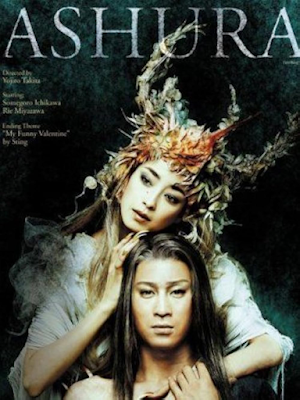


Starring: Somegorô Ichikawa, Rie Miyazawa, Kanako Higuchi, Atsuro Watabe, Takashi Naitô, Yukijirô Hotaru, Fumiyo Kohinata, Hanae Kan
Director: Yôjirô Takita
Action Director: n/a


It's almost fitting that I watched this (for the first time) after I watched 
Demon Slayer the Movie, as this movie does revolve around a similar premise: in the Edo period, the Capital is infested with demons. There is a corps of sword-wielding warriors known as the Demon Wardens whose job is to exterminate them. It sounds pretty similar to the immensely popular anime Demon Slayer, with the difference being that this is set in the Edo Period and the anime is set in the Taisho Period (1912 – 1926).

One of the aforementioned Demon Wardens is Izumo (Somegoro Ichikawa, who played the same role in the 2015 adaptation of the same material), retires from the force after a traumatic incident during a raid. But before that, we are introduced to the premise via a meeting between the head Demon Warden, Noboyuki Kuninari (Takashi Naitô, who did voice work in Spirited Away) and Bizan, the Demon Nun (
Casshern's Kanako Higuchi, who looks like Michelle Yeoh from some angles). Bizan is the current leader of the demon realm, but she informs Kuninari that Ashura, the Demon Queen, will soon be reborn. We then segue into the aforementioned raid, which ends with Izumo striking down a young child who was pretty obviously possessed by a demon. At that point, Izumo starts to wonder that age-old question: “Who’s the real monster?” I’m pretty sure it’s those creatures who are killing people and sucking their blood, but I may be biased.

Izumo becomes a popular Kabuki actor, the sort of one who’s a huge hit with the ladies. I do like how Kabuki Theater is an integral part of the story in the same way that Peking Opera was an integral part of Vengeance! I also like that the current venue is for a play that involves the hero riding a giant fire-breathing toad, which leads me to believe that it’s the same story that inspired The Magic Serpent. The trope’s writer-director, Naboku Tsuruya IV (Fumiyo Kohinata, 
Dark Water and Beyond Outrage), is desperate for some new inspiration. The nutjob even goes so far as to ask his main stagehands if they could get themselves eaten by demons in order to inspire him.

Izumo meets a travelling acrobat, Tsubaki (
The Twilight Samurai’s Rie Miyazawa, who looks like Michelle Yeoh from other angles), who seems to moonlight as a kunoichi, or female ninja, named “The Night Camellia.” At their first meeting—she’s hiding under a bridge from the authorities while Izumo is enjoying a Japanese gondola ride with his “leading lady” (actor Yukijiro Hotaru, of the 1990s Gamera trilogy)—Izumo comes into possession of her hairpin. She visits his quarters the next night in ninja mode and Izumo starts falling for her, even so far as to pull the “magical red thread” trick on her. What he doesn’t know is that their meeting has caused rose-shaped tattoo/scar to appear on her shoulder. And when a demon attacks her the next day, the scar goes into action and melts the poor bastard.

On hand to witness that strange event is Izumo’s former demon-slaying partner, Jaku (TV actor Atsuro Watabe). Jaku is a bit ambitious in the Demon Warden “corps,” so ambitious that the next time his boss and Lady Bizan meet up, Jaku just kills the old man and pledges allegiance to the demons. You see, Tsubaki is the vessel through which Ashura the Demon Queen shall be reborn. Jaku, like the wizard Saruman, thinks that the future favors the demons, and that if he goes turncoat now, he’ll be rewarded with a great amount of power. What Bizan doesn’t tell Jaku is that the key to unlocking the demon in Tsubaki is through love. And her blossoming relationship with Izumo may just be what the doctor ordered for a demon apocalypse…

The film is based off of a play, although I don't know if it’s a modern play or a kabuki play. I assume it’s the latter, which makes the film “meta” in that one of the subplots is how Naboku Tsuruya IV keeps on throwing himself in the middle of important events of the film so he’ll have something to write. By the end of the movie, he has written the tale of Ashura that is known to the Japanese people today. The film is mainly a love story, which permeates the proceedings right up to the final sword fight and its conclusion. I don’t mind that sort of melodramatic approach to the material, although at 118 minutes, the film is about 15 minutes too long. It needed to be tidied up a little bit in the last act, when the “big transformation” occurs and Izumo prepares to face Ashura in her castle.

Rie Miyazawa is very cute and a joy to watch. Apparently, she was a girl-next-door actress until she did a film called 
Erotic Liaisons and released a nude photo book, which was hugely successful. She had some personal problems in the late 1990s and dated a Sumo wrestler[1], but was able to put her career back together in the 2000s. She has since won multiple awards for her performances in films like The Twilight Samurai and Her Love Boils Bathwater. Somegoro Ichikawa makes for a convincing romantic hero, with a dollop of playful arrogance—or self-assured literacy--to complement his sword-fighting scenes. I guess that makes sense, as he was also in The Samurai I Loved.

There is a fair amount of action in the film, although it's choreographed more like a traditional chanbara film than in Hong Kong style, as many of its contemporaries (like 
Death Trance) were. The climax has our hero fighting of scores of ogres in an upside-down castle, with the camera moving in vertical circles around our hero, followed by a series of one-on-one duels.

The demons are very similar to those in "Demon Slayer," in which they look like normal humans until it's time to feast on blood. In this case, they have neon green eyes and green CGI blood. There are demons and trolls with more Wolfman-like faces that show up in a few scenes, especially during the final series of sword battles. Those creatures were designed by Tomoo Haraguchi, the FX guy who also directed films like
Mikadroid; Death Kappa; and Sakuya, Slayer of Demons. Eh…this is not his most creative mercenary job, but that wasn’t really the point of the film.  There are also some Godzilla-style miniatures during the destruction of Edo sequence; I enjoyed watching old-style buildings explode in the way modern buildings do in movies like Godzilla: Tokyo S.O.S.

The entire film feels intentionally staged, as if it were a successor to the set-bound
wuxia movies of the Shaw Brothers at its best. This goes back to the meta aspect of the film: a staged adaptation of a play, telling the story of the how the playwright had the idea for the play, much of which is set a theater itself. The best art direction—courtesy of Yoji Hayashida, who an impressive résumé that includes Uzumaki; The Great Yokai War: Guardians; Shin Godzilla; and the 13 Assassins remake. The most impressive visuals, set and costume-wise, come at the beginning during the raid on the festival. The cinematography is also strong, brought to you by Katsumi Yanagijima, whose credits include the Ju-On: The Grudge films, Takeshi Kitano’s Zatoichi, and Battle Royale.

It’s a good film, with great visuals—save for some dodgy CGI—a few good performances and some nice romance and melodrama (which is the intention). My major qualm is the aforementioned overlength, which is something that I often take issue with in Japanese films (a reason I often prefer the American cuts to Japanese Godzilla movies: they flow better). I also wish that they would have gotten Yuji Shimomura or Go Ohara to do the action. And gotten more and better creature designs out of Tomoo Haraguchi. But it’s still worth a view.


[1] - Dating a sumo wrestler is sort of a “prestigious” thing to do, but it is still what amounts to a flower vase role in the media. But yeah, successful sumo wrestlers can bag some hawt babes in Japan.

Tuesday, June 4, 2024

The Ghost (2001)

The Ghost (2001)
Aka: Code of the Dragon; Thunderbolt Female Killer


Starring: Julie Lee Wa-Yuet, Michael Madsen, Cary-Hiroyuki Tagawa, Richard Hatch, Michael Paul Chan, James Hong, Louis Herthum, Brad Hunt, George Cheung, Brad Dourif
Director: Douglas Jackson
Action Director: Koichi Sakamoto


The Ghost is an interesting oddity, if not a completely successful one. It was made in 2001, when the success of The Matrix and Crouching Tiger Hidden Dragon—not to mention the success of Jackie Chan and Jet Li in Hollywood—meant that much of Hollywood action would have a Hong Kong flavor to it. The Ghost was a made-for-cable movie with a few recognizable names and faces, from Michael Madsen to the ubiquitous James Hong, and some Hong Kong-style action, courtesy of Alpha Stunts. The filmmakers also brought in a Hong Kong actress to play the lead: Julie Lee Wa-Yuet.

I would like to know how she was chosen for the role, considering that she hadn’t acted in Hong Kong since 1995. Nor was she a particularly huge name, even to Hong Kong cinephiles. Moreover, Miss Lee was mainly known as a Category III actress and not an action one. She had roles in Cat III favorites like The Untold Story and Love to Kill. She garnered a lot of attention in Hong Kong in 1995 when she wrote, produced and directed Trilogy of Lust and its sequel, which are known for mixing extreme gore with un-simulated sex. Although the first of those films did OK, the sequel did not. This came at the same time that her self-financed solo music album was released and also flopped, at which point she seemed to drop out of the entertainment industry. Once again, how she was cast in this is anybody’s guess.

An intertitle at the opening informs us that the real power in Hong Kong belongs to the Tong Societies, and that they often employ ninja-like assassins known as “Ghosts” to eliminate their enemies with extreme prejudice. This brings up an interesting point: What is the difference between a Tong and a Triad. Tong comes from the Chinese word for “hall” or “gathering place,” and refers to benevolent organizations or secret societies of Chinese immigrants abroad. They are not by definition criminal organizations, although there might be some interactions between them and the Triads, which refer to the Chinese organized group organizations. Interestingly enough, even the Triads started out as something benevolent (depending on your point of view), as they were secret societies organized with the intent of raising up rebellions to overthrow the Manchurian-led Qing Dynasty and restore rule of China to the Han people. But as these things go, they often had to engage in illegal activities in order to raise money for their cause.

Our main character is Jing (Julie Lee, credited here as Chung Lai), the adopted daughter of a Tong leader (James Hong, of Bloodsport 2 and Everything Everywhere All At Once). We learn that she was abandoned as baby for being a girl—darn that One Child Policy!!!—and raised by the Tongs to be a cold-blooded killer. Her mission at the beginning is to strike fear into the heart of a renegade Tong leader, Chang (Cary-Hiroyuki Tagawa, of Mortal Kombat and The Man with the Iron Fists 2), who has gone a bit mad. Jing crashes his birthday orgy, which sets up the dark running joke of Chang shooting his girlfriends whenever he’s in a frenzy. She threatens his life if he doesn’t reign in his behavior and disappears.

Chang is pissed that another leader would send a Ghost after him, so he has Jing’s father and some other leaders murdered. One of the remaining leaders (stuntman George Cheung, who played Soo Yung’s driver in Rush Hour), tells her to leave Hong Kong for the States, even so much as giving her a new identity as a mail-order bride. As her future husband, Edward (Richard Hatch, best known for his roles in “Battlestar Galactica”), has been corresponding with another girl for some time, he has no idea what to expect when he sees her. That said, did the Tongs just kill the other girl and substitute Jing for her?

Jing arrives in the United States and meets her new fiancé, whom she is initially repelled at—she tells her Tong contact in L.A. Chinatown that he’s “weak and patronizing.” She gradually comes to like his “good man” ways and falls for him. But while she’s settling into her new identity, Chang and his spy on the HK Police Force, Detective Wu (Michael Paul Chan, of “Major Crimes” and U.S. Marshals—his filmography suggests that he’s the guy you get when you can’t afford Tzi Ma), are beating the information as to her whereabouts out of [George Cheung]. Wu then calls in a favor with his opposite number in Los Angeles, Captain Garland (Brad Dourif, of Alien Resurrection and the Child’s Play franchise). Captain Garland hires bail bondsman/bounty hunter Daniel Olinghouse (Michael Madsen, of Kill Bill Vol. 2 and Reservoir Dogs) to find her. But with two out-of-focus pictures and no name, Olinghouse has his work cut out for him. And the longer it takes to find her, the more people from Hong Kong will come to L.A. to speed up the process.

The Ghost
was written by David Tedder and Douglas Jackson, the latter of whom also directed. Tedder only has four writing credits to his name, although he helped in the sound department for God’s Army, a popular film among members of The Church of Jesus Christ of Latter-Day Saints. Jackson has been in the game since the early 1970s, although he has been mainly involved in making TV movies. His biggest film—one that I vaguely remember as a child going to theaters—was Whispers, with former Mrs. Steve Martin, Victoria Tenant. The story is the sort of “white guys write for Asian culture” that you’d expect in an early 1990s DTV movie. There is no real understanding for Tongs or Triads and their power structures in Hong Kong and abroad, and controversial issues like the One-Child Policy receive lip service, but in a shallow, sensationalist manner.

The acting is very much a mixed bag. Julie Lee stands out in that her performance is particularly stilted, even if her English accent is easy to understand. On the other end of the scale is Cary-Hiroyuki Tagawa, who overacts wildly as the main villain, breaking stuff in coke-induced rages and sneering and snarling so much that the scenery chews itself in fear. In the middle are Richard Hatch and Michael Madsen, whose roles don’t really require much of them. Then there’s Brad Dourif channeling his inner John Malkovich. A friend of mine said that John Malkovich always comes across as a man who’s perpetually irritated at the service he’s getting a restaurant. Dourif, with his deadly serious and over-annunciation of his lines, comes across very much like that.

The action was staged by Alpha Stunts and Koichi Sakamoto, best known for Drive (1997) and dozens of Japanese tokusatsu films and shows. Sakamoto also worked on DTV martial arts films like Martial Outlaw and Mission of Justice, which enjoy good reputations among fans. The fights, while generally short, have that fast Hong Kong vibe to them. Most of the fights involve Julie Lee—or to be more accurate, her stunt double—performing fast kicks and punch combos on a bunch of stuntmen: killers in Hong Kong, car jackers, killers at her house, thugs in Chinatown, etc. It’s clear that Lee isn’t doing any of the heavy hitting, since she’s notably slow the few times the camera focuses on her doing anything. Her double does some neat moves, like jumping backwards off a railing, performing the splits, and landing behind her opponent. There is also a legless black guy in Chinatown who gets in some fights (thanks to some accommodating stuntmen). The film ends on a big gunfight, although it has nothing on A Better Tomorrow 2…or even City War.

The film’s low budget (and script shortcomings) shows in numerous ways: Chinese people in Hong Kong who normally speak perfect American English; a Chinese assassin in Hong Kong leaving threats in English; L.A. Chinatown without crowds; the most chill police precinct in the entire L.A. metropolitan area, etc. In the end, there isn’t enough fighting from Alpha Stunts, nor does Julie Lee delve deep enough into her Category III roots to give the film anything to write home about. It’s just a mediocre little film all around.

Saturday, June 1, 2024

Battle of Wits (2006)

Battle of Wits (2006)
Aka: Battle of the Warriors
Chinese Title: 墨攻
Translation: Mohist Attack


Starring: Andy Lau Tak-Wah, Wang Zhiwen, Fan Bingbing, Nicky Wu Chi-Lung, An Seong-gi, Chin Siu-Ho, Wu Ma, Sammy Hung Tin-Chiu, Choe Shi-won, Yu Chenghui
Director: Jacob Cheung
Action Director: Stephen Tung Wai


The Zhou Dynasty of China is the second dynasty for which we have definitive archaeological evidence for—the supposed Xia Dynasty is to have predated the Shang Dynasty, and shows up in literature from that period, but there is no real evidence for its existence. The Zhou Dynasty was founded in 1046 B.C. and ran for some 789 years, ending with its absorption into the Qin Kingdom in 256 B.C. The Qin Kingdom, founded during the famed Warring States Period (481 – 221 B.C.), eventually conquered all of the states and formed the Qin Dynasty, led by Shi Huangdi, China’s first emperor.

As it goes with most dynasties, a period of artistic and technological advancement is eventually followed a period of decline, as the Powers That Be grow increasingly corrupt and focused on their own pleasures, and less concerned about running a large kingdom (or empire). The complacent central government—the dynasty—becomes weak as local warlords grow in power in their respective provinces or territories, ultimately leading to the fragmentation of the kingdom (or empire). Sometimes the fragmentation is temporary, but in the case of the Zhou Dynasty, it lasted more than 250 years.

During the Warring States Period, seven major states were formed, with the Zhou royal family just hanging out in the capitol, unable to do much about anything. There were a handful of smaller states—in the case of Battle of Wits, the focus will be on the small kingdom of Liang—that just existed until they were ultimately overcome by any of the bigger kingdoms.

This film is set in 370 B.C. That puts it about 110 years after the death of Confucius and 100 years after the birth of Mozi. Just who is Mozi? Well, he is credited as the founder of Mohism, one of the lesser-known of the major philosophies—Taoism, Confucianism, and Legalism—that was founded during the Zhou Dynasty. The philosophy preached a “universal love” and were largely pacificists, albeit semi-practical ones. They came to be during a period of perpetual war between the neighboring kingdoms, so they were more about helping those cities that were on the defensive during those troubled times. They became the best military strategists of their time, trying to defend their client’s cities while losing (and killing) as few people as possible.

We open with an intertitle informing us that the Kingdom of Zhao (in northern China) has sent a ginormous army to the neighboring kingdom of Yan (in northeastern China/southern Manchuria). The army will pass through the mini-state of Liang on their way and will most likely conquer it without any effort. The King (Wang Zhiwen, of The Storm Riders and The Emperor and the Assassin) has sent for a Mohist strategist to assist them, although it has taken a bit too long for him to arrive and the Zhao army is already on their doorstep. So, the King hastily sends General Niu (Chin Siu-Ho, of Fist of Legend and Legend of the Fox) to sign a non-aggression pact with the lead Zhao general, Xiang Yanzhong (Musa the Warrior’s An Seong-gi).

While that is going on, Mohist strategist Ge Li (Andy Lau, of A Moment of Romance and Firestorm) arrives at the city gates. They let him in and he quickly convinces the townspeople that they need to defend themselves, on the logic that a non-aggression pact won’t stop the Zhao army from executing most of the ministers, raping the locals and pillaging the city. He heroically fires an arrow at the Zhao frontline General Gao (Sammy Hung, son of Sammo) to show them he means business. The Zhao army retreats to confer with General Xiang on how to proceed.

The worthless King is initially too drunk to receive Ge Li, but the next day he questions and tests him and ultimately decides to give him command over the city’s armys, much to the dismay of the Royal Tutor (Wu Ma, of 14 Blades and Swordsman). General Niu is also surprised to see his power usurped by a new guy, although he keeps it to himself for now. Ge Li’s first item of business is to dismantle one of the walls from the palace to build a fortress around the exposed southern gate of the city, as the other sides are protected by mountainous terrain. He also promotes talented archer Zi Tuen (Nicky Wu, of Love in the Time of Twilight and The Valiant Ones New) to the rank of general over the archery division. All this time he is closely accompanied by Crown Prince Liang Shi (Choe Shi-won, of Dragon Blade and Helios), who comes to admire Ge Li’s wisdom. Also admiring his wisdom—initially from afar—is Cavalry Captain Yi Yue (Fan Bing-bing, of The Shinjuku Incident and The League of Gods).

The Zhao army eventually decides to attack the city of Liang, but thanks to Ge Li’s tactics, they are able to repel the invaders. And this despite an internal mutiny by condemned criminals being forced to fight in exchange for freedom. They even manage to kill General Gao and wound General Xiang. Following the battle, more people start to trust Ge Li, including Yi Yue, who just flat-out falls in love with him—can’t have a post-2000s period piece without an unrequited love subplot. Ge Li and Yi Yue discover that the Zhao Army is planning to invade the city via a series of tunnels, but the former sets up a series of traps and is able to capture the tunnel brigade—most of them, the rest are burned to death inside the tunnel or presumably are able to flee.

At this point, Ge Li has become a hero among the populace. Everybody praises him, except for the Royal Tutor and the King, that lazy good-for-nothing lay-about. In fact, the King is so jealous that he convinces himself that Ge Li is planning a rebellion with the intent of putting himself on the throne of that rickety little state. This is very similar to the story of David and Goliath. David slays Goliath, repelling the Philistine army. People eventually start singing David’s praises, boasting of his killing ten of thousands while King Saul only kills thousands. And then King Saul gets jealous and turns on David. Same story here. So, the King will charge General Niu with quelling a non-existent rebellion. Not only does that guarantee that innocent people will die, but the entire state of Liang will not have the competent people in charge when the Zhao come-a-knockin’ a third time…

The film is based on (and shares the same title as) a Japanese manga known as Bokkou (“Mohist Attack” in Japanese), which was written by Hideki Mori and first published in 1992. Apparently, the manga was popular and ran for about four years, when the story was concluded. The manga was based on a novel of the same name, written by Ken’ichi Sakemi and published the year before the manga was written. Reading the synopses of both the manga and the novel on Wikipedia, they seem to be more or less identical to what happens in the film, although the size of the Zhao army seems to be off by a factor of ten. The manga and novel tell of a Zhao army of 10,000 soldiers, while the Portuguese subtitles in the version I watched said 100,000 soldiers. If the number was indeed 10,000, then the 5000 casualties that General Xiang talks about in his final confrontation with Ge Li means that not only did he lose half of his army, but he also lost his ability to attack the Yan Kingdom as planned.

One aspect that the film makes a certain ado about is the fact that Ge Li was not formally sent by the Mohist clan to take up the Liang’s cause. He comes on his own. He never explicitly states why, but the Wikipedia synopsis of the Bokkou novel states that the Mohist clan had already grown corrupt in its third generation of leadership. I’m going to go out on a limb and say that they probably started asking for gifts and monetary compensation, something that Andy Lau’s character is adamant in not receiving throughout the film. As they say (or misquote), every good cause becomes a movement, then a business, and finally a racket.

There are a lot of pontifications about the effectiveness of Mohism as a philosophy throughout the film. Universal Love is good. Fighting in self-defense is acceptable and perhaps even to be lauded. Trying to kill a few people as possible in an armed conflict would be great when possible—just see Sergeant York. I guess Mohism is really limited by the context in which it grew: the Warring States Era. Whether it was border conflicts, expansionist designs, or a race to see who could conquer their neighbors and establish a new dynasty first, the Warring States Era was simply not going to end by itself. And by simply going from one invaded state to the next—even if job #2 had previously been the aggressor in job #1—they were more or less perpetuating the war by not taking a definitive side. People like Shi Huangdi and Cao Cao/Cao Pi are often considered villains in history, but they were the ones who united China at different moments, even if they resorted to butchery to do so.

The battle scenes were staged by Stephen Tung Wai, for which he received two nominations for Best Action Choreography—at the Hong Kong Film Award and Taiwan Golden Horse Awards. He lost out to Yuen Woo-Ping’s Fearless, however. And I understand that. Battle of Wits is not Red Cliff (or even Three Kingdoms: Resurrection of the Dragon), so don’t go in expecting that. As we have a very small army taking on a much larger one, the key to success is a lot more dependent on strategy, trickery, traps and long-range archery than on powerful generals taking out dozens of soldiers with a single swing of their guandao. So be prepared for hidden gates, creative uses of fire, and even a fun use of underground water sources. The relative realism of these battles may be a breath of fresh air to some, but those looking for weapons choreography in a mass battle scenario will surely be disappointed.

Beyond that, the film benefits from good performances, fine art direction, great cinematography, nice costumes and is just a great-looking production all around. It was a co-production involving Hong Kong, Mainland China, Japan and South Korea. Most of the Japanese influence was behind the scenes: Yoshinao Sakamoto (Tsui Hark’s Missing) was the director of photography; Yoshi Kawai, whose credits include the Ip Man films, Seven Swords, the ”When They Cry” anime, and the “Ghost in the Shell” sequels and Hollywood adaptation, did the music; and Yoshimitsu Yoshitsuru, whose credits include the Kuchisaki-Onna films and the Sex & Chopsticks movies, helped produce. I’m sure the Koreans contributed money and their actors, including Choe Shi-won, whose first film this was. If you want a good historical film, look no further than Battle of Wits. If you want something like Red Cliff, stick with Red Cliff.

Zeiram 2 (1994)

Zeiram 2 (1994) Starring : Yuko Moriyama, Yukijiro Hotaru, Kunihiro Ida, Sabu, Kazuhiko Inoue (voice), Mizuho Yoshida Director : Keita A...